· Car Removals Whangarei
Used Car Parts NZ: How to Find and Check Them
Your ute's alternator has failed, the replacement quote hurts, and you've found a used one that looks identical in the photo. Or perhaps you need a door, gearbox or headlight to keep an older car working without spending more than the repair justifies. The tempting move is to buy the cheapest listing and sort out the details afterwards.
With used car parts in NZ, that's how a saving turns into return freight, another workshop booking and a vehicle still sitting outside. Buy on fit, condition, traceability and written terms, not appearance alone. For Whangarei and Northland owners, the same checks matter whether you're repairing a daily driver or deciding what to do with its donor vehicle.
Table of Contents
- Which Used Car Parts Are Safe to Buy
- How to Confirm a Used Part Fits Your Car
- What Drives Used Car Part Prices in NZ
- Licensed Dismantlers Compared With Private Sellers
- Safe-Buying Checks, Warranties and Returns
- Deregistered, Abandoned and Written-Off Vehicles
- Handling Tyres, Batteries and Fluids Responsibly
- Choose a Licensed Dismantler and Confirm the Paperwork
Which Used Car Parts Are Safe to Buy
Body panels, trim, wheels, tyres and lights are generally the easiest used buys. Brake, steering, restraint and high-voltage components need much stricter scrutiny. These risk levels are buying priorities, not guarantees that an individual part is safe.
Used car part risk by category
| Part category | Risk level | Key check before buying |
|---|---|---|
| Body panels and trim | Low | Dents, rust, colour match and mounting points |
| Wheels and tyres | Low | Rim cracks, tread depth and tyre age |
| Lights and mirrors | Low to medium | Lens cracks, moisture and matching plug and wiring |
| Engines and gearboxes | Medium | Compression or leak test, donor mileage and VIN |
| Electronic control modules | Medium | Exact part number and flood or fire history |
| Brake and steering components | High | Exact specification match, wear and donor records |
| Airbags and seatbelt restraints | High | Avoid unless traceable and specialist-tested |
| Hybrid and EV traction batteries | High | Specialist isolation and documented testing only |
Judge what you can actually inspect
A dented door skin is relatively straightforward to assess. Check its lower seam for rust, inspect hinge mounts and decide whether repainting makes financial sense. With a front bumper of a car, look behind the painted face for broken tabs, damaged brackets and incompatible sensor openings.
An engine needs evidence beyond clean paint. Compression or leak-down results help assess internal condition, while inspection around seals and housings can reveal leaks. A gearbox needs checks appropriate to its type, not an assurance that it came from a running vehicle.
An ABS module can look undamaged yet have the wrong part number or calibration for the vehicle. Likewise, a traction battery casing tells you little about internal damage or electrical isolation.
Practical rule: The more systems a part controls, the less you should trust appearance alone.
Start with cosmetic and straightforward mechanical replacements. Move into drivetrain assemblies only when testing supports the purchase, and use a specialist for safety-critical equipment. Flood, fire or crash exposure raises the scrutiny required at every tier.
Even the low-risk label needs context: a cracked wheel or damaged tyre isn't a sensible purchase. Treat anything affecting safety as specification-controlled stock, then compare prices.
How to Confirm a Used Part Fits Your Car
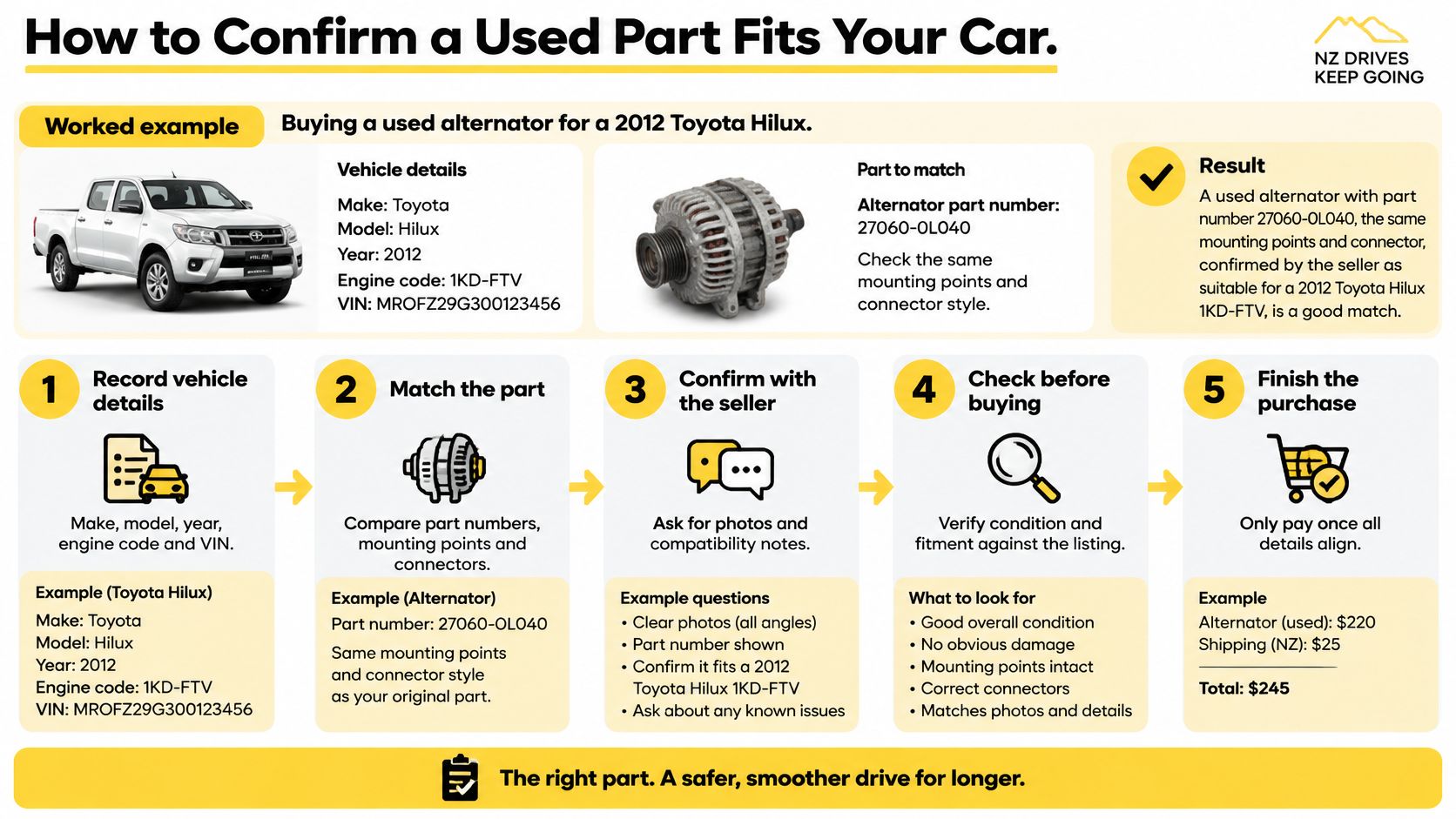
Say you're buying a used alternator for a 2012 Toyota Hilux. The listing says Hilux, and the housing looks familiar, but that isn't enough. You still need to confirm the engine application, electrical connections, mounting arrangement, pulley and output specification.
The common slip is assuming that a shared model name means interchangeable parts. Build changes can affect components without an obvious change to the bodywork.
Match the vehicle before the component
NZTA's replacement-components requirements say replacement equipment must meet the applicable approved standard for the vehicle's manufacture year, or a later applicable standard; where no component-specific rule applies, it must restore performance to an accepted manufacturer, original supplier or approved specification. Bolting into place doesn't establish compliance.
Use this routine before committing to the alternator or any other replacement assembly.
Record your vehicle details. Write down the make, model, year, engine code and VIN before searching. Give the seller the actual identifiers rather than relying on a description such as diesel Hilux.
Match the original part number. Photograph the old alternator's label and check any proposed replacement or superseded number against a reliable application catalogue. A similar casting doesn't establish that the regulator, output and pulley arrangement suit your vehicle.
Confirm the donor specification. Ask for the donor's year, engine and relevant build details, then compare them with your own. For an assembly offered without its original label, donor information becomes particularly important.
Request evidence of origin. Ask for appropriate donor documentation, such as deregistration papers, standards markings or evidence that the donor was legally registered in New Zealand. The seller should explain how the stock record connects those documents to the component offered.
Compare detailed photographs. Check the connectors, mounting ears, pulley alignment and labels against the removed alternator. Ask for another angle if a bracket or plug is obscured, rather than assuming it matches.
Reject unsupported substitutions. Don't accept a component outside manufacturer tolerances or one whose origin can't be evidenced. Get the installer's approval before considering an alternative that requires wiring changes or altered mounts.
Keep the donor record with the invoice. Save the listing, photographs and compatibility confirmation alongside it. Your installer then has something concrete to check, and a future inspector can trace the replacement.
Resolve differences before dispatch
For the hypothetical Hilux alternator, a different plug or pulley isn't a small detail to fix after delivery. It's a reason to stop and establish whether the seller has identified the correct application.
Ask the workshop to resolve uncertainty while the component is still on the shelf. Refuse the part if the seller can't explain a specification difference or connect it to an identifiable donor.
What Drives Used Car Part Prices in NZ
Used parts don't have a universal price list. Sellers assess a combination of:
- Demand and supply. How many buyers need that component, and how much suitable stock is available.
- Build specification. Early and late production versions may not serve the same applications.
- Condition. Wear, corrosion, damage and test evidence affect usefulness.
- Completeness. Brackets, sensors, wiring and ancillaries change what you're buying.
- Delivery and support. Freight, packaging and written return terms affect the landed cost.
Popular ute and 4WD applications, including Hilux, Ranger and Navara, can attract a broad repair audience. Don't confuse popularity with guaranteed cheap stock, though. Strong demand can keep a desirable assembly expensive, while a rare European component may be difficult to source even when few buyers want it.
Compare the complete repair cost
Consider competing engine quotes. One might cover a bare assembly, while the other includes the intake, alternator, starter and usable brackets. The cheaper headline price may leave your workshop transferring components, replacing missing fittings and checking compatibility.
A rust-free panel can also justify a higher purchase price than one needing metal repairs. Colour match helps, but inspect the finish in daylight and allow for paintwork rather than treating the colour code as a promise of an invisible match.
Fast-moving repair components and unusual trim create different stock decisions for sellers. An obscure electronic module may be scarce without being useful to many buyers, so rarity alone doesn't establish value.
A cheap part is only cheap after you've counted freight, fitting, missing components and the cost of getting a wrong item back to the seller.
Ask what the donor specification is, what's included and what happens if it doesn't fit. Those answers make quotes comparable without relying on an invented market average.
Before choosing, check:
- Same application. Both quotes cover the correct build and specification.
- Same contents. Included accessories and missing pieces are itemised.
- Same evidence. Condition and testing claims are equally clear.
- Same landed basis. Freight, packaging, return costs and any exchange conditions are understood.
Licensed Dismantlers Compared With Private Sellers
Used part sources compared on the same criteria
| Source | Warranty | Donor records | Returns |
|---|---|---|---|
| Licensed dismantler | Get coverage and exclusions in writing | Request donor records, especially for safety parts | Ask for written return terms |
| Private seller | Often no express warranty offered | Ask for VIN and registration history | Often offered as is; clarify before payment |
| Online marketplace | Check the individual seller's written terms | Check the listing and request supporting records | Confirm the individual seller's process |
A licensed dismantler is a sensible starting point, but the licence isn't a substitute for evidence about a particular component. Ask what was inspected, what was tested and which donor record belongs to the item. A seller's business category doesn't establish that every assembly has undergone the same checks.
Private sellers can offer useful, inexpensive panels or trim, especially where you can inspect them locally. The trade-off is often limited documentation and little practical support if the item turns out to be unsuitable.
Separate the platform from the seller
An online marketplace is a sales channel, not a testing standard. A dismantler and a private individual may advertise beside each other while offering very different records, inspection evidence and return arrangements.
Insurer salvage sales require another level of caution. Buying a damaged vehicle or salvage assembly doesn't establish that the component you want survived the event safely. Factor in assessment, transport, dismantling and disposal rather than pricing the purchase as a ready-to-fit part.
For safety-related stock, donor records are the deciding evidence. A traceable assembly gives the installer a basis for checking application and damage exposure; a loose component with no history leaves those questions unanswered.
Look beyond the part on the counter
A responsible dismantler also has to manage what isn't sold. If you're clearing an unwanted vehicle while sourcing a replacement part, the recovery process matters as much as the transaction.
Our guide to choosing a car wrecker in NZ helps frame that wider decision. At our yard, good recovered parts are tested before returning to Northland vehicles.
Choose the source that can support its claims. A lower private-sale price can make sense for an inspectable trim piece; it's a poor reason to accept an unverified restraint assembly. The cheapest source is only the best source when its evidence suits the risk.
Safe-Buying Checks, Warranties and Returns
Before payment, turn the seller's description into a clear record of what you'll receive. Don't let a booking with the mechanic push you into accepting missing photographs or vague test claims.
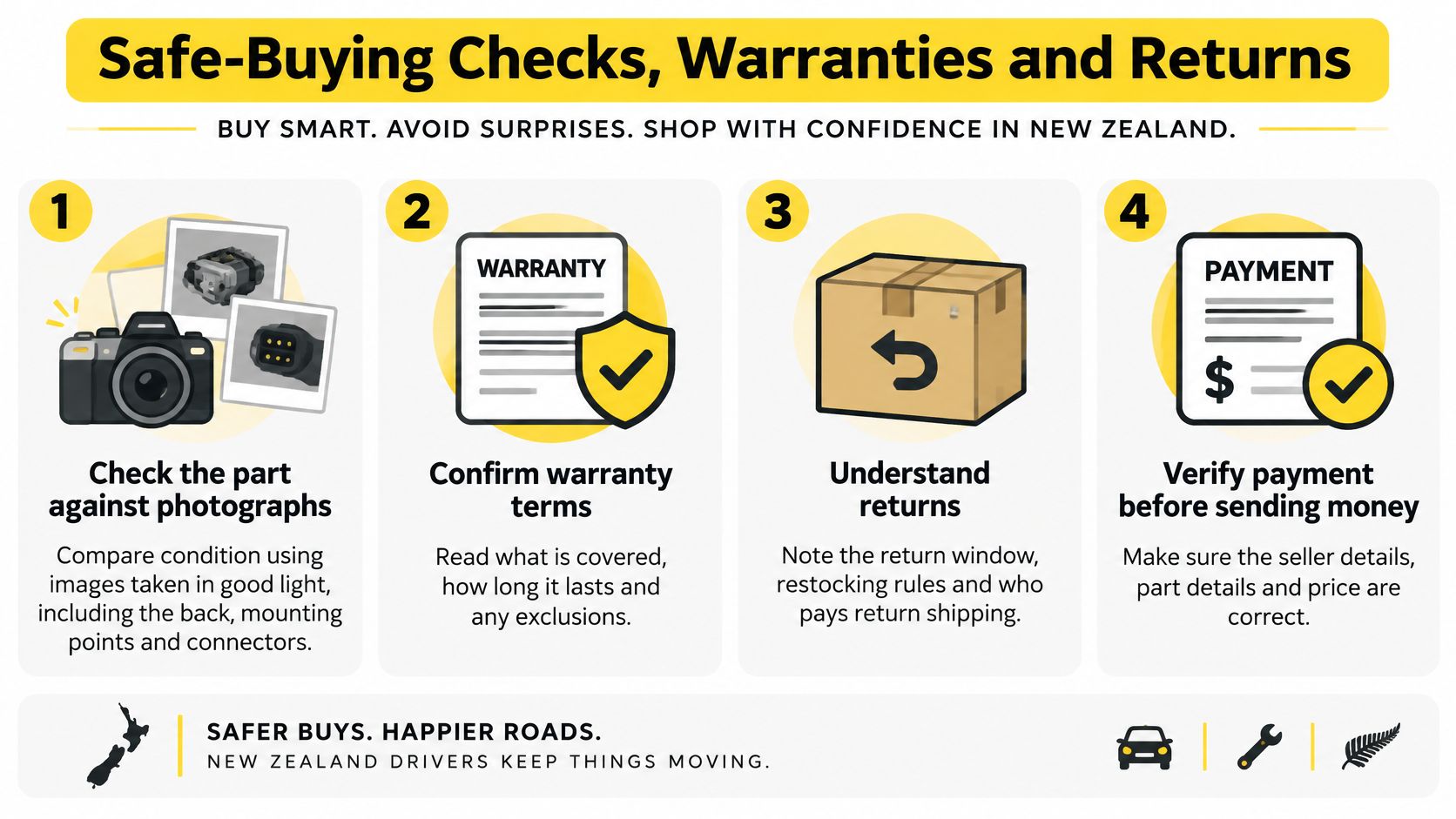
- Inspect the whole component. Request well-lit photographs of the front, back, mounting points, connectors and any damage.
- Check the identifiers. Compare the supplied item with your completed fit-check record, including stamped codes.
- Request meaningful test evidence. Ask what was tested, how it was tested and what the result showed.
- Confirm donor registration history. Get written confirmation before payment. If the seller won't provide it, treat the item as unverified stock and hold payment until the paperwork arrives.
- Verify the transaction. Check the seller's details, item description, agreed price and delivery address before sending money.
Ask what the test actually proves
An engine compression test should come with results, not just a statement that it passed. Ask whether the engine was run before removal and whether the seller recorded leaks, noise or other relevant observations.
For electronics, a continuity check can identify a broken circuit but doesn't prove that a control module communicates correctly or performs its full function. Ask for testing suited to the component. Clean terminals and an intact casing aren't functional test results.
Put warranty and return terms in writing
Get the warranty period, covered faults and exclusions before buying. Establish whether labour, diagnostic work, fluids or removal and refitting are included, and whether third-party installation affects the seller's express warranty.
A replacement-part promise can still leave you paying the workshop twice. Ask whether the remedy offered is repair, replacement or refund, and what installation records the seller expects.
Returns need separate clarification. Confirm the notification deadline, authorisation process, packaging requirements, any restocking conditions and who pays return freight. Specifically ask how the seller handles an item that doesn't match the donor specification it supplied.
Before you pay: A specific written promise is useful evidence. A verbal assurance that the seller will sort it out isn't enough.
Keep the invoice, donor details, test results, warranty, listing and photographs together. Written warranty terms help you understand the transaction, but don't assume they describe every right that may apply or accept an unexplained exclusion as the final word.
Deregistered, Abandoned and Written-Off Vehicles
Who remains responsible when a vehicle can't be driven, its registration has lapsed or it's sitting on private land? Don't assume that possession, registered-person status and legal ownership are the same thing. Responsibility can turn on the circumstances, not merely whose driveway the vehicle occupies.
The practical mistake is treating collection as the whole transaction. Removing plates or handing over keys doesn't, by itself, complete the administrative work.
Match the paperwork to the situation
- A running car being sold. The seller records the change of registered person, and the buyer completes their notification. Keep a dated sale receipt identifying the vehicle and both parties.
- A vehicle awaiting disposal on private land. Establish who can authorise removal, check its registration status and arrange cancellation if still required. Record disposal and retain the dismantler's collection receipt; don't try to cancel a registration that has already been cancelled.
- An accident write-off. Keep the insurer's paperwork and the holding yard's release with the vehicle record. Confirm who controls the salvage before arranging removal.
A landlord or farm owner shouldn't assume that an apparently abandoned vehicle is theirs to sell. Resolve authority first, particularly where another person's property is involved.
For an insurance loss, understanding what a statutory write-off vehicle means helps separate the vehicle's status from permission to collect it. A collection booking doesn't replace an insurer's decision or a yard release.
Never hand over a vehicle without a dated receipt. Include its identifying details, who collected it and a note of any plates surrendered. Retain copies of the notifications and supporting documents rather than relying on the vehicle's absence as proof that everything is finished.
Handling Tyres, Batteries and Fluids Responsibly
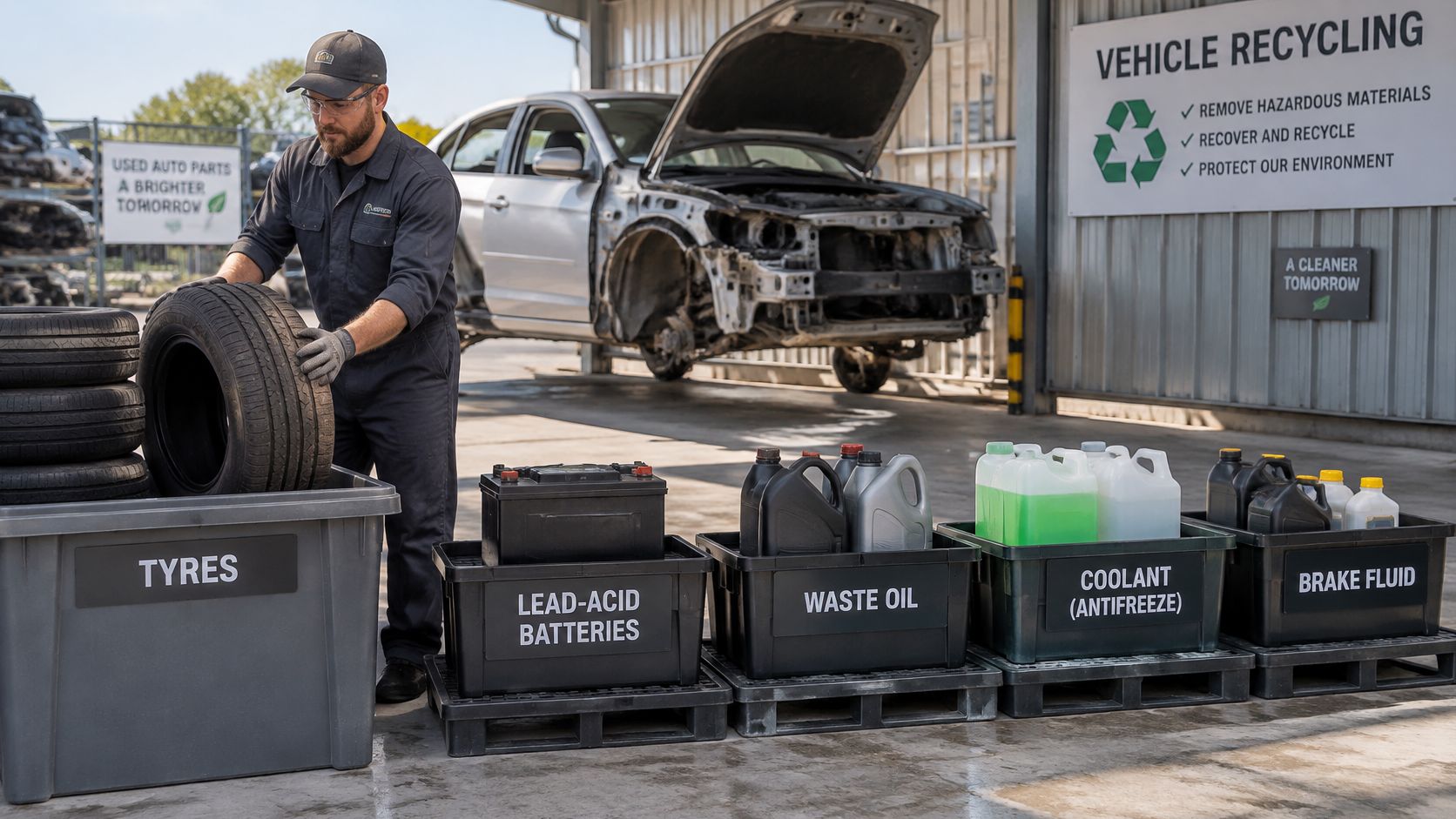
A donor vehicle contains engine and gearbox oils, coolant, brake fluid, batteries and tyres that shouldn't be mixed indiscriminately with scrap metal. Recovering a useful engine doesn't remove the need to manage the materials left behind.
The Ministry for the Environment's New Zealand Waste List classifies an end-of-life vehicle as hazardous under 16 01 04*, while a vehicle drained of liquids and emptied of hazardous components falls under 16 01 06. That distinction explains why depollution must happen before shell processing.
Separate materials before processing
Conventional lead-acid batteries follow a recycling pathway; hybrid and EV traction batteries need specialist assessment, isolation and downstream handling. Don't open a traction battery or assume a general recycling site will accept it.
Responsible handling means:
- Fluids are segregated. Oils, coolants and other liquids go into suitable labelled containers.
- Batteries are identified. Conventional and high-voltage batteries aren't treated as interchangeable waste.
- Tyres are removed. Reusable tyres are assessed separately from end-of-life material.
- Recovery is documented. The yard records what it removed and where controlled materials go.
The Ministry's waste work programme estimates that about 6.5 million tyres reach end of life annually in New Zealand, with only about 40 percent repurposed through the identified channels. Check local acceptance conditions: arrangements associated with tyre product stewardship commonly require clean tyres, free of debris and removed from rims, with public drop-offs often limited to five tyres per visit.
Finish the administrative work too
Environmental handling doesn't replace disposal notifications. NZTA's vehicle-ownership guidance distinguishes ownership from the registered person, requires both parties to notify a change promptly, and explains that the vehicle record remains after registration is cancelled.
The Hazardous Activities and Industries List identifies automotive dismantling and battery recycling as activities associated with potential land contamination. That doesn't mean every yard is contaminated, but it makes fluid containment and battery handling meaningful buying criteria.
Correct handling reduces environmental and administrative risk while preserving recoverable value. It isn't a blanket release from responsibility, so keep the disposal record.
Choose a Licensed Dismantler and Confirm the Paperwork
Make a licensed dismantler your first call, then assess the evidence for the specific part or vehicle. Car Removals Whangarei is a licensed Northland dismantler. Confirm our current licence before a transaction, and discuss how the relevant component is tested rather than assuming every test suits every part.
At our yard, fluids, batteries, tyres and airbags are removed and handled to New Zealand environmental standards. Reusable parts return to Northland vehicles, and the shell is baled for steel recycling.
Confirm recovery and release arrangements
We collect damaged vehicles from a panel beater or holding yard with a release from the yard and the registered owner's ID. Have those ready alongside any insurer documentation so collection authority is clear.
The Ministry for the Environment's priority product stewardship guidance identifies large batteries as a priority category and explains that public end-of-life tyre drop-off at registered Tyrewise sites has been available at no cost since September 2024. Neither pathway means every used battery or tyre has resale value.
For disposal, work through the change-of-registered-person notification, registration cancellation where applicable, surrendered plates and insurer write-off documents. Keep the completed record together.
Take these actions this week
- List the parts you need by part number, with your vehicle's identifying details.
- Request warranty and return terms in writing, including freight and installation exclusions.
- Confirm donor records before paying, and leave unsupported stock on the shelf.
The right purchase is the part your installer can verify, fit and stand behind, not the cheapest item carrying your model's name.
Car Removals Whangarei recovers and tests reusable parts for Northland vehicles and provides responsible removal for unwanted or damaged donor vehicles. Visit Car Removals Whangarei to discuss your vehicle, its recoverable parts and the paperwork needed for collection.
- used car parts nz
- car dismantler NZ
- second-hand car parts
- car parts compatibility
- NZ vehicle parts