· Car Removals Whangarei
Car Wrecker NZ Guide Services Pricing and How to Sell
That old car often sits there longer than anyone expects. It failed its WOF, the rego lapsed, the gearbox gave up, or an insurer wrote it off after a crash. You still need it gone, but the part that usually slows people down isn't the towing. It's working out who to call, what the car is worth, and how to make sure your name doesn't stay attached to it after it leaves.
A lot of first-time sellers assume a wrecker is just a tow truck with cash. That's too simple. A proper car wrecker in NZ combines valuation, collection, dismantling, recycling, and paperwork in one process. If the vehicle still has useful parts, that affects the quote. If it's only fit for scrap, weight matters more. If it's a hybrid or EV, the battery can change the whole conversation.
In New Zealand, this trade exists because the fleet is old and vehicles stay in service for a long time. Government transport research described New Zealand's fleet as one of the oldest in the developed world, with an average age of 12.49 years in 2009, later reporting put the average age at 14.8 years, and 63% of cars were already 10 years old or more. The same research found light vehicles here are typically retired at about 20 years and 215,000 km on average, with earlier NZTA research showing scrappage ages of 18.7 years for New Zealand-new light vehicles and 16.7 years for used imports, which helps explain why wreckers see a steady stream of aging vehicles rather than only rare crash write-offs (Ministry of Transport scrappage research).
Table of Contents
- Introduction to Car Wreckers in New Zealand
- What a Car Wrecker Actually Does
- How Pricing Works From Kerb Weight to Parts Value
- How to Choose a Reputable Wrecker in NZ
- Practical Steps to Sell or Dispose of Your Vehicle
- Licensing Environmental Compliance and EV Battery Handling
- Final Takeaways for a Safe and Profitable Sale
Introduction to Car Wreckers in New Zealand
A common Northland situation goes like this. The car still starts sometimes, but it smokes, leaks, or won't pass another inspection. You could try a private sale, answer messages for days, deal with people who don't turn up, then still have to sort out pickup and paperwork.
A car wrecker in NZ suits a different type of sale. It's built for vehicles that are unwanted, uneconomic to repair, damaged, deregistered, partly stripped, or at the end of the line. Instead of advertising the car to dozens of buyers, you contact one business that assesses its value, arranges removal, and takes it into the dismantling or scrap stream.
Why the trade is bigger than many people think
End-of-life vehicles aren't a small side issue in New Zealand. Massey University research estimated about 25,500 vehicles are abandoned nationwide each year, creating at least NZ$6 million in annual direct local-authority costs for recovery, notification, and disposal. The same research estimated the country's total end-of-life vehicle flow at roughly 150,000 vehicles per year from a fleet of about 3 million registered vehicles. It also noted that in 2017, 53% of 334,445 light vehicles registered were used imports rather than new vehicles, which helps explain why the parts and salvage market is shaped heavily by import age, repairability, and supply of used components (Massey University end-of-life vehicle research).
That matters to you as a seller because your old car isn't an oddball problem. It's part of a steady, normal stream of vehicles moving out of service and into dismantling, metal recovery, or salvage handling.
A wrecker is often the right fit when the car's next chapter is recycling, parts recovery, or lawful disposal, not another private owner.
When a wrecker is usually the right option
You don't need to guess. These are the situations where people usually stop chasing a private sale and call a wrecker instead:
- Failed WOF with costly repairs: The car still exists as an asset, but not as a practical retail sale.
- Accident or flood damage: Buyers get nervous about hidden damage. Wreckers assess salvage differently.
- Dead engine or transmission: Mechanical failure can still leave strong parts value in panels, interior, wheels, or driveline components.
- Rust, missing parts, or non-runner status: A tow-away process matters more than roadworthy presentation.
- Long-stored vehicles: If it has sat in a paddock, driveway, shed, or rental property, disposal may be the cleanest path.
What confuses people most isn't whether a wrecker will take the car. It's how the vehicle is valued, and how to protect yourself on the NZTA side. That's where most bad experiences start.
What a Car Wrecker Actually Does
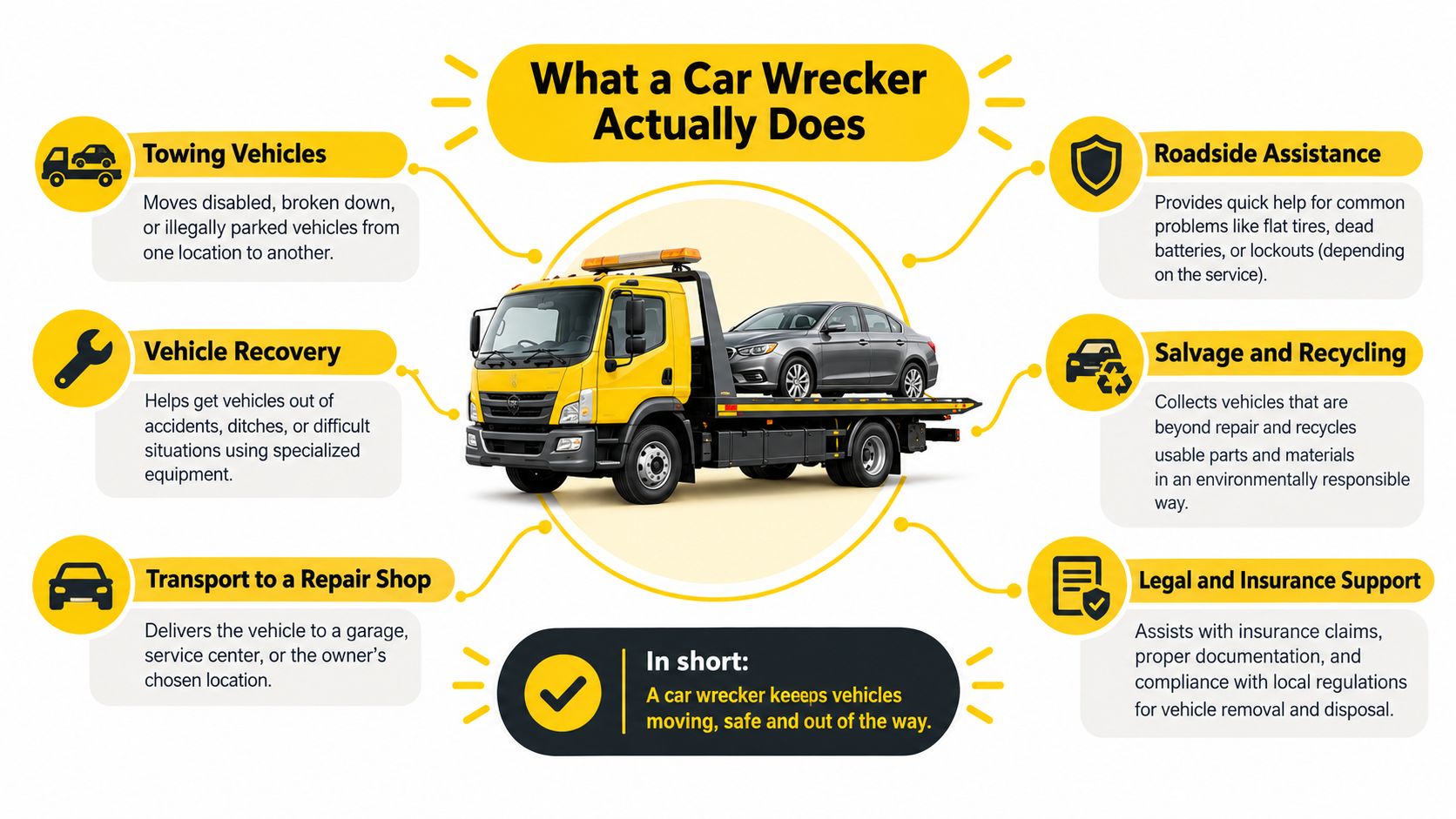
People often use three different services as if they're the same. They aren't. A wrecker, a scrap metal operator, and a tow-only removal service can all pick up a vehicle, but what they do with it next is completely different.
Think of it as harvest, recycle, and triage
A proper wrecker does three jobs.
First, harvest. If a vehicle has reusable parts, the dismantler removes components that still have service life left in them. That might be doors, mirrors, alternators, gearboxes, mags, seats, tail-lights, ECUs, trays, canopies, or engines.
Second, recycle. Once usable parts are removed, the shell still has metal value. Steel, alloy, catalytic components, and some other materials can still be recovered.
Third, triage. Some vehicles aren't simple parts cars or pure scrap. A late-model crash-damaged ute, hybrid, van, or commercial vehicle may need a salvage assessment because the vehicle's value isn't just in weight. Condition, model demand, and component integrity all matter.
What happens after pickup
Once a vehicle reaches the yard, the work should be organised and controlled.
- Depollution comes first: Fluids, batteries, tyres, and hazardous components need proper handling before dismantling or crushing.
- Reusable parts are assessed: Staff check what can be removed, stored, and resold.
- The shell is processed for recovery: After parts harvesting, the remaining body moves into the metal recycling path.
This is why two businesses can look similar from the road but offer very different quotes. One may only want tonnage. Another may see value in the gearbox, front end, tray, glass, diff, or hybrid system.
Practical rule: If the business can't explain whether your vehicle is being bought for parts, salvage, or scrap, the quote probably isn't based on a full assessment.
Who handles what
A simple comparison helps:
| Service type | Main job | Best for |
|---|---|---|
| Car wrecker | Dismantles vehicles, recovers parts, manages scrap and disposal | Non-runners, write-offs, failed WOF cars, older fleet vehicles |
| Scrap-focused buyer | Pays mainly on metal weight | Stripped shells, badly rusted vehicles, low-parts-value cars |
| Tow-only operator | Removes the vehicle from one place to another | Transport jobs where the vehicle isn't being purchased |
That difference matters in New Zealand because many end-of-life vehicles don't move through a perfect formal chain. Massey University research on ELV policy found that only about one in five deregistered vehicles was dumped, and it recommended stronger collection incentives, free acceptance for recycling, and licensing and monitoring of dismantlers to close data gaps (ELV policy research in New Zealand).
For a seller, the takeaway is simple. You don't just want the car gone. You want it entering a proper dismantling and disposal process.
How Pricing Works From Kerb Weight to Parts Value
The same model can attract very different quotes. That's not always a sign that someone is being tricky. It usually means the buyers are valuing the vehicle on different bases.
One buyer may see a scrap shell. Another may see a strong gearbox, tidy front panels, a sought-after diff, good doors, usable seats, and wheels that will sell quickly. That's why pricing only makes sense when you know what drives it.
The three main pricing levers
Most wrecker quotes come from a mix of these factors:
| Vehicle Condition | Primary Value Driver | Typical Quote Basis |
|---|---|---|
| Stripped, rusted, seized, or incomplete | Kerb weight and recoverable metal | Scrap-led quote |
| Common model with strong used-parts demand | Resale value of components | Parts-led quote |
| Late-model damaged, hybrid, or EV vehicle | Salvageable systems, electronics, battery, and major assemblies | Salvage-led quote |
Kerb weight matters because heavier vehicles carry more metal. A van, ute, or 4WD shell often lands differently from a small hatchback shell for that reason alone. But weight isn't the whole story. A lighter vehicle with in-demand parts can outquote a heavier one that nobody wants parts from.
Why model demand changes everything
Certain models stay busy in the used-parts market because there are many of them on the road, they get repaired rather than scrapped, and owners want a cheaper fix than buying new parts. That's why utes, vans, and common work vehicles are often assessed differently from an obscure sedan with little panel or driveline demand.
When you ask for a quote, the buyer is usually trying to answer practical questions:
- Can the vehicle be dismantled profitably?
- Are key components still present?
- Is the model one people regularly ask parts for?
- Will it roll, steer, and load easily, or need extra handling?
- Is there damage to high-value areas like engine, gearbox, front clips, diff, tray, or battery system?
If you want a more detailed breakdown of how quotes are built, this guide on how much wreckers pay for cars is a useful companion.
What to tell the buyer for an accurate quote
Short, clear information gets the cleanest price. You don't need a sales speech. You need the facts.
- Registration and plate details: This helps identify the exact vehicle.
- VIN if available: Useful where trim level or drivetrain matters.
- Condition that affects loading: Say if it won't roll, has no wheels, or is stuck in soft ground.
- Major mechanical faults: Blown head gasket, snapped cambelt, dead transmission, flood damage, or fire damage all change value.
- What's missing: Battery gone, catalytic converter removed, interior stripped, airbags deployed, mags swapped.
- Location and access: Narrow driveway, apartment basement, rural paddock, workshop hoist area.
The fastest way to get a bad quote is to leave out the details that matter most at pickup.
Hybrids and EVs aren't priced like ordinary scrap
A hybrid or EV should not be treated like a plain steel shell. The traction battery, inverter, electric drive components, and high-voltage condition can all affect value. In some cases, battery condition adds value. In others, damage, water exposure, or isolation risk changes the handling approach.
That is also why low headline numbers can be misleading. Some operators advertise a number to start the conversation, then reduce it later for towing, access, missing parts, or "unexpected" condition issues. A firmer quote usually comes from better information at the start and clearer agreement about towing and paperwork.
For context, Car Removals Whangarei buys cars, vans, 4WDs, trucks and machinery in varied condition, and its published service information states quotes are calculated from parts demand and steel pricing, with hybrid and EV battery value reflected where relevant.
How to Choose a Reputable Wrecker in NZ
A reputable wrecker usually sounds different on the phone before they even arrive. They ask the right questions, explain the process plainly, and don't dodge the paperwork side.
The risky version often sounds easy at first. They promise a quick pickup, say they'll "sort the forms later", and stay vague about deductions until the truck is outside your place.
What to check before you book
Use practical checks, not sales talk.
- Licensed dismantler status: Ask directly whether they operate as a licensed vehicle dismantler and handle depollution properly.
- Paperwork done at pickup: A serious operator should be ready to complete NZTA change details on site, not "when we get back to the yard".
- Clear handling of fluids and batteries: If they can't answer how they deal with oils, coolant, batteries, tyres, and airbags, that's a warning sign.
- Firm quote terms: Ask whether the amount is fixed assuming the details you've provided are accurate.
- Payment timing: Confirm whether payment happens before loading, not after the vehicle disappears.
- Tow control: Businesses with their own truck scheduling tend to give more reliable collection windows than those depending on whoever is available.
Reputable versus risky
A side-by-side view makes this easier.
| Checkpoint | Reputable operator | Risky operator |
|---|---|---|
| Quote | Explains what the price is based on | Gives a number with little detail |
| Pickup | Confirms access, rolling condition, and timing | Says "we'll see when we get there" |
| Payment | Agrees how and when you'll be paid | Leaves payment vague |
| NZTA steps | Handles seller details promptly | Says paperwork can wait |
| Environmental handling | Can explain disposal process | Avoids the question |
Why the paperwork question matters so much
Many sellers focus on payout and towing, then treat ownership notification as a side issue. That's backwards. NZTA says both buyer and seller must notify it straight away at the time of sale, and the seller needs the plate number plus the full name and address of the recipient. The same guidance is particularly important in regions where local seller guidance is thinner. In Northland, there are only 12 enterprises in the motor vehicle dismantling and used-parts wholesaling industry, which means many sellers don't get much practical advice before handing over a vehicle (NZTA selling guidance with Northland industry context).
If you're comparing local options, this article on car wreckers near me can help you think through service area, towing setup, and pickup process.
If a buyer says, "Don't worry, we'll sort NZTA later," keep worrying.
Questions worth asking on the call
Don't overcomplicate it. Ask these in plain English:
- Will you honour the quote if the vehicle matches my description?
- Do you pay before loading?
- Will you complete the NZTA change details with me at pickup?
- Do I need to deregister the vehicle first?
- If it's a hybrid or EV, how do you handle the battery safely?
A decent operator won't be annoyed by those questions. They'll answer them calmly because they're part of the job.
Practical Steps to Sell or Dispose of Your Vehicle
Once you've chosen who to deal with, the process should be straightforward. Most problems happen when people rush the handover and assume the buyer will sort everything after the truck leaves.
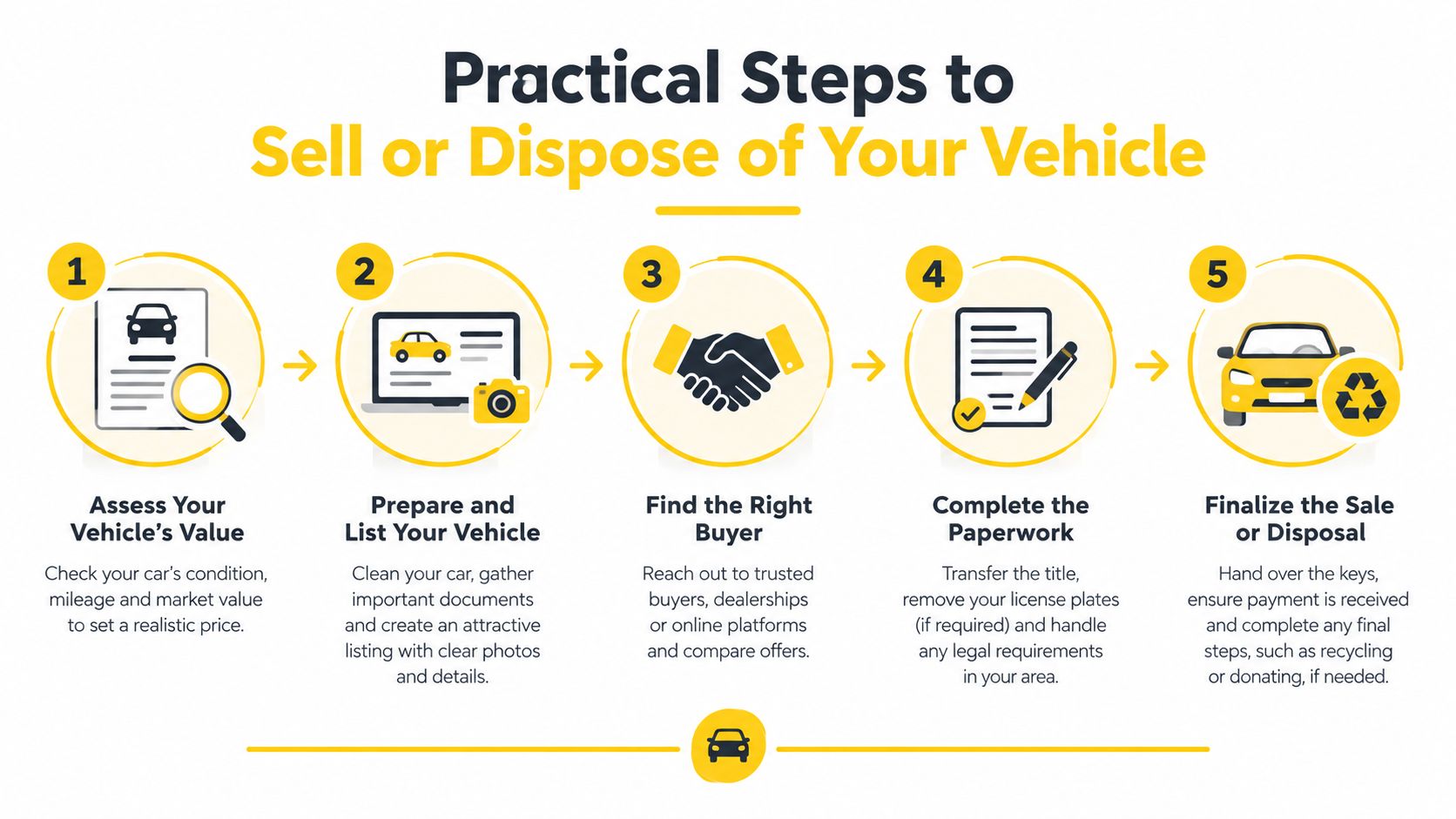
Step 1 Prepare the details before you call
Have the basics in front of you. That means your plate number, proof that you're the person entitled to sell or dispose of the vehicle, photo ID, and the vehicle's location.
If you can, also have the VIN and a quick list of known faults. Saying "it doesn't go" isn't enough if the issue is flood damage, a seized motor, no keys, or missing wheels.
Step 2 Get a firm quote, not a teaser number
Tell the truth about the condition. If the car won't roll, has front-end crash damage, or is buried behind another vehicle, say so now. Accurate details help the buyer price towing, loading effort, parts value, and risk properly.
You should also ask what is included. Clarify pickup area, whether towing is part of the quote, and how payment will be made.
Step 3 Book collection and set up the handover
Choose a time when you can be there in person if possible. Handover is easier when the seller can show ID, provide the keys, and confirm details directly.
If the vehicle is on private land but not at your home, make sure access is lawful and clear. That matters for farms, rental properties, workshop yards, and body corporate sites.
Step 4 Complete the NZTA side properly
This is the step many sellers miss. For scrap disposal, NZTA guidance says a vehicle should be deregistered before scrap disposal to reduce the chance of it reappearing on the road, and disposal notices should be lodged so the registered-person record is changed (Rightcar guidance on scrapping a vehicle).
Separate from that, NZTA also says both the buyer and the seller must notify it when a vehicle changes hands, because NZTA records the registered person rather than legal ownership. If the seller doesn't notify NZTA, they can remain exposed to the buyer's fees or fines, including tolls and speeding tickets, and any unpaid licensing fees remain tied to the registered person until the change is recorded (NZTA change-of-vehicle-responsibility guidance).
That means you should capture:
- The plate number
- The full name of the recipient
- The recipient's address
- Confirmation that notification has been completed
- Your own record of the date and time of handover
Keep your own proof. Don't rely on memory, and don't rely on a verbal promise.
Step 5 Understand what happens at pickup
At pickup, the usual sequence is simple. The driver confirms the vehicle, checks that it matches the agreed condition, completes the paperwork, arranges payment, then loads the car.
If you're selling to a wrecker, not just paying for removal, don't be shy about slowing the process down for five minutes to confirm the details. Once the vehicle is on the truck and gone, fixing an incomplete handover gets harder.
A few practical checks help:
- Keys and extras: Hand over keys, wheel lock, and any documents you agreed to include.
- Remove personal items: Check glovebox, boot, under seats, and door pockets.
- Take photos: One of the vehicle at pickup and one of any receipt or disposal record can save headaches later.
If you want a more seller-focused walkthrough, this guide on selling a car to wreckers adds useful context around pickup day and what to have ready.
Step 6 Close off any compliance loose ends
One more thing catches people out. NZTA's factsheet warns that selling a vehicle "as is, where is" doesn't remove legal requirements under consumer law and transport law. It also states that if road user charges are overdue at the time of sale, the seller is committing an offence under the Road User Charges Act 2012, which is a specific compliance risk in disposal and salvage transactions (NZTA factsheet on buying or selling a vehicle).
So before the truck leaves, make sure you've sorted any issue that still sits with you as the seller. The goal isn't just to get paid. It's to end your responsibility cleanly.
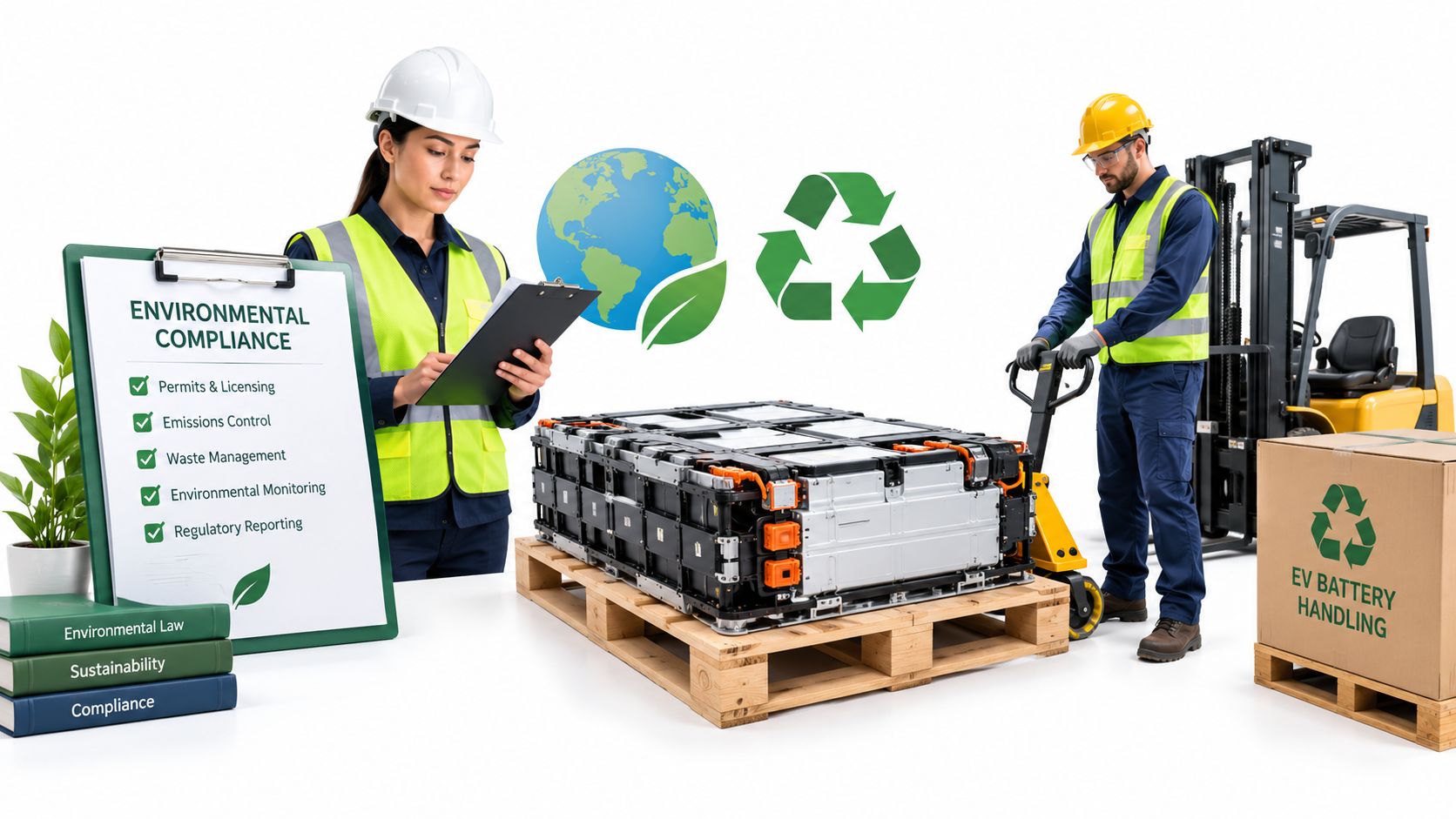
Licensing Environmental Compliance and EV Battery Handling
A vehicle disposal job doesn't finish when the car leaves your driveway. What matters next is how it is dismantled, depolluted, and moved through the waste and recycling system.
New Zealand still has a policy gap here. The Ministry of Transport's Vehicles Outcomes report says there are no specific policies, beyond in-service inspections, to encourage or address the permanent disposal of end-of-life vehicles. That matters in a country with a large aging fleet, because it helps explain why older vehicles can linger in service or drift into poor disposal pathways. It also leaves a sharper information gap for hybrids and EVs, especially around battery value, isolation, transport, and recycling in local salvage transactions (Ministry of Transport Vehicles Outcomes report).
What compliant dismantling looks like
A licensed dismantler should have a clear process for dealing with materials that can't just be left in a shell.
- Fluids: Fuel, oil, coolant, and other liquids need controlled removal.
- Batteries: Standard 12-volt batteries and high-voltage systems require different handling.
- Tyres and airbags: These are not ordinary scrap and need proper downstream handling.
- Parts storage: Reusable components should be removed and stored in a way that avoids damage and contamination.
The environmental side isn't separate from the pricing side. A vehicle with recoverable parts and systems is worth more when it can be dismantled safely and efficiently.
The EV and hybrid difference
Many general car disposal pages become too vague to be useful. Hybrids and EVs bring real safety and valuation differences. A damaged petrol hatch and a flood-affected EV are not the same collection job.
Ask practical questions:
- Can the buyer isolate the high-voltage system before transport?
- Does battery condition affect the quote?
- Will a flood-damaged hybrid or EV still be collected?
- Are there extra towing or dismantling charges for battery vehicles?
A hybrid or EV shouldn't be priced as if the battery is either worthless or automatically a problem. It needs a proper assessment.
Why this matters for your sale
A compliant operator protects more than the environment. They protect your transaction from going vague after pickup. Clear handling processes usually come with clearer quoting, better records, and fewer surprises.
If your vehicle is a standard petrol car, these checks are still worth making. If it's a hybrid, EV, flood write-off, or fire-damaged vehicle, they become essential.
Final Takeaways for a Safe and Profitable Sale
The easiest mistake is treating a wrecker sale like a simple tow job. It isn't. You're disposing of an asset, handing over a registered vehicle, and relying on someone else to move it into the dismantling system properly.
A safe sale comes down to a short chain of decisions. Match the vehicle to the right buyer. Give accurate details so the quote reflects reality. Confirm payment, towing, and pickup terms before anyone sets off. Then finish the NZTA steps properly so your name doesn't keep travelling with the car.
Use this checklist before you book:
- Have the right details ready: Plate, ID, location, keys, and a truthful condition summary.
- Ask how the quote is built: Weight, parts demand, salvage condition, or battery value.
- Confirm the handover terms: Payment timing, towing inclusion, and whether paperwork is completed on site.
- Record the recipient details: Name, address, plate number, and handover date.
- Make sure liability ends: Deregistration and notification should be treated as part of the job, not an optional extra.
If you do those five things, you avoid most of the trouble first-time sellers run into. You also give yourself the best chance of a fair quote, a smooth pickup, and a clean finish.
If you need a licensed Northland dismantler to remove a car, ute, van, truck, machinery, hybrid, or EV, Car Removals Whangarei handles quoting, towing, payment, and NZTA change-of-ownership steps at pickup. If you'd like a firm quote based on your vehicle's parts demand, kerb weight, and condition, visit Car Removals Whangarei.
- car wrecker nz
- car wreckers NZ
- cash for cars NZ
- scrap car removal
- NZTA vehicle disposal