· Car Removals Whangarei
Reg Plates Personalised NZ: Fees, Rules and Transfers

A standard pair of personalised plates for an ordinary motor vehicle costs $30.40, while motorcycles, mopeds, tractors and trailers cost $26.71 per plate, with a maximum of six characters for cars, vans and trucks and five characters for motorcycles, mopeds and trailers. If that production fee isn't the price of the name itself, what are you buying when you order reg plates personalised for your vehicle?
That question catches owners out because the plate looks like part of the car. It's bolted to the bumper, it matches your paperwork, and it leaves the driveway every time the car does. In New Zealand, though, the useful way to think about it is different. The character combination belongs to an entitlement that can move between vehicles, while the car itself has its own registration record. If you separate those two things in your head before you buy, sell or scrap a vehicle in Whangarei, the paperwork becomes much easier to follow.
Table of Contents
- Personalised Plate Fees and Character Limits
- What a Personalised Plate Is and the Rules It Must Meet
- Applying for a Personalised Plate Without Common Errors
- Moving a Personalised Plate to Another Vehicle
- Moving or Keeping Your Plate When You Sell or Scrap a Car
- Check Your Plate Before Your Car Leaves Whangarei
Personalised Plate Fees and Character Limits
The published fee schedule in the regulations lists $30.40 for a standard pair of personalised plates used on ordinary motor vehicles, and $26.71 per plate for motorcycles, mopeds, tractors and trailers. That's the clearest starting point if you're pricing reg plates personalised for a car, ute, bike or trailer.
Those figures are plate production fees. They cover making and issuing the physical plates, not securing a particular word, initials or business name. The legislation also allows higher fees where production and issuing costs justify them, and the standard production amount is separate from any price charged for acquiring the exclusive right to a particular character combination.
Fees and limits by vehicle type
| Vehicle type | Plate fee (NZD) | Maximum characters |
|---|---|---|
| Cars, vans and trucks | $30.40 for a standard pair | 6 |
| Motorcycles and mopeds | $26.71 per plate | 5 |
| Trailers | $26.71 per plate | 5 |
| Tractors | $26.71 per plate | 6 |
Read the table from left to right. Find your vehicle type first, check whether you're paying for a pair or a single plate, then test your preferred combination against the character limit. Ordinary motor vehicles use pairs, so the fee is stated that way. Motorcycles, mopeds, tractors and trailers are charged per plate, which matters if you need to replace one later.
The character limit is strict. You can't use spaces, punctuation or decorative formatting to stretch a name beyond the available positions. A seven letter family name won't fit on a car plate without shortening it, and a six character idea that works for a ute won't fit on a motorcycle. Counting letters and numbers first saves you paying for a combination you have to redesign.
Practical rule: Treat the table as the cost of manufacturing the plates, then check the price of the actual character combination separately before you commit.
One more check belongs here. The published schedule covers plate production only and doesn't set a price for a particular character combination, so you should check the current price with Personalised Plates Limited before committing to a name. That distinction explains why two owners can pay the same production fee and very different total amounts. The metal, reflective sheeting and issue process are standard, but the desirability and availability of the characters aren't.
If your first choice doesn't fit, try honest shortenings rather than tricks. Drop a vowel, use initials, or swap a full business name for a recognisable abbreviation. What you can't do is add punctuation to make the plate read like a longer phrase on paper. On the vehicle, only the approved letters and numbers count, and they have to sit inside the limit for that vehicle class.
What a Personalised Plate Is and the Rules It Must Meet
Say a Whangarei owner has driven the same ute for years with a plate that spells a nickname. The ute is now rusted, failed its warrant and ready to go, but the owner wants the nickname on the replacement vehicle. That works because a personalised plate isn't just a piece of the old ute. It's a distinct entitlement that can survive the vehicle.
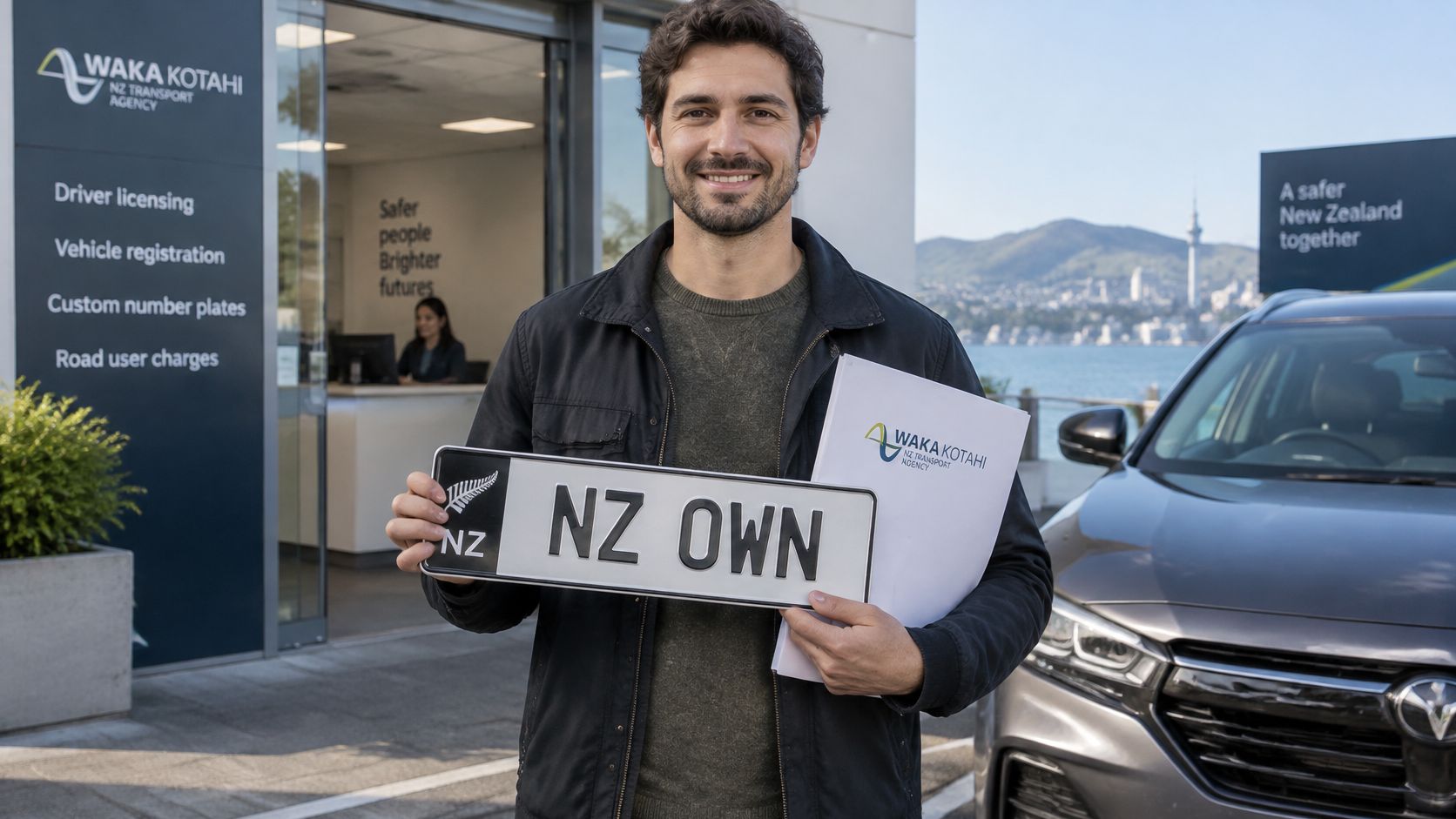
Waka Kotahi defines it in the NZ Transport Agency glossary for the Motor Vehicle Register as a plate carrying a unique character combination chosen by the registered person and purchased from Personalised Plates Limited. The glossary also explains that the plate can be used on different vehicles provided the required plate transfer or change of plate transaction is completed.
Think of the car as a house and the plate as a name registered to a person who can move between houses. The house can be sold or demolished. The name doesn't have to disappear with it, but the move still has to be recorded properly.
Three things owners blur together
Confusion usually starts when three separate matters are treated as one.
- Ownership of the car: This is who owns the physical vehicle and can sell it.
- Registration status: The Motor Vehicle Register records the vehicle and its registration status.
- Control of the plate: The personalised entitlement can move to another vehicle once the correct transaction is done.
A standard registration stays tied to the vehicle record in the ordinary way. A personalised entitlement gives you an extra decision. When the vehicle is sold, dismantled or removed, you need to decide whether the plate goes with it or moves elsewhere, and then complete that transaction before control changes.
If you're comparing ordinary and personalised options, our guide to plates for cars helps place this distinction alongside the standard plate rules.
The legal frame around the design
Personalisation doesn't take a plate outside normal law. The Transport (Vehicle and Driver Registration and Licensing) Act 1986 treats a personalised plate as a specially allocated registration identifier bearing letters, numbers, or both, or even a single letter or number, allocated by the Registrar for personalised use. The Act authorises the Minister to prescribe plate form, colour, dimensions, character style, visibility requirements, and the number and position of plates displayed.
The identifier is also exclusive. The NZTA number plates guidance explains that the same character combination cannot be allocated to another vehicle while the purchaser's right remains active, and it sets the maximum at six characters for cars, vans, trucks and other non-motorcycle vehicles and five for motorcycles, mopeds and trailers.
Approved colour schemes include black, red or blue characters on white retro-reflective sheeting, and white or silver characters on a black background. Those options change appearance, not your display duties. The plate must still be fitted in the prescribed vehicle position and kept legible.
A stylised plate is still a registration plate first and a design feature second. If another driver or an enforcement officer can't read it clearly from the road, the styling has gone too far.
Before ordering, run a short checklist. Confirm the colour scheme is an approved one, check where the plate will sit on your make and model, and look at the characters at a realistic distance. Tow bars, bike racks, plate frames and road grime can all affect legibility. You're responsible for the plate as it's displayed on your vehicle, not as it looked on a screen when you chose the combination.
That is why reg plates personalised for a vehicle should be treated as a separately transferable asset. You may value the characters long after the engine, bodywork or warrant status have made the vehicle itself worth removing.
Applying for a Personalised Plate Without Common Errors
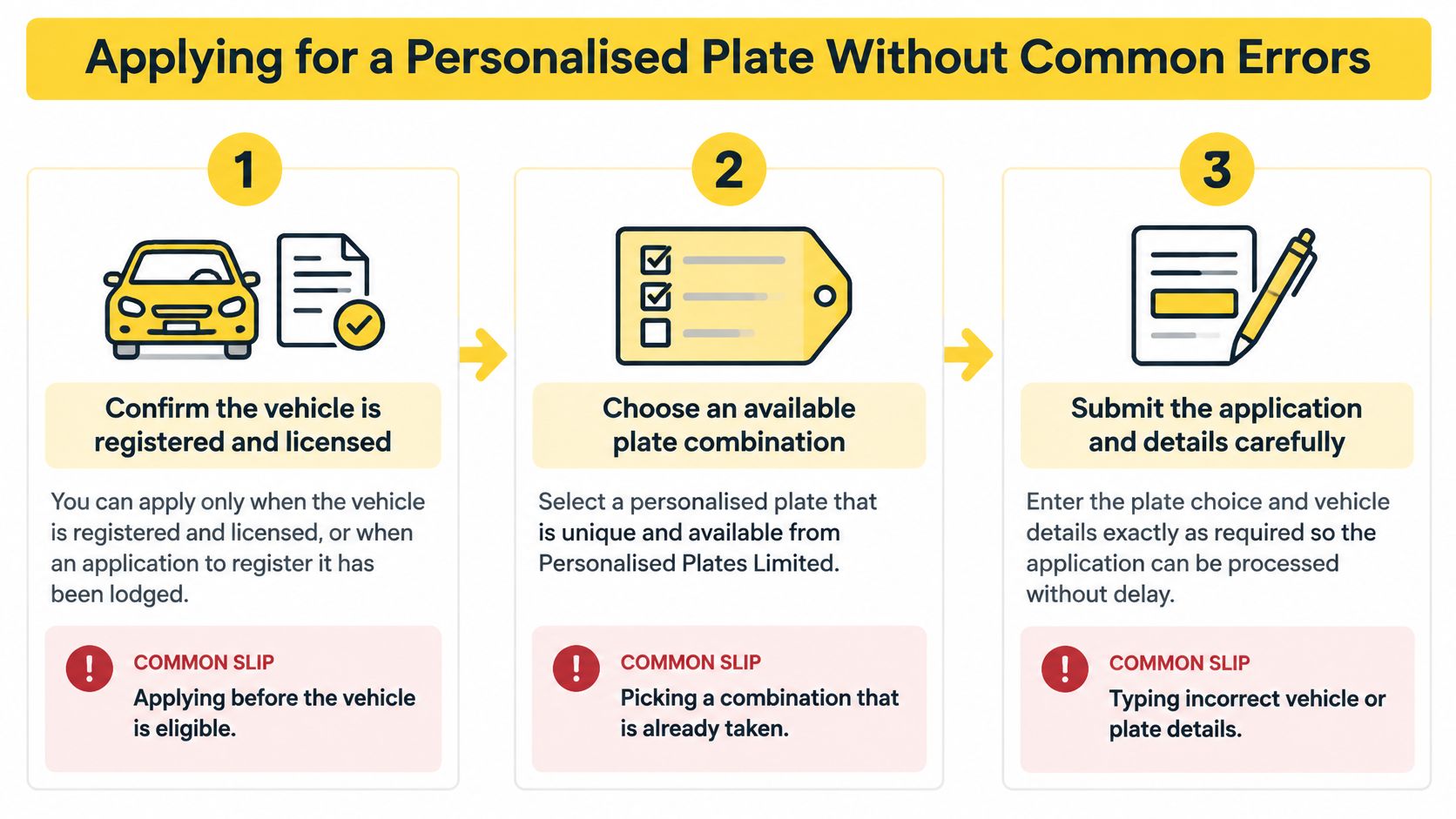
What should you check before ordering a personalised plate? Start with the vehicle's registration position, then confirm the combination and charges. That order helps prevent a common mix-up: choosing the characters first and only later finding that the vehicle record is not ready for the plate transaction.
The Land Transport (Motor Vehicle Registration and Licensing) Regulations set out the order of the registration steps. Before personalised plates are issued, the vehicle must be registered and licensed or have an application to register it, and the prescribed plate fee must be paid. NZTA then issues an updated certificate of registration identifying the personalised plates, and the vehicle's existing plates must be surrendered.
The application sequence
Check the vehicle's registration position. It must be registered and licensed, or have an application to register it lodged. If that step is incomplete, sort it before ordering. The plate transaction depends on the vehicle record, so choosing a combination does not make an unready record eligible.
Choose a combination for the vehicle class. Count every letter and number, and do not treat spaces or punctuation as a way to shorten the combination. A combination that suits a car may not fit a motorcycle, moped or trailer. Check availability before settling on a spelling, since a preferred combination cannot be assumed to be obtainable.
Check the charges before paying. Keep the prescribed plate fee separate from any combination charge when working out the total. The plate production fee is not necessarily the whole amount associated with the name you want. Look up the applicable charges as part of the application, rather than relying on an old estimate or treating the two charges as interchangeable.
Wait for the updated certificate of registration. It identifies the personalised plates against the vehicle record. This is the paperwork showing that the administrative record reflects the purchase, not just that you have ordered a set of plates.
Surrender the existing plates as required. Once the exchange is complete, the old plates are not a spare set for the same vehicle. Keeping both sets in circulation can create confusion about which registration plates belong with the vehicle.
Allow for manufacture when the plates are needed for fitting. The Land Transport (Motor Vehicle Registration and Licensing) Regulations do not allow the plates to be manufactured until they are needed for fitting. If you are planning around a birthday, a business launch or a vehicle pickup, account for that timing instead of expecting production well ahead of fitting.
Fit the plates in the prescribed position. Use secure fixings, keep the characters unobscured by a frame, and check both plates where a pair is required. A decorative treatment may look clear nearby yet make the characters difficult to read from the road.
Keep the confirmation paperwork. Store it with your registration papers rather than leaving it in a vehicle that may be sold or removed. The record can help if you need to replace a damaged plate or later separate the personalised plate from the car.
Where the process goes wrong in practice
A personalised plate is a controlled registration transaction, not an accessory to attach to any vehicle. The vehicle record, surrendered plates and updated certificate need to correspond. The plate itself can have value apart from the car, so consider its status before the vehicle is sold or collected for removal.
For example, you buy a replacement hatchback in Whangarei on a Friday and want your nickname plate on it before the weekend. First make sure the receiving vehicle's registration position is sorted and the correct transaction has been lodged. Having the plates in your garage does not, by itself, update the registration record.
Before you pay: Read the exact combination aloud, character by character, and compare it with your vehicle details. A transposed letter can produce a different identifier.
Before making arrangements to sell or remove a vehicle, check which vehicle record the personalised plate is attached to. Treat that plate as a separate asset with its own administrative step, rather than assuming it will follow the car automatically. A clear record makes it easier to decide what should happen to the plate before the vehicle leaves.
Moving a Personalised Plate to Another Vehicle
A personalised plate can leave its current car when you complete the required transfer or change of plate transaction. Physical possession isn't enough. You might have the plates in your hand, but the registry still needs to show them on the right vehicle.
Start with the paperwork rather than a screwdriver. Registration documents tell you which vehicle currently carries the entitlement, and they give you the details you'll need if anything doesn't match. If the plate is on a vehicle that's deregistered, damaged or about to be dismantled, this check matters even more because your access to that vehicle record may soon change.
A clean transfer sequence
Confirm the current vehicle record. Check your registration paperwork and make sure the plate is recorded against the vehicle you currently hold.
Check the receiving vehicle. It needs to be registered and licensed, or have an application to register it lodged.
Lodge the change of plate transaction. Do this before fitting the plate to the new vehicle. The order matters because the updated record is what authorises the move.
Pay any prescribed fee that applies at the time. Keep the receipt with the transaction confirmation.
Wait for the updated certificate. It should identify the personalised plate on the receiving vehicle. Surrender any plates previously fitted to that vehicle as required.
Fit the plates and keep the confirmation. Once fitted, check position and legibility on the new vehicle's mounting points.
The common slip is fitting reg plates personalised for one car onto a second car before the transaction is lodged. Owners do this because it feels harmless, especially when both vehicles are theirs and sitting side by side. The problem is administrative, not mechanical. For a period, the vehicle on the road and the vehicle on the register don't match.
A worked example
Say an owner in Kamo is replacing a station wagon that's heading to a dismantler. The personalised plate has been on the wagon for years and the family wants it on the replacement people mover. The safe sequence is to confirm the wagon record, check the people mover is eligible, lodge the change while the wagon is still under the owner's control, wait for the updated certificate, then fit the plates to the people mover.
Waiting until after the wagon is collected reverses the advantage. You no longer hold the vehicle, the old plates may have gone with it, and you're trying to reconstruct the correct sequence from copies and memory. None of that makes the transfer more sensible.
There's also a practical fitting point. Different vehicles place plates differently. A plate that sat flat on a sedan may flex on a ute tray, sit lower on a 4WD, or be partly covered by a tow bar tongue. After the transaction is complete, fit the plates securely and step back. Check from behind and from an angle, in daylight, that every character can be read without obstruction.
If you're not moving the plate straight onto another vehicle, don't leave the decision vague. Decide whether you're retaining the entitlement, transferring it as part of a sale, or letting it go with the vehicle. Write that decision down for anyone collecting or buying the car. Clear instructions prevent a well meaning helper from treating retained plates as scrap.
Moving or Keeping Your Plate When You Sell or Scrap a Car
This step is becoming more common locally. The NZTA Motor Vehicle Register data released under the Official Information Act shows licensed vehicles in Northland carrying a plate classified as PERSONALISED, SPECIAL ISSUE, or INVESTMENT increased from 7,541 at 31 December 2016 to 11,877 at 31 December 2025, an increase of 4,336 vehicles, or approximately 57.5% over nine years.
Those three plate types are counted together, so the figures show a broad distinctive plate trend rather than personalised plates alone. They also count active vehicle registrations at each year end by the registered owner's region. Even with that qualification, more Northland vehicles are reaching sale or dismantling with a plate question attached.
Three situations that need a decision before handover
A private sale is the easiest place to be precise. Transfer or exchange the plate before the buyer takes the vehicle, unless the plate is expressly part of the deal. If the buyer expects the plate included, put that in writing. If they don't, complete your plate transaction first so the vehicle leaves on the correct ordinary arrangements.
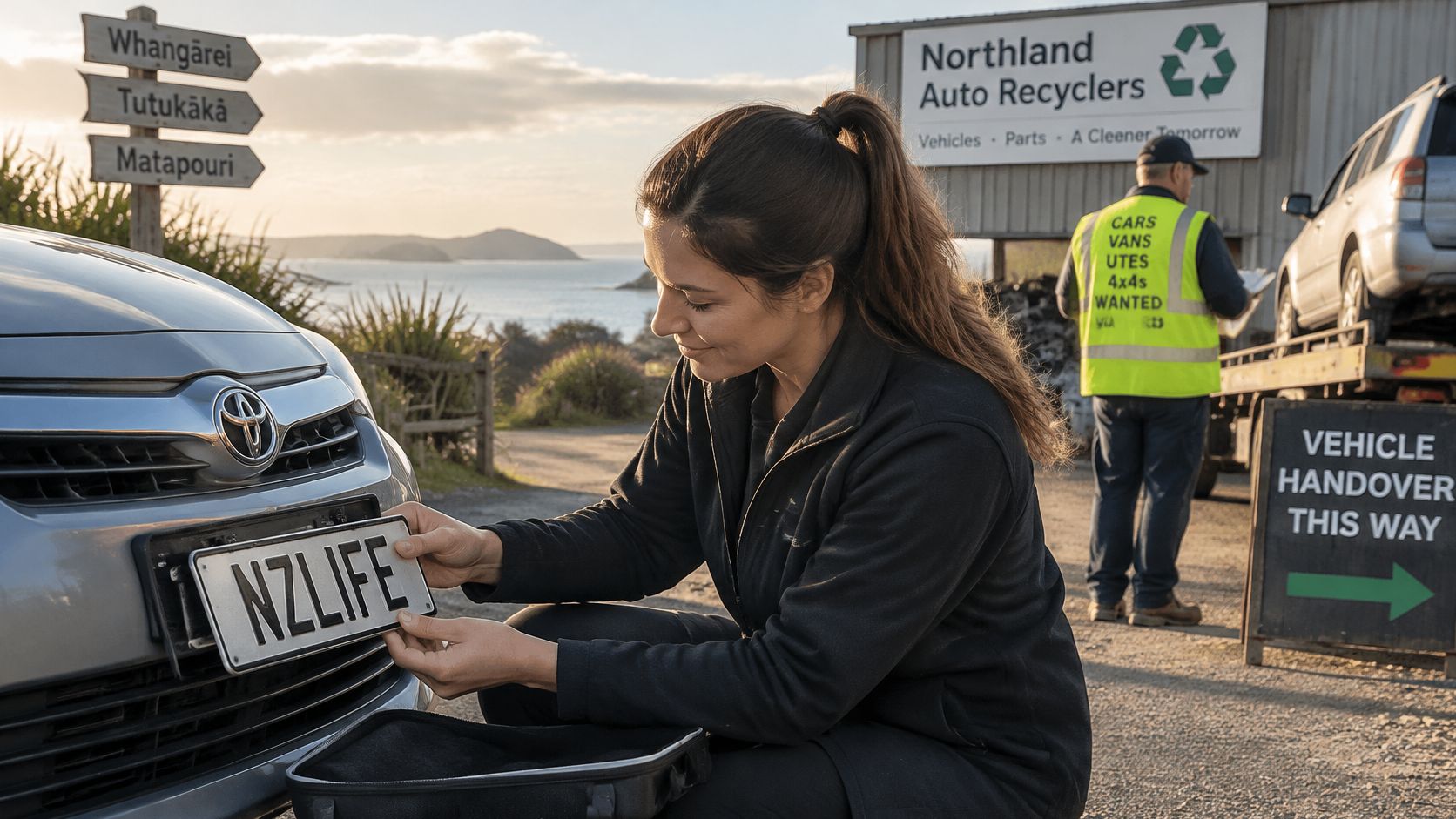
A scrap or dismantling pickup is less forgiving because the vehicle may be processed soon after arrival at the yard. Personal items, aftermarket accessories you want to keep, and licence plates to be retained must be removed before pickup. We're not responsible for items left in a vehicle once it's collected, so don't plan to recover plates after the truck has gone.
An insurance write-off sits between the two. The car may be at home, at a panel beater or in a holding yard. Settle the plate question before it leaves your control, and tell the insurer, yard or collector the same thing. Mixed messages create delays because each party assumes someone else has removed or retained the plates.
For the ownership side of a sale or removal, see the process for NZTA registration change of ownership so the plate decision and the vehicle transfer don't get confused.
The four step handover sequence
- Transfer or exchange the plate while the vehicle is still yours to deal with.
- Remove the plates you're keeping and store them with the confirmation paperwork.
- Keep the transaction confirmation somewhere you can find it after collection day.
- Hand over the car with photo ID and proof of ownership, such as registration papers or the rego record in your name.
Once a buyer or dismantler takes possession, the ownership notification needs to be handled promptly. In our case, we complete the NZTA change of ownership notification for the customer, so the vehicle is no longer the customer's liability. That closes the vehicle side cleanly, provided you've already closed the plate side before collection.
Check Your Plate Before Your Car Leaves Whangarei
Before any unwanted car leaves your property, make three checks and don't book the pickup until you can answer yes to each one.
- The plate transfer or exchange is complete. You have the confirmation, and the record matches the vehicle that now carries the plate.
- The plates you want to keep are removed. They are stored away from the vehicle, not sitting on the passenger seat for someone to load with the car.
- Your ID and ownership proof are ready. You have photo ID and proof that you own the vehicle, such as registration papers or the rego record in your name.
Those checks take minutes on a quiet afternoon. They take much longer when a tow truck is booked, a buyer is waiting, or a written off vehicle is sitting in someone else's yard. That timing difference is the whole lesson with reg plates personalised for a car you no longer want. The entitlement is portable, but only if you move it deliberately.
If the vehicle itself is ready to go, you can request a quote by phone on 0800 99 55 99. The quote carries no obligation, and your details are used only to quote the vehicle, so you can check the value before committing to a pickup. If you'd rather ask questions in person, our yard is at Unit 8E/50 Kioreroa Road, Port Whangarei, Whangarei 0110.
Owners deciding whether a vehicle has reached the end of the road can also read what to expect when you scrap my car and how collection fits around paperwork. Use that information after the plate checks, not instead of them.
Gather the confirmation, remove the retained plates, put your ID and ownership proof in one envelope, then call for the quote. That order means the plate question is settled before the vehicle leaves your control, and collection day can focus on identification, payment and loading rather than last minute searching for plates or documents.
If your personalised plate is sorted but the vehicle underneath it is damaged, deregistered, or unwanted, we can quote the car, complete the NZTA ownership notification at pickup, and remove it from your property without you having to move it first. Visit Car Removals Whangarei or call 0800 99 55 99 to get a no obligation quote before you book collection.
- reg plates personalised
- personalised number plates NZ
- NZ number plates
- NZTA plate transfer
- Whangarei car removal