· Car Removals Whangarei
Car Valuation Online Explained: What Your Number Means

If a website says your car is worth one number, why does almost every buyer offer you a different one? That gap isn't usually trickery, and it doesn't mean one figure is a lie. It means each number was built for a different way of selling.
Understanding that distinction protects you from two costly mistakes. You won't reject a fair firm offer because you saw a higher retail price online, and you won't accept a weak offer without checking what your vehicle's parts, steel and battery are worth. The steps below build that understanding in order, from what car valuation online means to how you turn an estimate into a number you can rely on before you sell.
Table of Contents
- What an Online Car Valuation Actually Measures
- Inputs and Accuracy Limits Behind Your Number
- Parts, Steel and Batteries That Set the Number
- Age, Condition and registration Status in Practice
- Document and Transfer Details to Have Ready
- Get a Firm Number Before You Sell
What an Online Car Valuation Actually Measures
An online car valuation is an estimate of one specific value. It isn't a universal price for your vehicle, and the number changes with the channel it is built for. A tool trained on dealer adverts answers a different question than a dismantler quoting to collect a non-running ute this week.
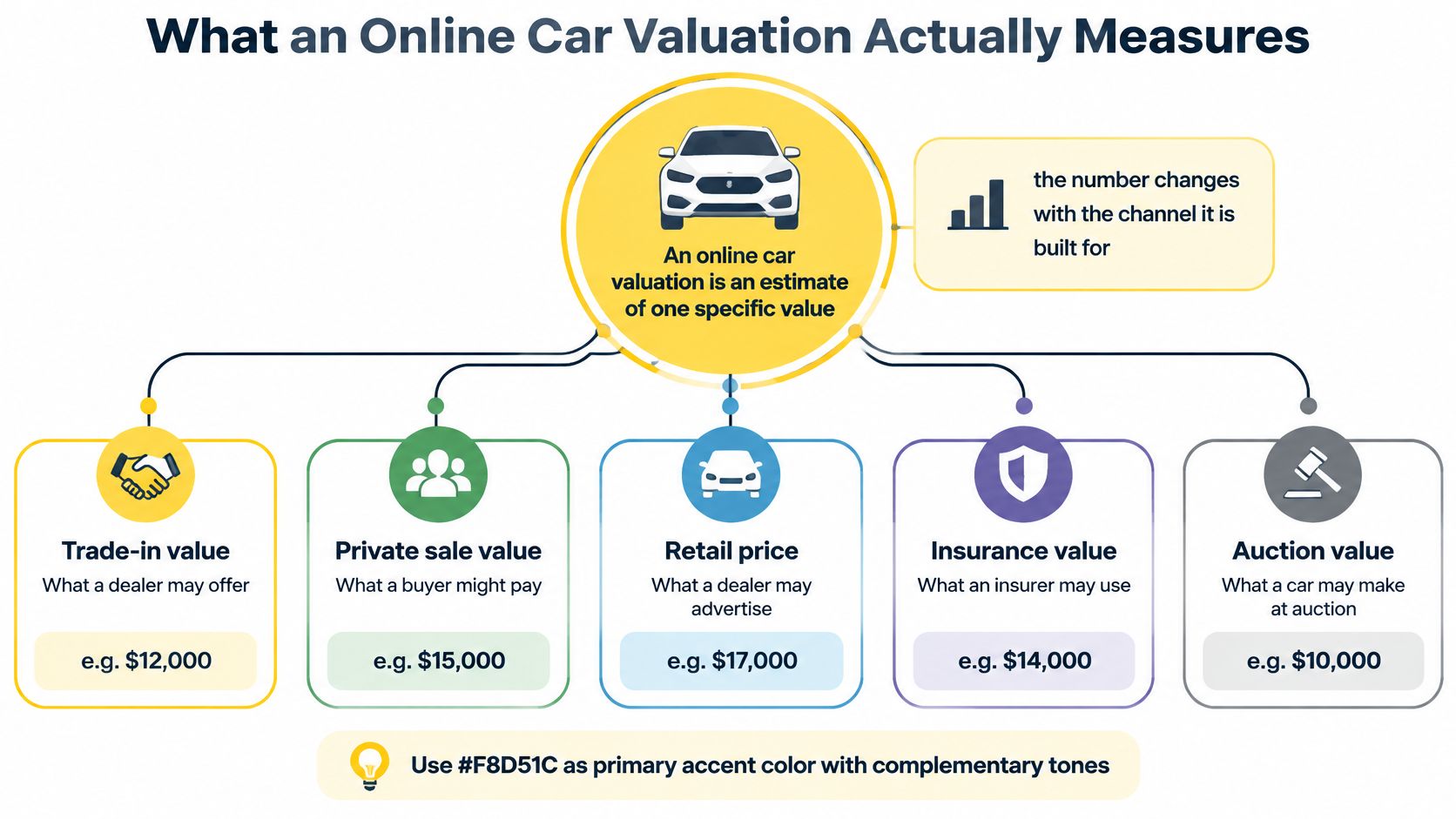
Five Numbers for the Same Vehicle
Read an online figure by asking who would pay it, in what condition, and after which costs. The table separates the common value types so you can compare like with like.
| Valuation type | Built from | Usually includes | Compared with a firm offer |
|---|---|---|---|
| Retail online estimate | Advertised prices for similar roadworthy cars | Dealer margin, preparation and warranty risk | Often higher than what you receive |
| Private sale price | What a buyer pays after inspection and haggling | Your time, listing and test drives | Usually above a dismantler offer, below retail |
| Trade-in offer | Dealer resale estimate minus margin | Immediate sale with limited negotiation | Usually below a private sale |
| Insurance salvage bid | Wholesale value of a damaged vehicle | Damage assessment and recovery risk | Set by bidder assessment of damage and resale |
| Dismantler or scrap offer | Parts demand and steel weight | Removal, handling and recovery costs | Often the firmest figure for non-running cars |
Channel matters in New Zealand's market as a whole. The Mordor Intelligence New Zealand used-car market report reports offline outlets still represented 57.95% of used-car sales in 2025, while online sales were growing faster at 7.72% annually. An online listing price therefore reflects one selling route, not the whole market.
Why the Retail Figure Often Looks Too High
A dealer asking price has to cover grooming, repairs, a fresh WOF, warranty risk, finance, transport and margin. None of that money reaches you as the seller. If your vehicle has failed its WOF, been deregistered, rusted, been accident damaged or won't run, your realistic alternatives are usually dismantling, parts recovery, scrap or a wholesale sale instead of retail resale.
Rural location narrows the gap further. A buyer who must recover, load and tow a vehicle from an outlying Northland property deducts those logistics from what they can pay. A lower firm offer that includes towing and immediate payment can be worth more to you than a higher estimate that requires repairs, listing fees and weeks of enquiries.
Practical rule: Name the channel you plan to sell through before comparing any two numbers. Treat the online figure as your starting benchmark, not your final price.
Inputs and Accuracy Limits Behind Your Number
Good inputs matter because the vehicle pool is large and varied. The NZTA fleet status data sourced from the Motor Vehicle Register shows the active fleet reached 5,848,639 vehicles by 31 August 2025. With that many near-identical models on the register, a tool relying on broad make and model averages can't separate the version you own from dozens of others.
Seven Inputs to Check on the Car and Paperwork
Work through these in order before you trust any estimate. If you can't confirm a field, say it's unknown rather than guessing.
- Registration number: Read the plate from the vehicle and its registration label. It pins the exact variant and licence status, so two vehicles sharing a model name aren't confused.
- First registration year: Check both the overseas build or first registration year and the date the vehicle first entered New Zealand. NZTA vehicle attribute definitions require the vehicle year to represent the first year of registration anywhere, while the separate date of first New Zealand registration records when the vehicle entered the NZ fleet. An import can look newer here than its actual history suggests.
- Odometer and unit: Photograph the reading and note whether it's in kilometres or miles. If the display is dead or unreadable, flag it. Entering zero invents low mileage and inflates the estimate.
- Body and fuel type: Match the badge, cab style, drivetrain and fuel system. A double-cab diesel 4WD ute and a single-cab petrol version carry different demand and parts value.
- WOF and registration status: Note the current WOF expiry and whether the vehicle is licensed, on hold or deregistered. That status decides whether a buyer values it as roadworthy or as a recovery job.
- Accident or flood history: Keep any insurer write-off notice and repair records handy. A recorded write-off lowers retail value and changes what a dismantler can reuse.
- Completeness and battery: List whether the engine, gearbox, wheels and catalytic converter are present, plus any EV or hybrid battery. Parts demand can't be priced correctly if major components are missing.
When you request a quote from us, tell us the make, model, year, registration number and whether the vehicle runs or rolls. Those details identify the vehicle and confirm we can load it safely.
What Each Method Can and Can't Verify
An online tool can only process what you enter. It can't see hidden structural damage, a modified engine, rust under trim or parts you didn't report. A phone conversation closes some of those gaps through direct questions, and an on-site check closes most of the rest.
| Check | Online estimate | Phone quote | On-site check |
|---|---|---|---|
| Vehicle identity | Matched from the plate or VIN you enter | Confirmed by reading the details back to you | Confirmed from the VIN plate and paperwork |
| Condition | Inferred from your answers | Based on your description | Seen and assessed in person |
| Hidden damage | Not visible | Partly covered by questions | Found during inspection |
| Missing parts | Only if you report them | Asked directly | Counted at the vehicle |
| Price certainty | Estimate only | Firm if the description matches | Firm, subject to access and condition at pickup |
That firmness has limits you should understand. Our quote may be revised at pickup if the vehicle differs materially from its description, such as major parts missing or a tow truck being unable to access it. In that situation you may decline, and the vehicle is left where it is at no cost. Confirm the pickup terms in writing first so there's no surprise on the day.
One more check applies to insurance write-offs. If your insurer retains salvage rights, check with the insurer before selling the vehicle. Use the online figure to set expectations, then obtain a phone or on-site number before you decide.
Parts, Steel and Batteries That Set the Number
A car that won't start can still carry a meaningful price. That's the surprise for many owners, because we value vehicles on parts demand and steel weight, not on whether they start. A dead engine ends one kind of value, but it doesn't remove the value sitting in the panels, gearbox, wheels and shell. A deeper explanation of that calculation sits in our guide to how a scrap car valuation is built from weight and recoverable components.
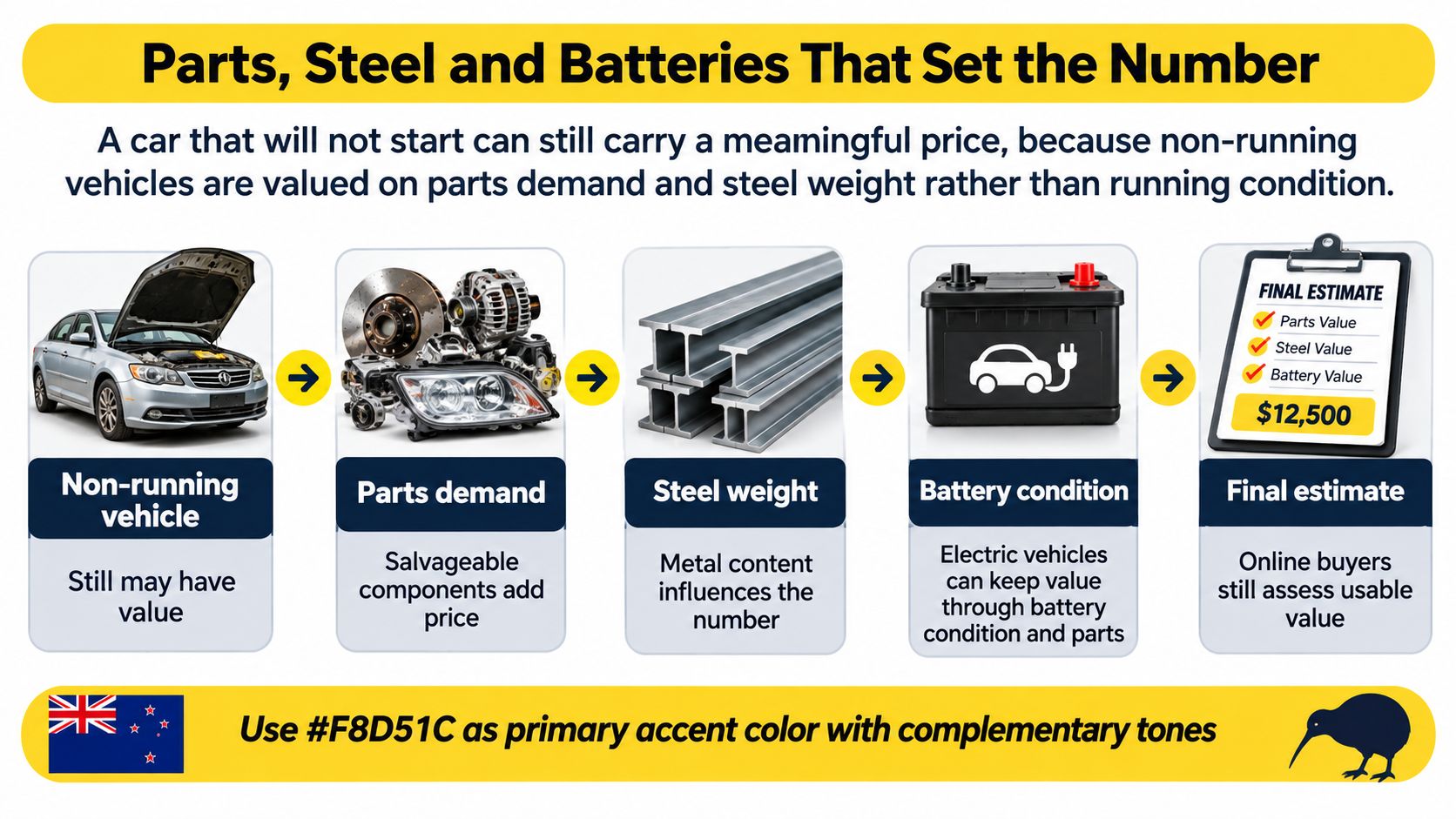
The Five Step Scrap Calculation
Treat the number as a sequence rather than a guess:
- Weigh the vehicle: Kerb weight sets the steel floor for the offer.
- Identify recoverable parts: Engine, gearbox, alternator, panels, lights, interior and wheels are assessed for reuse.
- Check current dismantler demand: A part is only valuable if another owner needs it soon.
- Deduct removal and handling costs: Towing, loading, fluid draining and dismantling time come off the gross figure.
- Set the offer: The final number reflects what's recoverable, minus the cost of recovering it.
Steel prices move with the wider scrap market, so the steel component can shift between quote dates. Parts demand varies more sharply by model. Common engines, gearboxes, panels and wheels for popular utes, 4WDs and sedans can hold value for years because thousands of matching vehicles remain on the road. An unusual model, or one sold here in tiny numbers, may attract little demand even in tidy condition. Catalytic converters and alloy wheels add value when they're present and intact, which is why their absence changes a quote.
Complete Car Versus Stripped Shell
Compare two examples of the same model. The complete car offers a full set of saleable components plus its full steel weight. The stripped shell has already lost its converter, wheels and gearbox, so only panels and steel remain. Each missing major part lowers the figure, and the gap between the two can be larger than owners expect.
Age explains why a simple depreciation curve fails here. The Ministry of Transport NZ Vehicle Fleet Report 2018 reported the average light-fleet age rose from 11.7 years in 2000 to 14.1 years in 2018, with almost one in five light vehicles older than 20 years. At that age, value depends on running condition, WOF status, completeness, local demand and recoverable components rather than a percentage of the original price.
Work with two outputs instead. An operating-market value suits a roadworthy vehicle, while a recovery value prices usable parts, steel, towing and loading costs, and dismantling risk.
Don't assume the lower figure automatically applies. A complete late-model 4WD, hybrid, ute or van may have component demand well above its scrap-only value, because late-model parts are scarce and expensive new. Regional logistics pull the other way for rural vehicles, since recovery and inter-regional transport costs come off the net value before any buyer can dismantle it.
EV and Hybrid Batteries Need Their Own Check
Electrified vehicles break the standard model because the traction battery is the largest single component. Its state of health sets much of the vehicle's value, and the battery's value is separate from the value of the car around it. A complete, operational pack with known charging behaviour is worth more than one with unknown health, crash damage, water exposure, isolation faults or missing modules.
That doesn't make an unwanted EV worthless. The EECA guide to electric vehicle benefits states used EV batteries can be refurbished, repurposed for energy storage, or recycled, and that owners may be paid for an old battery. Battery value can lift a payout, but uncertainty about its condition pulls the offer back down.
Safety sets the boundary. A battery involved in a flood, fire or collision presents high-voltage risk and must be isolated by trained people before transport. It can't be handled like ordinary ferrous scrap, and it shouldn't be winched, cut or stored by anyone untrained. Hybrids raise the same questions with a smaller pack, so the same disclosure applies.
Give any buyer these details up front:
- Battery warnings and dash lights: Photograph the instrument cluster if it powers up.
- Charging status: Say whether it charges, holds charge or refuses to connect.
- Accident or flood history: Include water height if you know it.
- Rolling condition: State clearly whether the vehicle rolls, steers and has all wheels fitted.
Before accepting any offer, ask two questions. Is the battery value included in the figure, and who handles isolation and transport safely? A remote estimate for an EV or hybrid stays conditional until someone qualified can inspect it.
Age, Condition and registration Status in Practice
Age is the starting point because New Zealand's fleet is old. The EHINZ age of vehicles report found 43.3% of the country's light-vehicle fleet was at least 15 years old in 2024, while average ages reached 15.3 years for passenger vehicles and 13.0 years for light commercial vehicles. A valuation model built for a younger overseas fleet will tend to overvalue older cars here.
Age drives more than depreciation. It affects remaining service life, safety and compliance costs, insurance demand, and how easily reusable parts can be found. In regional markets an older ute or 4WD may keep genuine practical utility long after its retail value looks modest, which is why age alone shouldn't decide the number.
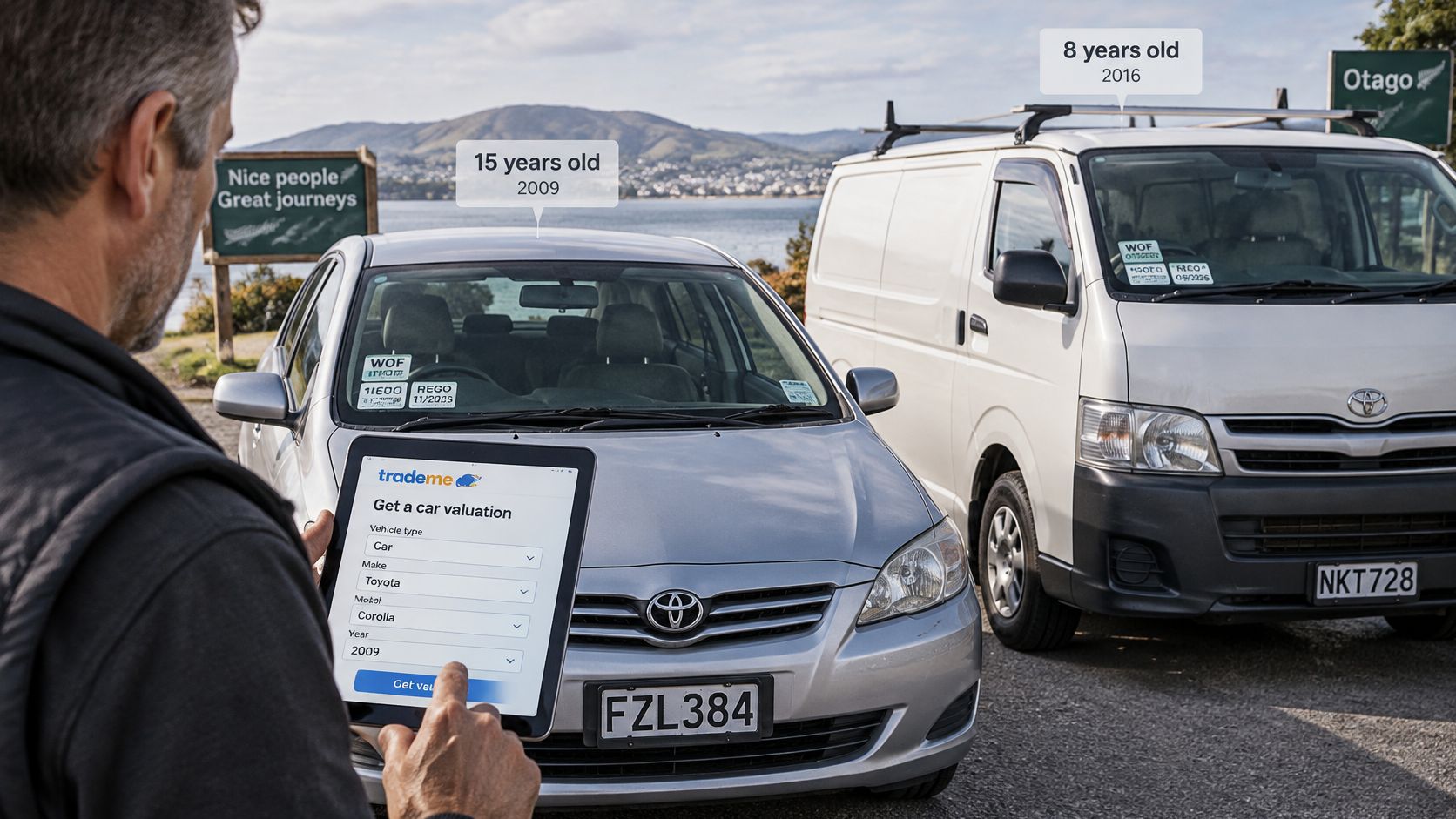
Place Your Car in a Condition Band
| Condition band | What it looks like | Likely valuation basis |
|---|---|---|
| Roadworthy with current WOF | Runs, drives and has a clean history | Retail or private sale estimate |
| WOF expired but driveable | Needs repairs before it can pass inspection | Private sale as-is, below the roadworthy figure |
| Non-running but complete | Dead engine with all major parts present | Operating-market or parts-led offer |
| Rusted or incomplete | Structural rust or missing major parts | Scrap weight plus recoverable parts |
| Accident or flood write-off | Insurer-declared or unrepaired damage | Salvage bid or dismantling value |
Two Utes That Look Alike Online
Say you have two utes of the same model and age. One holds a current WOF, has a clean body and documented servicing. The other has an expired WOF and rust in the chassis rails. An online tool working from make, model and year may show similar retail estimates for both, because it can't see the chassis. Realistic offers diverge sharply, since the second ute can't return to the road without structural repair and will be priced on parts and weight.
Several checks move a vehicle between bands. Warning lights point to faults a buyer must price in before resale. Body and underbody rust turns a repair job into a dismantling job. Mileage that can't be verified forces a cautious assumption, and repairs that were never recorded leave a buyer guessing about what's been cut, welded or replaced with mismatched parts.
Place your car in one band before comparing any figure. If you're unsure between two bands, describe the faults that worry you and ask the buyer which band they'd use and why. That conversation usually explains the number better than the estimate itself.
Document and Transfer Details to Have Ready
What details keep a sale tied to the right vehicle? Have the registration plate, make, model and VIN or chassis number ready. The NZTA guidance on buying and selling for motor vehicle traders identifies these as core vehicle details. The seller also needs to provide identifying information about the buyer or purchasing organisation.
Before collection, check each item:
- Registration plate: Copy it exactly from the vehicle and registration label.
- Make and model: Use the details shown on the registration, not just the badge variant.
- VIN or chassis number: Read it from the vehicle and compare it with the paperwork.
- Licence status: Note whether it is licensed, on hold or deregistered.
- Buyer details: Record the buyer's name or organisation and the identifying details NZTA requires.
Have the plate and VIN to hand when requesting a quote. Matching the vehicle details helps avoid valuing the wrong variant or a damaged shell. For a phone quote from Car Removals Whangarei, provide the make, model, year, rego and whether the vehicle runs or rolls. The online form asks for your name, phone, vehicle details and pickup address.
Keep the agreed price and pickup terms with the transfer details. Check the NZTA registration change of ownership process for the steps, and confirm current requirements with NZTA before the vehicle leaves. A higher online retail estimate may be a useful benchmark for that sales channel, but it may not tell you what a damaged, non-running or rural Northland vehicle can sell for.
Get a Firm Number Before You Sell
How can you tell whether an online estimate is useful for the vehicle you have? Treat it as a benchmark for one selling channel, not a guaranteed payout. A retail-style figure may be less useful than a firm offer if your vehicle is damaged, does not run or is in a rural part of Northland.
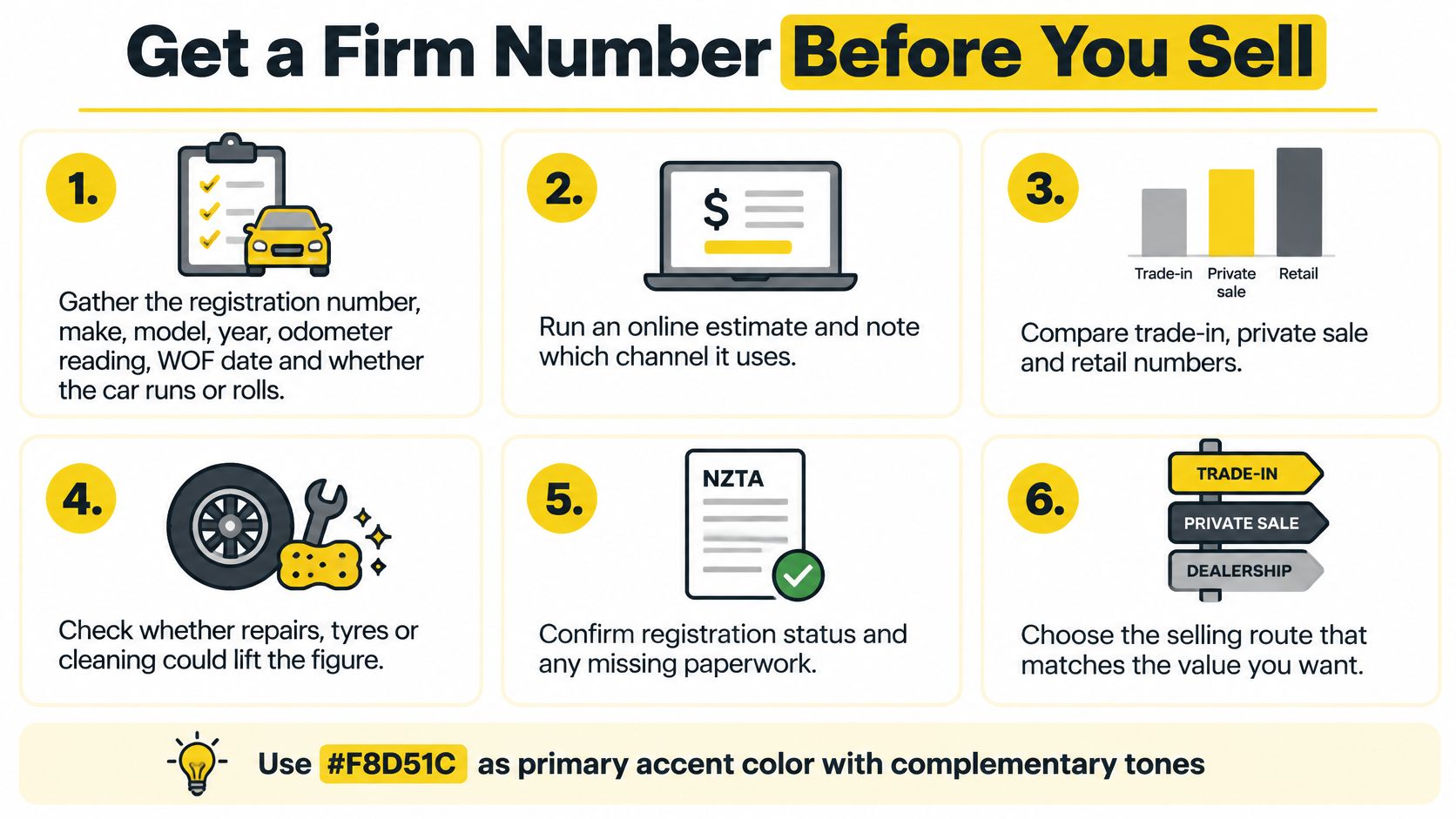
- Gather the basics: Note the registration number, make, model, year, odometer reading, WOF status and whether the vehicle runs or rolls.
- Identify the estimate's channel: Check whether it reflects a retail sale, private sale, trade-in, insurance salvage or dismantler offer. These figures describe different kinds of sale.
- Check salvage rights: If the vehicle is an accident write-off and the insurer retains salvage rights, check with the insurer before selling.
- Request a phone quote: Provide the make, model, year, rego and rough condition. Car Removals Whangarei gives a firm cash figure in about two minutes on the phone. The car removal quote process explains what information to have ready.
- Compare offers: Put the phone figure beside any existing written offer. Car Removals Whangarei often pays more than an insurance salvage bid, particularly for late-model utes, 4WDs and European cars, and comparing its offer costs nothing.
- Confirm the terms: Record the agreed price, pickup arrangements and payment method. With Car Removals Whangarei, the price agreed on the phone is the price paid in cash at pickup, with no towing fee or deductions.
A quote is based on the details you provide, so mention missing parts or access problems that could affect collection. If the figure seems low, ask how the vehicle's condition, completeness and parts demand shaped it. There is no obligation to accept the quote.
If an online estimate does not fit your vehicle's actual condition or location, request a firm phone quote based on its parts demand, weight and completeness. Visit Car Removals Whangarei to request a no-obligation quote and arrange pickup.
- car valuation online
- online car valuation
- scrap car value
- vehicle valuation NZ
- car valuation New Zealand