· Car Removals Whangarei
Wrecked Cars in NZ: Your Options, Costs and Next Steps

Your damaged car is sitting in the driveway or at a panel beater, and you're trying to decide whether to fix it, accept the insurance settlement or get it taken away. It might still start. It might also have damage that makes driving it unsafe, even though the outside doesn't look too bad.
With wrecked cars, the first decision isn't who offers the most money. You need to establish who can authorise the sale, what the registration record says and whether the vehicle needs specialist handling. Once those are settled, you can compare repair costs, parts value and the amount you'll receive after collection.
Table of Contents
- Your Four Options for a Wrecked Car
- Check the Car's Status and Deregister It
- Deciding Between Repair, Parts and Scrap
- Handling Hybrid and EV Wrecks Safely
- Why Licensed Dismantlers Can Pay More
- Towing, Collection and Remote Pickups
- Get a Firm Quote Before You Decide
Your Four Options for a Wrecked Car
Routes for a wrecked car in New Zealand
| Option | Best for | What the seller usually receives | Paperwork to expect |
|---|---|---|---|
| Cash sale to a licensed dismantler | Non-running, crashed, flood-damaged or rusted cars with no road future | Cash based on parts demand and steel weight, with payment before loading agreed in writing | Registration details, owner ID and a release if a panel beater holds the car |
| Insurer write-off and salvage tender | Insured cars declared a total loss | The insurer's settlement, which may be less than a dismantler's offer, although these aren't directly equivalent payments | Insurer settlement records, damage category and salvage-rights terms |
| Keep and repair | Cars with non-structural damage that can be restored | The car back on the road after applicable inspection and certification | Repair records and any required NZTA certification; structural cases need specialist assessment |
| Scrap removal | Rusted, stripped or seized shells | Payment based on kerb weight plus recoverable parts | Cancellation of registration using MR15 if still registered and permanently withdrawn |
If the car runs and the damage appears non-structural, get a repair assessment before committing to disposal. Include inspection, certification, transport and hidden-damage allowances, not just replacement panels. A cheap repair estimate isn't useful if it leaves out the work needed to make the car legally usable.
An insured total loss needs a different approach. Read the settlement and salvage-rights terms before accepting a separate offer. If the insurer retains the salvage, it controls that sale unless another arrangement is agreed.
Choose the route before comparing money
For a dead, rusted or stripped car with no realistic road future, scrap removal is usually the simplest option. For a complete vehicle, reusable components may justify a dismantling assessment rather than a weight-only offer.
These routes overlap. An insurance write-off may become a parts donor, while a technically repairable vehicle may still be uneconomic to restore.
Start with permission, not price: An offer doesn't establish your right to sell the vehicle.
Ask yourself: Is the car insured? Is it still registered? Does it have structural damage? Those answers determine which offers are relevant and which paperwork must come first.
Check the Car's Status and Deregister It
Check the vehicle's legal status before discussing a road-going sale. Under NZTA's written-off and damaged vehicle guidance, a vehicle whose registration was cancelled because of fire, structural or water damage receives a safety flag, requires entry-certifier inspection before returning to the road, and can have the flag removed only after repairs are verified within the manufacturer's safe tolerances.
A starting engine isn't proof of roadworthiness. Cosmetic repairs can conceal damaged airbags, seat-belt pretensioners or electrical systems, so keep the vehicle out of road-use resale until its required certification pathway is complete.
Establish the record and sale authority
- Confirm registration status. Match the plate details and vehicle identification number to the records. Establish whether registration is current, merely unlicensed or already cancelled.
- Get the insurer's written assessment. Request the damage category and the reason for the write-off, including whether the paperwork describes it as statutory.
- Settle salvage rights. If the insurer retains them, speak to it before selling or removing components. A settlement offer isn't automatically permission to dispose of the car.
- Record the damage type. Identify fire, water, structural or non-structural damage rather than relying on a general description such as accident damaged.
The NZTA entry-certification threshold guidance distinguishes specialist-referral cases from qualifying non-structural losses.
Damage type and the NZTA status it triggers
| Damage or write-off type | NZTA status or flag | Next step |
|---|---|---|
| Fire, structural or water damage with cancelled registration | NZTA safety flag applied | Entry-certifier inspection; flag removed only once repairs are verified |
| Terms statutory, written off, salvage, junked or non-repairable | Specialist repair-certifier referral trigger | Ask the insurer for the reason and whether the structural threshold was exceeded |
| Non-structural damage, insurer confirms no body or structural cause | Referral may be avoided below the structural threshold | Keep the insurer's written confirmation |
| Destroyed or permanently useless car | Registration cancelled through MR15 | Surrender plates to a plate agent; re-register before road use |
For more detail on the terminology, read our explanation of what a statutory write-off vehicle means.
Complete cancellation and handover separately
For a destroyed or permanently useless vehicle, NZTA's registration factsheet provides for an Application to Cancel Registration, MR15, normally with the plates surrendered to a plate agent; a cancelled vehicle must be registered again before road use, and structural damage or deterioration can make that process more complicated and costly.
Agree the price and collection terms in writing. Keep the cancellation record, receipt and buyer's details together. If a panel beater holds the vehicle, we require the yard's release and the registered owner's ID before collection.
Cancellation, disposal notification and repair certification are separate actions. Cancellation doesn't resolve every existing charge or liability. Complete the applicable seller notification, retain confirmation and record the handover time rather than assuming the tow truck's departure closes the paperwork.
Deciding Between Repair, Parts and Scrap
Likely outcome by condition of the car
| Condition | Likely outcome | What decides it |
|---|---|---|
| Non-structural damage, insurer confirms no body or structural cause | Repair is possible | Write-off reason and remaining below the structural threshold |
| Structural damage such as split seam welds or distorted suspension mounts | Specialist certification or parts only | Physical damage and referral-triggering terms such as statutory, salvage or non-repairable |
| Fire, water or flood damage with cancelled registration | Inspection and certified repair before road use | NZTA safety flag, retained until repairs are verified |
| Non-running, seized or stripped car | Parts and steel value | Whether it's complete or a stripped shell |
| Hybrid or EV with visible battery or wiring damage | Specialist high-voltage handling, then parts or scrap | Battery condition, coolant leaks and shield damage |
A write-off description isn't a repair specification. Under NZTA's repair-certification threshold rules, collision damage capable of splitting seam welds, distorting suspension members or mounting points, or tearing metal structures requires specialist referral; documents containing statutory, written off, salvage, junked or non-repairable also trigger referral unless the insurer confirms a qualifying non-body, non-structural loss below the structural threshold.
Price the complete repair pathway
A repairable car needs more than a panel-and-paint quote. Ask the repairer to identify structural assessment, dismantling for inspection, restraint-system work and certification separately. Establish what happens if additional damage appears after trim or panels come off.
Say a vehicle needs a replacement engine but has a sound body and useful interior. Its components may support a worthwhile dismantling offer even when an engine replacement doesn't make financial sense. Conversely, a running engine won't make a distorted shell economical to restore.
A dismantler can assess the components suitable for recovery, but suitability for reuse still requires checking. Our guide to used car parts in New Zealand explains what to consider when choosing replacement components.
Photographs help price a collection. They don't establish structural integrity.
A competent assessment should examine floor and chassis deformation, suspension pick-up points and weld separation. Unverified restoration can leave alignment problems, altered crash-energy management and unsafe suspension loading.
Before spending money, ask the insurer:
- What caused the write-off? Request the actual loss reason, not just the total-loss label.
- Was the structural threshold exceeded? Get the answer in writing.
- What terminology appears in the records? Give the repairer and certifier the complete documents.
Handling Hybrid and EV Wrecks Safely
A normal-looking hybrid or EV isn't proof of a safe traction battery. NZTA's electric and hybrid inspection requirements involve a visual rather than invasive battery examination and identify hazards including damaged wiring or insulation, insecure or leaking batteries, missing or damaged shields and leaking battery coolant.
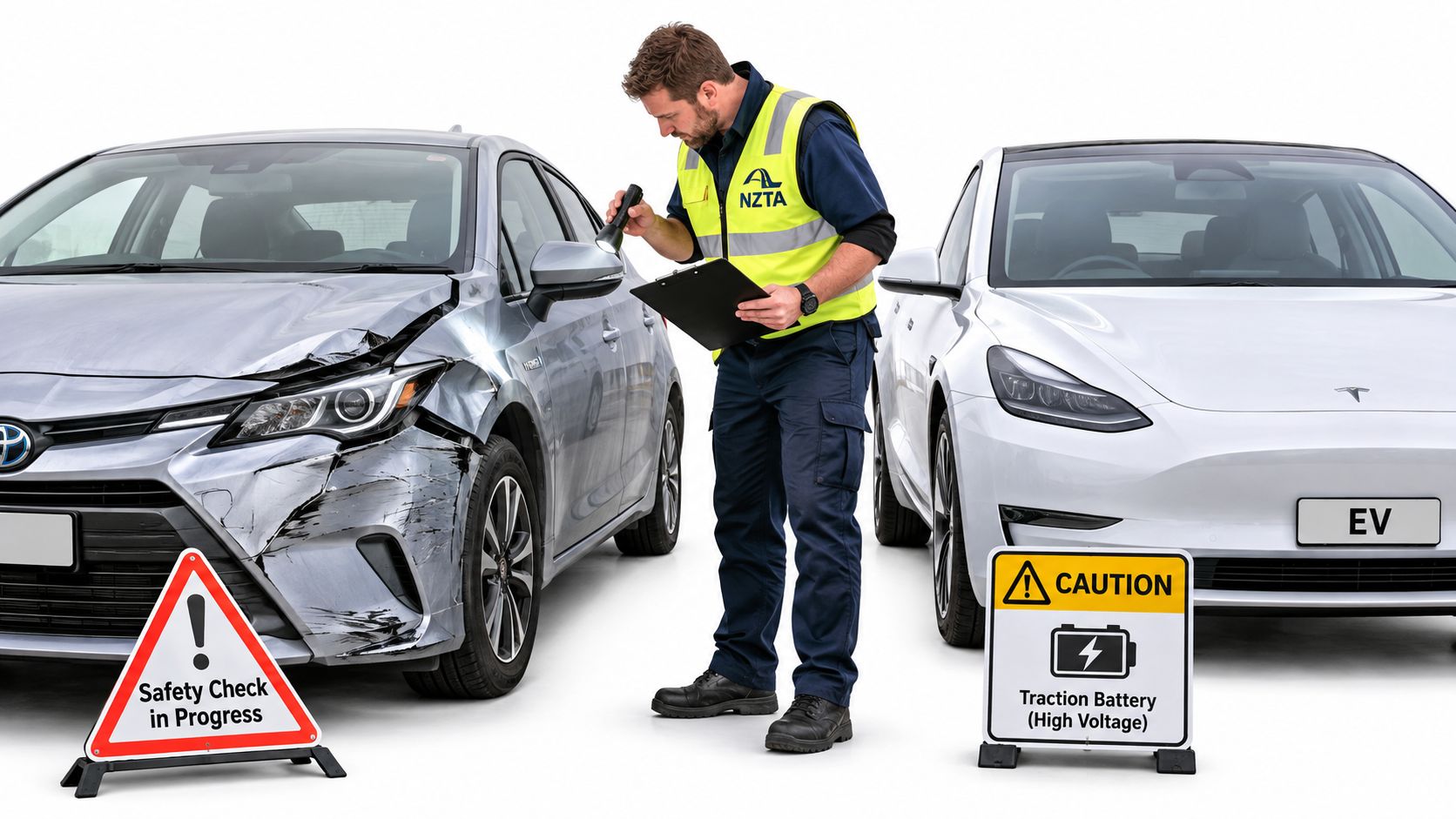
Leave high-voltage work to equipped handlers
- Don't start or charge it. Don't test whether a visibly damaged vehicle still works.
- Don't dismantle it. Leave orange high-voltage cables, battery covers and isolation components alone.
- Avoid indoor storage. Arrange safe isolation away from buildings and ignition sources.
- Disclose its history. Tell the handler about crashes, flooding, warning lights, coolant leaks and any unusual heat.
- Specify specialist recovery. The handler needs equipment and procedures for high-voltage isolation and battery transport.
NZTA's same inspection requirements direct that a vehicle showing high battery temperature be removed from indoor premises, switched off and referred for diagnostics. Don't attempt to drive or physically move a hot, smoking or otherwise unstable vehicle yourself. Keep clear and contact emergency services if there's an immediate danger.
Battery value can improve salvage economics, but a compromised pack can also require specialist transport, assessment and quarantine. A high offer that ignores those tasks isn't a sound comparison with a properly costed recovery.
On remote Northland land, arrange collection early rather than leaving an uncertain battery condition unattended. Tell the recovery operator where the vehicle sits and whether safe access is available without starting it.
Why Licensed Dismantlers Can Pay More
A dismantler values more than the damaged vehicle as a whole. Reusable engines, transmissions, body panels, lights and interior components can support an offer above the bare shell's steel value. That's why a complete car generally has more recovery potential than one stripped of its useful parts.
A salvage tender and an insurer's settlement aren't the same thing. The settlement addresses the insurance claim, while a salvage bid prices the damaged asset. Compare disposal offers against each other, and don't assume you can collect both a full settlement and separate salvage proceeds.
Compare the net payment
Parts demand for the model, completeness, steel weight and recovery difficulty all affect the result. A car with desirable components may justify more than a similar-weight shell, but damaged or untested parts shouldn't be valued as ready-to-sell stock.
Responsible dismantling also involves work that a headline offer can conceal. Fluids need draining and appropriate disposal, batteries and tyres need controlled handling, and airbags require care. We test good components for reuse and send the bare shell for steel recovery.
Use this checklist when judging an offer:
- Confirm licensed status. We're a licensed Northland dismantler. Establish who the actual buyer is, not just who answered the advertisement.
- Get a firm written amount. Record the vehicle's disclosed condition, included collection and any agreed exclusions.
- Set payment before loading. Don't leave the payment method or timing until the vehicle is on the truck.
- Complete the handover records. We complete NZTA ownership notifications at pickup; retain your receipt and confirmation.
Compare what you keep: A higher headline price loses its advantage if towing, yard charges or collection deductions come out afterwards.
The strongest offer is one the buyer can honour while completing the paperwork and handling the particular vehicle safely. That matters more than an unsupported promise made without asking about damage.
Towing, Collection and Remote Pickups
A wrecked car can be straightforward to buy but difficult to recover. Locked steering, missing wheels, collapsed suspension or a narrow farm entrance can change the equipment needed. Describe those conditions before accepting the collection arrangement.
Get written confirmation of whether towing is included and whether yard access, winching or a non-rolling vehicle creates a charge. Give the exact pickup address, gate arrangements and available working space. Don't describe a paddock recovery as an ordinary driveway pickup.
Prepare access without taking risks
- Confirm authority. Check the registration details and registered person's name, and establish the owner's authorisation. A vehicle sitting on your property isn't automatically yours to sell.
- Clear the approach. Open gates, move other vehicles and identify soft ground, overhead obstructions or narrow turns. Only reposition the wreck if it can be done safely.
- Report leaks. Identify fuel, oil, coolant or battery leakage. Don't crawl underneath an unstable car or attempt to contain an unknown battery leak.
- Flag specialist hazards. State whether it's a hybrid or EV and describe fire or flood damage so suitable equipment is allocated.
- Arrange yard release. If a panel beater or holding yard has the car, resolve release permission and outstanding storage arrangements before dispatch.
Avoid leaving a wreck on remote land indefinitely. Deteriorating tyres, seized brakes and vegetation around the vehicle can make loading harder, while further deterioration may complicate any later repair assessment.
Confirm the pickup window in writing. Record the tow operator's identity on the collection receipt, but make sure the disposal paperwork identifies the actual buyer, which may be a different party.
Get a Firm Quote Before You Decide
A useful quote starts with an accurate description, not a hopeful asking price. Gather the registration and vehicle identification details, the insurer's written settlement and damage category, and clear photographs of the exterior, cabin and damaged areas. Include fire, water and battery history, even if the vehicle now looks dry or starts normally.
Send enough detail for a reliable offer
- Identify the vehicle. Include make, model, registration, engine and transmission details where known.
- Describe completeness. List missing wheels, engine components, catalytic converter or interior parts rather than calling it complete.
- Explain access. State whether it rolls, steers and brakes, and whether a yard release is required.
- Attach authority records. Include relevant insurer permission or owner authorisation before booking removal.
Compare written offers against the licensing, price, payment and paperwork checklist, rather than choosing by headline amount alone. Our car removal quote guide helps you prepare the information needed for an accurate assessment.
Car Removals Whangarei is a licensed Northland dismantler buying sedans, hatches, wagons and people movers that are running, driveable or completely dead, with a firm phone quote and cash paid before loading. Unwanted cars are removed the same day for most Whangarei addresses and within 48 hours for wider Northland.
Don't authorise repairs because the car still runs, and don't cancel registration casually if you're considering restoration. Confirm the status, paperwork and handling rules first, then take the firm quote that fits the car's condition.
Car Removals Whangarei offers assessment and removal for wrecked cars, including non-runners, insurance write-offs and vehicles with structural damage. Visit Car Removals Whangarei with your vehicle details, damage description and pickup location to arrange a firm quote before deciding what to do next.
- wrecked cars
- wrecked cars NZ
- insurance write-off NZ
- car dismantler NZ
- damaged car removal