· Car Removals Whangarei
Failed WOF Options: Repair, Sell or Remove for Cash
A failed warrant of fitness is not an unusual event in New Zealand. It is routine. The NZTA national failed-inspection dataset, covering inspections from 1 January 2010 to 23 November 2025, records annual failed-inspection counts reaching into the hundreds of thousands across older vehicle age groups, including 358,392 failed inspections in a single age and import category.
That scale should change how you read your own fail sheet. It isn't a verdict on the car and it isn't an emergency. It's a defect list, and it opens three legitimate routes: repair and recheck, sell as is to a buyer who accepts the faults, or remove the car for cash and close the matter. Which one is right depends on what failed, what the car is worth once fixed, and whether it can legally move at all.
Table of Contents
- Your Three Options After a Failed WOF
- Reading the Failure Sheet by Defect Type
- Driving Rules, Safety and Special Vehicles
- How to Decide Between Repair and Disposal
- How to Sell or Remove a Failed WOF Vehicle
- Confirm Your Next Step Before Booking a Removal
Your Three Options After a Failed WOF
A failed WOF leaves you three real paths, and none of them requires you to drive a car that isn't safe. The choice comes down to the sheet in your hand and the value left in the vehicle.
In June 2025, NZTA recorded 13,080 first-time WOF inspections in Northland, with 5,001 failures against 8,079 passes. That's a 38.23% first-time failure rate, or roughly one in every 2.6 vehicles presented, according to NZTA's Northland inspection figures for June 2025. Rechecks lifted the region's total inspection workload to 19,266 that month, and Northland's first-time failure rate ran above Auckland's 32.54%.
You're in a large, ordinary group of Northland owners, not a rare one. Here's how the three routes compare.
| Option | Best when | Road use allowed | Paperwork | Timing |
|---|---|---|---|---|
| Repair and recheck | Defects are minor or the repair cost is well below the car's value | Only to reach a repairer or a recheck, and only if it is safe | Written failure sheet and repair invoice | Free recheck within 28 days at the same inspecting organisation |
| Sell as is | The car still drives safely and a buyer accepts the listed faults | Only to a repairer or the buyer, and only if it is safe | Failure sheet disclosed to the buyer, ownership transfer completed | Counted in days or weeks of storage while local demand decides |
| Remove for cash | The car doesn't roll, the repair is uneconomic, or it is unsafe to drive | Not driven. Towed | Owner ID and the ownership change notified to NZTA | Set by the tow booking and site access, so confirm a collection slot first |
Repair makes sense when the faults are predictable wear items and the finished car is clearly worth more than the invoice. Selling as is works when the vehicle is still legally and safely mobile and a buyer will take on the listed defects. Removal wins when the car won't roll, the repair bill outruns the value, or driving it anywhere is a risk you shouldn't take.
The test that matters: if the repair quote plus towing and storage lands above what the car sells for once fixed, you aren't repairing a car. You're buying back one you already own.
The failure sheet and the 28-day recheck window shape all three options. Pick the two you're weighing, then read the defect groups next.
Reading the Failure Sheet by Defect Type
A single failed inspection can carry more than one fault code, so recorded defects can outnumber failed inspections, as Waka Kotahi's inspection outcome guidance sets out. That matters because the fault you noticed is rarely the whole story. A blown headlamp can sit on the same sheet as a pitted brake pipe, a corroded suspension mount and a frayed seatbelt.
The sheet is where the decision lives. Read it item by item before you talk to anyone about money.

The agency's own examples run from cosmetic to structural. A 150 mm windscreen crack in the driver's line of sight, wipers that smear rather than clear, corroded suspension-mounting areas, frayed seatbelts, an airbag warning lamp that never illuminates, pitted brake pipes, bulging brake hoses, mismatched directional tyres, missing wheel nuts, exhaust leaks and split driveshaft rubbers all appear on real sheets.
| Defect group | Example items | Decision signal |
|---|---|---|
| Safety-critical brakes and tyres | Pitted brake pipes, bulging brake hoses, mismatched directional tyres, missing wheel nuts | Do not drive. Repair before any road use |
| Structural corrosion | Corroded suspension-mounting areas, towbar corrosion or cracking | Get a specialist quote. May make repair uneconomic |
| Driveline and exhaust | Split driveshaft rubbers, exhaust leaks, excessive visible smoke | Specialist diagnosis before deciding |
| Glazing and restraints | 150 mm windscreen crack, frayed seatbelts, non-operating airbag warning lamp | Usually replaceable parts. Compare quotes |
| Lighting and wipers | Ineffective wipers, missing or moisture-affected lamps | Usually low cost. Fix first and recheck |
A three-step read of the sheet
- Sort every item into its group. You want four piles: immediate safety, structural corrosion, emissions or equipment, and major mechanical work.
- Mark the items that stop the car being driven at all. Anything touching brakes, steering, structure or restraints goes to the top. Those decide whether you tow it or drive it.
- Look for clusters. Corrosion alongside brake, steering or restraint faults usually means the repair bill compounds rather than staying near the first estimate.
What you're holding is a defect inventory, not a repair estimate. Ask for one written quote per group, then compare the total against the car's realistic post-repair value and what towing and storage will add.
Driving Rules, Safety and Special Vehicles
Road use comes first, because it decides which options are even open to you.
What the law allows after a fail
A failed car may be driven only when it's being taken to a place for repair or to obtain a new WOF, and only if it is safe to drive, under NZTA's warrant of fitness rules. That rules out driving home from the inspection, using it for work the next morning, or running it to a buyer's address. If it can't be driven safely, towing is the compliant alternative, not a workaround.
The 28-day window governs fees, not driving
The 28 days people remember is about money and timing. NZTA's guidance on operating a vehicle without a current WOF confirms a recheck at the same inspecting organisation inside 28 days carries no new inspection fee, while a vehicle presented after that needs a fresh inspection and a fee. The period doesn't authorise everyday use.
One point catches owners out. If the car held a current WOF when it failed, it still has to be repaired and compliant before normal use, even if the old expiry date is weeks away.
| Situation | Rule that applies | What it means for you |
|---|---|---|
| Recheck within 28 days at the same inspecting organisation | No new inspection fee | Repair the listed faults and return to the same place |
| Presented after 28 days | Fee payable and a new WOF inspection required | Treat it as a fresh inspection and budget for the fee |
| Failed car that is unsafe | Driving allowed only to repair or recheck, and only if safe | Tow it if there is any doubt |
| Car that held a current WOF when it failed | Must be repaired and compliant before normal use | Don't treat the old expiry date as permission to drive |
Three scenarios that settle the transport question
- Minor faults, car safe to drive. Drive it to the repairer, then straight back for the recheck. Nothing else in between.
- Brake, steering or structural failure. Tow it. The saving from driving it is smaller than the risk and the liability that follows a crash.
- Unregistered or deregistered. Don't drive it anywhere, and don't assume a WOF appointment legitimises a trip. Getting a WOF without a rego sets out where the registration line sits.
Hybrids and EVs carry a different risk
Waka Kotahi rejection criteria specifically cover damaged or missing high-voltage battery or wiring shields, leaking high-voltage-component coolant systems and illuminated electrical-system warning lamps, per the in-service inspection requirements. The same rules reject insecure driveline mountings, severely damaged driveshafts, worn support bearings, corroded or cracked towbars, excessive visible smoke and moisture-permeated lamps.
Don't repeatedly energise or dismantle a damaged EV. Disclose the failure reason, any crash or flood history, the warning lights and the battery condition before anyone collects it.
Older vehicles come back sooner
Vehicles first registered anywhere in the world before 1 January 2000 are inspected every six months, while those first registered on or after that date generally need one inspection every 12 months, according to NZTA's inspection interval guidance. For a pre-2000 ute or farm vehicle, add the next two inspection costs to your repair maths. The interval follows the first registration date, not the day you bought it.
How to Decide Between Repair and Disposal
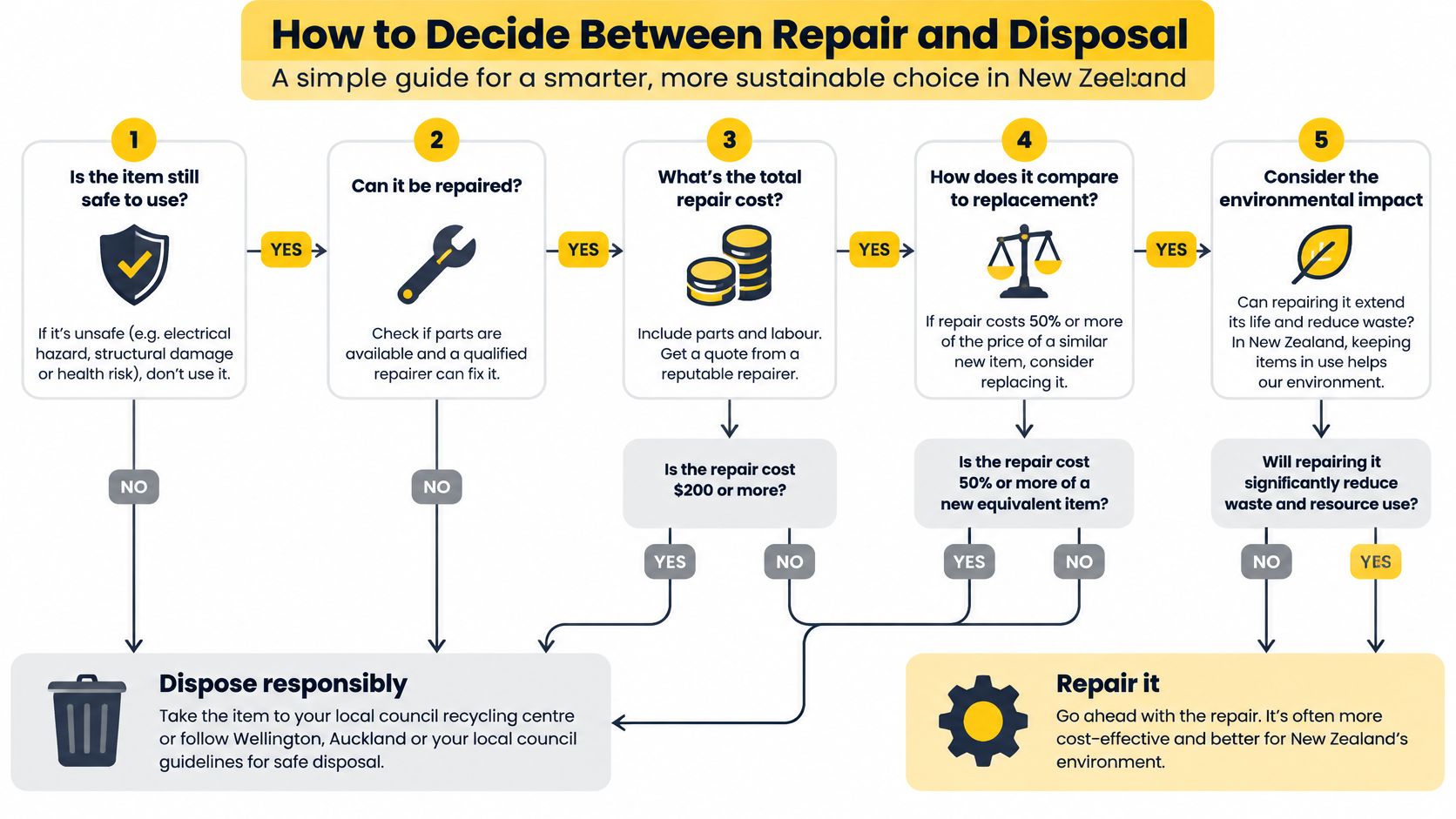
Six numbers settle this, and all of them fit on one page.
- Price each defect group separately. A written quote per group shows you which items drive the total. Verbal estimates grow once the car is on the hoist and the corroded mount turns out to run two panels deep.
- Add towing. One trip to the repairer, plus another if the car has to move again for the recheck.
- Add storage. Every day the car sits unusable costs a yard fee or the use of a vehicle you're still insuring and registering.
- Estimate the post-repair value. Check what comparable cars sell for locally, not what you paid. An online car valuation gives you a starting point before you commit.
- Get a cash disposal quote. Ask what the car is worth as it stands, including parts value in a gearbox, diff, tray or a good set of tyres.
- Compare, then decide. Repair when the work sits well below post-repair value with nothing structural or safety-critical in the list. Dispose when corrosion, driveline damage or several unrelated faults push the total past the car's fixed value.
Where the line falls is easier to see with real numbers. A $1,800 repair on a car worth $4,000 once fixed is usually sensible, because you finish with a vehicle worth more than the invoice. A $3,500 repair on a car worth $2,500 once fixed is not, no matter how attached you are to it.
Here's the order to work through before you spend anything.
| Cost line | What to record |
|---|---|
| Repair quote for all listed faults | Written quote for each defect group |
| Towing to repairer | Distance and tow rate |
| Storage while waiting | Number of days and daily fee |
| Estimated post-repair value | Comparable sales in your local market |
| Cash disposal quote | Quote for the car as it stands, with parts value |
Fill the worksheet in before you book a single repair. Owners who price the whole pathway first are the ones who avoid a second round of quotes after the first repair reveals more rust.
Work through the table, then make the call inside the recheck window rather than letting the car sit while the fee-free recheck expires.
How to Sell or Remove a Failed WOF Vehicle
Disclosure comes before anything else. Hand the buyer a copy of the failure sheet so the listed faults are on the record in writing, and keep the original.
Match the registered owner to the seller. Finance, an active security interest or a stolen-vehicle report means we won't purchase the car, and a private buyer shouldn't either. Sort that out before any money moves.
Photograph the plate, VIN and odometer. You want your own record of what left your possession and when.
Strip your belongings. Remove tools, child seats, toll tags and anything holding personal data.
Book the right transport. If the car doesn't roll, a general-purpose trailer isn't the answer. Match the tow to the weight and condition of the vehicle.
Notify NZTA of the ownership change and keep the receipt. That step is what ends your liability for the vehicle.
No WOF or registration is needed to sell a vehicle to us, which is exactly why a cash removal suits cars that can't be sold privately. A broken car collection handles non-running and deregistered vehicles without a current WOF.
Only sell a vehicle that's yours to sell. Providing false ownership information can be reported to Police, and it's a poor trade for a few hundred dollars.
Keep every document from the sale in one folder: failure sheet, sale record, ownership notification, payment confirmation and photos.
Confirm Your Next Step Before Booking a Removal
You now have enough to choose. Finish the worksheet, compare the repair quote with the cash quote, and act inside the 28-day window if repair is the path.
Before you call anyone about removal, have these details ready:
- Vehicle identity. Make, model and year.
- Registration plate. The plate as it appears on the car.
- Condition. Whether it runs, rolls or is stuck where it sits.
- Location. Where it's parked and how a tow truck reaches it.
- Access. Gates, fences, soft ground or tight driveways that change the approach.
We're a licensed vehicle dismantler based in Port Whangarei, serving Northland. We remove non-running, deregistered and failed WOF vehicles, offer free towing within roughly 100 km, give a firm phone quote honoured at pickup, pay before loading and complete the NZTA ownership change on site. Same-day city pickups are available when the details are ready.
Gather the vehicle details, get your repair quote and your cash quote side by side, then choose and book within the recheck window.
When the repair bill has outrun the car's value, Car Removals Whangarei buys failed WOF vehicles across Whangarei and Northland, running or not, with no WOF or registration required to sell. We quote firmly over the phone, tow free within roughly 100 km, pay before loading and lodge the NZTA ownership change at pickup so your liability ends with the car. Visit Car Removals Whangarei with your plate and location and get a figure today.
- failed WOF
- WOF repairs
- WOF recheck
- sell failed car NZ
- cash for cars