· Car Removals Whangarei
Can You Get a WOF Without a Rego? NZ Rules Explained

A WOF can be issued without current rego when the vehicle is still registered and its licence has been expired for less than 12 months. A vehicle whose registration was cancelled or whose licence has lapsed for more than 12 months needs entry or re-entry inspection first.
But does an expired label on the windscreen tell you which situation you're in? Not necessarily. The useful starting point is the vehicle's registration status, followed by its licence expiry date and physical condition.
For Whangarei and Northland owners, there's another practical question: how will the car reach the right inspection site legally? A stored hatchback, an immobile farm ute and a recently imported vehicle can need very different arrangements.
Table of Contents
- When a WOF Is Possible Without Current Rego
- Registration, Licence and WOF Explained Simply
- Moving an Unregistered Vehicle to Inspection Legally
- How to Book a WOF for a Lapsed Vehicle
- Three Owner Scenarios and Their Next Steps
- Selling, Insurance and Scrapping Without Papers
When a WOF Is Possible Without Current Rego
You can get a normal WOF without a current vehicle licence only if the vehicle remains registered and is eligible for that inspection. An expired rego label alone doesn't establish whether an inspector can issue a warrant.
The NZTA inspection outcome guide distinguishes a licence expired for less than 12 months from a vehicle that is no longer currently registered, including cancelled registration or a licence expired for more than 12 months. In the latter situation, the inspector must not issue an ordinary WOF and must refer the vehicle for entry or re-entry inspection.
WOF eligibility by vehicle status
| Vehicle status | Normal WOF issued? | What to do first | Driven to inspection? |
|---|---|---|---|
| Still registered, licence expired under 12 months | Yes, through a normal inspection | Pass the WOF, then renew the licence | Only a direct trip to inspection, and only if safe |
| Licence lapsed over 12 months or registration cancelled | No | Entry or re-entry inspection and certification | No; arrange a tow or trailer |
| Never registered in New Zealand, such as a new import | No ordinary in-service WOF | Entry inspection, then registration | No; arrange a tow or trailer |
| Non-running, structurally unsafe or deregistered | No while unsafe; a deregistered vehicle needs re-entry completed | Confirm the inspection or re-entry pathway, or consider sale or scrapping | No; tow or trailer only |
The first row describes a licensing problem rather than a missing registration record. The owner can arrange the appropriate safety inspection, address any faults and then complete licensing after a pass.
The next rows involve a different starting point. Entry or re-entry can involve identity, ownership, structural condition and safety certification, rather than just the checks associated with an ordinary WOF.
A non-running car needs a little more care when interpreting the table. Not running doesn't, by itself, mean deregistered. A registered car with a mechanical fault may need repairs and a normal inspection, while a deregistered car needs its certification pathway confirmed as well.
Before booking: Find the registration status and licence expiry date on the vehicle record, then match the vehicle to the appropriate inspection route.
Registration, Licence and WOF Explained Simply
Think of registration, licensing and WOF as separate keys associated with a house: its identity record, permission to occupy it and a safety inspection. They're connected, but one doesn't replace the others.
Registration establishes the vehicle's record on the Motor Vehicle Register. It identifies the vehicle within the registered fleet, although that registration can subsequently be cancelled.
Licensing is the ongoing permission associated with using the vehicle on public roads. This is what most owners mean when they say they need to renew their rego.
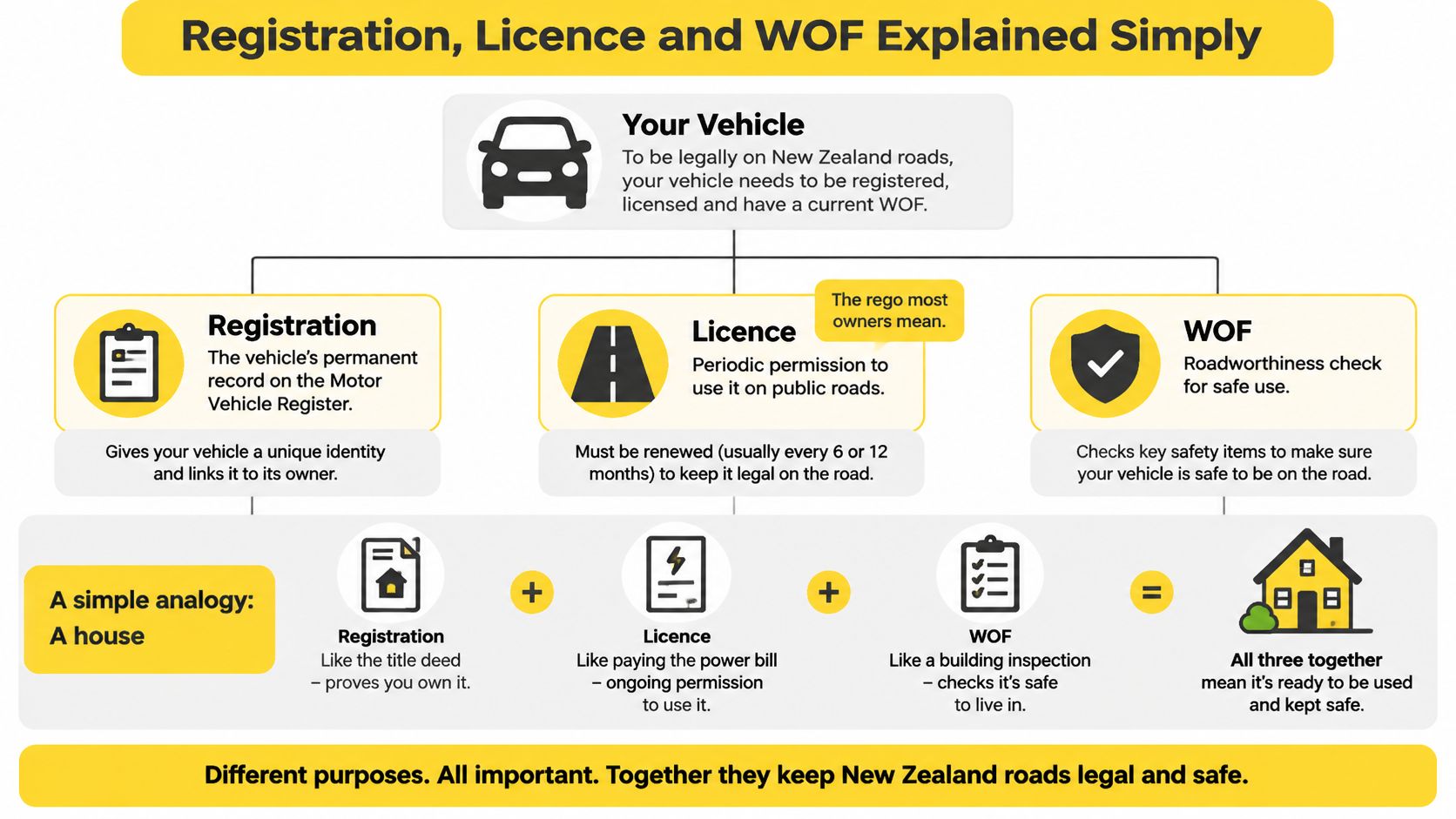
A Warrant of Fitness records that the vehicle met the applicable safety requirements when inspected. It isn't a promise that nothing will wear out or fail before the next inspection, so maintenance still matters.
NZTA's Warrant of Fitness guidance explains that a current WOF or Certificate of Fitness is normally required before licensing, and gives the following validity periods based on vehicle age and registration history.
WOF validity periods after a pass
| Vehicle type | WOF period after a pass |
|---|---|
| Light vehicle first registered on or after 1 January 2000 | 12 months |
| Light vehicle first registered before 1 January 2000 | Six months |
| Brand-new vehicle never previously registered | Three years |
| Vehicle inspected within two years of first registration | Warrant may run through the vehicle's third anniversary |
An expired licence and cancelled registration therefore require different responses. One may be resolved through inspection and renewal; the other may require certification before the vehicle returns to service.
A current WOF does not make an unregistered car legal to drive.
Buying or selling introduces another administrative task. Our guide to NZTA registration and change of ownership explains the ownership-notification side, which shouldn't be confused with renewing a licence.
Before making arrangements, answer these questions:
- Registration: Is the vehicle still registered?
- Licensing: When did its licence expire?
- Inspection: What WOF status appears on the vehicle record?
Moving an Unregistered Vehicle to Inspection Legally
A vehicle without current licensing can be driven on public roads only under narrow conditions. An inspection booking is not blanket permission to drive, particularly when registration has been cancelled or the vehicle's safety is uncertain.
The NZTA licensing-exemption factsheet describes limited purpose-based exceptions involving inspection, servicing or repairs. The journey must qualify for the exception, and the vehicle must still be safe to use.
Lawful ways to move an unregistered vehicle to inspection
| Option | When it is allowed | Conditions | Risk level |
|---|---|---|---|
| Drive directly to a WOF inspection | Licence lapsed but vehicle still registered, under the applicable exception | Direct trip only, for inspection, servicing or repairs; vehicle must be safe | Low to medium, depending on condition |
| Drive to repairs after a failed WOF | Vehicle has failed inspection and remains safe to operate | Only to repairs or re-inspection under the applicable exception | Medium |
| Tow truck | Any vehicle, including non-runners | Book with a tow operator and describe its condition and access | Lowest for damaged or unsafe vehicles |
| Trailer | A vehicle that cannot be driven safely | Suitable towing vehicle and roadworthy trailer, with the load properly secured | Low when correctly arranged |
These risk descriptions are practical comparisons, not legal guarantees. A tow truck avoids asking a damaged car to perform safely under its own power, while a trailer still requires suitable equipment and careful loading.
A direct compliance trip doesn't include shopping, visiting someone or testing the car around town. If the car fails inspection, the failure report also doesn't authorise unrestricted driving while you decide what to fix.
Check condition before considering a drive
Assess brakes, steering, tyres and lights, then look for structural rust and accident damage. A flat tyre is visible; deteriorated brakes or corrosion underneath a stored vehicle may not be.
Don't use a public-road drive to find out whether the brakes work. If you can't establish that the vehicle is safe, have a mechanic assess it where it stands or arrange transport.
For rural Northland owners, consider the entire journey, including hills, narrow access and the possibility that the vehicle won't pass. Our Whangarei tow-truck guide helps you prepare collection details and access information.
Confirm any proposed permit or trade-plate arrangement with NZTA and the inspecting organisation before relying on it. Those arrangements have their own conditions and aren't substitutes for checking the vehicle's status.
Practical rule: If you're unsure whether the car is safe or the journey is lawful, tow it.
How to Book a WOF for a Lapsed Vehicle
Book the inspection the vehicle needs, not the nearest available WOF appointment. Tell the inspecting organisation about the registration record and the car's condition before arranging transport.
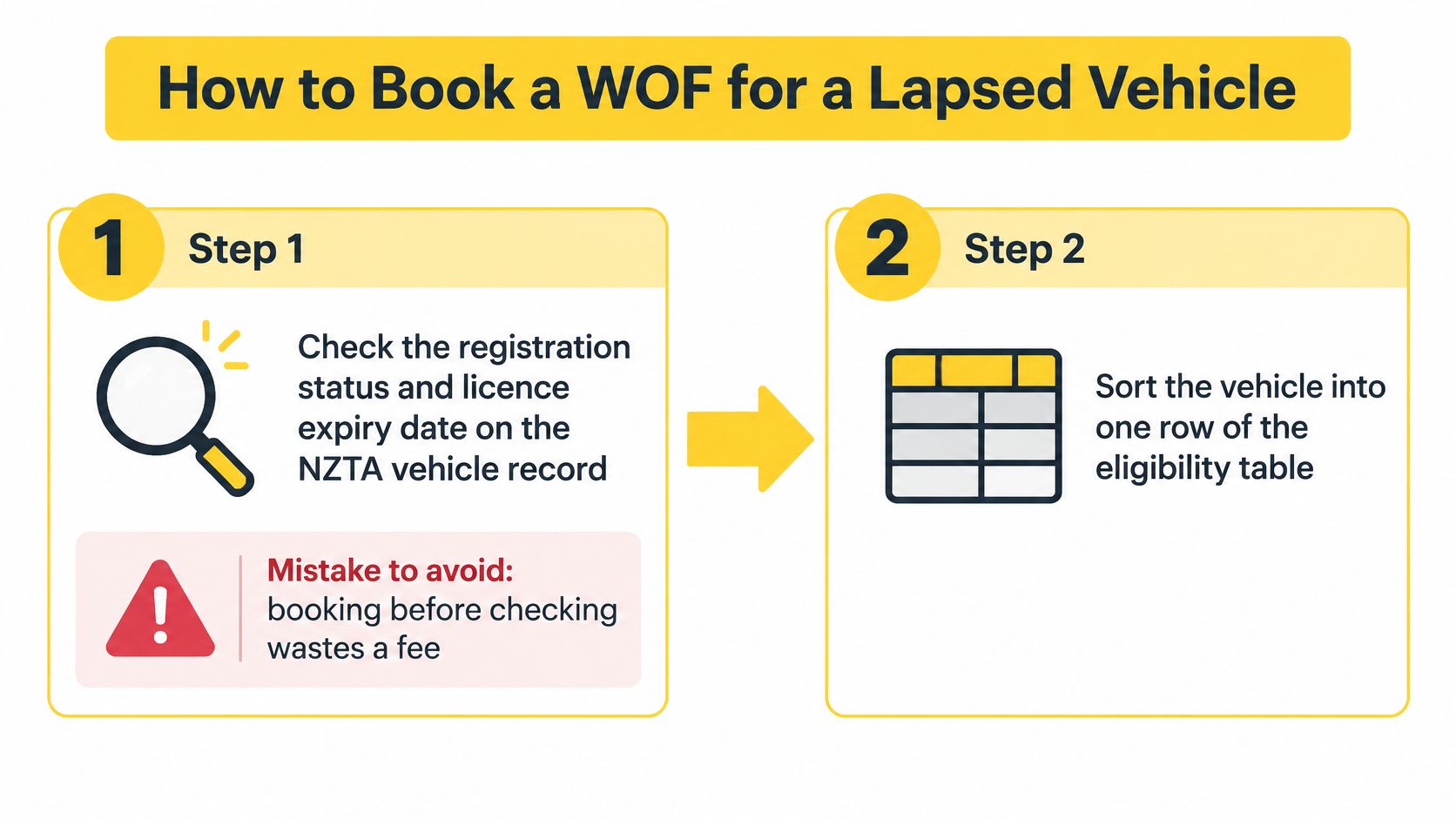
Prepare the record and inspection booking
Check the NZTA vehicle record. Establish the registration status, licence expiry and recorded WOF status rather than relying on the windscreen labels. Booking before checking can mean paying for an appointment that doesn't resolve the actual problem.
Choose the correct pathway. Match the status to a normal WOF, entry certification or re-entry certification, and decide whether returning the car to service is your intention. Don't assume an ordinary inspection can restore cancelled registration.
Check identification and plates. NZTA's rules for unclassified vehicles require a registration plate to be attached for inspection and distinguish deregistered vehicles that need entry certification before re-entering service. Don't remove an existing plate before asking the inspector what identification is required for your particular vehicle.
Contact an NZTA-authorised inspecting organisation. Give the registration details and explain whether the vehicle has been stored, damaged or deregistered. Ask explicitly whether you need a standard WOF appointment or a certification booking, rather than assuming every inspection site provides both.
Arrange transport and finish the process
Plan lawful delivery and collection. Use a tow truck or suitable trailer if the car is unsafe, immobile or unsuitable for a permitted road journey. Remember to plan how it will leave the inspection site if it fails, not just how it will arrive.
Gather documents and vehicle details. Have photo ID, available ownership evidence, the registration number, make, model and year ready, then confirm the inspector's document requirements. For transport, explain whether it runs, rolls or is stuck, where it's parked and whether a tow truck can reach it.
Complete licensing after the inspection pathway. Following a standard WOF pass, renew the licence before ordinary road use; a certification case may also need registration completed. Keep the inspection result and confirmation of licensing so you're not relying on memory or an appointment receipt.
If you decide against repairs, those same vehicle details help us assess disposal. We ask for the make, model, year, rego and rough condition, and provide a firm cash figure in about two minutes on the phone.
Our removal is free, with no call-out fee, tow charge or deduction from the quote when the vehicle arrives. Tell us about difficult access or specialist recovery needs before booking so any exceptional arrangements can be identified beforehand.
Three Owner Scenarios and Their Next Steps
These hypothetical examples show why the answer to “Can you get a WOF without a rego?” starts with status rather than appearance. A tidy-looking vehicle can need certification, while a dusty stored car may still qualify for an ordinary inspection.
A Whangarei hatchback parked for eight months
Say the licence expired when the hatchback was parked, but its registration remains in place. The owner checks the record, books a standard WOF and assesses whether a direct inspection trip is safe and permitted, arranging a tow if it isn't. After a pass, the owner renews the licence before returning to everyday driving. First action: confirm the registration record, rather than assuming the time parked tells the whole story.
A Northland farm ute deregistered for two years
Suppose a farmer has a non-running ute with cancelled registration. The owner needs to discuss entry or re-entry certification, structural condition and repairs with the appropriate inspecting organisation, rather than booking an ordinary WOF. Transport is by tow truck or suitable trailer, and comparing restoration with disposal may be sensible before spending on repairs. First action: request confirmation of the certification pathway.
A used import never registered in New Zealand
A used import hasn't yet joined the New Zealand registered fleet, even if it has overseas paperwork. Its owner follows the entry-inspection and registration pathway, gathers identification and ownership documents, and confirms the required evidence with the certifier. First action: contact an entry-certification organisation before arranging delivery.
Match the vehicle's status before spending money on an inspection.
NZTA's vehicle-licensing guidance makes clear that ordinary public-road use requires registration and licensing unless a specific exemption applies. A successful safety inspection is therefore a step towards compliance, not permission to skip the remaining administrative steps.
Selling, Insurance and Scrapping Without Papers
You don't need a WOF to sell a vehicle to us for scrap. If repairs or re-entry aren't worthwhile, you don't have to obtain a warrant solely to complete that sale.
At Car Removals Whangarei, no WOF or registration is needed for a sale to us. That includes trucks with an expired COF, a failed inspection or a long deregistration, but the seller must still establish that they're entitled to sell.
Documents and insurance checks before pickup
- Photo identification: Have your photo ID ready so we can confirm who is authorising the sale.
- Ownership evidence: Prepare registration papers or the rego record in your name. If there are no plates or papers, we accept scrap vehicles when the seller shows ID and confirms their entitlement to sell.
- Someone else's vehicle: Being on your property isn't enough on its own. Abandoned vehicles require the registered owner's authorisation or evidence that the correct disposal process has been followed.
- Personal items and retained parts: Remove belongings, aftermarket accessories you want to keep and any plates you intend to retain before collection.
- Insurance for driving: Ask your insurer how the policy treats expired licensing, cancelled registration and the proposed journey. Don't assume an inspection booking guarantees cover.
- Insurance while stored: Confirm whether cover continues for risks such as theft, fire or accidental damage while the vehicle is off the road.
Missing paperwork and missing entitlement are different problems. Explain any document gaps before pickup so we can identify what's needed, rather than discovering an ownership issue when the tow truck arrives.
Our guide to disposing of a vehicle explains the practical preparation for handing over an unwanted car. Keep a record of the agreed sale and collection details for your own files.
Record the sale with NZTA, and retain confirmation that the ownership notification has been completed.
If your car has no current WOF or rego and you've decided not to return it to the road, Car Removals Whangarei can assess it for purchase and arrange removal. Visit Car Removals Whangarei with the make, model, year, registration number and condition ready, including whether it runs, rolls or is stuck.
- WOF without rego
- NZ WOF rules
- unregistered vehicle NZ
- WOF inspection NZ
- rego lapsed NZ