· Car Removals Whangarei
Tow Truck Whangarei Services and Free Towing Explained
The car won't start in your Whangārei driveway. Perhaps it failed its WOF, has been sitting rusted beside a farm shed, or was damaged in a crash and can't roll under its own power. You need more than a truck to arrive. You need the vehicle assessed, loaded without creating another hazard, taken to the right destination, and handed over with the paperwork that helps end your responsibility.
That's the practical role of a tow truck Whangārei service. Emergency recovery gets a vehicle away from a dangerous roadside position. Planned removal clears an unwanted car, van, 4WD, truck, or machine from private property. The two jobs may use different equipment, timing, and documentation, even though both involve moving a vehicle.
Whangārei also sits within an active Northland transport network. The region recorded 27 road deaths in 2024, down from 33 in 2023, and 1,653 transport-related hospitalisations in 2023, according to Northland road safety statistics. Those incidents create an ongoing need for recovery, towing, salvage, and lawful vehicle removal across the city and wider district.
This guide follows the complete journey, from the first phone call to the final handover. It explains coverage, vehicle types, towing compliance, free-towing conditions, preparation, vehicle value, and the difference between a tow pickup and an NZTA notification.
Table of Contents
- Introduction to Tow Truck Help in Whangārei
- What a Tow Truck Service Does and How It Works
- Coverage Area and Response Times Around Whangārei
- Vehicle Types Handled From Cars to Machinery
- Free Towing Terms and How Pricing Is Calculated
- How to Prepare Your Vehicle for Fast Pickup
- Choosing the Right Tow Truck Option in Whangārei
Introduction to Tow Truck Help in Whangārei
A car can fail in a driveway, stop on a rural road, or become immovable after a crash. Each situation combines a vehicle problem with a site problem. The car may block access, sit in a live traffic area, or occupy land that a landlord, farmer, or business needs to use.
The collection plan depends on details that are easy to overlook. A vehicle that rolls and steers may load onto a standard recovery platform. A non-runner with locked wheels might require winching, skates, or lifting equipment. A rusted shell in a paddock may need a ground and access check before the operator can confirm how it will be removed.
Practical rule: Describe the vehicle accurately before dispatch. “It doesn't run” does not explain whether the wheels are locked, the keys are missing, or the truck can reach the vehicle.
Emergency recovery puts safety and access first. A damaged vehicle may be moved from a traffic lane or roadside shoulder to a secure location, with a second transport step arranged if the final destination needs different equipment. Planned removal allows more preparation around property access, loading conditions, payment, and paperwork.
The journey works like a chain. The first link is accurate information, followed by a suitable loading method, an agreed destination, and a recorded handover. A weak link can delay collection or create uncertainty about who remains responsible for the vehicle.
Northland's freight routes also make local operating knowledge useful. Regional planning identifies state highways as areas where higher-severity crashes are concentrated, while winter injury crashes increase by about 36% on state highways and 41% on local roads, as reported in Northland's regional transportation planning material. Someone stopped on a freight route needs clear instructions about safe positioning and access, not only an estimated arrival time.
Removal does not automatically end the registered person's responsibility. The handover should record who authorised the move, where the vehicle went, and what notification or registration steps are required with NZTA. That record helps separate the physical movement of the vehicle from the legal and administrative end of the job.
What a Tow Truck Service Does and How It Works
A useful way to understand towing is to think of the truck as a mobile workshop and loading platform. It doesn't repair every fault, but it arrives with the equipment and judgement needed to stabilise the situation, move the vehicle, and transport it without relying on the vehicle's own engine.
The recovery sequence
The operator starts by asking practical questions. Where is the vehicle? Is it on a public road, driveway, paddock, car park, or worksite? Does it start, roll, steer, and brake? Are the keys available? Is there accident damage, flood exposure, fire damage, or a risk from a hybrid or EV high-voltage system?
Those answers determine the loading approach. A running car may be driven onto a platform. A non-running car may be winched. A vehicle with locked wheels or severe impact damage may require additional securing equipment, a different truck, or a site assessment before loading.
The destination also changes the job. Roadside recovery might end at a repairer, insurer-approved storage yard, or safe private address. Property removal might end at a dismantling yard, salvage facility, or another agreed location. An abandoned vehicle on private land requires the owner's authority and a clear record of who authorised the removal.
For a plain-language explanation of the pickup stages, see how the removal process works.
Why loading compliance matters
A vehicle can be physically attached and still be an unsuitable tow. Waka Kotahi requires every light vehicle and trailer combination to be capable of stopping within 7 metres from 30 km/h, and recommends that an unbraked trailer not exceed three-quarters of the towing vehicle's unladen weight, with excellent brakes and tyres. Those requirements are explained in the Waka Kotahi safe loading and towing guide.
For heavier work, the operator must consider gross vehicle mass, gross combination mass, brake capacity, drawbar rating, axle loading, and the manufacturer's towing limit. The truck's winch rating and ramps matter too. A careful operator is matching the whole setup, not asking whether the vehicle will fit on the deck.
That's why a proper tow service begins with questions. Good information prevents the wrong truck from being dispatched and reduces delays when the vehicle is already difficult to access.
Coverage Area and Response Times Around Whangārei
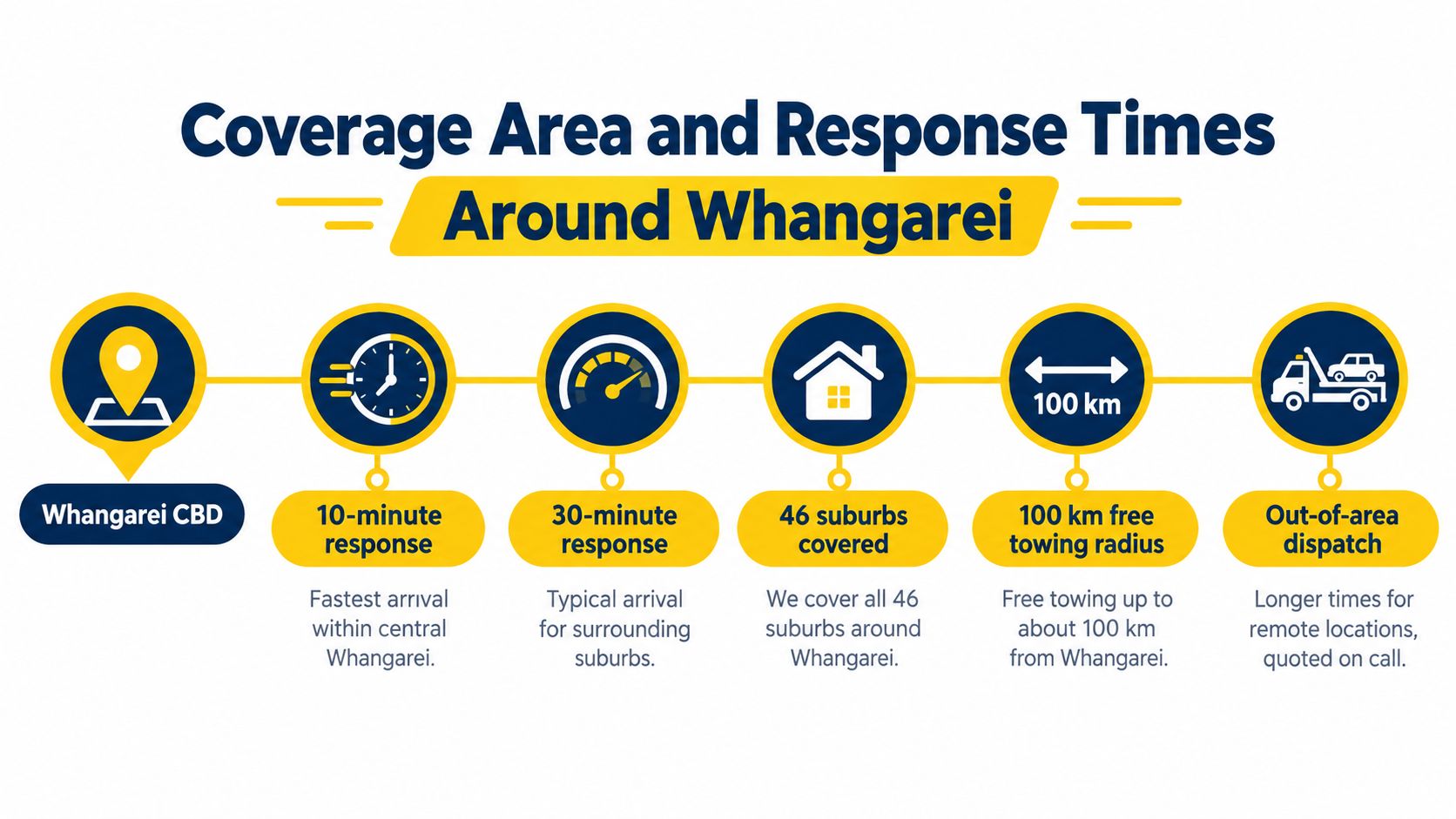
A car outside Whangārei Central may be collected during a city run, while a vehicle on a farm track needs a different plan. Route length, road surface, access, equipment, and the vehicle's condition all affect the arrival window. Check coverage for Whangārei Central to confirm timing for your suburb.
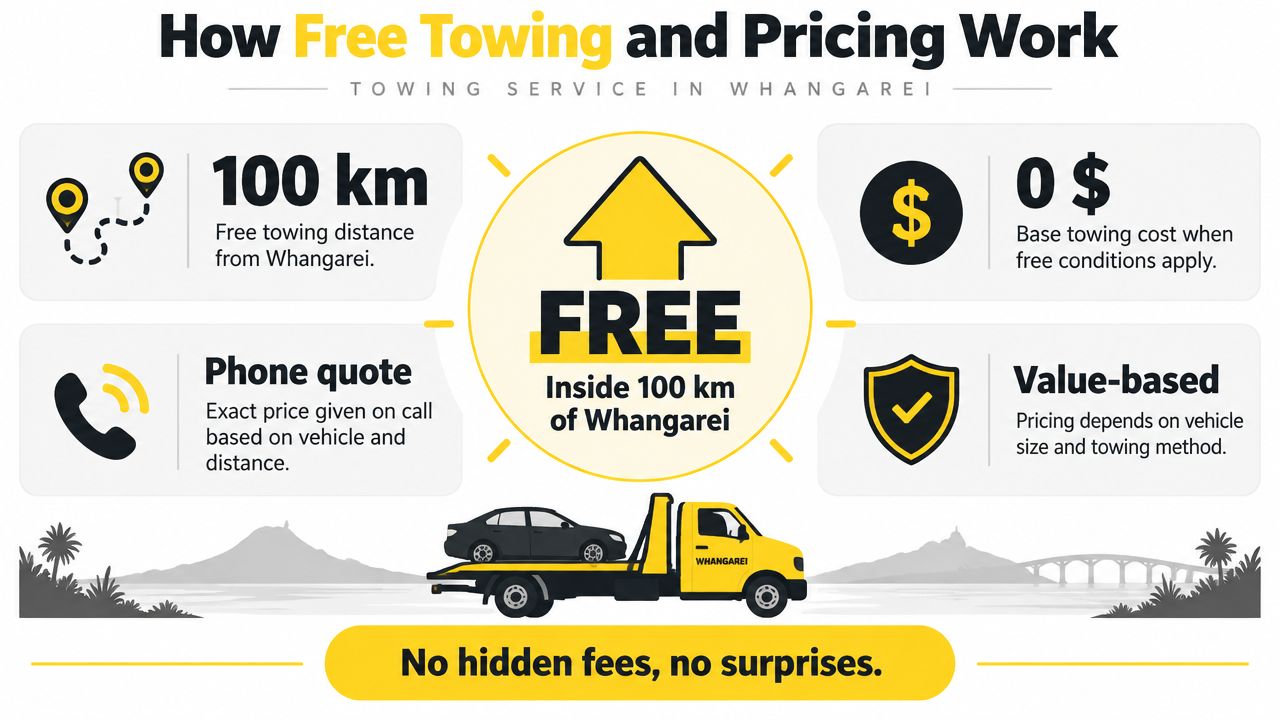
Car Removals Whangārei describes service across 46 suburbs and towns around Whangārei, with a yard on Kioreroa Road. Its service information also describes free towing within roughly 100 km of Whangārei. City collections are generally handled the same day, while rural Northland pickups may be arranged as planned runs. Confirm the address and timing by phone, because a short urban recovery and a remote removal rarely fit the same schedule.
City, suburban, and rural jobs
A central pickup often has firm road access and room for loading. The operator still needs the exact street, vehicle position, and information about blocked traffic or other vehicles. A suburban driveway can slow the job if the truck cannot turn, a gate restricts access, or low branches interfere with the platform.
Rural collections add distance and site conditions. Gravel, soft ground, steep driveways, narrow farm tracks, locked gates, and the distance from the main road can change the loading method. Free towing within the service area does not remove the need to check access, because difficult ground may require different equipment or a safer collection point.
Before you call: Provide the nearest town, road name, access instructions, vehicle position, and whether the vehicle rolls. “Near Whangārei” is less useful than a clear description of the site.
Traffic can change the practical arrival time. Busy freight routes may require the operator to choose a safer roadside position, account for passing vehicles, or approach from another direction. A recovery beside an active road is managed like loading beside a moving conveyor. The operator needs enough space and visibility before the truck can work.
Winter weather can affect routes and incident demand. Regional planning information records higher injury-crash activity during winter on state highways and local roads. This does not delay every collection, but it makes a realistic arrival window more useful than a fixed promise for every suburb and road condition. Clear location details also help the operator decide whether the vehicle can be collected directly or needs a safer handover point.
Vehicle Types Handled From Cars to Machinery
A tow truck operator can't plan a sedan, a Hilux, and a tractor in the same way. The vehicle's weight, dimensions, ground clearance, wheel condition, steering, braking, and access route determine whether the job needs a platform truck, winch, lifting equipment, or a heavier recovery setup.
The table below shows the main differences a caller should explain.
Vehicle Types and Recovery Approach in Whangārei
| Vehicle Category | Typical Condition Accepted | Recovery Consideration |
|---|---|---|
| Sedans, hatchbacks, wagons, and people movers | Non-running, failed WOF, accident-damaged, deregistered, or unwanted vehicles | Confirm whether it rolls, steers, and has keys. Locked wheels or impact damage can require controlled winching. |
| 4WDs and utes, such as Hilux, Ranger, Navara, and similar vehicles | Blown motors, rusted chassis, collision damage, or vehicles that have been sitting | Greater mass and ground clearance affect loading. The operator needs the model, position, and access conditions. |
| Vans and light commercial vehicles | Non-runners, damaged work vehicles, stripped vehicles, or end-of-life vans | Height, wheelbase, payload, and tight property access can affect platform choice and securing points. |
| Light trucks and buses | Accident-damaged, mechanically failed, or unwanted commercial vehicles | Axle loads, gross combination limits, dimensions, and braking requirements need checking before dispatch. |
| Tractors, diggers, implements, and small plant | Rusted, seized, non-running, or surplus machinery | On-site assessment is important. Soft ground, attachments, uneven terrain, and lifting points can change the recovery method. |
| Hybrids and EVs | Accident-damaged, written-off, non-running, or unwanted vehicles | High-voltage systems need isolation and careful handling. The vehicle's battery condition should be disclosed before loading. |
A vehicle's appearance can mislead. A small-looking machine may concentrate its weight over a few axles, while a stripped car may be lighter but harder to move because it no longer rolls. A truck, van, or machinery recovery plan should be based on measured load limits rather than visual estimates. Waka Kotahi's vehicle dimension and mass guidance explains that a light motor vehicle towing a heavy trailer must remain within the lesser of 1.5 times the towing vehicle's gross mass or the manufacturer's maximum towed mass, while the relevant GVM, GCM, BCM, and drawbar ratings must not be exceeded.
What to tell the operator
Use plain descriptions:
- Running or not: Say whether the engine starts.
- Rolling or not: Mention flat tyres, locked wheels, missing wheels, or a seized drivetrain.
- Accessible or not: Explain gates, slopes, narrow tracks, soft ground, and overhead obstacles.
- Damaged or hazardous: Identify flood, fire, chemical, battery, or high-voltage concerns.
- Loaded or stripped: State whether parts, attachments, or cargo remain on the vehicle.
That information lets the operator select suitable gear and identify a compliant loading plan before arrival.
Free Towing Terms and How Pricing Is Calculated
“Free towing” can be confusing because it describes the transport part of an agreed vehicle removal service, not an unconditional promise to move every vehicle anywhere without assessment. The usual question is whether the vehicle has enough value to cover the pickup and whether the location falls within the service area.
For Car Removals Whangārei, the stated service area includes free towing within roughly 100 km of Whangārei. The exact arrangement should be confirmed before dispatch, especially for remote properties, difficult access, heavy machinery, or a vehicle requiring specialised recovery.
What creates the vehicle's value
A damaged or unwanted vehicle can still contain several value streams. A complete car may have reusable panels, wheels, lights, engines, transmissions, interior components, catalytic equipment, or electronic modules. A stripped or rusted shell has a different basis, usually related to kerb weight and recoverable metal.
The publisher's service information states that cash offers for cars can range from $200 to $15,000, paid before loading. Because this is a quantitative claim, the range should be treated as a stated service range, not a guaranteed price. The quote depends on the exact vehicle, condition, completeness, location, and current demand for parts and steel.
Hybrids and EVs require another layer of assessment. The traction battery may carry value, but it also requires high-voltage isolation and controlled handling. A vehicle with flood or crash damage must be described accurately so the operator can account for safety and recycling requirements.
A firm quote should answer two questions: what will be paid for the vehicle, and whether any transport or recovery charge applies to the agreed pickup.
New Zealand's end-of-life vehicle stream includes easy-to-recycle and difficult-to-treat materials. About 75% of vehicle weight consists of materials such as steel and iron that are relatively easy to recycle, while the remaining 25% includes fluids, plastics, tyres, glass, batteries, and airbags requiring separate treatment, as discussed in Massey University research on end-of-life vehicles. A responsible removal process therefore involves more than putting a shell in a scrap pile. Fluids, batteries, tyres, airbags, and other components need appropriate handling.
For more detail on the distinction between vehicle removal and wrecking, see car wreckers that pick up vehicles. Ask for the quote before loading, confirm the payment method, and check whether the quoted amount is subject to deductions. A clear agreement prevents the common misunderstanding that the price changes after the vehicle is already on the truck.
How to Prepare Your Vehicle for Fast Pickup
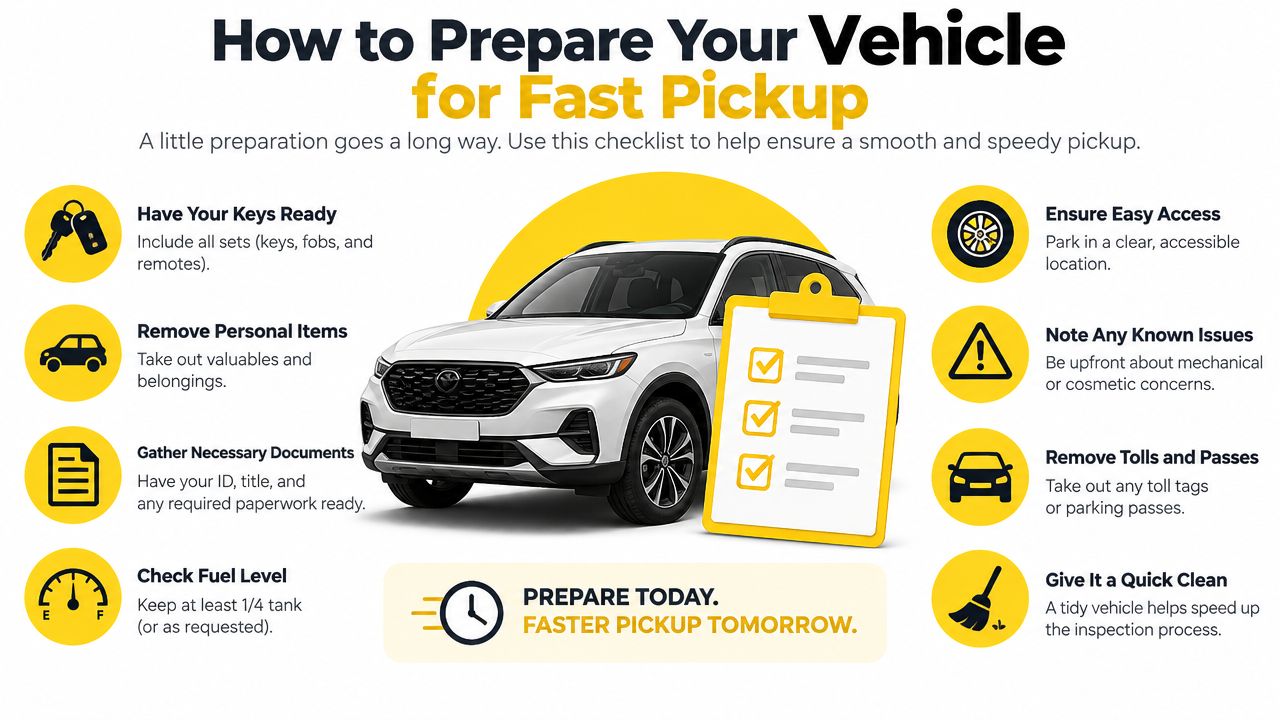
Preparation doesn't mean repairing the vehicle. It means removing uncertainty before the truck arrives. A pickup runs smoothly when the operator knows who authorised the removal, where the vehicle sits, and what condition it's in.
Have the essentials ready
Start with authorisation and identification. If you're the registered person, have the relevant vehicle details available. If you're acting for a landlord, farm owner, body corporate, insurer, or business, keep written authority or supporting documentation ready.
Collect the keys if you have them, even if the vehicle doesn't run. The keys can help release steering locks, open compartments, or confirm that the operator has access to the vehicle. If the keys are missing, say so before dispatch rather than waiting until loading begins.
Remove personal belongings, tools, documents, toll equipment, garage remotes, and anything you want to keep. Once the vehicle leaves, retrieving small items can be difficult or impossible.
Make the site workable
Clear the route to the vehicle. Open gates, move other cars, secure animals, and remove loose objects around the loading area. Tell the operator about slopes, soft ground, low branches, narrow entrances, and any part of the vehicle that extends beyond its normal dimensions.
For an accident-damaged or flood-damaged vehicle, disclose the damage. A vehicle with deployed airbags, leaking fluids, damaged battery components, or unstable bodywork needs a different risk assessment from an ordinary non-runner.
Keep the handover evidence
Before loading, confirm the agreed vehicle description, payment, pickup location, and destination or removal outcome. If payment is made by instant bank transfer or cash, retain the receipt, transaction record, or written confirmation.
A tow truck pickup also isn't the same as an ownership change. NZTA says it doesn't record vehicle ownership. Instead, the buyer and seller must change the registered person when a vehicle changes hands, and both parties must notify NZTA straight away through the NZTA vehicle ownership guidance. NZTA warns that a seller who doesn't notify the sale may remain exposed to the buyer's fees or fines, and may remain responsible for overdue registration fees up to the date of notification.
Abandoned vehicles need extra care. Councils use formal evidence and notification pathways for abandoned vehicles, as shown in Auckland Transport's abandoned-vehicle process. On private property, the person arranging removal should be able to show lawful authority, ownership information where available, and a record of the instruction.
Choosing the Right Tow Truck Option in Whangārei
The right provider is the one that matches the vehicle and the handover, not the one that says it can send a truck. Before booking, confirm the collection address, vehicle type, running and rolling condition, access restrictions, destination, quote, payment timing, and paperwork.
For an emergency roadside recovery, ask how the vehicle will be secured and where it will be taken. For an unwanted or non-running vehicle, ask whether the quote includes towing, whether the price is firm at pickup, and what happens to the vehicle after removal. A local operator with its own fleet can coordinate timing directly instead of relying on several third parties.
Compliance should be part of the conversation. Light vehicle and trailer combinations must meet stopping-distance and weight requirements, while heavier recovery work must respect mass, axle, braking, and drawbar limits. If the operator asks for vehicle measurements, photos, or access details, that's usually a sign the job is being planned rather than guessed.
The paperwork deserves equal attention. Ask who will notify NZTA, what evidence you'll receive, and when your responsibility as the seller or registered person ends. If the vehicle is abandoned, confirm that the property owner or manager has authorised the removal.
Car Removals Whangārei offers vehicle purchasing, free towing within roughly 100 km of Whangārei, same-day city collection when scheduled, and removal of cars, vans, 4WDs, trucks, and machinery. Its stated process includes payment before loading and NZTA notification at pickup. Treat those as points to confirm against your specific vehicle and location when you call.
If your unwanted, damaged, non-running, or farm vehicle is ready to go, contact Car Removals Whangārei with its location, condition, access details, and whether it rolls. Visit Car Removals Whangarei to request a firm quote and arrange a compliant pickup across Whangārei and Northland.
- tow truck whangarei
- car removals whangarei
- free towing whangarei
- vehicle recovery northland
- scrap car removal