· Car Removals Whangarei
Broken Car Collection: From Booking to Ownership Transfer
You've got a dead car in the driveway in Whangarei, rego expired, a flat tyre going soft, and a repair quote that costs more than the car is worth. You don't want another week of looking at it. You want it gone, paid for, and off your name.
That's what a good broken car collection does in one visit. Firm quote first. Site ready. Payment before loading. NZTA disposal notice lodged on the day so responsibility passes cleanly to the buyer.
The work is simple when you split it properly. Some steps are yours. Some are the buyer's. Mixing them up is where delays and price cuts happen.
Table of Contents
- Details to Have Ready Before You Book
- What Drives the Quote and What to Ask
- How to Book Your Pickup and Confirm the Time
- How to Prepare the Site for the Tow Truck
- How to Complete the Ownership Paperwork
- Book Your Collection and Close the Ownership Loop
Details to Have Ready Before You Book
The truck is ready to leave, but the car is locked in gear, a tyre is flat, and the seller forgot to mention a high-voltage battery. Those details can change the equipment needed and hold up pickup. Have the basics ready before you ask for a firm quote, then confirm what you need to prepare and what the buyer will handle.
Read the number plate from the car. Check whether it rolls, steers and holds air in its tyres. Be clear about leaks, damage and battery type. Photos can help the buyer assess the vehicle, but they do not replace accurate answers.
| Detail | Why it matters | Example to check |
|---|---|---|
| Number plate | Needed for the NZTA disposal notice | Read it from the plate itself |
| Rolling or non-rolling | Helps the buyer arrange suitable loading equipment | Seized engine, flat tyres, locked steering |
| Registration and WOF status | Affects the paperwork, not whether the car can be picked up | Rego expired 18 months ago |
| Make, model and year | Helps assess parts demand and the quote | 2009 Toyota Hilux 4WD or 2008 hatchback |
| Fuel and fluid status | Leaks may need containment and recovery | Fuel smell or oil patch under the engine bay |
| Damage type | Flood or fire damage can affect handling and value | Water line on seats, smoke smell |
| Battery type | A traction battery affects handling and may change the payout | 12-volt battery or hybrid/EV traction pack |
| Owner status | Finance or a different registered name can delay or prevent the sale | Registered name differs from the seller's |
The Details That Change Handling
An expired registration or WOF does not usually stop collection, but give the buyer the correct status for the paperwork. Finance owing, or a registered owner who is not the seller, can prevent the sale from going ahead until the right person authorises it. Disclose that before agreeing to pickup.
Tell the buyer if the car has flood or fire damage. That history can affect records and how the vehicle is handled at disposal. NZTA information on water-damaged and electric vehicle records discusses water-damaged vehicles and electric vehicle records. Do not start a flood-damaged car to prove it runs. A visible water line, silt or smoke smell is useful information for the buyer.
If the vehicle is a hybrid or EV, say so and identify whether it has a traction battery. High-voltage isolation is work for the collection crew, not the seller. A sound battery pack may affect the offer; damage or contamination can affect it too.
Before calling, take photos of the plate, odometer, visible damage and battery area. Send them if requested, and describe anything the pictures cannot show, such as locked steering or a fluid leak. Then ask the buyer to confirm the quote, any site preparation you must do, and who will lodge the NZTA disposal notice after pickup.
What Drives the Quote and What to Ask
A car can look complete and still have little resale value in parts. A blown motor in a popular 4WD may be worth more than a running sedan with few parts buyers want. A firm quote reflects recoverable parts and scrap steel value, minus the cost of handling hazardous materials.
Age alone does not settle the price. Older vehicles can still have saleable components, as the Ministry of Transport scrappage trial report describes. Buyers assess engines, transmissions, catalytic converters, alternators, electronics, wheels and straight panels, then consider whether each part suits the model, can be tested and is affected by corrosion.
The usual processing order is to remove saleable and hazardous parts, drain fluids, flatten the shell, then crush and shred it, as outlined in this technical account of end-of-life vehicle processing. A stripped shell is priced differently from a complete car, so tell the buyer which parts are missing before agreeing to a figure.
| Factor | What it changes | What to ask |
|---|---|---|
| Kerb weight | Steel value and scrap price | What weight is the offer based on? |
| Recoverable parts | Engine, gearbox, wheels, electronics | Which parts are counted in the price? |
| Engine and gearbox condition | Seized or blown units lower parts value | Does the offer assume a blown motor? |
| Damage type | Flood or fire can reduce resale parts | Is the offer adjusted for water or fire damage? |
| Traction battery | Can add value or reduce it when damaged | Is battery value included or excluded? |
| Model and age | Popular 4WD and ute models draw parts demand | Is the price based on current demand for this model? |
| Access and towing | Free within about 100 km | Does access or distance change the price? |
| Payment | Cash or instant bank transfer before loading | Is payment made before the car is loaded? |
Work through the table on the phone, one row at a time. For a clearer idea of what to check, read this guide to what a car wreckers quote should include before you agree to the price.
What a Firm Quote Must Show
Get the quote in writing, even by text. It should list the vehicle details, the price in NZD, the payment method and timing, and confirm that no towing fees or deductions will be applied at pickup.
Ask: “Is this price final if the car matches my description and photos?” A higher offer that can be reduced when the driver arrives is not necessarily better. Disclose flood damage, fire damage and traction battery condition before pickup. Those details can change the figure, and leaving them until the truck is waiting at the gate can delay collection or lead to a revised offer. Make sure the written quote states what is included and when payment is due, so you know what the buyer has agreed to before the car is loaded.
How to Book Your Pickup and Confirm the Time
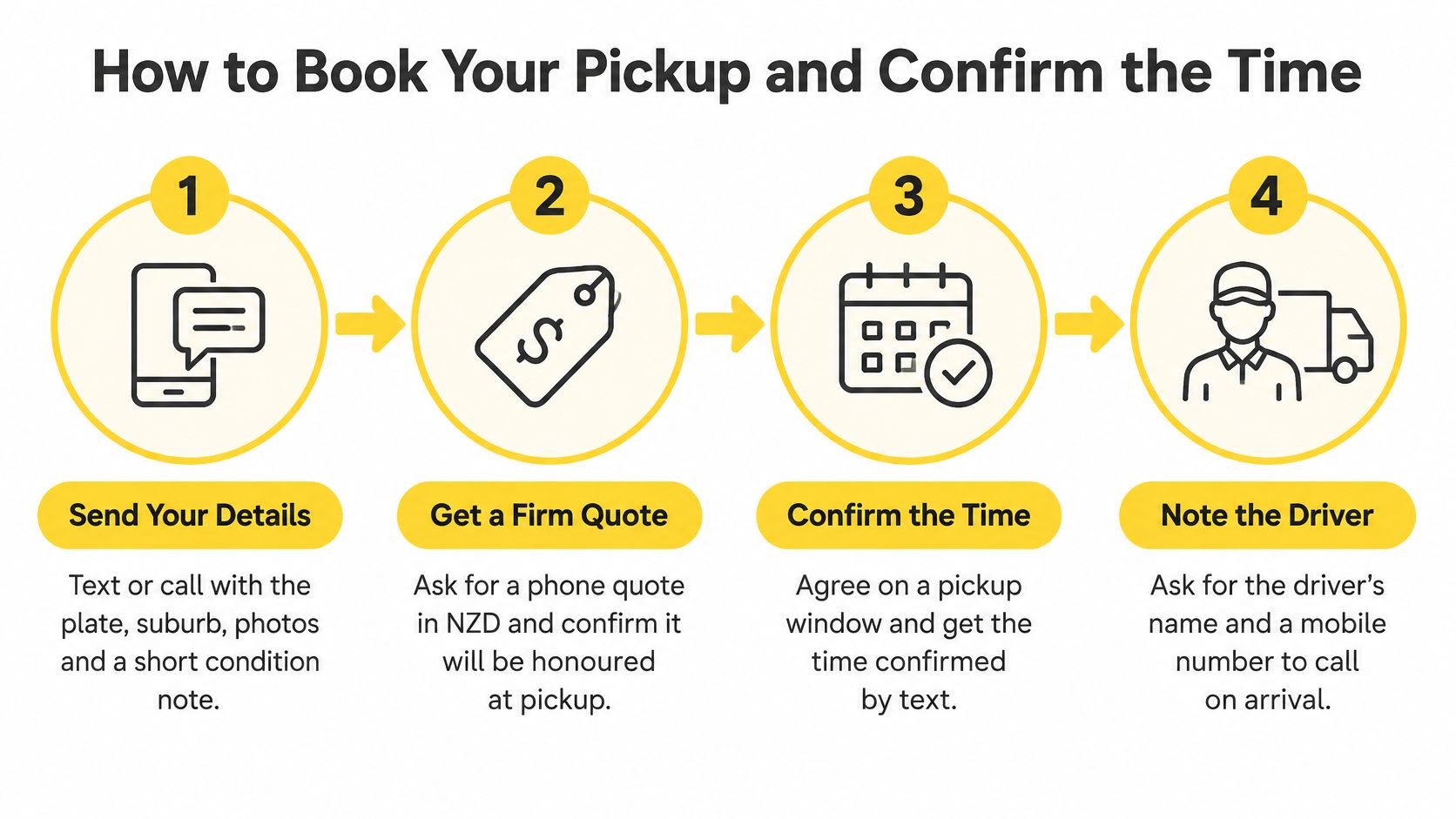
Book in order and the job stays boring, which is what you want. Each step below removes one reason for the driver to ring you from the roadside.
- Send the basics. Text or call with the plate, suburb, photos and a short condition note. Include rolling status and battery type.
- Lock the quote. Ask for a firm phone quote and confirm it'll be honoured at pickup if the car matches your description.
- Pick a window. Agree a time you can actually be there, or nominate the person who will be on site with the keys.
- Describe where it sits. Gate codes, a steep drive, soft ground, a carport with low clearance. The crew brings different gear for each.
- Sort authority to sell. Confirm you're the registered owner or have permission. Flag finance, an unknown owner, or a suspected stolen or flood-damaged car now.
- Confirm payment. Cash or instant bank transfer before loading. No cheques, no hold-backs, no pay you Tuesday.
The four steps in the booking flow below mirror that first call.
Timing by Location
| Location | Expected timing | Towing |
|---|---|---|
| Whangarei city | Same-day pickup in most cases | Free within about 100 km |
| Rural Northland, regular routes | Next-day service | Free within about 100 km |
| Urgent city disposal | Same-day within 7am to 7pm window | Free within about 100 km |
| Outside about 100 km | Confirm before booking | Ask about towing cost before you book |
Outside roughly 100 km, don't assume free towing carries over. Ask before you book and get the answer in the same text thread as the quote.
Public Road Versus Private Land
This distinction decides who you should even call. Councils generally have authority over vehicles abandoned on roads or public places, not cars on private farms, rentals or body corporate land, a limit reflected in Grey District Council guidance on abandoned cars. On private land, get the owner's written authorisation before booking.
Practical rule: If it's on a public road, the council may be the right contact. If it's on your land, it's your job to prove you can lawfully dispose of it.
Finish the call with three things noted down. The time window, the quote reference, and the name and mobile of the person meeting the truck. If the driver can't reach anyone, even a simple job stalls.
How to Prepare the Site for the Tow Truck
Good prep turns a forty minute wrestle into a clean load. Work through this the night before, not while the truck reverses in.
- Clear a firm path. Flat, solid ground from the car to the road, wide enough for the truck and a winch cable to run straight.
- Create winch room. Move bins, trailers and other cars. Keep the pull line clear of fences, trees and overhead lines.
- Empty the car. Personal items, child seats, tools, plates you want to keep, loose parts in the boot. Once it's loaded, it's heading for dismantling.
- Sort the keys. Hand them to the driver or leave them in the agreed spot. Mention any spare set and where it is.
- Contain leaks. Put a drip tray or absorbent mat under visible oil or fuel. Keep kids and pets well clear of the loading zone.
- Don't start it. A flooded, burned or fuel-leaking car stays off. Starting it can turn a recoverable part into scrap and a safe job into a risky one.
A clear driveway lets the crew load a non-runner without dragging it across your lawn or concrete.
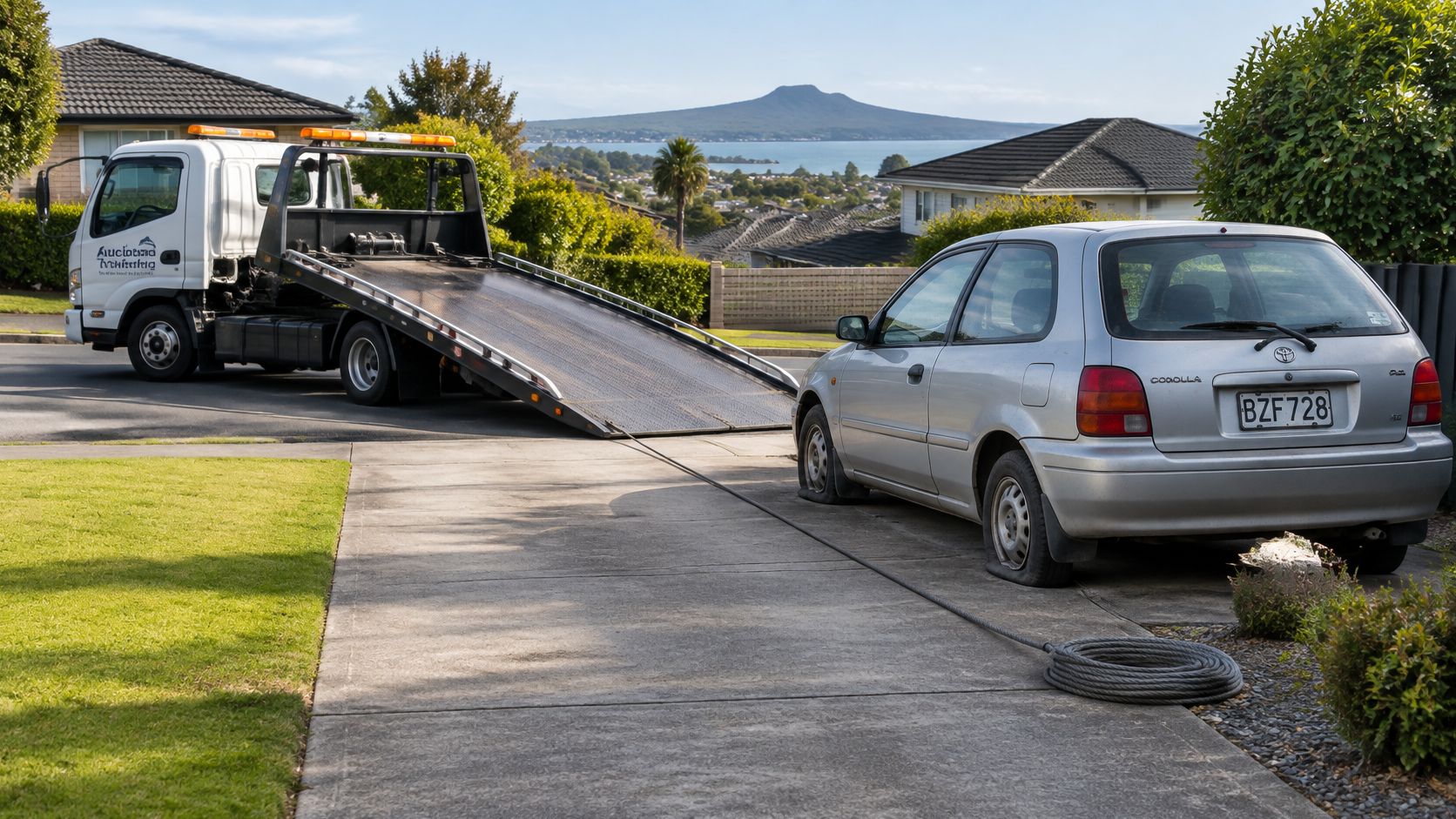
If it won't roll, say so again on the morning. The crew can bring a skid or winch, but only if they know. Our guide to how car wreckers pick up non-running vehicles covers what that gear does on site.
Three Common Snags
- Stuck in mud. Lay boards or old plywood under the wheels so the car climbs out instead of digging in.
- Seized steering lock. Leave it alone. Forcing it can snap the column. The driver will deal with it on site.
- Flat tyre with the car sitting low. Check where the jack point is before anyone lifts, especially on rusted sills.
Photograph the car and the access path before the truck arrives. If anything about the job changes on the day, photos settle it faster than memory.
How to Complete the Ownership Paperwork
The car can be loaded and paid for, but the registered person's responsibility is not settled until the disposal notice is lodged. Agree who will submit it before pickup, then follow through while the driver is still there.
- Confirm the buyer. Get the buyer's details for the disposal notice, and check any information the online form asks you to provide.
- Check the plate. Read it from the vehicle and compare it with the details in the notice. A mismatch can delay the transfer.
- Lodge the notice promptly. Submit the disposal notification through the NZTA notice of disposal transaction as soon as the vehicle is sold or handed over.
- Save the confirmation. Keep the reference or confirmation with the quote and receipt, in one folder or email thread.
- Check the handover. Make sure the driver has the keys and any agreed paperwork, and that the site is left as arranged.
- Confirm the notice is recorded. Before the truck leaves, check the on-screen confirmation and save the reference. Then contact your insurer to cancel or transfer the policy.
The checklist below puts the paperwork and handover checks in one place.
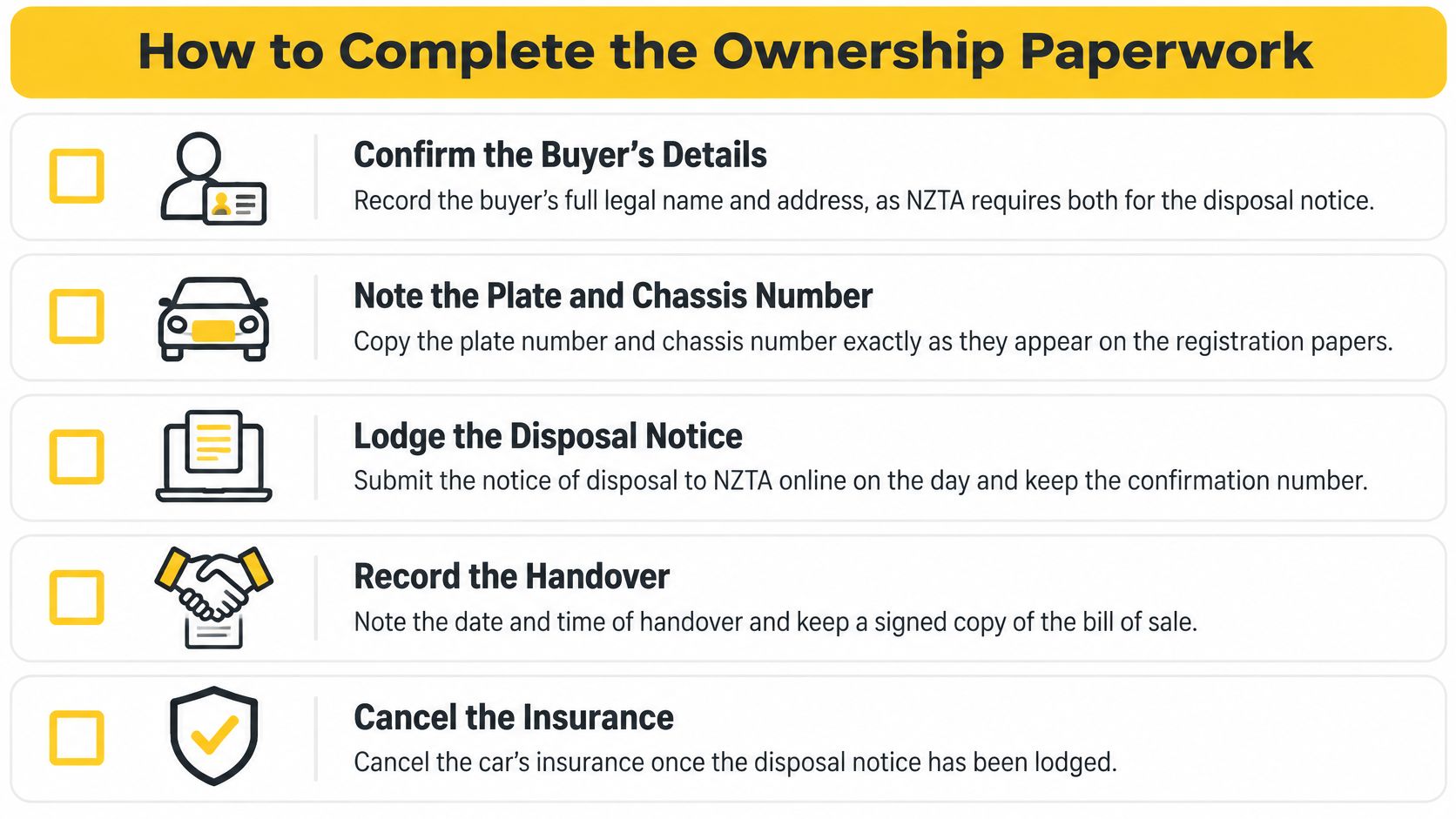
A buyer may offer to complete the notice on site, but check the confirmation yourself before the truck leaves. For a walkthrough of the process, see NZTA registration and change of ownership. Tell the buyer in writing at the quote stage if the vehicle has flood or fire damage, so the condition is clear before collection.
When the Name on the Rego Is Not You
Company cars, estate vehicles and farm vehicles need an authority check before pickup. Confirm who the registered person is and who can sign on their behalf.
For a company, that may be an authorised officer. For an estate, it may be the executor or administrator. If an old farm vehicle was never transferred, trace the registered name and resolve who can authorise the sale before collection day. It is much easier to sort out before the truck is loaded.
Do not hand over a car unless you have clear authority to sell it. A quick check beforehand can prevent a disputed disposal later.
The final check is the actual notice confirmation, not just the handover. Save the reference before the truck leaves, then deal with the insurance.
Book Your Collection and Close the Ownership Loop
A firm quote, a clear pickup site and an agreed plan for the NZTA notice keep collection day straightforward. Before you book, send the vehicle details and location, confirm the price in writing, and check who is authorised to complete the disposal notice.
Car Removals Whangarei arranges collections around Whangarei and across Northland. Send the plate, photos and location for a phone quote. Confirm what the quote covers, when payment is made and the pickup time before agreeing to the booking.
The seller's job is to make the vehicle accessible and have authority to release it. The buyer handles the agreed collection and completes the NZTA notice on site. Check the notice confirmation before the truck leaves, and keep your record.
What Gets Accepted
Ask about your vehicle when you request the quote. Non-running, deregistered, failed-WOF, rusted, accident-damaged and flood-damaged cars may be suitable, but acceptance and price depend on the vehicle and its condition. For a vehicle on farm, rental or body corporate land, arrange the owner's authorisation before booking.
If the vehicle is a hybrid or EV, tell the buyer when you call. The crew needs to handle its high-voltage system, and the vehicle's condition can affect the quote. Do not try to handle the traction battery yourself.
If You Are Not Sure Your Case Fits
If the vehicle is on a public road, contact the council to check the right disposal process. On private land, get written permission from the landowner and confirm the plate details before arranging removal.
Mention finance owing or a deceased estate during the first call. These cases may need paperwork to be sorted before pickup, so raise them before confirming the booking.
Take photos of the plate, odometer and damage, and note whether the car rolls. Send those details with the pickup location, then ask for the firm quote, payment timing and collection window in writing. That gives you a clear checklist: you prepare the site and confirm your authority; at pickup, the buyer collects the vehicle and completes the agreed disposal notice.
Ready to arrange a broken car collection? Contact Car Removals Whangarei with the plate, photos and location to request a quote and confirm the pickup details. The company states that towing is free within about 100 km, payment is made before loading, and the NZTA disposal notice is completed on site. Car Removals Whangarei can take your booking.
- broken car collection
- car removal Whangarei
- NZTA disposal notice
- non-running car
- junk car NZ