· Car Removals Whangarei
What's My Car Worth NZ? Values, Methods and Real Payouts

You've got a car in the driveway, a repair bill on the kitchen bench and an online listing for something similar that looks surprisingly expensive. Then someone offers much less for yours. Is their offer unfair, or is the advertised car a different proposition altogether?
If you're asking what's my car worth in NZ, start by separating the price someone hopes to receive from the money you can really keep. For Whangarei and rural Northland owners, condition, transport and paperwork can change the answer as much as the badge on the bonnet.
Table of Contents
- Typical NZ Car Values at a Glance
- Make, Model, Age and Market Demand
- Mileage, Condition and Your Odometer Record
- Four Ways to Value Your Car and What Each Really Pays
- When Parts and Scrap Value Outweigh the Whole Car
- Registration and Paperwork That Change Your Payout
- Confirm Your Number and Sell With a Firm Offer
Typical NZ Car Values at a Glance
The same vehicle can have a private-sale asking price, a dealer trade-in figure and a dismantler offer. Those figures answer different questions, so they shouldn't be treated as interchangeable estimates.
There isn't a verified national dollar band for every vehicle situation below. Use the assessment rules to identify the right valuation route rather than treating an unsupported range as an appraisal.
| Vehicle situation | Trade-in assessment | Cash-for-car or scrap assessment |
|---|---|---|
| Late-model 4WD or ute, 2015 or newer, running, WoF current | Compare the exact model, specification, kilometres and purchase deal | Price usable drivetrain, body parts and completeness individually |
| Eight to twelve year old sedan or hatch, running, WoF current | Assess dealer resale potential after preparation | Assess model-specific parts demand and remaining usable assemblies |
| Fifteen-plus year old car, running, high kilometres | Establish whether the dealer can economically resell it | Separate saleable components from material recovery |
| Failed WoF or non-running, complete | Acceptance requires an economic repair or disposal route | Deduct recovery and processing costs from parts and material value |
| Stripped, rusted or seized shell | Generally unsuitable for ordinary retail trade-in | Price remaining recoverable material and parts, less collection and handling |
The age descriptions identify comparison groups, not guaranteed price brackets. A particular vehicle still needs its own assessment, and a listing price isn't a sale price.
Find your vehicle's starting position
Write down the make, model, year, kilometres, WoF status and whether it runs and rolls. Record whether registration remains active and whether the vehicle is currently licensed. Don't use “rego” as shorthand for all those separate checks.
New Zealand has a broad comparison market: the NZTA Motor Vehicle Register fleet-status document records 5,820,732 active vehicles in 2024, covering multiple vehicle classes, not just passenger cars. That national total gives context, not a price for your particular hatchback or ute.
A currently licensed, running vehicle generally has a wider resale audience than an unlicensed or non-running equivalent. Buyers considering a damaged vehicle are more likely to concentrate on recoverable components and recyclable material.
Starting point: Choose the row that describes the car as it sits today, not the condition you hope to achieve after repairs.
If your car starts but needs extensive work, don't automatically place it alongside healthy running examples. Its faults, records and repair prospects determine where a realistic offer sits.
Make, Model, Age and Market Demand
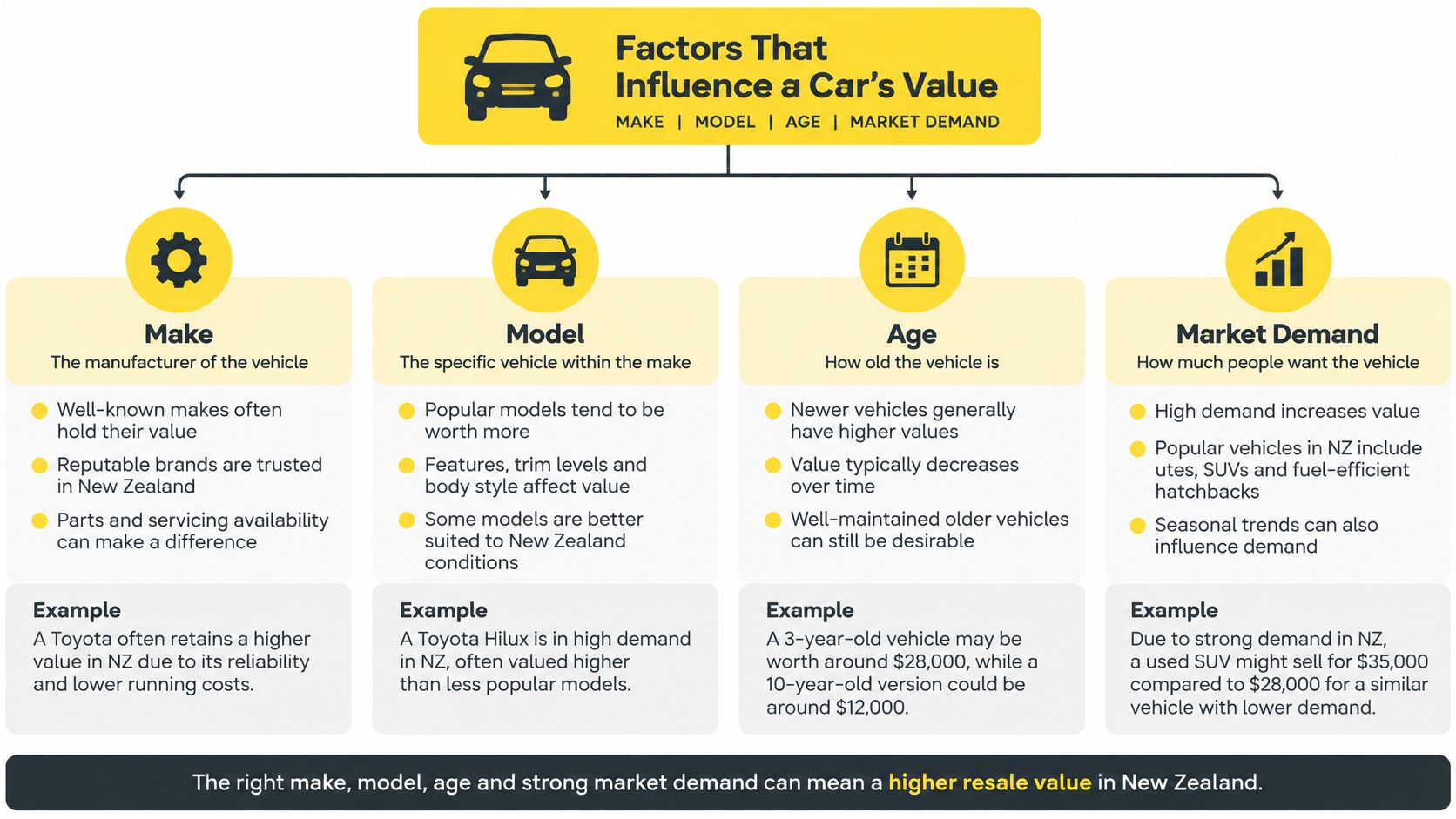
Start with demand for the exact vehicle, then work down through age, documented use, condition, completeness and location. This is a useful assessment order, although a major defect can outweigh every other factor.
Start with demand and age
A Toyota Hilux, Ford Ranger, Nissan Navara or Toyota Corolla needs model-specific comparisons. Don't assume every example commands a premium: engine type, generation, specification and faults matter to both whole-car buyers and dismantlers.
An obscure model might have fewer interested buyers, but rarity alone doesn't establish value either. The practical question is whether someone wants that complete vehicle or its usable components.
Age provides a baseline. In the latest listed year of the Ministry of Transport vehicle fleet dataset, 773,269 vehicles were aged 15–19 years, about 19.1% of the recorded fleet series. That substantial older-vehicle group makes maintenance and remaining usefulness especially important in local comparisons.
An older Toyota, Nissan, Ford or Mitsubishi may retain dismantling value through its engine, transmission, panels or four-wheel-drive components. A newer vehicle with severe damage may be a weaker proposition despite its registration year.
Adjust for the individual vehicle
Use the remaining drivers to explain why your car differs from its closest comparison:
- Kilometres and servicing: A documented maintenance history helps a buyer assess accumulated use and upcoming work.
- Condition and damage: Rust, chassis damage, water exposure and fire history can outweigh attractive paintwork.
- Completeness and drivetrain: Identify automatic or manual transmission, diesel or petrol power, four-wheel drive and any missing assemblies. Hybrid and EV battery condition needs separate attention.
- Location and timing: A rural Northland buyer seeking a working ute has different needs from a city buyer seeking a compact commuter. Access and collection logistics also affect an offer.
Don't assume that waiting for a different season will produce a better result. Compare actual interest in your vehicle with the costs of keeping it.
Write down your main value drivers, then mark each as adding or reducing value. For example, a desirable drivetrain may help, while chassis rust and missing service records pull the assessment down. That gives you a reasoned way to question a quote rather than arguing from age alone.
Mileage, Condition and Your Odometer Record
The dashboard tells you what the odometer displays. It doesn't, by itself, prove how far the vehicle has travelled.
Under NZTA's entry-certification rules, odometer readings are recorded to the nearest whole kilometre, and suspected tampering, including an entry reading below an earlier border reading, must be recorded and referred to Police. The rules also identify acceptable evidence for disputed import readings.
Verify the record in order
- Check the vehicle record. Compare available inspection readings in date order. An unexplained reversal creates uncertainty about the vehicle's actual use.
- Match WoF documents and service invoices. Look for a continuous sequence rather than relying on the latest invoice. Consistency gives buyers a firmer basis for comparison.
- Check import documentation. For disputed readings, collect official inspection documentation or certification from a recognised odometer specialist. Auction or sales papers alone aren't sufficient evidence.
- Inspect physical condition. Check sills and chassis for rust, tyres for age-related deterioration and tread wear, and the ground beneath the car for leaks. Warning lights, engine smoke and seized wheels all change the assessment.
Value the vehicle using its verified mileage, not merely its claimed reading. A low dashboard figure with gaps in the paperwork doesn't justify the same benchmark as a continuous documented history.
Photograph what affects the offer
Send clear, daylight images that let the buyer assess the car without guessing:
- Exterior: Front, rear, both sides and visible damage.
- Interior: Dashboard, odometer, warning lights and upholstery.
- Mechanical areas: Engine bay, leaks and accessible rust areas.
- Collection access: Wheels, driveway, gates and obstructions.
Don't crawl beneath an unsupported vehicle or start an engine that may be unsafe. Describe what you can't inspect rather than assuming it's sound.
Four Ways to Value Your Car and What Each Really Pays
Consider a hypothetical calculation, not a market-price forecast. A running car sells for $9,000, but the seller spends $800 on WoF and brake repairs, $300 moving it from a rural property and $200 on fuel and the value of their time arranging viewings. The remaining amount is $7,700.
In another hypothetical case, a non-running car might achieve $3,000 after $1,200 of repairs, leaving $1,800 before other selling costs. A firm as-is offer of $2,000 with collection included would leave that seller better off, provided the repaired sale price and repair bill were realistic.
Compare the outcome, not just the estimate
Those examples illustrate the difference between an estimate, an offer and net proceeds. Your actual costs must come from repair estimates, transport terms and agreed sale conditions, not a generic allowance.
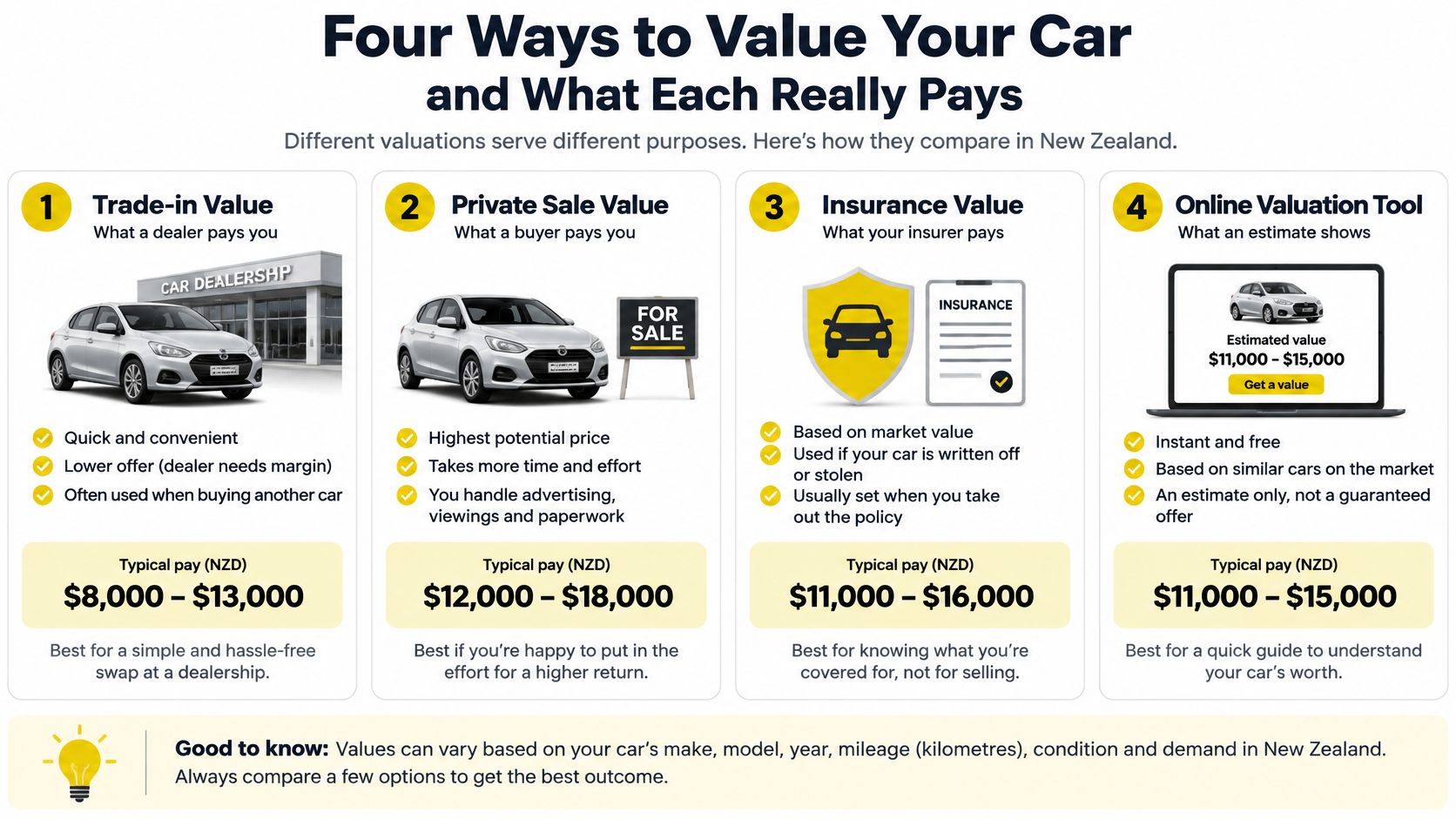
| Valuation method | What it measures | Typical outcome for seller | Main catch |
|---|---|---|---|
| Online valuation tool | Estimated value from vehicle details | A starting benchmark, not an offer | May not account for damage, status, access or paperwork |
| Dealer trade-in | An allowance towards another purchase | Convenient disposal within a purchase transaction | Compare the entire changeover deal, not the allowance alone |
| Private sale listing | An asking price tested by buyers | Potentially stronger proceeds for a healthy vehicle | Negotiation, preparation, viewings and uncertainty |
| Wrecker or car removal cash offer | Recoverable parts and materials after costs | A practical disposal route for damaged or uneconomic vehicles | Completeness and collection terms affect the final result |
| Insurance write-off settlement | The insurer's assessment under the policy | A settlement through the insurance process | Policy terms, excess and salvage arrangements need checking |
A private listing is an advertisement, not evidence that a buyer paid the advertised amount. For a closer explanation of that distinction, use our guide to interpreting an online car estimate.
Keep insurance separate from ordinary sale offers
An insurance settlement isn't just another buyer's bid. NZTA's water-damaged vehicle guidance explains that an insurer must cancel registration when it writes a vehicle off, with safety flags added for specified damage histories.
Before accepting a separate salvage offer, establish whether you're entitled to sell the vehicle and how that affects the settlement.
The useful comparison is the amount you'll retain after agreed costs, with a clear handover and no unresolved ownership issue.
Use online tools to establish context, private sale when the vehicle is healthy and you can manage the process, and firm as-is offers when repairs or movement make ordinary resale impractical.
When Parts and Scrap Value Outweigh the Whole Car
A damaged car isn't automatically worth a fixed percentage of its pre-accident retail price. A dismantler assesses what can be recovered, what someone is likely to buy and what it will cost to collect, test, store and process the vehicle.
Recoverable components plus recyclable material, less handling and risk, is the more useful model.
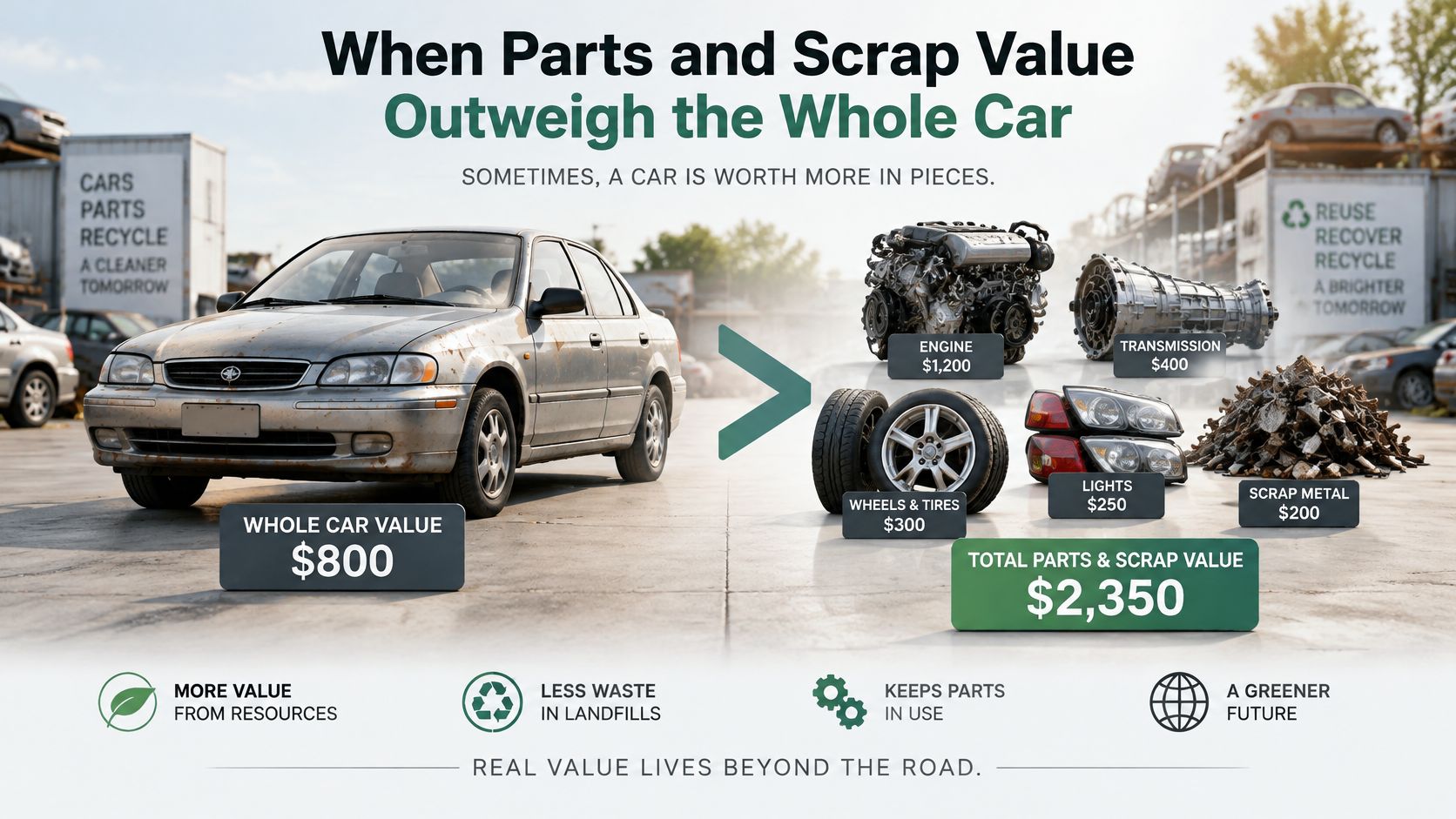
The illustration's component totals shouldn't be read as a guaranteed seller payout. A buyer still has to remove, inspect and sell those parts, and some may never sell.
Separate usable parts from damaged assemblies
Engines, gearboxes, differentials, transfer cases, panels and four-wheel-drive assemblies may preserve value when the whole car is uneconomic to repair. Alloy wheels, catalytic converters and batteries also belong in the assessment.
Damage changes what's recoverable. NZTA's border-inspection reference material distinguishes structural, supplementary restraint system, fire and water damage, with damage recording and photographic requirements. A part's presence doesn't prove it's safe or economical to reuse.
Give the buyer an accurate inventory:
- Major assemblies: Identify the engine, gearbox and drivetrain parts still present.
- Missing items: Disclose removed wheels, converter, battery, panels or interior components.
- Damage exposure: Describe water, fire, chassis and airbag-system damage.
- Recovery needs: Explain whether the car rolls, steers and can be reached by loading equipment.
A complete vehicle usually offers more recovery options than a stripped shell. Removing attractive components before requesting a quote can reduce the remaining offer and make collection harder.
Treat steel recovery as tonnage, not guaranteed money
A steel recovery percentage estimates recoverable material, not a dollar floor. It doesn't establish the vehicle's steel content, the buyer's current price per tonne or the cost of processing it.
The working calculation is:
Material-only estimate = recoverable steel tonnes × the buyer's current scrap price per tonne, less collection and handling costs.
Keep reusable parts separate so you don't count their metal twice. Our scrap car valuation guide explains the distinction between material weight and salvage potential.
For hybrids and EVs, traction-battery condition and safe high-voltage isolation require their own assessment. Don't open a battery pack or disturb high-voltage cabling to improve a quote.
Before agreeing to disposal, establish whether the figure includes loading, transport and paperwork, and what disclosed facts could change it. A gross recovery estimate isn't the same as an amount payable to you.
Registration and Paperwork That Change Your Payout
A car can be registered but unlicensed, deregistered, or carrying an insurance write-off record. Each status attracts different offers, because registration works like a filter on the price: two identical vehicles can show the same headline figure while leaving you different amounts once fees and obligations come out. A current WoF answers none of these questions on its own.
The NZTA buying and selling factsheet distinguishes the registered person from the legal owner, requires both parties to notify NZTA immediately after a sale, and describes cancellation after 12 months without licensing for most vehicles, or 24 months for tractors, trailers and certain other types.
Establish the vehicle's status
Each status opens some sale routes and closes others:
| Status | What it means | What it does to the sale |
|---|---|---|
| Licensed and current | Registration held, licence paid | Ordinary sale; both parties notify NZTA |
| Licence expired | Registration held, licensing lapsed | Outstanding fees can reduce what you keep |
| Cancelled (deregistered) | MR15 lodged, plates returned | Re-registration needed before road use; no ordinary change of registered person |
| Written off | Insurer damage record attached | Damage-related requirements can sit alongside registration questions |
Under NZTA's registration factsheet, cancellation normally involves an MR15 application, returning plates to an agent and addressing any outstanding licensing fees. It is a formal step, distinct from leaving a car unused or letting its licence lapse. The same factsheet covers re-registering a previously registered vehicle, which usually calls for evidence of its earlier registration and a clear ownership trail. Expect the offer on a deregistered car to reflect that extra work.
Prepare a clean handover
Gather the following before committing to a sale:
- Authority to sell: Ownership evidence and any estate, company or property-owner authorisation.
- Vehicle identification: Registration number, VIN and available WoF or CoF records.
- Status documents: Cancellation, write-off and plate-return records where applicable.
- Financial position: Outstanding licensing charges and any secured-finance payout.
If finance remains, get the lender's payout figure and agree how it will be discharged before accepting an offer. Every dollar used to clear the debt is a dollar out of what you keep, which is why one car can show a respectable sale price and still produce a thin net result.
Our NZTA change-of-ownership guide explains the notification process. We complete the required NZTA notification when taking possession, and the vehicle becomes our responsibility from that point.
Then compare value after liability: sale proceeds less finance, storage, compliance, licensing and transport obligations. A documented handover at a modest figure can leave you better off than a higher price with unresolved costs attached.
Confirm Your Number and Sell With a Firm Offer
Get another number before accepting an offer. Compare what each buyer commits to paying you after deductions, rather than assuming the highest headline figure is the strongest outcome.
Give each buyer the same information. If one assessment includes the failed transmission and difficult access while another assumes a driveable car beside the road, the offers aren't genuinely comparable.
Turn your assessment into an agreed sale
Use a short preparation and acceptance checklist:
- Prepare the details. Have the make, model, year, registration number, photographs and a clear description of whether the car runs and rolls.
- Identify the appropriate route. Match the vehicle's actual condition to the assessment table, then decide whether repair, ordinary resale or dismantling deserves consideration.
- Record the terms. Obtain the payable NZD amount, collection arrangements, payment timing and any conditions attached to the offer.
- Complete the handover. Confirm payment and the applicable NZTA notification before the vehicle departs. Keep the receipt and transaction confirmation.
At Car Removals Whangarei, we use your make, model, year, rego and rough condition to provide a firm phone figure in about two minutes. We pay $200 up to $15,000 in cash per vehicle at pickup, with payment made before loading.
We include towing within roughly 100 km of Whangarei. Outside that area, we tell you before booking whether a towing fee applies, so you can compare the actual amount you'll retain.
Make the final comparison fairly
A sound running car may justify the extra work of a private sale. A damaged or immobile vehicle may produce a better practical outcome through a documented as-is handover.
Don't spend money repairing the car solely because an advertised example looks expensive. First obtain a repair estimate and a realistic post-repair sale assessment, then compare that result with the firm offer already available.
Your final check is simple: does the second offer leave you better off after costs, with equally clear payment and paperwork terms? If it does, you have a reason to choose it. If it doesn't, a higher headline price hasn't improved your position.
Car Removals Whangarei offers firm cash assessments for unwanted vehicles, helping you compare a realistic pickup payout with the costs of repairing or selling privately. Visit Car Removals Whangarei with your vehicle details and condition photos, then compare our figure with another offer before deciding.
- car worth NZ
- car valuation NZ
- sell car NZ
- scrap car value
- car removal Whangarei