· Car Removals Whangarei
Free to Sell Cars Northland Whangarei: A Seller's Guide

Selling an unwanted car in Whangarei and Northland can be free, with no towing fees, no deductions and payment before loading, but completing the NZTA notification is the essential step in ending your responsibility as the recorded seller. Collection alone doesn't update the vehicle's record or wipe out obligations that already exist.
Perhaps your car has failed its WOF and is sitting behind the shed. Maybe a deregistered ute is blocking the farm gate, or an insurance write-off is taking up the rental driveway. You need it gone, but you also need to know who's receiving it, what you'll be paid and what confirmation you'll have when the truck leaves.
Table of Contents
- Why Unwanted Cars in Northland Need a Clear Exit
- How Free Towing and Collection Work Across Northland
- What Sets Your Firm Quote and Payout
- Completing the NZTA Notification at Pickup
- When Your Liability Actually Ends
- Special Cases from Abandoned Cars to EVs
- Choosing Between a Private Sale and Dismantler Removal
- Booking Your Free Collection in Whangarei
Why Unwanted Cars in Northland Need a Clear Exit
A failed-WOF car in a yard can look like a simple towing job. The owner wants the space back, the engine won't start and spending more on repairs doesn't make sense. Yet accepting a collection without checking the paperwork can leave the physical problem solved and the administrative problem untouched.
Northland owners also need to think about access. A vehicle beside a workshop is a different collection from a seized ute beyond a farm gate. The useful question isn't just what the vehicle is worth, but whether the agreed price includes getting it out of its actual location.
A substantial local vehicle stock
Whangārei had 68,704 registered vehicles and an estimated population of 81,400 in 2013, equivalent to about 844 vehicles per 1,000 residents, according to NZTA's historical territorial-authority statistical summary. These are historical figures, not a current fleet count, but they establish the scale of local vehicle ownership.
That context matters when deciding how to dispose of an unwanted vehicle. Passenger vehicles, work utes and vans eventually reach a point where their owners must choose between further repairs, selling privately and arranging removal. For an owner with a non-runner, transporting it to a buyer may be the awkward part.
Practical rule: Agree on the collection, price and paperwork before agreeing to let the vehicle leave.
A clear exit should cover:
- Collection costs: Confirm that towing and the disclosed loading requirements are included.
- The agreed payout: Get a firm figure based on the vehicle's actual condition.
- The recipient: Know the legal name and address of whoever receives it.
- The transfer record: Keep confirmation of the NZTA notification and the handover.
If you're searching for “free to sell cars Northland Whangarei”, judge the offer by the complete handover, not just the biggest figure mentioned on the phone.
How Free Towing and Collection Work Across Northland
Free towing should mean you don't have to pay to move the vehicle to the dismantler. It shouldn't mean a transport charge appears after you've accepted the quote, or that the driver deducts loading costs for a problem you already disclosed.
The collection starts with an accurate description. Tell the booking team where the vehicle is, whether it rolls and steers, and whether a truck can reach it. A missing wheel, locked steering or soft ground should be discussed before dispatch, not discovered beside the tow truck.
From booking to departure
- Describe the location: Give the collection address, gate instructions and any narrow access, steep driveway or overhead obstruction.
- Describe the vehicle: Explain whether it starts, whether the wheels turn and whether it has collision damage or missing components.
- Agree on the collection terms: Confirm the payout, free towing, payment method and expected arrival window.
- Prepare for handover: Remove belongings, organise keys and documents, and make sure someone with authority is available.
Whangarei city collections can typically be arranged the same day, while rural Northland pickups are planned around regular routes, generally for the following day. Confirm availability for your address rather than treating either arrangement as an unconditional promise.
An owned tow fleet gives the operator more direct control over dispatch and loading equipment. It doesn't remove the need to describe the job accurately, particularly for non-rolling shells, machinery or vehicles tucked behind other equipment.
Recovery and disposal aren't the same booking
A vehicle safely parked on private land can usually be booked as a planned collection. A vehicle beside a live road needs its immediate recovery circumstances assessed first.
If you're dealing with a breakdown or crash, explain the location and any immediate danger before discussing salvage value. Don't assume a routine free-removal booking includes every roadside recovery situation. Establish where the vehicle can safely be collected, who has authority to release it and whether another organisation is already managing the recovery.
What Sets Your Firm Quote and Payout
A dismantler's quote should reflect the vehicle being collected, not an optimistic description of something similar. Recoverable parts, material value and condition all matter. A complete vehicle with useful components presents a different proposition from a stripped shell, even when both carry the same badge.
The practical trade-off is between quoting quickly and quoting accurately. A short call can work well if you provide the important details. If you leave out a missing engine, damaged battery or stripped interior, the quote may have been built around the wrong vehicle.
Payout drivers by vehicle type
| Vehicle type | What sets the quoted payout |
|---|---|
| Sedans, hatchbacks, wagons and people movers | Completeness, condition and the potential to recover useful components |
| Rusted, stripped or seized scrap vehicles | Kerb weight, recoverable material and the parts still present |
| Hilux, Ranger, Navara and other utes or 4WDs | Model, drivetrain specification, usable assemblies and chassis condition |
| Hiace and other vans | Configuration, mechanical condition and recoverable commercial-vehicle components |
| Hybrids and EVs | Traction battery condition, damage history and other recoverable parts |
| Trucks, buses and machinery | Equipment type, recoverable assemblies and the loading arrangement |
Don't assume a blown motor makes a ute worthless, or that a heavy vehicle automatically attracts the strongest offer. A usable component may contribute more than its material weight, while damage or missing equipment may limit recovery options.
Give the quote enough detail
Have the make, model, approximate age and registration plate ready. Describe the fault plainly: seized engine, structural rust, flood exposure, missing wheels or collision damage. Photos can help resolve uncertainty before the driver arrives.
For a closer explanation of the assessment, the guide to scrap car valuation separates recoverable-parts value from the vehicle's scrap-material value.
A firm quote is most useful when both parties are describing the same complete job.
Confirm that the agreed figure will be honoured for the condition disclosed, without towing deductions or unexpected adjustments. Payment should be settled before loading, whether you've agreed on cash or bank transfer. If using a transfer, check your own banking record rather than relying solely on a payment screenshot.
Completing the NZTA Notification at Pickup
The paperwork should identify the vehicle and the actual recipient before loading begins. A trading name on a truck isn't a substitute for the receiving party's full details.
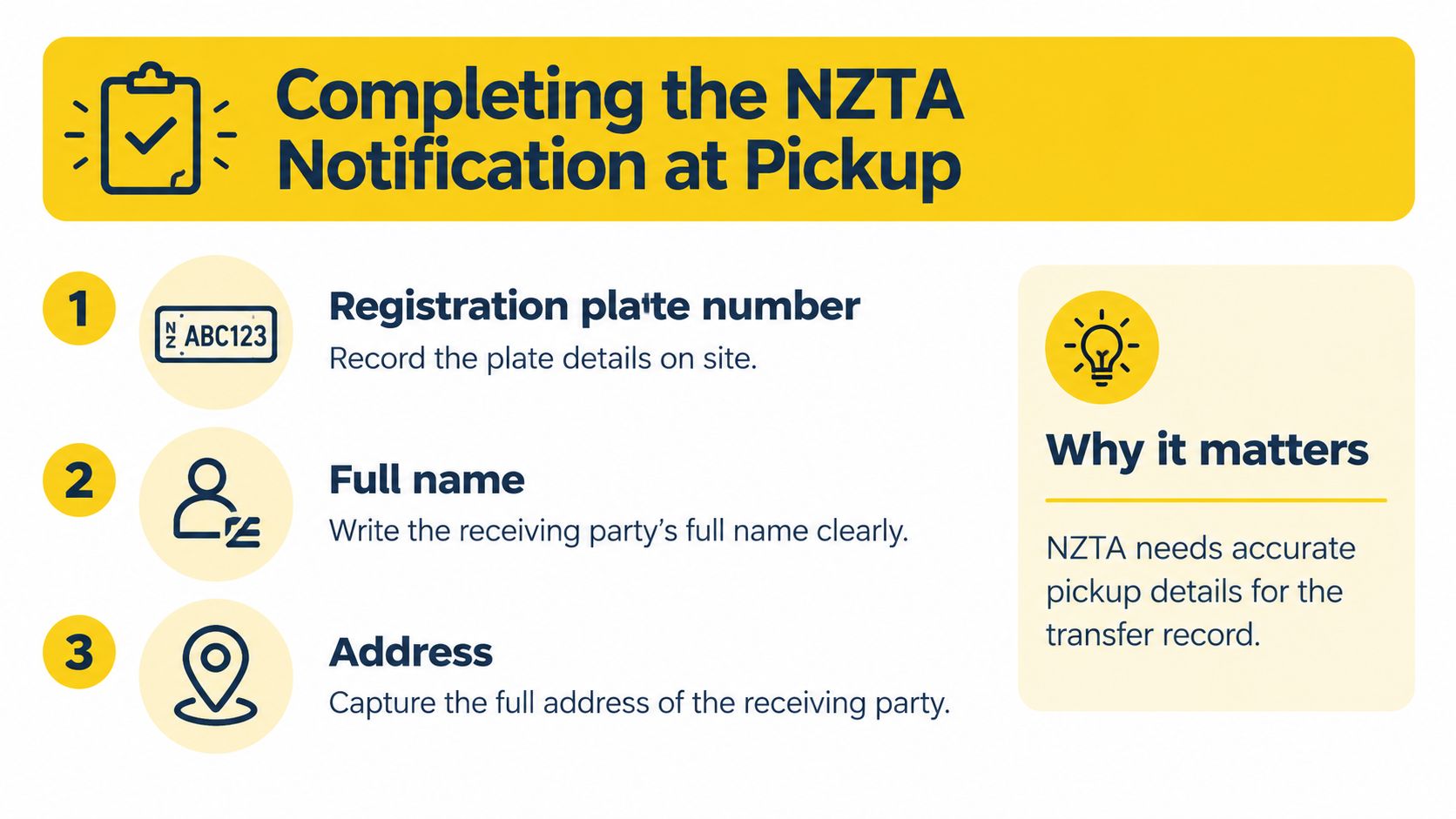
NZTA's notice of disposal transaction requires the registration plate number and the full name and address of the person or organisation receiving the vehicle. Record those details accurately so the notification relates to the correct handover.
Prepare the vehicle identity and authority
- Plate or chassis details: Check that the paperwork identifies the vehicle being collected. If plates are missing, raise this before pickup so the correct process can be confirmed.
- Recipient details: Obtain the receiving person's or organisation's full legal name and address, not just the driver's first name.
- Seller authority: Have your details ready and establish who can authorise disposal if the vehicle belongs to a company or someone else.
- Supporting documents: Gather any deregistration records, insurer release, statutory-loss documents or written authority relevant to the vehicle.
Don't leave an unresolved identity mismatch until the vehicle is already secured on the truck. A plate from another vehicle, an unclear chassis identity or inconsistent insurer paperwork needs checking before the handover proceeds.
Keep confirmation on your side
Complete your seller notification at pickup and retain the confirmation. Ask the recipient to confirm that their required notification has also been completed. The practical guide to NZTA registration and change of ownership provides further detail on that administrative process.
Keep the sale receipt alongside the notification confirmation. The receipt should record the vehicle, parties, agreed amount and handover date, giving you a useful record if a later enquiry arrives.
If the vehicle is already deregistered, don't assume the usual online transaction will apply unchanged. Confirm the disposal requirements for that status and keep written evidence of who received it. The aim is an accurate record, not just a completed screen.
When Your Liability Actually Ends
A tow truck leaving your driveway isn't proof that your registered-person record has changed. Nor does calling a sale “as is, where is” settle every legal obligation connected with the vehicle.
NZTA's guidance on selling a vehicle says both buyer and seller must notify the change in registered person. Without that notification, the former owner can remain exposed to tolls, speeding tickets, licensing charges and other fees. The same guidance says an unroadworthy vehicle must be deregistered and may be sold to a wrecker, and that an as-is, where-is sale doesn't remove transport- or consumer-law obligations.
Separate the handover from existing obligations
The practical endpoint is a documented handover supported by the correct NZTA notification and confirmation that the registered-person record has been updated. That addresses the risk of remaining recorded against a vehicle you've sold.
It doesn't erase matters that arose before collection. Outstanding finance, existing charges, disputed ownership or an unresolved insurance claim must be dealt with separately. A dismantler's receipt isn't a release from a lender.
Keep the distinction clear: Ending your association with the vehicle's registration record isn't the same as cancelling every debt or obligation attached to its history.
Before treating the disposal as finished:
- Retain confirmation: Save the seller notification and written handover record.
- Check the recipient's completion: Don't rely on a promise that someone will sort it out later.
- Update connected accounts: Remove the sold vehicle from your toll account and contact the relevant providers about other arrangements.
- Resolve older matters separately: Keep finance, insurance and pre-sale correspondence with the disposal documents.
A non-running car still needs this administrative endpoint. Its inability to move under its own power doesn't tell NZTA that someone else has received it.
For a rural business or company fleet, store the confirmation where the person handling accounts and vehicle administration can find it. That's more useful than leaving the only receipt in a departing employee's messages.
Special Cases from Abandoned Cars to EVs
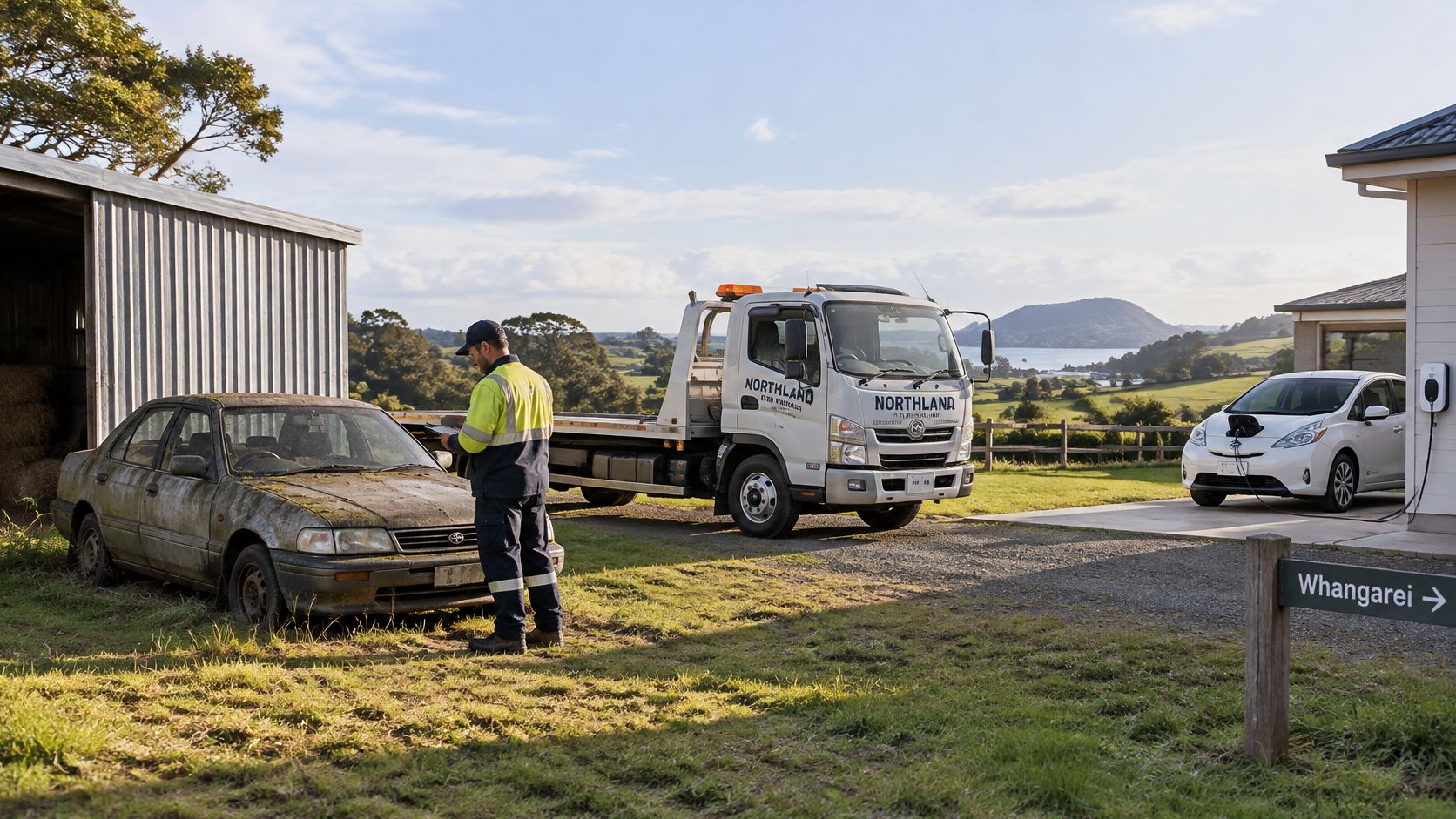
A derelict vehicle behind a farm shed may appear ready for scrap, but appearance doesn't establish who can authorise its removal. The same applies to a car left in a rental driveway after the occupant has gone.
Vehicles left on private property
Council powers shouldn't be assumed to cover private-land clearance. For example, Waimate District Council's abandoned-vehicle guidance explicitly says it has no authority over vehicles abandoned on private property. That isn't a statement of Northland council policy, but it illustrates why owners should check the applicable local process.
A Northland landlord, farm owner or property manager should establish lawful authority before requesting disposal. If ownership is disputed or the owner can't be contacted, obtain advice on the appropriate route rather than treating landownership as permission to sell the vehicle.
- Record the identity: Photograph the plate or VIN and the vehicle's condition.
- Establish authority: Gather owner consent or other documentation supporting lawful removal.
- Disclose outside interests: Tell the collector about any known Police, insurer or ownership issue.
- Separate multiple vehicles: Prepare an authority and identity record for each, even if they're collected together.
Write-offs and high-voltage vehicles
For an accident, flood, fire or hail write-off, confirm who owns the salvage and who can release it. Keep insurer documentation and any statutory-loss or deregistration papers available. Settlement discussions and physical collection shouldn't proceed on conflicting assumptions.
With a hybrid or EV, disclose battery damage, flood exposure and warning information before booking. Arrange a collector equipped for high-voltage isolation and don't attempt to disconnect or dismantle the traction battery yourself.
Responsible dismantling also means separating recovery streams. New Zealand's priority product-stewardship guidance identifies tyres as a controlled recovery stream through Tyrewise. Ask how the collector handles tyres, fluids and batteries rather than assuming the entire vehicle goes into a single scrap pile.
The right approach to an unusual vehicle is to disclose more, not less. That allows the collector to organise suitable equipment and check the documentation before arriving.
Choosing Between a Private Sale and Dismantler Removal
A private sale can suit a roadworthy car with a genuine buyer ready to proceed. You retain the opportunity to sell it as a usable vehicle, but you also manage enquiries, inspections, payment arrangements and the handover.
Dismantler removal suits a different problem. If the vehicle has failed its WOF, is deregistered, has a seized engine or is heavily stripped, collection may be more practical than finding someone willing to organise transport.
Compare the complete transaction
| Decision point | Private sale | Dismantler collection |
|---|---|---|
| Finding a buyer | You advertise, answer enquiries and assess interest | You request a quote for the vehicle's disclosed condition |
| Transport | You and the buyer must agree on a lawful collection arrangement | Suitable transport can be included in the removal |
| Price | You negotiate with a buyer seeking the vehicle for their intended use | The offer reflects recoverable parts and materials |
| Preparation | Buyers may expect inspections and supporting vehicle history | Accurate condition and access details are central |
| Paperwork | Both parties still have notification obligations | Collection doesn't replace either party's required notification |
| Suitability | Useful for a serviceable vehicle with an interested buyer | Useful for non-running, damaged or end-of-life vehicles |
Don't compare a hopeful advertising price with a confirmed collection offer as though they're equivalent. One depends on finding and completing a sale with a buyer; the other should describe an agreed disposal job.
Choose according to the vehicle you have
For a repairable car, consider whether you're prepared to manage inspections and explain the faults clearly. For a rusted shell, focus on loading access, authority to dispose and the written collection terms.
A licensed local dismantler is an option alongside private sale, particularly where transport is the main obstacle. Look for a firm quote, payment before loading, suitable equipment and an organised notification process rather than choosing solely on an initial headline offer.
The guide to how to sell a car can help you prepare for the broader selling decision. Whichever route you choose, don't let urgency turn an incomplete handover into an accepted one.
Booking Your Free Collection in Whangarei
Start with the vehicle's identity, condition and location. You don't need to diagnose every mechanical fault, but you should describe what you know and flag what remains uncertain.
If the vehicle belongs to a company, an insurer controls the salvage or finance is outstanding, resolve who can authorise the sale before arranging removal. That avoids a truck arriving for a vehicle that can't yet be released.
Have the booking details ready
- Vehicle identity: Registration plate, make, model and chassis details if needed.
- Actual condition: Whether it starts, rolls and steers, plus missing parts or damage.
- Road status: Whether it has failed its WOF, is unlicensed or has been deregistered.
- Authority and interests: Seller details, written permission where relevant, and any finance or insurer involvement.
- Collection access: Address, gates, ground conditions, obstacles and the vehicle's exact position.
- Handover arrangements: Who'll be present, which documents are available and your preferred payment method.
Confirm the whole booking
Request a firm phone quote and ask the operator to confirm that the disclosed collection is free. Agree on a city pickup or rural route slot, then check how you'll be told about arrival timing.
Before the truck comes, remove personal belongings and make the paperwork accessible. Don't dismantle safety systems or move an unsafe vehicle merely to make it look easier to collect.
Leave yourself with evidence of the sale, not just an empty parking space.
At handover, use the agreed payment and notification process rather than accepting a last-minute promise to finish it later. Keep the receipt and confirmation together, and follow up promptly if the registered-person record hasn't been updated. A completed disposal should leave you able to identify the recipient and show when the handover occurred.
Car Removals Whangarei offers free collection for eligible Northland vehicles, firm phone quotes and payment before loading, with NZTA notification handled at pickup. Visit Car Removals Whangarei with your registration plate, vehicle condition and collection address ready to request a quote and confirm the handover arrangements.
- free car removal
- sell cars Whangarei
- cash for cars Northland
- NZTA notification
- unwanted car disposal