· Car Removals Whangarei
Sell My Van in Whangarei: Valuation, Paperwork and Payout
A van that won't start is easy to ignore for a season. The rego lapses, the WoF sticker goes stale, and the Hiace or Transit sits on the lawn holding space you need for the trailer. Then someone turns up, offers half of what the old listing suggested, and you're left working out whether that number was fair or just the cheapest way to make the problem disappear.
New Zealand runs one of the world's most vehicle-intensive transport systems, and the Ministry of Transport's 2021 fleet statistics counted more than 4.5 million motor vehicles, or approximately 889 vehicles per 1,000 people (Ministry of Transport 2021 annual fleet statistics). Vans make up a serious slice of that fleet, and plenty of them change hands in far rougher condition than anything on a dealer's forecourt. What yours is worth depends less on what you'd like for it than on which sale route matches its condition.
Table of Contents
- Three Routes to Sell a Van in Northland and What Each Pays
- Valuation Factors That Move Your Van's Price
- Selling a Van That Won't Run or Has No Registration
- How to Complete the NZTA Change of Ownership
- Payment, Pickup and What Can Change the Offer
- Confirm Your Route and Book Your Van Collection
Three Routes to Sell a Van in Northland and What Each Pays
Two questions decide this before any price does. Does the van run and hold a current WoF, and how fast do you need the cash? Everything else, the make, the kilometres, the colour, is a smaller adjustment on top of those two.
| Sale route | Price basis | Time to cash | Main hidden cost | Best fit |
|---|---|---|---|---|
| Private sale of a roadworthy van | Retail value with a current WoF | Days to weeks | Advertising, viewings and buyer no-shows | Running, clean and recently certified |
| Trade-in or auction | Dealer or auction bid after margin | Same day to days | Dealer margin and gap to retail | Late-model vans and a quick sale |
| Dismantler cash purchase | Parts demand, kerb weight and metal value | Same day to next day | Few, if the quote is firm | Non-running, damaged or out-of-WoF vans |
A private sale pays retail, but only for a van a stranger can legally drive away. That means a current WoF, a straight body and no faults a buyer finds on a test drive. Buyers deduct for every flaw they spot, and they spot more than you'd like.
Trade-in and auction shift the risk to someone else and take a slice for carrying it. A dealer bids under retail because they hold the yard, the warranty and the wait. An auction bid lands wherever the room stops, and you find out on the day.
A dismantler's cash purchase is the route for a van that won't start, won't pass, or can't be certified economically. Here the figure comes from parts demand, recoverable metals, catalytic converter or battery components, loading difficulty and towing distance, not the advertised price of a working equivalent. The market itself isn't one segment either: NZTA's monthly fleet data separates passenger vans from goods vans, trucks and utilities and records licence status, fuel type and vehicle year (NZTA New Zealand vehicle fleet status data). A nine-seater people mover and a high-roof goods van draw completely different buyers.
Take a 2012 Hiace with a blown engine and a clean body. A private buyer only pays strong money if they plan to fit an engine and know what that costs. Without a repair budget behind them, the practical comparison isn't the asking price of a running equivalent. It's the dismantler's firm offer against the cost of getting the van to a state where a private buyer says yes.
The test that settles it: write down what each route guarantees you after towing, advertising, repairs and time off the road. Choose the highest guaranteed figure, not the highest headline number.
As a van gets older, the gap between those two figures widens in the dismantler's favour. A running van with a fresh WoF keeps its retail value. A non-runner keeps only what its components and steel are worth to someone who can move them.
Valuation Factors That Move Your Van's Price
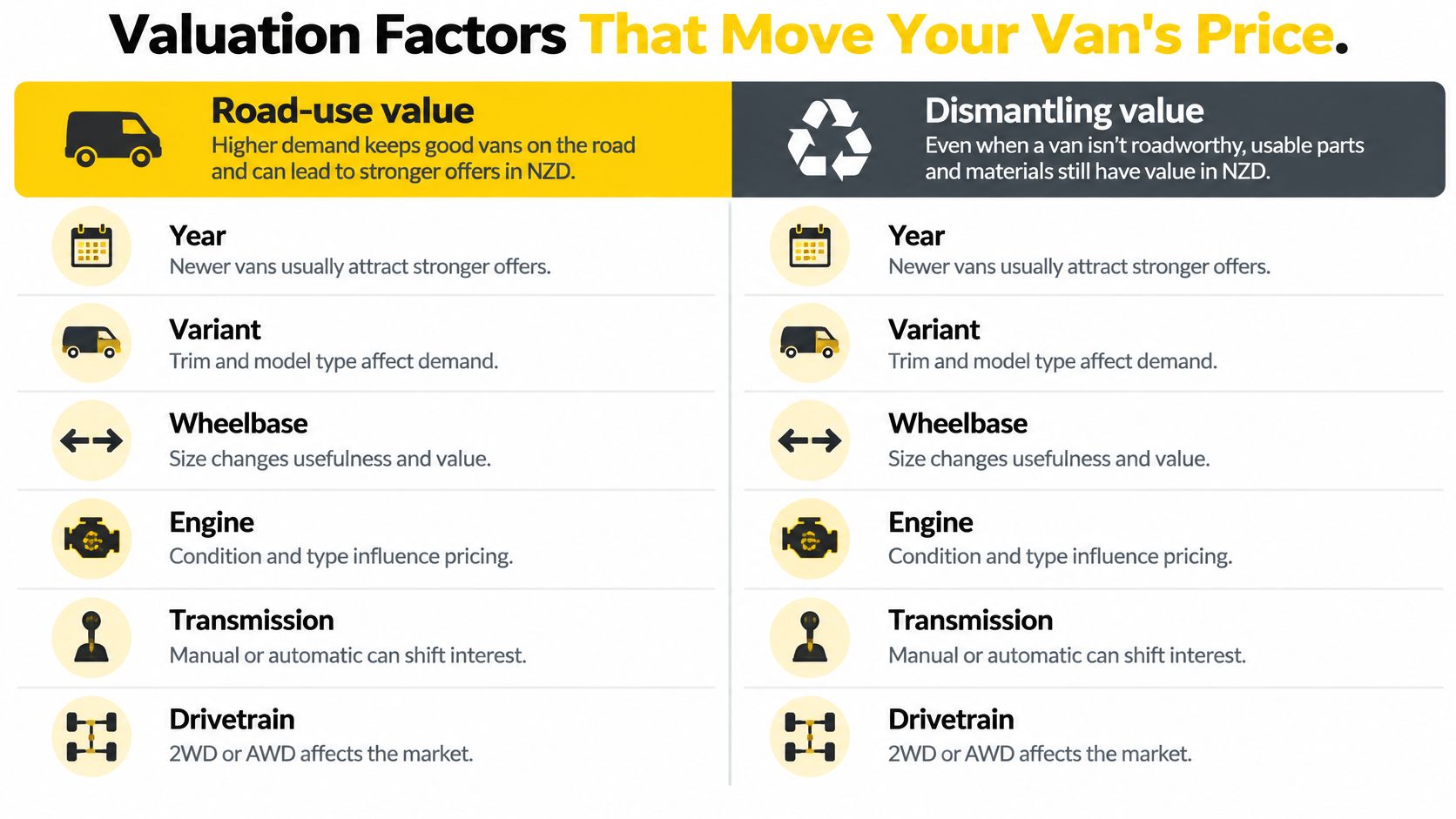
Every offer comes out of one of two calculations. Road-use value asks what a driver will pay for a legal, working van. Dismantling value asks what the parts, fluids and metals are worth once the van stops being a van. Blur the two and you'll either overprice a wreck or give away a good runner.
Classification comes first, and it follows a fixed order: year, variant, wheelbase, engine and transmission, drivetrain, mileage, registration status, WoF or CoF status, structural condition and completeness. The same NZTA selling guidance sets the benchmark most sellers miss, that a light vehicle offered for a normal sale should carry a WoF less than one month old, and that a van which can't be certified has to be handled as unroadworthy rather than sold as a runner (NZTA guidance on selling a vehicle).
Here's how those factors stack up at the point where an offer is made.
| Van condition | What sets the value | First check |
|---|---|---|
| Running with a current WoF | Roadworthy retail value | Body rust and engine or gearbox noise |
| Running with an expired WoF | Retail value less the cost of a WoF repair | Quote for the WoF repairs |
| Non-running but complete | Reusable parts plus recoverable metal | Engine and gearbox rotation |
| Accident-damaged | Undamaged parts and metal, less disposal | Airbag deployment and chassis alignment |
| Flood-damaged | Metal and sound parts only | Electronic modules and contamination |
The Checks That Change the Figure
On a non-runner or a crash repair, walk the van systematically rather than by impression.
- Driveline: does the engine turn, does the gearbox select, is the differential intact.
- Body: doors, sliding-door mechanisms, load floor, chassis rails, undamaged panels.
- Electrical: lights, electronic modules, instrument cluster, any hybrid or EV high-voltage gear.
- Wheels and interior: tyres with tread, alloys, seats, trim, and whether the factory toolkit and spare are still there.
- Damage history: airbag deployment, flood contamination, fire, and whether the van has been stripped of major parts by a previous owner.
The Comparison That Flatters the Wrong Number
The most common pricing error is comparing a dismantler's immediate cash offer with a retail asking price. Those two numbers measure different things. The retail figure assumes repair time, certification, advertising, storage, viewings and the genuine chance the buyer backs out after a deposit. Subtract those costs from the retail price and the gap usually narrows to something much less dramatic.
A better method is to collect itemised offers from different types of buyer, disclose every material defect up front, and compare the guaranteed net amount after towing and deductions. If you want a second reference point before you ring anyone, run the van through an online car valuation check and see whether the range matches what you've been quoted.
Selling a Van That Won't Run or Has No Registration
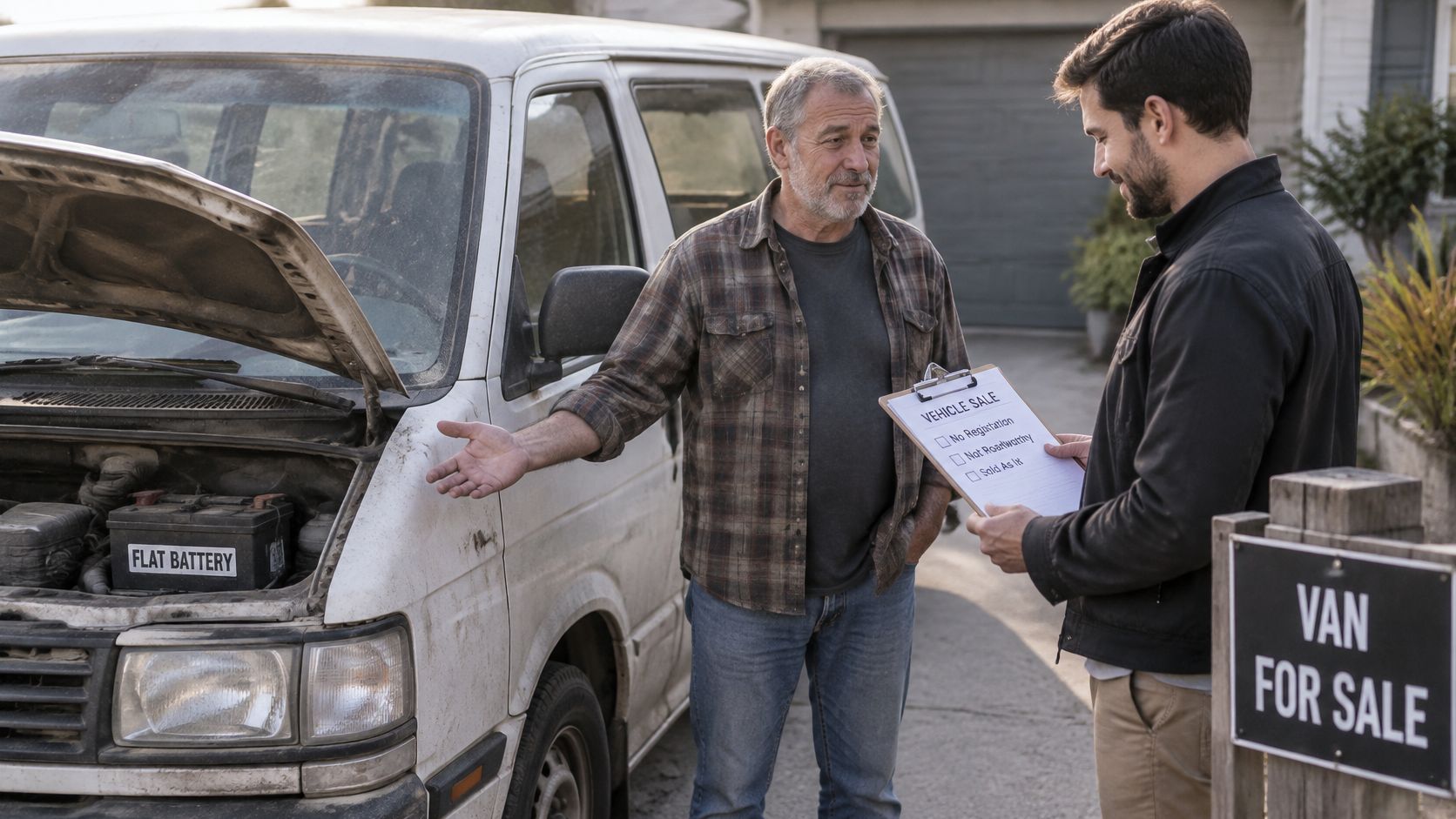
A Hiace with a seized motor and a registration that lapsed last winter still has two prices. One is what a private buyer pays after you fund an engine or gearbox and a fresh WoF. The other is what a dismantler pays now for the chassis, panels, diff and steel. On a damaged or dead van, the parts figure is often the higher one.
| Van status | Legal sale route | Paperwork needed |
|---|---|---|
| Registered with current WoF | Private sale, trade or auction | NZTA notice of disposal at pickup |
| Registered with expired WoF | Private sale after WoF repair, or dismantler | WoF repair quote and notice of disposal |
| Registered but permanently off road | Dismantler | Deregistration and notice of disposal |
| Unregistered, no WoF | Dismantler firm quote | Proof of ownership and photo ID; buyer must re-register before road use |
| Written off, fire or flood damaged | Dismantler or salvage | Insurer salvage check and notice of disposal |
How a Van Leaves the Active Fleet
Three exits exist, and they are not interchangeable. The van is resold to another owner, deregistered, or dismantled and scrapped. Ministry of Transport data show the light commercial fleet grew from 347,325 vehicles in 2000 and that light commercials rose 70% over the previous decade (Ministry of Transport annual fleet statistics sheet). A van that fails inspection, or needs a gearbox the repair cannot justify, still holds value in parts and materials. Car Removals Whangarei pays cash from $200 up to $15,000, with the figure set by make, model, year, weight, completeness and current parts demand.
The Repair Test Before You List
Run the comparison in this order.
- Confirm the van is still registered in your name. If someone else is on the register, you cannot dispose of it cleanly.
- Get a real repair number. Price the engine or gearbox job properly, including certification, rather than guessing.
- Set that number against a roadworthy private sale. If the repair costs more than the van would sell for once certified, stop spending. I would take the dismantling payout: recoverable parts and kerb weight beat a project that stays in the driveway.
- Sell it non-running and disclose everything. A firm phone quote on a described van beats a retail listing that draws buyers who arrive, look, and leave.
Deregistration is a real step. A vehicle permanently taken off the road must be deregistered, and describing the van as scrap does not complete that step.
No WoF or registration is needed to sell a vehicle to Car Removals Whangarei. A van with no plates or papers is still accepted if you show photo ID and confirm you are entitled to sell it. For a van already past a sensible repair, broken car collection covers the pickup.
Name fire damage, flood contamination, airbag deployment and missing major parts before the truck arrives. Those defects decide whether the offer is a parts price or a project price. If the insurer still holds salvage rights on a write-off, check with the insurer before you sell.
How to Complete the NZTA Change of Ownership
A roadworthy van can still be worth listing privately. The same van with a blown motor or a seized gearbox is often worth more as recoverable parts than as a project nobody will certify. Either route leaves the same hole if the register is ignored. The sale isn't finished when the keys change hands. Both parties must notify NZTA for the change of registered person to be complete, and until that happens tolls, licensing charges and speed camera penalties can still land on the person whose name is on the register (NZTA vehicle ownership). On a dismantling sale, Car Removals Whangarei handles that seller notice at pickup, before the van is loaded.
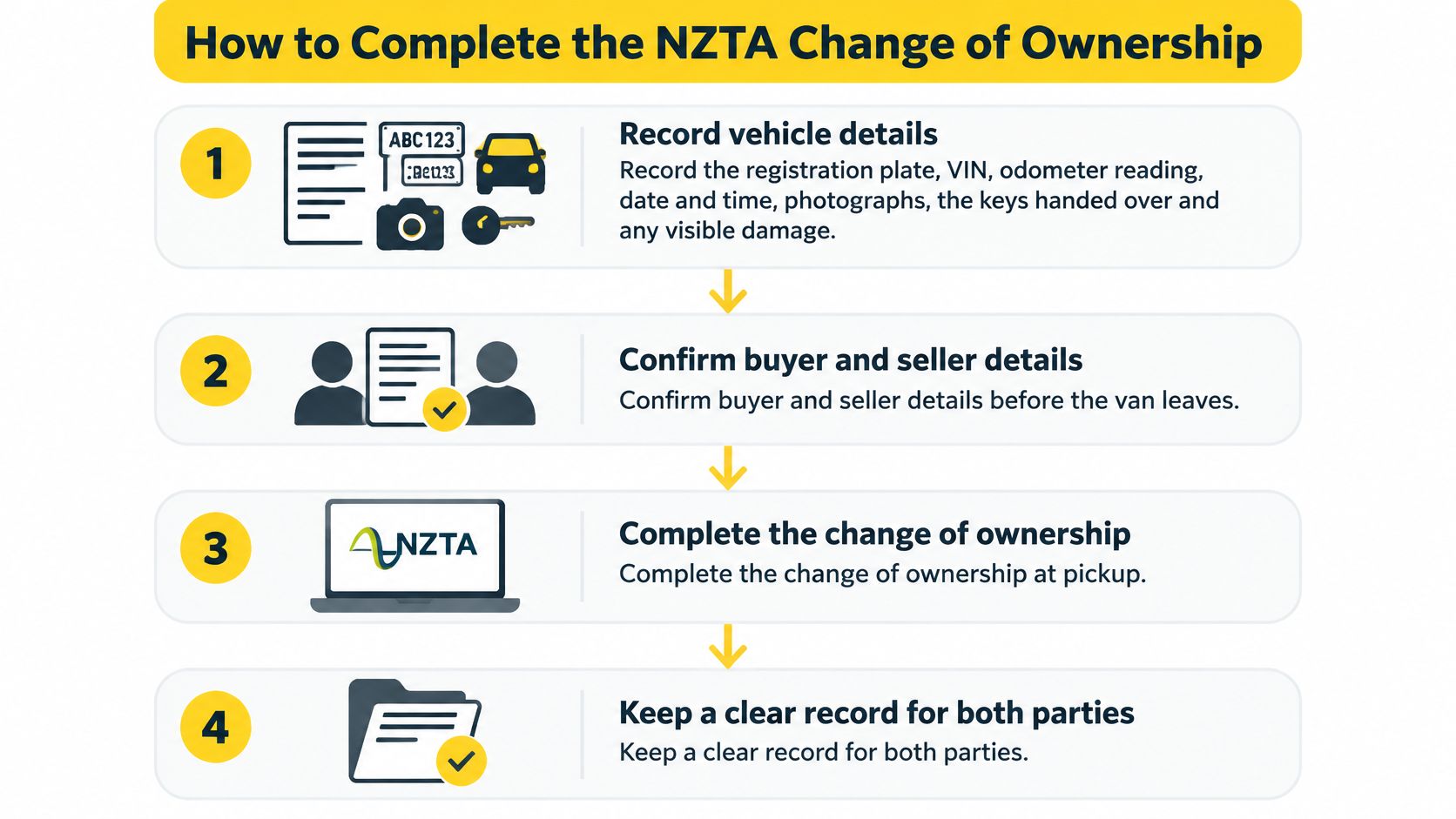
- Record the van before it moves. Registration plate, VIN, odometer reading, date and time, photographs of every panel, the keys handed over and any known faults. This is the file you'll want if a question arrives in six weeks.
- Verify the buyer. Full legal name and address exactly as they appear on their paperwork, not a first name and a mobile number. A dismantler gives you the trading name and the yard address.
- Confirm the notice of disposal has been lodged. Car Removals Whangarei files it at pickup so the van leaves your name. I would not treat a verbal promise as done. Watch that it is lodged, then keep the written confirmation they can supply for fleet or accounting records.
- Close off toll accounts and licensing associations. An active toll account tied to the plate is the classic way a clean sale turns into a letter in your mailbox.
- Keep the confirmation and a written receipt. Screenshot or file the NZTA confirmation, photograph the signed receipt, and store both with the sale photos.
Who Is Actually Entitled to Sell the Van
Only the legal owner, or someone holding the owner's written authority, can sell it. That sounds obvious until a family van is registered to a deceased parent or a company that's been wound up. If an insurer still holds salvage rights on a written-off van, check with the insurer before selling, because the payout and the wreck can belong to different parties.
Before the sale, check the Personal Property Securities Register for any registered security interest, and clear it before the van changes hands.
Pitfalls That Resurface Months Later
- Keys handed over before you've confirmed the disposal is lodged. Once the van is on the truck, chasing a missing notice is slower than checking it at the kerb.
- An approximate buyer name. "Dave from the yard" won't satisfy a register that wants a legal entity.
- A private as-is sale treated as a substitute for notification. As-is covers condition, not the register. A private buyer may pay more for a roadworthy van, and you still carry the register until the notice is filed.
- Assuming the plate comes off the record. It doesn't until the paperwork is filed.
The NZTA registration change of ownership process is the part worth getting right the first time, because fixing it afterwards means tracking down a buyer who has no reason to help you.
Payment, Pickup and What Can Change the Offer
Most disputes in this trade happen at the last metre, not in the negotiation. Get the money mechanics straight before the truck is booked.
The seller is paid at pickup, before the vehicle is loaded, by cash or instant bank transfer at the seller's choice. There are no hold-backs and no cheque in the post. Confirm which method you want when you book, not when the driver is standing in your driveway with the keys in his hand.
Before the truck arrives: agree the payment method, have the bank app open or the cash counted, and know exactly who is signing the receipt.
A quote can be revised at pickup if the van differs materially from the description, for example major parts missing or a van a tow truck can't physically reach. You can decline at that point and the vehicle stays where it is at no cost to you. That's the reason accuracy on the phone protects your number rather than threatening it.
Preparing for the Day
- Describe the van accurately. Missing wheels, a stripped interior, rust in the load floor, a gearbox that's already gone. Every surprise at the kerb is a reason to revise.
- Photograph it. Body, engine bay, interior, odometer and any warning lights. Send them with the enquiry if you can.
- Clear your gear out. Tools, stock, child seats, the paperwork in the glovebox. Decide whether you're keeping the plates.
- Walk the access route. Gates, steep driveways, soft ground, low branches, a rural track that's had 50mm of rain on it. A tow truck needs room to turn and a surface that will take the weight.
- Have the keys ready. Both of them, plus the spare fob if there is one.
The tow and pickup are free, so nothing should be deducted for transport on the day. Get that in writing on the quote and check the final figure against it before you sign anything. A quote only holds when the van on the trailer matches the description you gave.
Confirm Your Route and Book Your Van Collection
A Hiace with a current WoF can still justify a private sale: photos, a test drive, and days of messages. The same van with a blown motor, a rusted chassis or no registration is often worth more as parts and steel than as a project. Sell a roadworthy van privately or trade it. If it will not run, is damaged, or the registration has lapsed, take a dismantler's firm quote and compare the two nets before you pay for a WoF you may not recover.
Car Removals Whangarei is a licensed dismantler in Port Whangarei, and the booking path is short.
Put your name, phone, the van's details and the pickup address on the online form. On the call, give the make, model, year, rego and rough condition, and you get a firm cash figure in about two minutes. Offers run from $200 to $15,000, set by make, model, year, weight, completeness and current parts demand. I would accept only when that number beats a realistic private-sale net, after time on the market and any repair still required.
Have proof you own the van, or the owner's written authority, and plan the NZTA change of ownership for pickup day. Rural Northland pickups run on scheduled regular routes, typically next day, so it helps to book as early as you can.
If your van is past the point where a WoF repair makes sense, Car Removals Whangarei buys it as it sits, running or not, registered or not, and pays cash before it is loaded. You get a firm quote based on parts demand and steel pricing rather than a hopeful retail guess, free towing within about 100 km, and the NZTA change of ownership completed at pickup so your liability ends when the van leaves. Send the make, model, year, rego and a rough description through Car Removals Whangarei and compare the figure against your own net-number test.
- sell my van
- sell van Whangarei
- van valuation NZ
- NZTA ownership transfer