· Car Removals Whangarei
Scrap Metal Recycling in New Zealand: Yard to Steel Mill
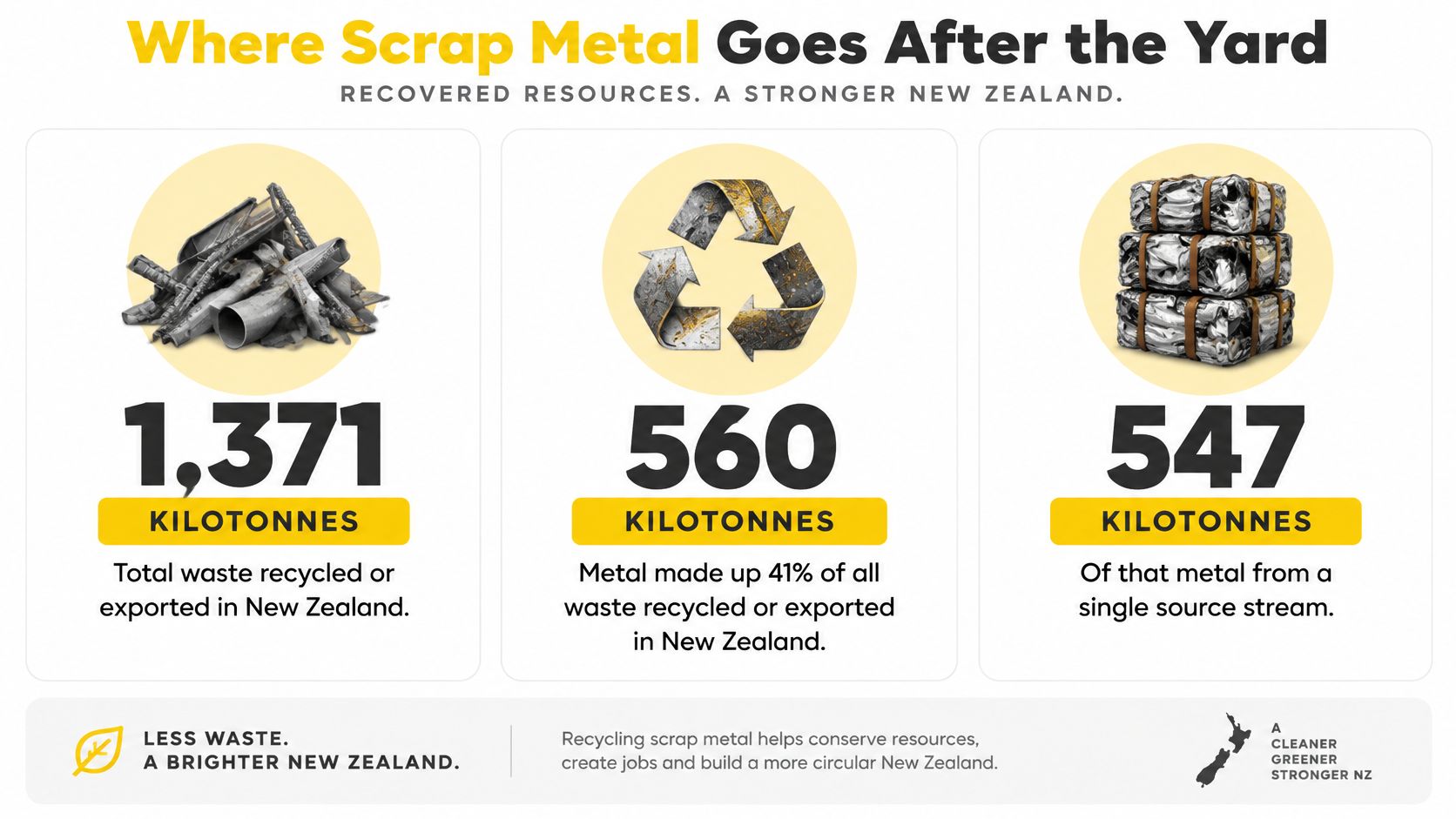
Almost all of New Zealand's recycled metal leaves the country. A joint Ministry for the Environment and MBIE analysis estimated that, of 1,371 kilotonnes of waste recycled or exported, metal was 560 kilotonnes, or 41%. 547 kilotonnes of that metal, 98%, was exported for processing overseas, and only 13 kilotonnes, about 2%, was recycled domestically in the data presented.
That scale is why one dismantled car still matters. The shell is a small slice of a national export stream, and the quality of the handoff decides whether the steel, aluminium and copper stay usable.
Weight sets the floor of what a Northland owner is paid. Condition, parts demand and a safe handoff decide the final outcome. A vehicle that starts isn't automatically worth more than one that doesn't. A clean, depolluted shell with saleable parts beats a heavier wreck full of oil, glass and a damaged battery.
Scrap metal recycling for an end-of-life vehicle is a relay, not a single drop-off. The yard runs the first leg. Processors and mills run the rest.
Table of Contents
- Where Scrap Metal Goes After the Yard
- How Scrap Vehicles Are Valued
- How to Depollute a Scrap Vehicle Safely
- Sorting Metals So Each Stream Earns Its Value
- Handling Electric and Hybrid Batteries Safely
- Paperwork and Booking a Removal Safely
Where Scrap Metal Goes After the Yard
Local transfer stations already show how much metal sits in the Northland mix. Far North District Council records attributed 16.58% of recyclable volume to scrap metal in July 2025, and individual collections recorded several cubic metres sent to a metal recycler. That volume covers household and farm metal alongside vehicles. Once a car enters a yard, it joins the same outbound stream.
Three stages a shell has to clear
A yard controls only the first stage, but it decides how the rest go. A shell that reaches a processor oily, mixed and full of plastic can't be placed as a specified grade.
- Collection and depollution. The vehicle is identified, fluids are drained to New Zealand environmental standards, and the battery, tyres and airbags come off before anyone bales the shell. Skip this and the metal is still waste with a hazard attached.
- Sorting into clean streams. Steel stays with steel. Aluminium wheels, copper harnesses and stainless exhaust sections come off as their own lots. Mixed feed is harder to sell and easier to downgrade.
- Export or domestic reprocessing. The bulk of recovered metal leaves the country for processing, while a smaller share stays with manufacturers when the scrap suits their furnaces. Your car doesn't need a nearby mill to count. It needs a yard that hands over a clean fraction.
Engines, gearboxes, panels and electronic modules often outearn the bare shell, which is why used car parts in New Zealand sit alongside the scrap price in a proper dismantling job. A stripped shell can still be recycled and still pay very little, because the pieces buyers want have already left. Weight sets the floor. What stays on the car sets the rest.
What to ask before you hand over the keys
Ask this before you book: Where does the shell go after the yard, and are fluids and batteries removed on site?
If the answer is vague, the metal may still be recycled later, but the mess has already shifted onto a drain, a paddock or a council site. A licensed dismantler keeps those steps on the record, which is what stops a recyclable car becoming someone else's waste problem. When each stage is done properly, roughly three quarters of a scrapped car by weight comes back into use.
How Scrap Vehicles Are Valued
A scrap quote isn't a verdict on whether the engine turns. It's a split between steel weight, which sets the base, and recoverable parts, which sit on top. We price on parts demand and steel weight, not on whether the vehicle starts. A dead car with a good gearbox can outpay a runner that's already been picked clean.
Two identical sedans at the same kerb weight will not quote the same. Leave the engine, gearbox and interior in the first, and the buyer is pricing parts plus steel. Pull the engine from the second, and you're mostly selling weight. Complete scrap vehicles are worth more than stripped shells for that reason. The extra metal in a complete car isn't the prize. The components still in demand are.
| Vehicle condition | What drives the value | Effect on the quote |
|---|---|---|
| Complete and running | Parts demand plus steel weight | Highest value, because engine, gearbox and body parts resell |
| Complete but non-running | Parts demand plus steel weight | Starting status doesn't matter; the parts do |
| Stripped shell | Kerb weight plus any remaining salvage | Lower, because the most valuable parts are already gone |
| Crash or flood written-off | Usable panels, engine and electronics | Quote tracks what survived, not the write-off label |
| EV or hybrid | Traction battery value and high-voltage isolation effort | A sound pack can lift the quote; a damaged pack can cut it |
How each row moves the number
A complete runner is the top of the table because more than one buyer wants the same pieces. Gearboxes, diffs, doors and headlights move faster than a tonne of mixed steel.
A complete non-runner is closer to that top than owners expect. Seized motors, flat batteries and failed warrants don't wipe the parts list. What matters is whether the gearbox, ECU, wheels and body panels are still intact.
A stripped shell falls to kerb weight plus whatever small salvage is left, such as a converter or a set of alloys. Non-rolling shells are still worth collecting. They just shouldn't be priced as if the drivetrain were still there.
A crash or flood write-off is judged part by part. A bent rail can leave a good engine, a clean door and working electronics. Flood height matters more than the insurer's label. Electronics and looms that sat in water are often unsaleable even when the steel looks fine.
An EV or hybrid adds a third line, the traction battery. A sound pack can add value. A damaged, inaccessible or hard-to-move pack can reduce it once isolation and transport are costed. Chasing the highest scrap figure without costing that pack is how quotes unravel at pickup.
If a quote won't say whether it covers weight, parts, or both, and whether condition has already been allowed for, it isn't a firm quote.
The highest-value option is seldom the vehicle with the most metal. It's the one where saleable parts are still identified, hazards are already priced, and the shell weight is only the floor.
How to Depollute a Scrap Vehicle Safely
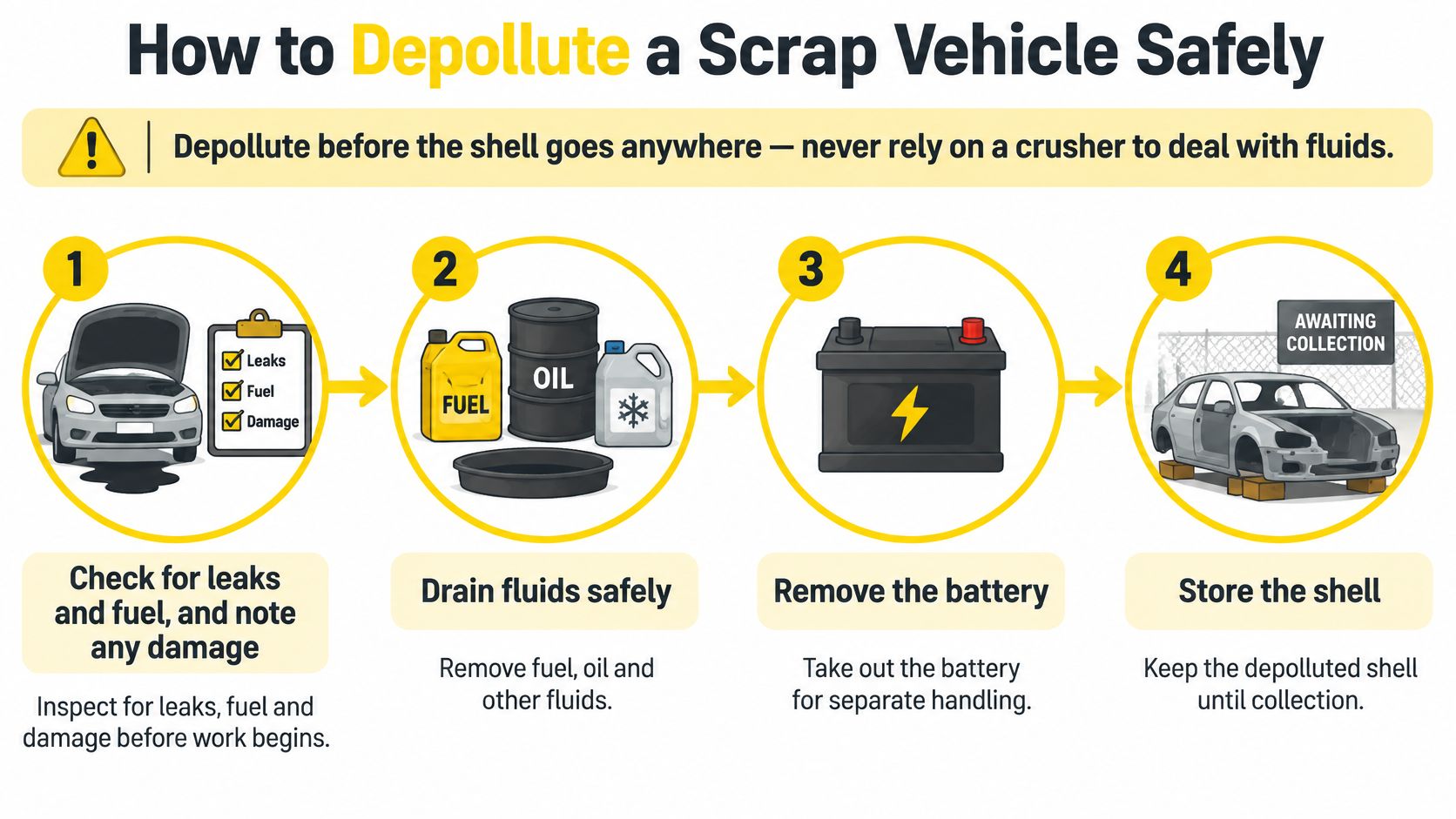
Depollute before the shell goes anywhere. Never rely on a crusher to deal with fluids. Oil in a baled shell doesn't vanish. It leaks in transit, contaminates the ferrous fraction, and can end up in a drain. A live airbag can still fire if someone cuts into the wrong pillar.
The sequence that keeps the steel clean
- Walk the vehicle before any drain plug comes out. Look for leaking sumps, split fuel lines and damage that will spill once the car is lifted. Note the damage so the crew stages drip trays before the tow starts.
- Drain engine oil, transmission and differential oil, coolant and brake fluid into labelled, sealed containers. Unsealed oil is the failure mode that reaches stormwater. Fuel comes out the same way, never onto the ground to "empty it quicker".
- Disconnect the 12-volt battery and set it aside for a battery recycler. Leave any traction battery to trained staff. A starter battery is a lead-acid unit. A traction pack is a different job entirely.
- Remove the tyres for separate recycling. Rubber left on the shell adds contamination and no useful steel. Tyres come off each vehicle rather than going through the baler.
- Have trained staff remove airbags and pretensioners, and recover refrigerant with certified equipment. An undeployed airbag is a stored charge, not trim. Refrigerant vented to the air is a release, not a shortcut.
- Remove the catalytic converter intact. Cutting it open on the driveway throws away the value and scatters the ceramic. It travels as its own item, not as part of the exhaust in the steel pile.
- Strip non-metallic trim, glass, plastic and upholstery so the steel stays clean. Glass and plastic in the ferrous fraction are what processors reject or downgrade. Cleaner feed is the point of the labour.
- Record each fluid and component removed. A log is what shows the shell was depolluted, not merely flattened. It also tells the next holder which hazards have already left the vehicle.
Why the recovery rate changes the climate result
Clean ferrous recovery is what the carbon maths rewards. A HERA-commissioned thinkstep-anz assessment estimated that about 545 kilotonnes of steel scrap were collected annually, with a net benefit of about 793 kilotonnes of CO₂-equivalent under its 2020 assumptions. At a 72% recovery rate, each tonne of recovered steel scrap avoided about 1,054 kg CO₂-equivalent, and modelling a 100% recovery rate lifted that to about 1,471 kg CO₂-equivalent per tonne.
That gap is why fluids, batteries, tyres, trim and hazardous parts come off before a shell is trucked or shredded. Transport to overseas recycling still sits inside the footprint, so consolidating loads and skipping extra yard-to-yard moves protects the benefit you just earned on the steel. A single muddy shell on its own truck is a worse outcome than a full, depolluted load.
Sorting Metals So Each Stream Earns Its Value
Processors pay for clean, identifiable streams. They struggle with mixed residues because a shredder pile can't be specified as steel, aluminium or copper. Domestic capacity makes that grading sharper, not looser. The Ministry for the Environment infrastructure stocktake reports that recovered ferrous metal is reprocessed in relatively small quantities in New Zealand, mainly through manufacturing, and that recycling aluminium takes about 5% of the energy used to produce primary aluminium. Two large steel-production facilities in the Auckland region take recovered steel, with the share moving according to how much suitable scrap is on hand, while smaller quantities of copper, stainless steel and aluminium alloys are also processed.
| Material | Where it sits in a vehicle | How to handle before sale | Why it matters |
|---|---|---|---|
| Ferrous steel | Body panels, chassis, frames and the bare shell | Keep clean and free of trim, glass and plastic | Most of the metal stream is steel, and clean feed is worth more |
| Aluminium | Wheels, radiators, engine blocks and some panels | Keep separate from steel | Recycling uses about 5% of the energy needed for primary aluminium |
| Copper | Wiring harnesses, motors and some electronics | Pull out and keep apart from steel | Mixing dilutes a stream that processors specify separately |
| Stainless steel | Exhaust sections, trim and some fittings | Separate from carbon steel | Reprocessed in smaller volumes in New Zealand |
| Catalytic converters | Exhaust system near the engine | Remove intact and keep as a separate item | Carry platinum-group metals that are recovered apart from general steel |
Why each split changes the price
Ferrous steel is the bulk. A clean body and chassis, free of headliners, glass and bumper covers, is what a mill or an exporter can book as a grade. Leave the interior in and you're selling a disposal problem with the metal.
Aluminium is the energy-sensitive stream. Wheels, radiators and some panels should stay identifiable rather than riding inside the steel bale. Once they're mixed, nobody captures that energy saving, and you don't get paid for a non-ferrous grade. Alloys and converters are the add-ons that move a scrap quote off pure weight, which is also why it pays to watch scrap metal prices in New Zealand as separate lines, not one blended number.
Copper is small in kilos and large in value. Harnesses and starter motors disappear into general steel if nobody pulls them. The steel buyer then has a contaminated grade, and the copper buyer never sees the lot. Stainless exhaust sections and trim are a thinner domestic stream, so they need their own bin rather than a toss into the carbon-steel pile. Converters stay intact because the platinum-group metals are recovered on a different line from the shell.
Before anything leaves the site, pull ferrous steel apart from aluminium, copper, stainless and mixed residues. Four labelled piles beat one heavy heap. The heap looks like more metal. It pays like less.
Handling Electric and Hybrid Batteries Safely
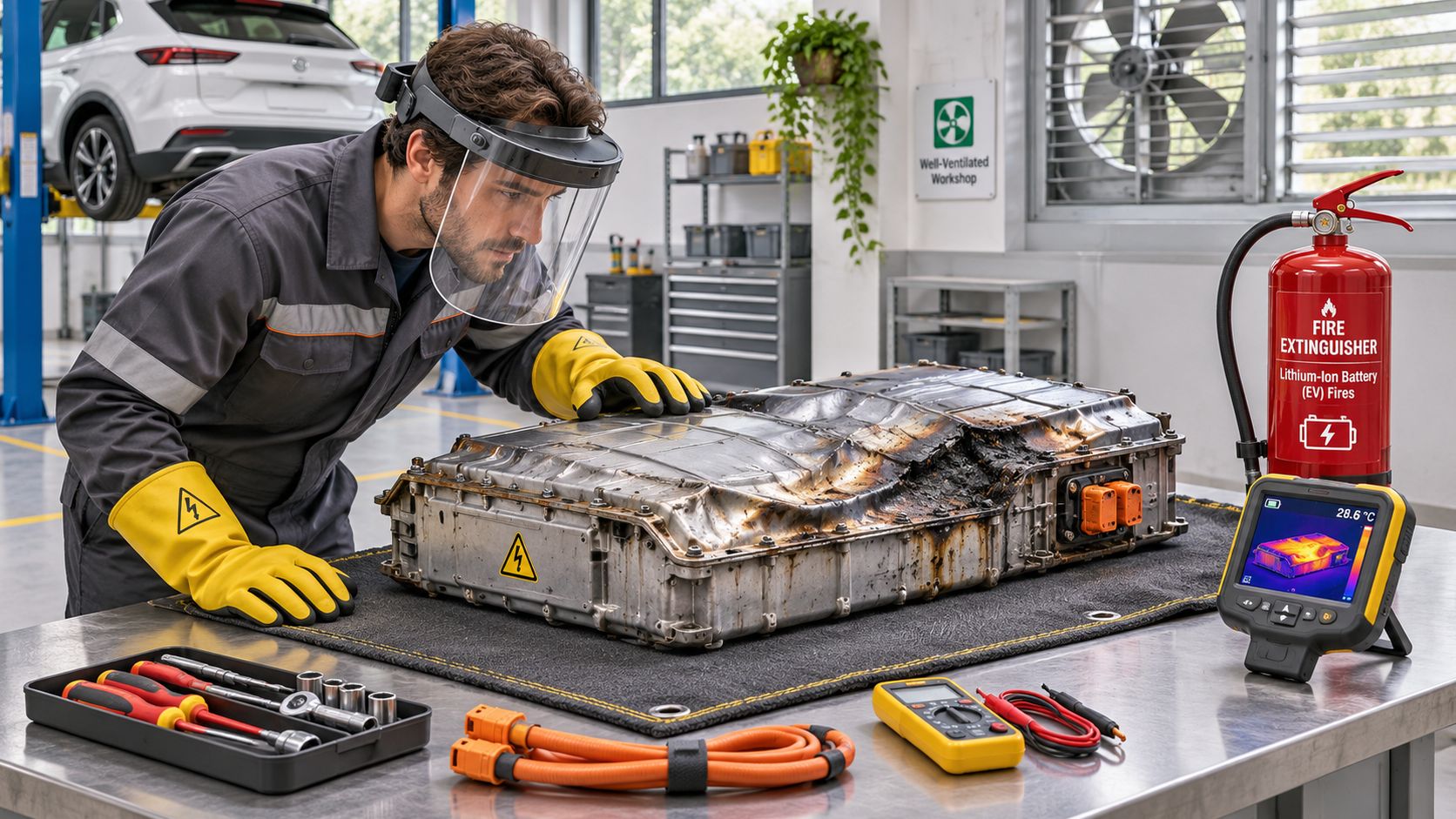
The assumption that a hybrid or EV is just a higher-value scrap car is the one that gets people hurt. A damaged lithium-ion traction battery can catch fire, and the risk doesn't end when the engine does. Chasing the maximum scrap figure, then asking the owner to "just drop the battery off", is the wrong trade.
New Zealand treats large batteries, including EV traction batteries, as a priority product under the Waste Minimisation Act, yet there is still no mandatory product-stewardship scheme and no nationally standardised end-of-life procedure. The VIA end-of-life battery report sets out that gap, and Vector modelling estimates New Zealand could face nearly 84,000 end-of-life EV battery packs needing management each year by 2030. Until a scheme is in place there is no single rulebook, so the safety margin depends on who handles the vehicle.
| Battery | Typical vehicle | Main risk | Owner action |
|---|---|---|---|
| Lead-acid | Petrol and diesel vehicles, as the 12-volt starter battery | Acid leakage and lead exposure | Don't drain or tip it. Leave it in place for the dismantler |
| Nickel-metal-hydride | Older hybrid traction packs | High-voltage shock and heavy pack handling | Leave removal to trained staff; don't open or move the pack |
| Lithium-ion | EV and newer hybrid traction packs | Thermal runaway fire if damaged or left unmonitored | Never remove, puncture or move the pack; ask the dismantler to document isolation and transport |
The four questions worth asking
Is it safe to tow after a crash or a flood? Only after an isolation check. A cracked housing, a submerged pack or a vehicle that smells sweet and chemical needs assessing before a hook goes on. Flat-towing a car with an unknown high-voltage state is how a recovery job becomes an incident.
Who isolates the high-voltage system? Trained dismantling staff, not the owner and not a general scrap handler with side cutters. Isolation is a documented step: the 12-volt system is separated, the traction pack stays sealed, and the vehicle is recorded as safe to move.
Does chemistry change the payout? Yes. A serviceable pack can add to the quote. A swollen, punctured or flooded pack can reduce it, because hazardous-goods transport and downstream handling cost real money. Recoverable metals inside a damaged pack don't override that cost.
Can a damaged pack be stored or transported legally? A damaged pack can't go out as ordinary scrap, and it can't sit in a shed "until someone wants it". Storage and transport follow hazardous-goods rules, which a dismantler arranges. Owners shouldn't deliver the pack themselves.
Never remove, puncture or move a traction battery yourself. Ask the dismantler to document isolation and where the pack goes next.
A battery with recoverable material can still be the line that lowers the quote. Weight sets the floor for what any vehicle is worth, but condition and a safe handoff decide what an owner walks away with. The safe price is the one that still looks right after the fire risk is priced in.
Paperwork and Booking a Removal Safely
The step owners skip is the one that leaves their name on the record after the car is gone. NZTA states that an owner selling a registered vehicle to a wrecker must notify the agency that the vehicle has been sold, and the NZTA change of ownership process is what moves liability off your name at pickup. If you cancel registration before the sale, NZTA requires an application to cancel registration, form MR15, through a registration agent, and the number plates must be handed in.
That paperwork matters most for deregistered cars, failed warrants and insurance write-offs, because those are the vehicles people assume have already left the system. They often haven't. A ute that sat behind a shed for six years can still carry your name if nobody filed the notification.
What to have in hand
- Registration details or plates. Bring what you still hold, even if the car hasn't been on the road for years.
- Photo identification. This ties the seller to the vehicle at pickup.
- Proof you can sell it. Registration papers where they exist, plus a clear statement that you're entitled to sell.
- Insurer documents. Write-off paperwork, and a check on who owns the salvage.
Three checks come before a price is agreed. Confirm you're dealing with a licensed dismantler rather than a general scrap yard that can't depollute on site. We are a licensed Northland dismantler, and scrap cars with no plates or papers are accepted when the seller shows ID and confirms they are entitled to sell. If an insurer is involved and retains salvage rights, check with the insurer before selling the vehicle.
Three ways a vehicle leaves a property
A licensed dismantler buys the vehicle, completes the ownership notification on site, drains fluids and removes batteries and tyres to New Zealand environmental standards, recovers the parts that still have demand, and bales the shell for steel recovery. Payment lands before loading. Liability moves when the vehicle does.
Leaving it on private land is not a holding pattern. A landlord, farm owner or body corporate should only have a vehicle removed when they hold authority to sell or clear it. Without that authority, a tow becomes another dispute parked on the grass. Lawful abandoned clearance works when the person instructing the removal can show they are entitled to arrange it.
Dumping is the option that spreads the cost onto everyone else. The Ministry for the Environment reported that about 25,000 cars were dumped illegally across the country each year, at an estimated $6 million cost for authorities. End-of-life vehicles are a hazardous waste issue because used oil, refrigerants, batteries and circuit boards have to be removed and treated or disposed of properly, rather than left in the vehicle or sent straight to landfill. A paddock at the back of a section doesn't change that.
What a proper booking sounds like
On the phone, ask whether the quote covers weight, parts and battery handling, and whether the ownership notification is completed on site. Payment terms should be agreed before the vehicle is loaded, and a firm phone quote should hold when the truck arrives. A non-rolling, empty or bogged shell shouldn't attract a call-out fee dressed up as a scrap adjustment.
The test of a finished job is simple. The paperwork is complete, fluids and batteries are logged, and the shell is baled for steel recovery. Anything short of that is a collection, not scrap metal recycling.
Car Removals Whangarei buys unwanted, damaged and non-running vehicles across Northland, depollutes them, recovers the parts that still have demand, and bales the shells for steel recovery. If you want a firm quote based on weight, parts and safe battery handling, with the ownership notification done at pickup, visit Car Removals Whangarei and tell us what you're clearing.
- scrap metal recycling
- scrap car removal
- vehicle depollution
- end-of-life vehicles
- Northland recycling