· Car Removals Whangarei
91 vs 95 Fuel in New Zealand: Which to Choose
Under New Zealand's fuel regulations, 91 is regular-grade petrol with a minimum Research Octane Number of 91.0 and a minimum Motor Octane Number of 81.0, while 95 is premium-grade petrol with minimums of 95.0 and 85.0. Those are legal floors for knock resistance, and the grade your engine needs is the one printed in the owner's manual or on the fuel flap, not the one with the bigger number on the pump.
So why does a tank of 95 feel smoother in one car and make no measurable difference in the next? Because octane doesn't measure energy. It measures how much cylinder pressure the fuel can take before it ignites early, and only an engine calibrated to use that extra margin turns it into something you can feel. For most drivers around Whangarei, the useful question isn't whether 95 is better, it's whether 95 pays for itself per kilometre in your car, at your local price gap.
Table of Contents
- 91 and 95 Petrol Side by Side
- What Octane Measures and What It Does Not
- How to Check Your Owner's Manual for the Grade
- When 91 Is Enough and When 95 Is Required
- Working Out Whether 95 Pays Off per Kilometre
- Symptoms of the Wrong Grade and How to Respond
- Check the Break-Even Figure Before the Next Fill
91 and 95 Petrol Side by Side
The two grades aren't a brand hierarchy. They're written into the Engine Fuel Specifications Regulations 2011, and the 2022 consolidated regulations define 95-octane petrol as premium-grade petrol with a minimum Research Octane Number of 95.0 and a minimum Motor Octane Number of 85.0, against 81.0 for regular petrol. RON and MON are two separate laboratory measurements of the same property, resistance to knock, taken under different test conditions, so a grade sold as 95 has to clear both thresholds. That's why 95 isn't 91 with a marketing claim attached.
| Grade | Minimum RON | Minimum MON | Engines it suits |
|---|---|---|---|
| Regular 91 | 91.0 | 81.0 | Engines approved for 91 in the owner's manual |
| Premium 95 | 95.0 | 85.0 | Engines that specify 95, or high-load and turbocharged engines |
The arithmetic is easy to misread. Four RON points sounds minor until you measure it against the 91 minimum, where it works out to roughly a 4.4% higher octane specification, as set out in the Engine Fuel Specifications Regulations 2011. That 4.4% is a percentage of knock resistance. It is not 4.4% more energy, 4.4% more litres per 100 km, or 4.4% more kilowatts.
New Zealand also sells 98 as a third grade, which official consumer guidance identifies alongside 91 and 95. This comparison stays with 91 and 95 because those two sit either side of the regular and premium boundary, and that boundary is where most drivers make a decision.
A pump label is a legal floor, not a tuning recommendation. The number tells you the minimum anti-knock performance the fuel must deliver under the national specification. What your engine's ignition timing and boost strategy expect is a separate question, and it's answered in the vehicle's own documentation.
What Octane Measures and What It Does Not
An octane rating describes how well petrol resists uncontrolled combustion, known as knock, at a given compression. New Zealand's 91 and 95 refer to minimum Research Octane Numbers, tested under ASTM D2699, and the corresponding minimum Motor Octane Numbers of 81.0 and 85.0 come from a more demanding, high-load test, as the Engine Fuel Specifications Regulations set out.
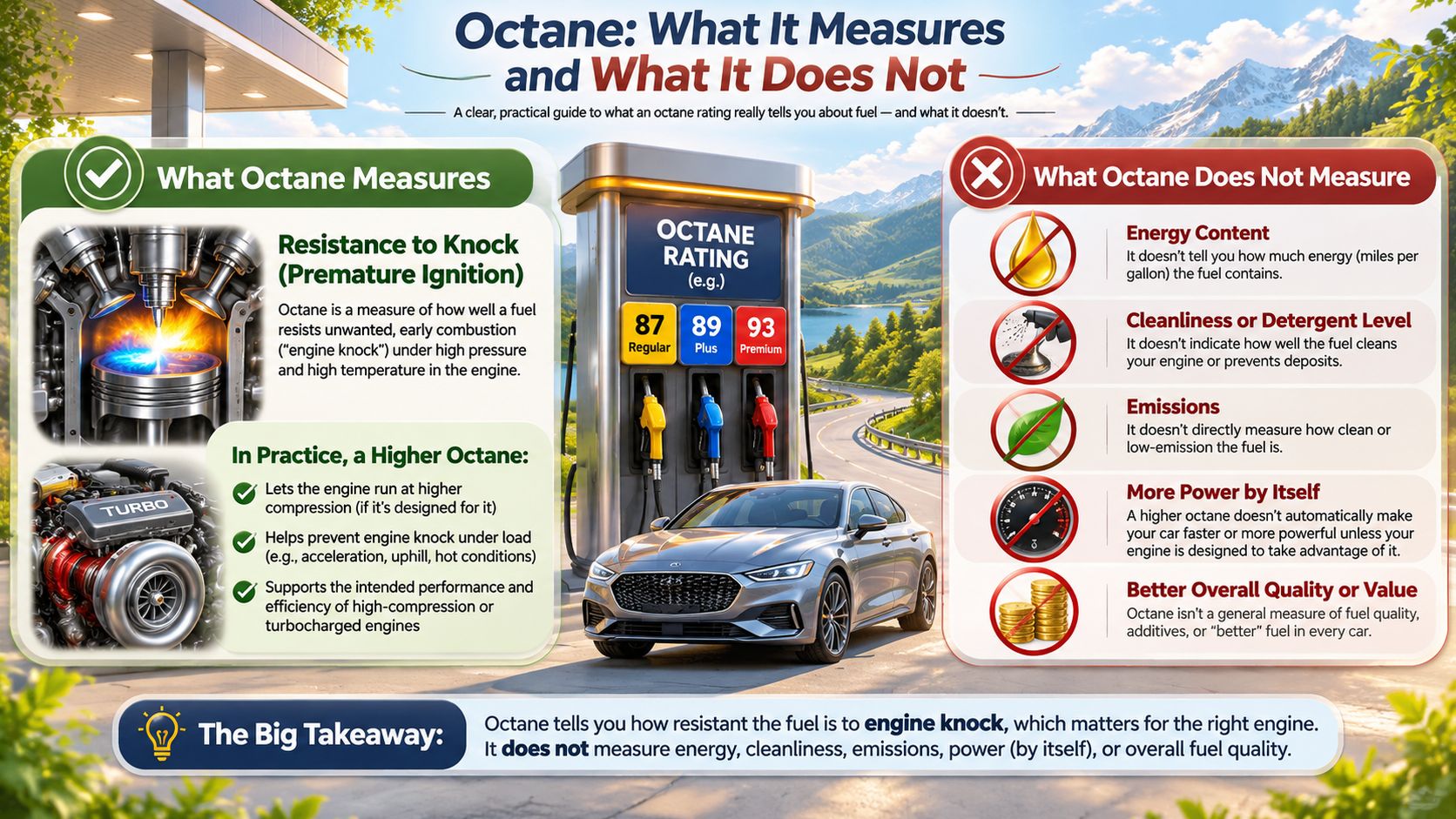
Here's the mechanism in plain terms. RON is measured under comparatively mild conditions. MON is measured under severe ones, closer to a hot engine pulling hard uphill with a load behind it. The four-point MON gap is the part that matters on real roads, because it describes how much better premium fuel holds its composure when cylinder pressures climb.
Where the extra margin earns its keep
The conditions that raise knock risk are ordinary Northland driving conditions, not racetrack ones:
- High engine load: a full car climbing the Brynderwyns on a warm day.
- High intake temperature: stop-start summer traffic with the air conditioning running.
- Towing: a trailer or boat adding weight the engine has to drag.
- Turbocharger boost: forced induction raises cylinder pressure by design.
- Steep gradients: sustained throttle on hills like those inland from Whangarei.
The misconception worth killing
Octane is not an energy rating. A higher number does not mean the fuel contains more energy, and it does not automatically deliver better economy or more power. The benefit only appears when the engine management system can use the extra knock margin, by running more ignition advance or more boost without triggering protection. That's why the same tank of 95 can transform a turbocharged engine's response and do nothing measurable in a small naturally aspirated commuter.
The one sentence to remember: Octane tells you how much protection against knock you're buying, not how far the car will go on a litre.
Official fuel-quality information makes the same point from the other direction, noting that octane doesn't indicate energy content and doesn't mean 95 petrol is 95 percent petrol, as the Trading Standards fuel information for consumers explains. A 95 label is a rating of behaviour under pressure.
How to Check Your Owner's Manual for the Grade
The manual is the deciding document, and finding the right line takes about two minutes. In New Zealand, 91-octane petrol is legally classified as regular-grade petrol with a RON of at least 91.0 but below 95.0, measured by ASTM D2699, so the number on the pump identifies a minimum anti-knock performance rather than a brand promise, per the current fuel specifications.
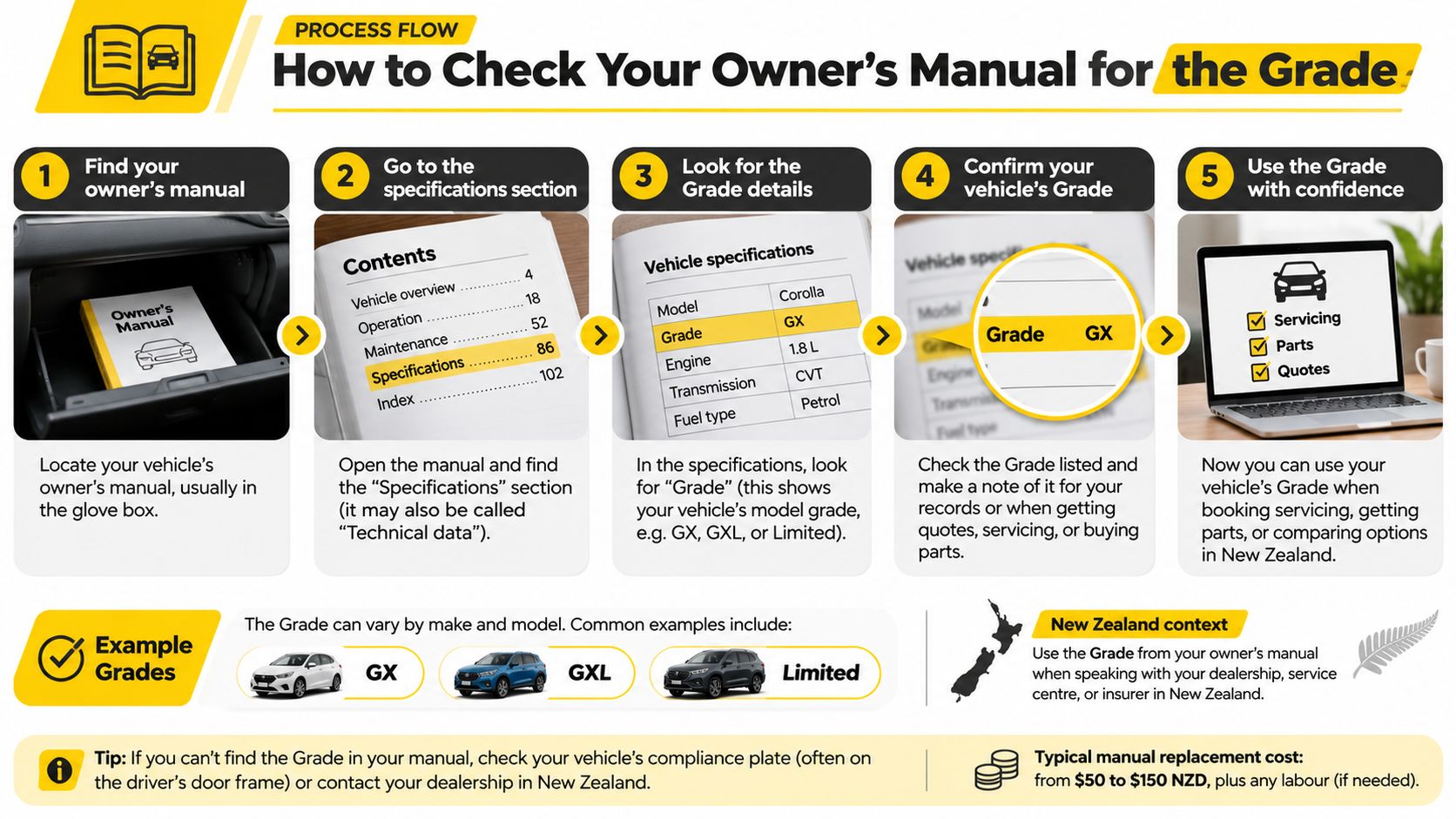
- Start at the fuel flap. The label inside it is the fastest reference the manufacturer gives you. The common slip is assuming it covers every variant of that model, when a different engine or tune in the same body can carry a different requirement.
- Open the manual and search the index for "fuel", "octane" or "RON". The requirement usually sits in the specifications table or the fuelling section, and searching beats flipping, because the wording you need is often one line in a dense table.
- Read the exact phrasing. "Minimum 91 RON", "95 RON required" and "95 RON recommended" mean three different things. The common slip is treating a recommendation as a requirement, or a requirement as a suggestion.
- Note when both grades are listed. If the manual says 91 is acceptable and 95 is recommended for full performance, both are approved. That's a cost decision, and it's the case where a break-even test earns its keep.
- Resolve any conflict in favour of the manual for your model year, then confirm with a dealer using the registration or chassis number. Flap labels get swapped, reprinted and lost.
- If there's no manual, search the manufacturer's site for your model's fuel specification. Older vehicles sometimes list the grade only in printed service literature, so a dealer parts desk is the practical fallback.
- Write the answer down. Put the exact phrase on a note in the glovebox or in your phone, so the next driver, or the next buyer looking over the car, doesn't have to guess.
Practical rule: the manual outranks habit, price per litre and whatever the previous owner used.
When 91 Is Enough and When 95 Is Required
Engine situations sort into a small number of cases, and each has a clear answer.
| Engine situation | Suggested grade | Why |
|---|---|---|
| Naturally aspirated engine approved for 91 | 91 | The manufacturer specifies it, and 95 adds little measurable benefit |
| Turbocharged or high-compression engine requiring 95 | 95 | 91 can trigger knock control and reduced power |
| Manual lists 91 and 95 as acceptable | 91 unless the break-even test favours 95 | Both are approved, so cost and measured economy decide |
| 91-approved engine used for towing or steep hills | 91 unless the manual advises otherwise | Heavier load raises knock risk only where the engine is designed to use more margin |
| Manual gives no grade and the flap is unreadable | Confirm with the dealer before filling | Guessing risks knock and reduced performance |
A small non-turbo hatchback commuting between Whangarei suburbia and the CBD is the easy case. The manufacturer approved 91, the engine's calibration was written around 91, and 95 has nothing to exploit. You'd be paying a premium for a margin the ignition map never asks for.
A turbocharged performance hatchback that calls for 95 is the opposite case. On 91, the engine's knock sensor detects the onset of detonation and the computer pulls ignition timing to protect itself, which costs power and driveability exactly when you're asking for both.
The mixed case is the interesting one. Say a manual lists 91 as acceptable and 95 as recommended for full performance. Both fuels are safe, so the decision becomes arithmetic on your own fuel log, not a question of mechanical risk.
For towing and hills, check the manual before assuming. Extra load raises knock risk, but it only costs you something in an engine designed to use more octane margin. A 91-rated ute towing a trailer within its rated capacity is doing what it was built for.
What the monitoring data tells you
New Zealand's nationwide fuel-quality programme tests these grades against enforceable minimums rather than marketing categories. The 2024–25 Fuel Quality Monitoring annual report records 162 of 162 regular-petrol samples at or above the RON 91 minimum, and 136 of 136 premium samples at or above RON 95, with premium samples also meeting the MON requirement of 85.
That's a 100% compliance rate in the reported sample, and it supports trusting the printed grade at the pump. What it doesn't show is that 95 saves fuel or adds power in an engine approved for 91. Reliable labelling and a measurable benefit are two different claims, and only one of them is backed by the monitors.
If a vehicle is being retired rather than driven, we at Car Removals Whangarei buy cars, utes and 4WDs in any condition, running or not, with a firm phone quote based on make, model, year and rough condition.
Working Out Whether 95 Pays Off per Kilometre
Price per litre is the wrong comparison. Cost per kilometre is the right one, and the formula is short: price per litre multiplied by litres used per 100 km, divided by 100. For a car burning 8.0 L/100 km, a litre price of NZ$2.67 gives 21.4 cents per kilometre. Change the fuel and you change both terms, which is why the grade question is a two-variable problem.
Stats NZ recorded a national average price of NZ$2.67 per litre for 91-octane petrol in the March 2025 quarter, per its March 2025 inflation release. Use that as your reference point and the premium becomes a number you can test, because the only way 95 wins is by using less fuel per 100 km.
| Premium over 91 | Implied 95 price at NZ$2.67 for 91 | Economy gain needed to break even |
|---|---|---|
| 5 cents | NZ$2.72 | 1.8% |
| 10 cents | NZ$2.77 | 3.6% |
| 20 cents | NZ$2.87 | 7.0% |
The percentages are the crux. A 20-cent gap demands a 7.0% improvement in fuel consumption just to stand still financially. A 5-cent gap needs only 1.8%. Price gaps move, too: the Commerce Commission's quarterly fuel monitoring reported that both 91 and 95 rose by 10 cents per litre, or 4%, in the December 2024 to March 2025 quarter, so the gap between them isn't fixed and neither is the break-even figure.
How to run the test properly
Pick one route you drive weekly and keep it. Set tyre pressures to the placard figure and check them at the start of each tank, because a soft tyre can cost you more fuel than any octane decision. Fill on 91 for three tanks, record litres and distance, then repeat on 95 over the same route in similar weather and traffic.
One tank proves nothing. Short trips, cold starts, a headwind on the harbour bridge and a week of school-run traffic will all swamp a 2% difference. If you're weighing up a specific vehicle purchase first, our guide to the Kia SUV line-up sold in New Zealand covers the models and what each one asks for at the pump.
Rule of thumb: if the measured gain is smaller than the break-even figure, 91 is the cheaper choice. If the manual requires 95, the sum doesn't apply, because you're buying protection rather than economy.
Symptoms of the Wrong Grade and How to Respond
The most common symptom is a light, rapid pinging under acceleration, often climbing a hill or joining a highway. That's the sound of 91 being asked to do a job the engine was calibrated for 95 to handle, or of the knock control system intervening late. Modern engine computers react fast, so by the time you hear it clearly, the protection has probably been working for a while.
| Symptom | Likely cause | What to do |
|---|---|---|
| Pinging or knocking under acceleration | 91 used where 95 is required, or knock control retarding ignition | Switch to the grade in the manual and book a check if it continues |
| Lower power or sluggish response under load | Ignition retard from knock control | Use the manual grade and check for stored fault codes |
| No change after switching to 95 | Engine approved for 91, so the extra knock margin is unused | Return to 91 and keep the savings |
Reading the symptoms correctly
Reduced power under load is the quiet version of the same problem. The engine isn't damaged, it's defending itself by retarding ignition timing, and the cost shows up as weaker pull on hills, heavier throttle for the same speed, and sometimes worse economy than you'd get on the correct grade.
A change that never arrives is equally informative. If you own a car approved for 91, fill it with 95 for a few tanks, and the fuel log shows no measurable difference, the engine never used the extra margin. Go back to 91. The savings are real and the protection was never needed.
Persistent knock is a warning to act on, not something to drive around.
If symptoms continue after you've been running the correct grade for a full tank, the cause may not be fuel at all. Stored fault codes, a failing knock sensor, carbon build-up raising compression, or an overheating engine can all produce similar behaviour, and a diagnostic scan is cheaper than guessing at the pump.
Check the Break-Even Figure Before the Next Fill
One worked fill-up turns all of this into a single number. Start with 91 at the national average for the March 2025 quarter, NZ$2.67 a litre, and a car using 8.0 L/100 km. That's NZ$21.36 to cover 100 km. Now say the local 95 price sits 20 cents higher, at NZ$2.87. To match that NZ$21.36, the car has to burn about 7.0% less fuel, which means 7.44 L/100 km or better. At exactly 7.44 L/100 km and NZ$2.87, 100 km costs about NZ$21.35. That's the break-even point, and 95 has to beat it to be worth buying on economics alone.
Now run the realistic case. Say your log over several tanks shows a 2% improvement on 95, which takes consumption to 7.84 L/100 km. At NZ$2.87 a litre, 100 km now costs about NZ$22.50, roughly NZ$1.14 more every 100 km than staying on 91. Over 15,000 km a year that's a meaningful sum spent on a margin your engine didn't need. If the manual allows either grade, stay on 91.
The decision tree collapses quickly from there:
- Manual says 95 required: buy 95, skip the arithmetic entirely.
- Manual says minimum 91: buy 91, and stop paying for protection the engine never asks for.
- Manual approves both: run the multi-tank test, then compare your measured gain against the break-even figure for your local price gap.
Tonight, open the fuel section of your manual, copy the exact phrase onto a glovebox note, whether that reads minimum 91 RON, 95 RON required or 95 recommended, and write today's station price gap beside it. The next fill then follows the break-even figure rather than habit.
If a vehicle in your yard or driveway has reached the end of its useful life, Car Removals Whangarei buys cars, vans, 4WDs, trucks and machinery in any condition, with cash from $200 to $15,000 and free towing within roughly 100 km of Whangarei. We quote by phone on make, model, year and condition, honour the quote at pickup, and complete the NZTA change of ownership on site so your liability ends when the vehicle leaves. Call us for a firm quote, or visit Car Removals Whangarei to arrange a same-day city pickup or a rural run.
- 91 vs 95 fuel
- octane rating NZ
- premium petrol
- fuel grade
- petrol comparison