· Car Removals Whangarei
Wreckers NZ Explained: What They Take and How It Works
The ute behind the shed hasn't started in months. You've already spent money trying to keep it going, and now you're wondering whether anyone will take it, whether it's worth anything, and how a tow truck will reach it across the paddock. For a Northland farmer or homeowner, those are practical questions, not just a search for the highest cash offer.
Searching for wreckers NZ-wide can turn up plenty of promises, but a useful quote starts with understanding what's still recoverable. A dead vehicle can have value as spare parts and metal, provided the collection, paperwork and disposal are handled properly.
Table of Contents
- What a Wrecker Does and Why It Matters in New Zealand
- Which Vehicles Wreckers Accept and What They Recover
- How a Wrecker Works Out Your Offer
- How to Book and Complete a Collection Step by Step
- Ownership Transfer and Paperwork at Pickup
- What Happens to Fluids, Batteries and Tyres
- Why Hybrids and EVs Need Special Handling
- Choosing a Licensed Dismantler and Booking Your Removal
What a Wrecker Does and Why It Matters in New Zealand
A wrecker, also called a car wrecker or vehicle dismantler, buys vehicles that are damaged, worn out or no longer economical to repair. The yard removes usable components, deals with hazardous materials, and sends the remaining metal for recycling.
Take that ute behind the shed. Its engine might be seized, but the gearbox, doors, lights and wheels could still be useful to someone repairing another vehicle. The steel shell has a separate recovery value.
A wrecker does more than weigh metal
The distinction between a wrecker and a scrap dealer is where each looks for value. A dismantler assesses individual components for resale, while a scrap dealer mainly assesses the material being weighed. Some businesses combine both activities, so ask what will happen to the vehicle.
That difference matters when a complete vehicle contains usable parts. Selling it purely by weight may overlook components that a dismantler can recover.
Practical rule: A vehicle that's no longer worth repairing isn't necessarily worthless.
Responsible dismantling also addresses a wider waste problem. The Ministry for the Environment's Environment New Zealand 2007 waste assessment reported about 100,000 vehicles legally disposed of each year, another 25,000 dumped illegally, and illegal dumping costs of about NZ$6 million for local authorities. These are historical benchmarks, not current annual totals.
Used oil, refrigerants, batteries and circuit boards need controlled removal and treatment. Leaving a deteriorating vehicle on land, or sending it into an unmanaged waste stream, doesn't resolve those risks.
For an owner, the decision comes down to clear answers: which vehicles are accepted, how the offer is calculated, what collection involves, and whether the dismantler can demonstrate responsible practices. A licensed operator should be able to explain the whole job, not just name a payout.
Which Vehicles Wreckers Accept and What They Recover
Almost any vehicle can be a dismantling candidate, running or not, if recoverable parts or metal justify the job. Acceptance still requires suitable equipment, safe handling and authority to dispose of it.
| Vehicle type | Typical situation | What the wrecker recovers |
|---|---|---|
| Non-running car | Engine failure, transmission loss or dead battery | Reusable parts and metal weight |
| Failed WOF or deregistered car | Not roadworthy and not worth repairing | Parts and steel, with ownership paperwork completed |
| Accident or flood-damaged vehicle | Crash, hail, flood or fire damage | Usable parts and the steel shell once insurer documents are checked |
| Rusted or seized shell | Corrosion or a seized engine, often not rolling | Steel weight and any parts still in good condition |
| 4WD, ute or van | Blown motor, rusted chassis or high-kilometre work vehicle | Usable engine and drivetrain parts, plus steel weight |
| Truck or light commercial vehicle | Too big to tow conventionally | Parts and steel, assessed on site with suitable recovery equipment |
| Machinery or farm plant | Tractor, digger or implement left idle | Parts and metal, usually assessed on site |
| Abandoned vehicle | Left on private land, a rental property or a body corporate site | Parts and metal, removed with the owner's authorisation |
| Hybrid or EV | Crash or battery damage, or end of life | Parts and metal, after high-voltage isolation |
Non-running doesn't mean nothing is usable
A car that won't start may have an electrical fault rather than a failed engine. Equally, an engine failure doesn't tell the dismantler anything about the condition of its doors, interior, transmission or wheels.
Damage also needs to be assessed by location and severity. Hail can damage panels without affecting the drivetrain; a front-end crash may leave rear doors and tail lights intact. Flood and fire damage require more caution because contamination, heat and electrical faults can affect components that look sound.
An abandoned vehicle needs a different check. Being left on your property doesn't automatically give you authority to sell it, so establish the owner's authorisation before arranging disposal.
Before requesting a quote, make a short condition list:
- What still works: Note known-good components without attempting unsafe tests.
- What's badly damaged: Describe impact areas, corrosion, flooding or fire exposure.
- What's missing: Identify removed wheels, engine parts, batteries or other major components.
Those details give the dismantler a much clearer starting point than saying the vehicle is scrap.
How a Wrecker Works Out Your Offer
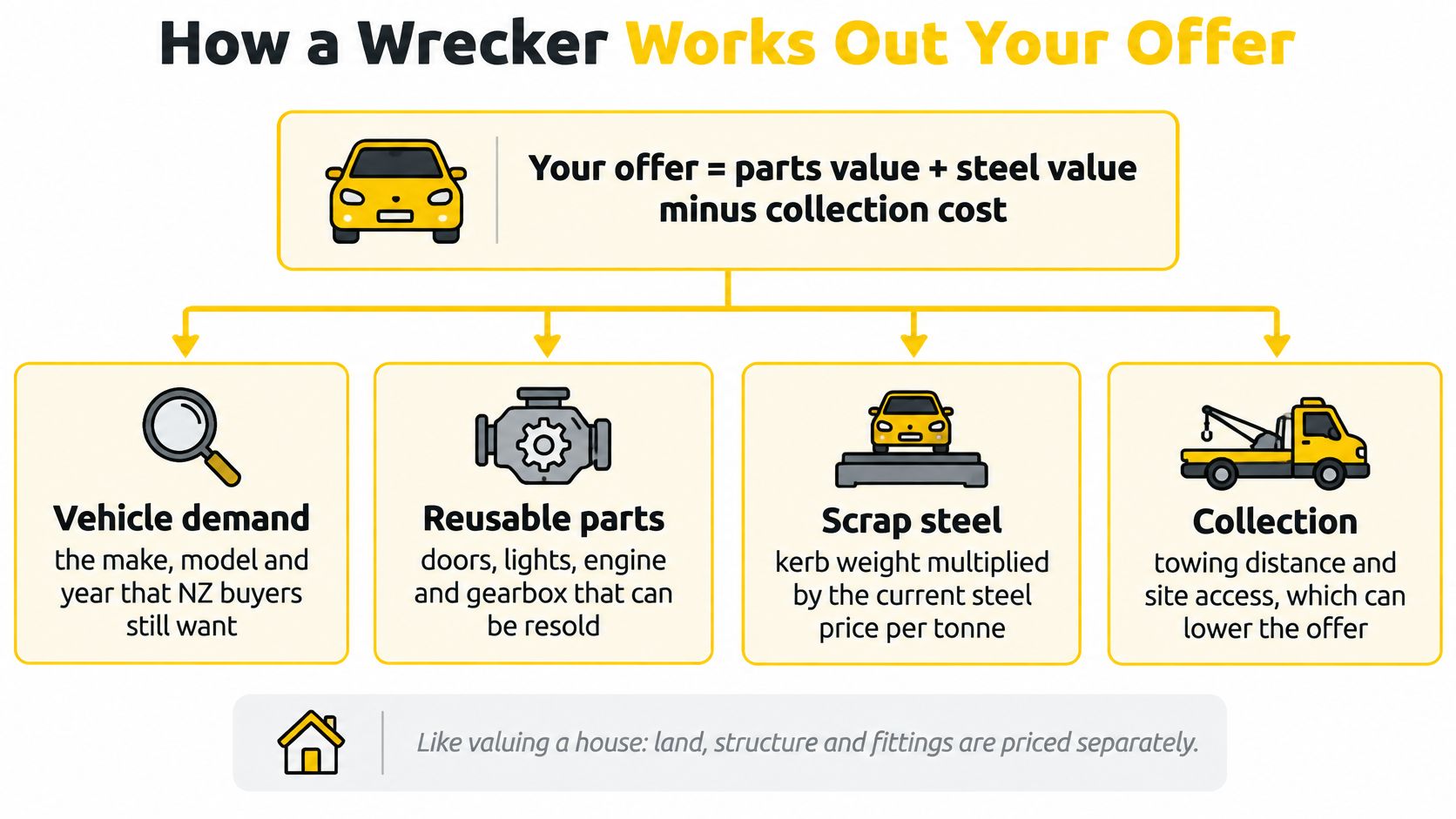
A wrecker's offer combines parts demand, recoverable metal, condition and completeness, and age and mileage. Think of valuing a house: the land, building and fittings contribute separately, rather than receiving one undifferentiated price.
Collection costs can then affect the amount available to pay the owner.
Parts demand and metal value
Model demand affects how readily a dismantler can resell components. Say a Toyota Hilux has a usable gearbox with a likely buyer, while an uncommon vehicle has components the yard rarely receives enquiries about. The Hilux's recoverable parts may support a stronger offer, even if neither vehicle can return to the road.
Steel weight provides another part of the valuation. Kerb weight helps estimate the starting material quantity, but it isn't a precise measurement of recoverable steel. Glass, plastics, fluids and removed components mean the whole vehicle's listed weight shouldn't be treated as saleable steel.
Condition, completeness and mileage
A complete vehicle gives the yard more components to assess. Missing drivetrain parts, extensive corrosion or fire damage can reduce recovery value and increase handling work.
The official Christchurch and Wellington scrappage-trial report recorded average odometer readings of 218,000 km and 211,000 km respectively, while New Zealand-new vehicles entering those trials averaged 21.6 and 18.6 years old respectively. Those trial averages illustrate the age and mileage of participating vehicles, not a compulsory scrapping point.
High mileage can make major repairs difficult to justify, but it doesn't erase the value of every component. A sound door or light assembly doesn't become unusable just because the engine is worn out.
Judge the offer against what the dismantler can recover, not what you originally paid for the vehicle.
Our scrap car valuation guide explains that distinction in more detail. Keep towing separate from the vehicle assessment: for vehicles outside about 100 km of Whangarei, we tell you before booking whether a towing fee applies.
How to Book and Complete a Collection Step by Step
A collection goes more smoothly when the description, access arrangements and agreed payment are settled before the truck arrives. Don't repair or dismantle anything just to prepare for a quote.
Before booking
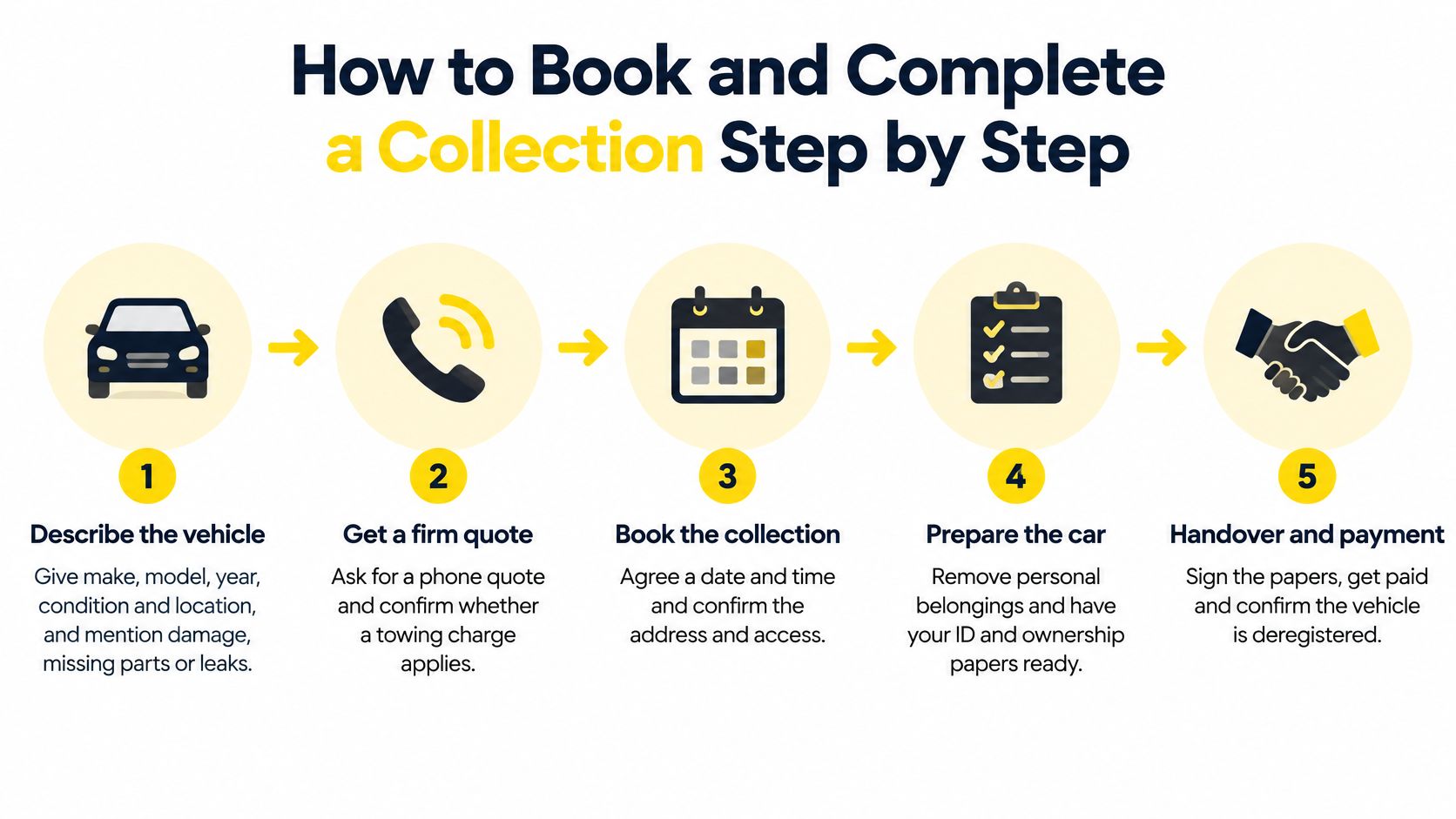
Describe the vehicle accurately. Give the make, model, year, condition and location, including leaks, damage and missing parts. Mention whether it rolls, steers and has accessible keys, because those details affect loading.
Get a firm quote. Ask for the agreed amount to be recorded in writing and clarify any towing charge before accepting. An accurate description helps prevent a disagreement about what the crew expected to collect.
Gather your identification and vehicle details. Have your driver licence, registration plate number and VIN or chassis number ready. Photograph the identifiers if they're difficult to reach, but don't crawl beneath an unstable vehicle.
Agree on a pickup window. Our Whangarei city pickups happen the same day when you call before mid-afternoon, with same-day removal for most Whangarei addresses and collection within 48 hours for wider Northland. Confirm the address and any timing constraints when booking.
Before the truck arrives
Remove belongings and unrelated loose items. Check the glovebox, centre console, boot, door pockets and spaces beneath the seats. Take out tools, child seats, toll tags and anything else you intend to keep, without removing components included in the quote.
Prepare safe access. Arrange gate access, keys and room for the recovery vehicle to manoeuvre. Tell the crew about soft ground, steep driveways, low branches or a vehicle trapped behind other equipment rather than trying to drag it out yourself.
At handover
Check the agreement and complete the documents. Confirm the payout matches the accepted quote before signing the collection paperwork. Keep copies or photographs of the transaction record so you can identify the buyer and vehicle later.
Receive payment and confirm departure. Check that you've received the agreed payment, then let the crew complete loading and removal. Walk around the cleared space afterwards to check for belongings or debris.
For a farm clean-up or workshop clearance, prepare a vehicle-by-vehicle list. Mark which vehicles are going, which are staying, and who can authorise each disposal. That avoids confusion when several similar shells or machines are parked together.
Ownership Transfer and Paperwork at Pickup
An old vehicle can leave your driveway while still being associated with you on the vehicle register. That's why notification and deregistration aren't optional loose ends to sort out whenever you find time.
The Waka Kotahi selling-a-vehicle guidance says both seller and buyer must notify it when a vehicle changes hands, and a vehicle that's no longer roadworthy and is sold to a wrecker must be deregistered. You can cancel the registration yourself or have the wrecker do it.
Know which record you're updating
The registered person and the legal owner aren't necessarily the same person. Updating the register records responsibility for the vehicle, but it isn't a substitute for establishing that you have authority to sell it.
Failing to update the register can leave you exposed to someone else's fines and vehicle-related responsibilities. Complete your seller notification straight away, preferably during the handover, rather than assuming the buyer's notification replaces yours.
Have the following ready:
- Your identification: Your New Zealand driver licence and matching contact details.
- Vehicle identifiers: The plate number, make, model and VIN or chassis number.
- Buyer details: The buyer's full name and address for your notification.
- Supporting authority: Any documents needed to establish that you're entitled to arrange the sale.
The Waka Kotahi motor-vehicle-trader guidance explains the identification and vehicle details used for transaction records. Check names and identifiers carefully rather than signing a partly completed document.
Vehicles held somewhere else
For a damaged vehicle at a panel beater or holding yard, we collect with a release from the yard and the registered owner's ID. Arrange that release before dispatch so the crew isn't prevented from collecting it.
Our NZTA registration and change-of-ownership guide helps distinguish the processes. Before the vehicle leaves, have the paperwork signed and deregistration confirmed, not merely promised.
What Happens to Fluids, Batteries and Tyres
A responsible dismantler doesn't put a complete vehicle straight into a crusher. Depollution, removing substances and components that need controlled handling, comes before processing the shell.
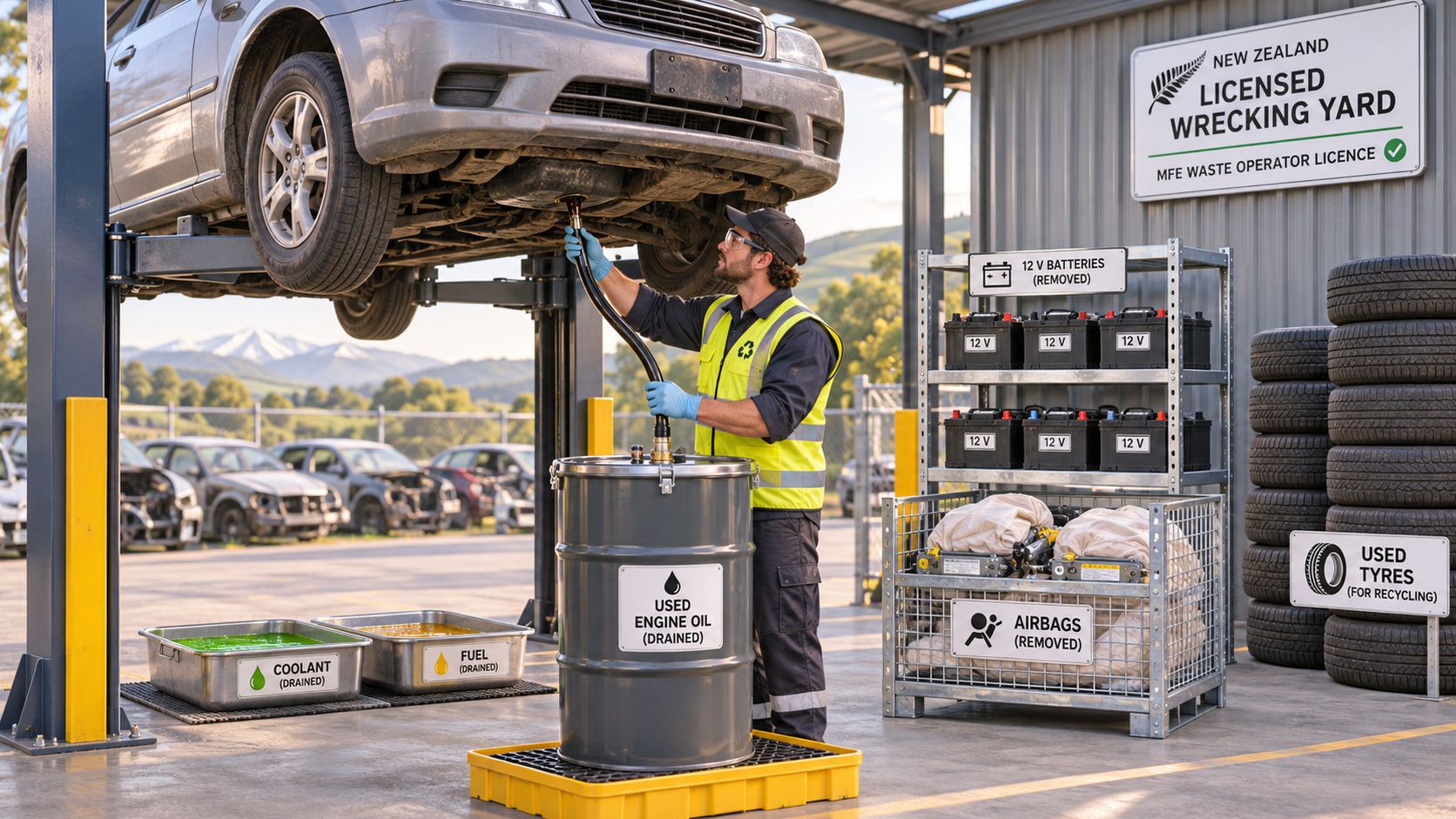
At our yard, fluids, batteries, tyres and airbags are removed and handled to New Zealand environmental standards. Engine oil, coolant and fuel need separate collection rather than being allowed to drain onto the ground.
Usable components are assessed and tested for reuse. Our recovered parts go back into Northland vehicles, and the remaining shell is baled for steel recycling.
Tyres need their own disposal pathway
The Ministry for the Environment's waste and resource efficiency work programme identifies about 6.5 million end-of-life tyres annually, notes that only about 40% were previously recycled, exported or otherwise repurposed, and records Tyrewise becoming fully operational on 1 September 2024. The scheme's stewardship fee is intended to fund collection, transport and processing.
That national scheme doesn't, by itself, demonstrate how a particular yard handles tyres. Before booking any dismantler, establish:
- Who collects them: Ask for the downstream collector or handling route.
- Whether Tyrewise applies: Confirm how tyres attached to the vehicle, and any loose tyres, are accepted.
- Whether extra charges apply: Identify costs for tyres outside the accepted scheme pathway.
Loose tyres accumulated around a farm aren't automatically included in a vehicle-removal quote. Describe them separately, including their type and condition, so they can be assessed without a surprise at collection.
Ask for the destination: A claim that something is recycled is more useful when the operator can explain where it goes.
The Ministry for the Environment's tyre-scheme announcement explains that tyre recovery can involve different end markets. Reuse, processed products and tyre-derived fuel aren't identical outcomes, so ask for evidence of downstream handling rather than assuming every tyre becomes another tyre.
Why Hybrids and EVs Need Special Handling
A hybrid or EV has a high-voltage system that needs more than ordinary towing precautions. Damaged batteries and wiring can create electrical shock and fire risks, even when the vehicle appears switched off.
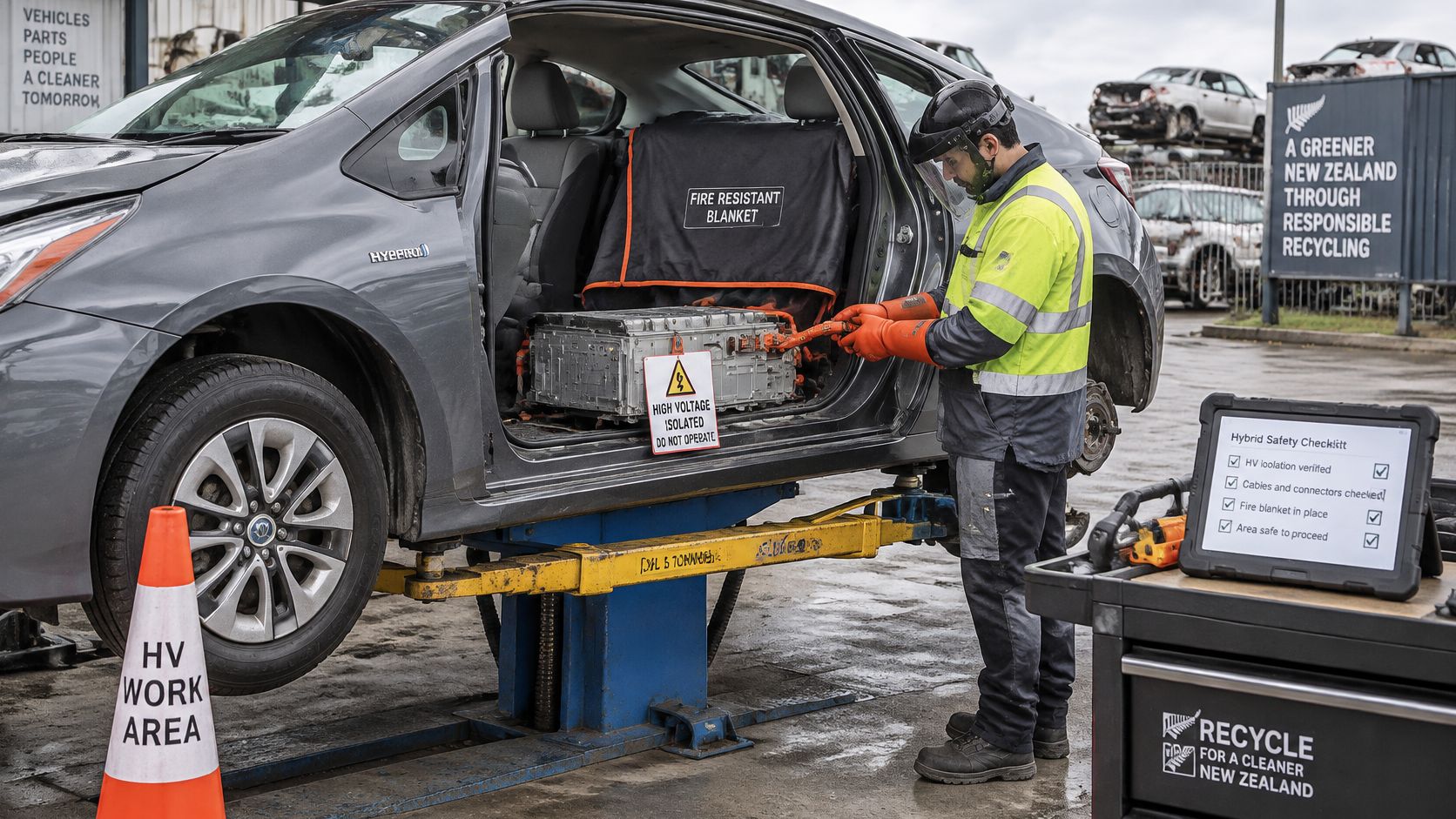
The Waka Kotahi electric and hybrid vehicle inspection requirements identify unsafe defects including insecure, damaged, deteriorated or inadequately insulated high-voltage wiring, damaged or leaking batteries, missing or damaged shields, leaking high-voltage coolant systems and an illuminated electrical-system warning lamp. Wiring must also be positioned away from hot components, sharp edges, rotating parts and the ground.
Describe the damage without investigating it
Those inspection criteria help explain what the recovery crew needs to know. If an impact has exposed wiring or damaged the underside, report the location and send photographs taken from a safe position.
Don't touch exposed cables, remove battery covers or attempt your own high-voltage isolation. After a crash, flood, fire or suspected battery damage, don't drive or move the vehicle yourself; arrange trained assessment and recovery.
Useful questions focus on the actual job:
- Isolation: Who will assess and isolate the high-voltage system before loading?
- Damage: Has the crew been told about water exposure, warning lights, leaks or impact near the battery?
- Loading: What recovery method will be used for the vehicle's condition?
Keep battery value separate from battery safety
A traction battery may contribute to the payout, but its condition and suitability for recovery matter. A damaged pack shouldn't be assumed to have the same value as a serviceable one.
We use high-voltage isolation for hybrid and EV removals, and traction battery value is reflected in the quoted payout. Confirm that the quote includes the battery rather than treating it as an unspecified extra.
Our EV battery recycling guide for New Zealand explains the battery-specific considerations. Leave physical inspection and isolation to trained personnel.
Choosing a Licensed Dismantler and Booking Your Removal
Use the same checklist whether you're comparing a Whangarei yard or arranging removal elsewhere. A clear answer should identify who is responsible, what's included and what record you'll receive.
| Question to ask | What a sound answer looks like | Why it matters |
|---|---|---|
| Is the business a licensed dismantler? | Gives a licence number you can check before booking | Confirms the yard is licensed to take and process the vehicle |
| Is the quote firm and in writing? | A stated figure with any deductions named | Prevents a lower offer at pickup |
| Is towing included? | A clear distance rule and any fee stated before booking | Avoids surprise charges |
| Who completes ownership transfer and deregistration? | The dismantler explains its role and confirms it in writing | Protects the seller from fines and unresolved vehicle responsibilities |
| How are fluids, batteries, tyres and airbags handled? | Names each handling step and any extra tyre charge | Shows hazardous materials are controlled and whether tyres fall under Tyrewise |
Compare the complete agreement
A higher headline offer isn't automatically a better outcome. Compare what you'll receive, the collection arrangements, the written conditions and the disposal pathway.
Be cautious if an operator won't identify the business buying the vehicle or wants you to sign blank documents. Equally, don't accept an unexplained reduction at pickup when the vehicle matches the description used for the agreed quote.
Keep the transaction record somewhere you can find it. It should let you connect the buyer, vehicle and payment without relying on a phone conversation you can no longer reconstruct.
A Whangarei and Northland option
Car Removals Whangarei is Whangarei owned and operated and a licensed Northland dismantler. We pay $200 up to $15,000 in cash per vehicle at pickup, with the individual offer based on the vehicle being assessed.
Free towing and removal are included in the quote for vehicles within roughly 100 km of Whangarei. For a more distant address, we state whether a towing fee applies before booking, so you can compare the complete arrangement rather than the payout alone.
Use the checklist to assess us as you would any dismantler. The next step is straightforward: gather the plate number, VIN or chassis number and your driver licence, call for a firm quote, and agree on a pickup window that suits your timing.
Car Removals Whangarei offers licensed vehicle dismantling and organised removal for unwanted and damaged vehicles across Whangarei and Northland. Visit Car Removals Whangarei with your vehicle details ready to request a firm quote, confirm the collection arrangements and book your pickup.
- wreckers NZ
- vehicle wreckers
- car wreckers NZ
- scrap car removal
- licensed dismantler