· Car Removals Whangarei
EV Battery Recycling NZ: What Happens to Old Packs
New Zealand had more than 81,000 battery-electric vehicles registered by the end of February 2025, alongside roughly 36,500 plug-in hybrids, a combined fleet above 117,500 plug-in vehicles, according to figures in the 2025 Gen Less EV battery report. Every one of those packs was built to outlast the car around it. Most will see several owners before they see a recycling process.
Owners tend to assume a traction battery dies with the vehicle, at some predictable age or odometer reading. It doesn't. A pack fails because of what happened to it: a rear-end impact, a flooded road, a heat event, or enough charge cycles that usable capacity drops below what a driver needs. Two cars of the same year and mileage can send their batteries in completely different directions.
This is a plain walk through EV battery recycling NZ as it stands, covering what happens after the pack leaves the car, who is allowed to touch it, what it's worth, and where the honest limits sit. The organising idea is simple. Condition, not age, decides the route.
Table of Contents
- Where Your EV Battery Goes in New Zealand
- Why New Zealand's EV Battery Recycling Is Still Early
- What Is Inside an EV Battery and Why Chemistry Matters
- Why Damaged Batteries Need Special Handling
- What an EV Battery Is Worth and How to Read the Quote
- How to Arrange Safe EV Battery Removal
Where Your EV Battery Goes in New Zealand
The short answer is that your pack quite likely leaves the country. New Zealand's end-of-life EV battery pathway is built on local collection and sorting, followed by export to certified facilities in Japan and South Korea, as a 2025 technical review for the Australasian Transport Research Forum describes. Batteries are sorted by chemistry at sites in Christchurch and Auckland, then packaged to International Maritime Dangerous Goods requirements before they ship.
What puts a pack on one route rather than another is its condition. Five cases cover almost every pack that comes out of a vehicle.
| Battery condition | Likely route | Who handles it | Key check |
|---|---|---|---|
| Intact, in use or recently driven | Keep in use, or assess for reuse or stationary storage | Owner or specialist tester | State of health and insulation resistance |
| Intact but end of life | Reuse assessment, then export recycling | Certified specialist | Remaining capacity and chemistry |
| Damaged in a crash or hail event | Isolate, store safely, get specialist advice before export | Licensed dismantler with high-voltage training | Pack damage and fire-risk assessment |
| Flood or fire damaged | Specialist isolation and fire controls; export may be refused | Specialist only | Water ingress or thermal damage |
| Unknown condition, vehicle non-running | Treat as damaged until tested | Dismantler, then specialist | Chemistry and voltage check |
The triage logic only runs one way. Intact packs need voltage isolation and a state-of-health assessment before anything else happens. Damaged or flooded packs need isolation, fire-risk controls and specialist advice before anyone makes a shipping call. Only packs cleared at that stage enter reuse or export recycling channels.
That's why the route can change mid-process. A pack that looked like an export candidate can be reclassified after inspection, and any plan has to absorb that. Reuse as stationary storage is real, but whether it stacks up depends on pack condition, remaining capacity, testing cost and enough national volume to make the exercise worthwhile.
A traction battery never joins the general scrap stream. When a conventional scrap car is processed, the shell is baled and sold as steel, a flow explained in our guide to scrap metal recycling. A high-voltage pack comes out and gets logged before any of that starts.
Two things to insist on before you agree to anything: the pack's condition and chemistry in writing, and confirmation that the vehicle won't be crushed or baled until the battery is out and recorded. A yard that can't state both is guessing.
Why New Zealand's EV Battery Recycling Is Still Early
Fewer than 1% of lithium-ion batteries are reportedly recycled domestically in New Zealand, according to a 2025 feasibility analysis from the University of Canterbury. That figure answers the question most owners are really asking, which is whether they can drop a pack somewhere local and have it broken down here.
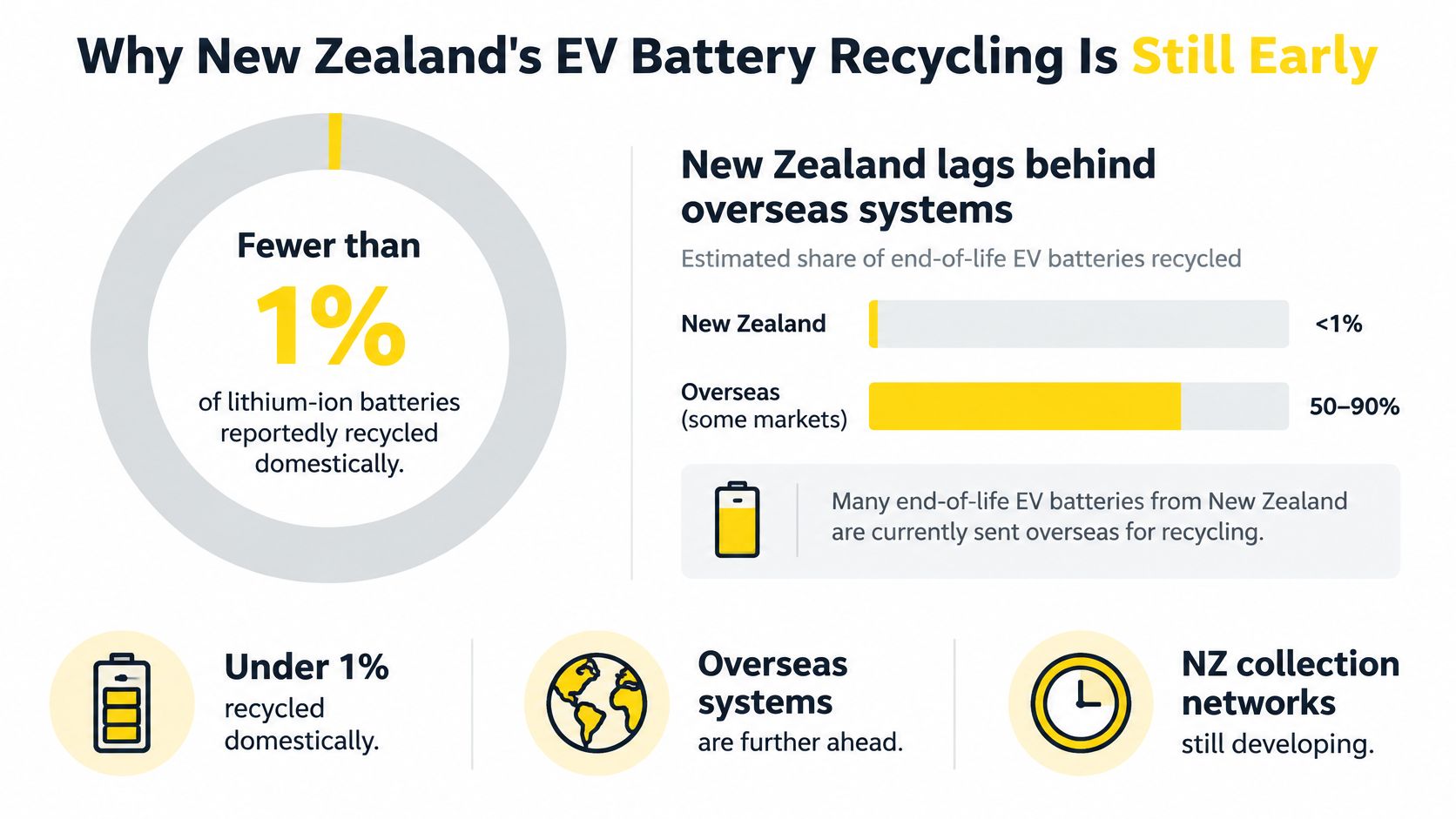
A recycling line behaves like a ferry timetable. The boat only runs when enough passengers turn up to pay for crew and fuel, and a plant only runs when enough batteries arrive to justify the shredder, the fume extraction and the chemical recovery circuit. New Zealand doesn't yet generate that volume, and the analysis names the two structural barriers directly: a domestic market too small for economies of scale, and geographic isolation that makes shipping packs to specialist overseas recyclers expensive.
The volume is coming. The same analysis estimates that 17,094 electric-vehicle battery packs could be off the road by 2025, rising to approximately 84,000 packs by 2030. End-of-life and damaged traction batteries are expected to grow much faster than domestic recycling capacity, and the pinch lands first on dismantlers, insurers, panel beaters, repairers and the owners holding a written-off car with a live pack inside it.
What this means for you: until local processing develops, a battery may sit in safe storage, move into reuse, or leave the country. Disposal costs can currently fall on the battery owner, so budget for fees and waiting times rather than assuming a free pickup.
Treat it like a tyre disposal fee. Nobody enjoys paying it, but it's a genuine cost of owning the vehicle, not a charge someone invented to bother you.
What Is Inside an EV Battery and Why Chemistry Matters
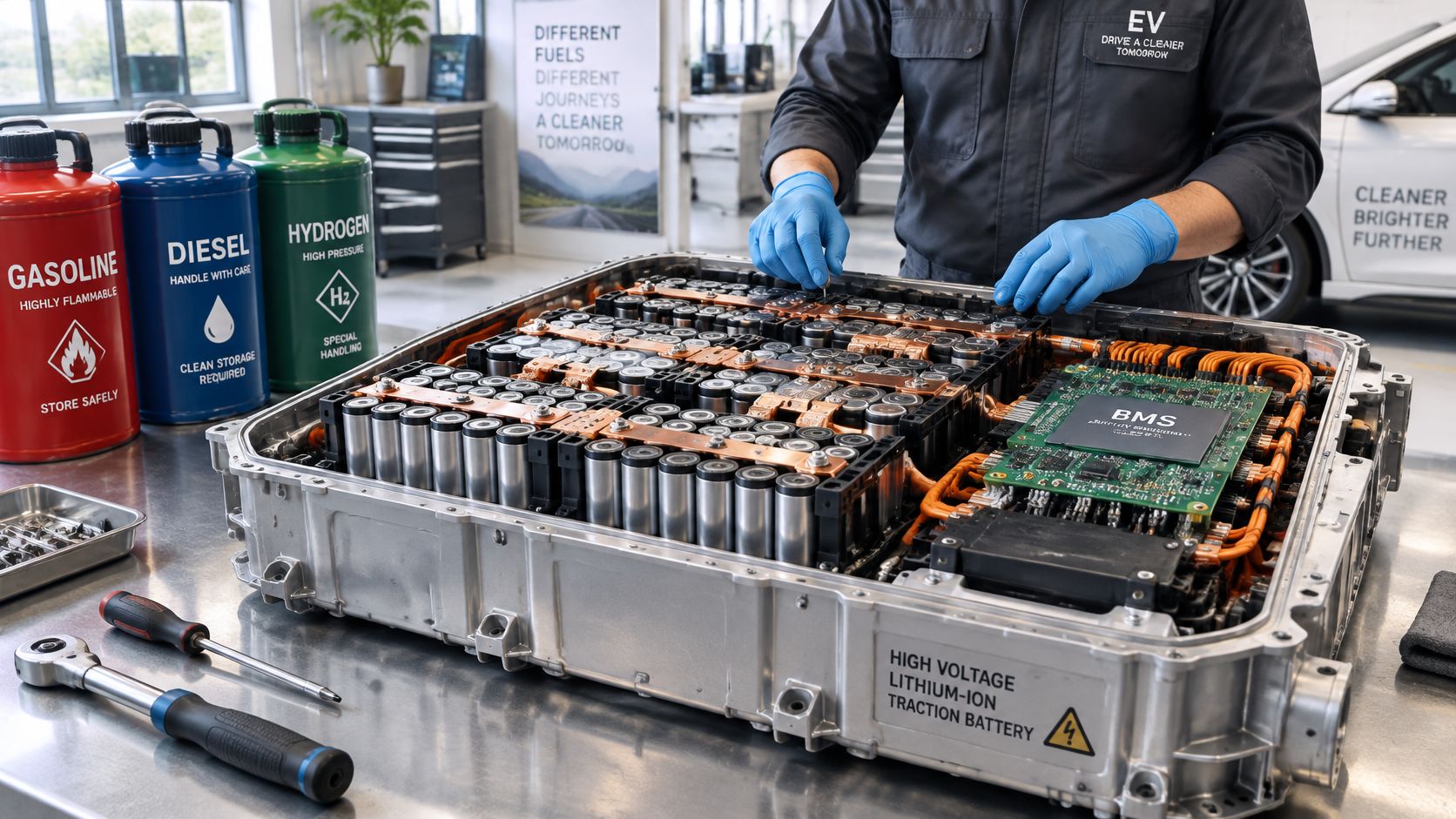
Think of traction batteries as different fuels. Petrol, diesel and LPG all burn, but you wouldn't store or handle them the same way, and the same logic runs through battery chemistries.
An EV traction battery isn't one battery. It's a pack built from many cells, grouped into modules, supervised by a battery management system that watches voltage and temperature cell by cell and decides how much current the pack can safely accept. That management system is also what a tester reads when someone asks how healthy the pack is.
Three chemistries dominate the vehicles that arrive for dismantling, and each carries its own handling consequence.
| Chemistry | Typically found in | Key materials | Handling note |
|---|---|---|---|
| Lithium-nickel-manganese-cobalt | Many battery-electric cars | Nickel, manganese, cobalt | High material value; sorted and packed separately before shipping |
| Lithium-iron-phosphate | Some standard-range battery-electric cars | Iron and phosphate, no nickel or cobalt | Lower material value; different discharge and processing needs |
| Nickel-metal-hydride | Older hybrid vehicles | Nickel and rare-earth metals | Not lithium-ion; kept apart from lithium-ion packs during sorting |
Segregation before shipping isn't housekeeping. The three families differ in fire behaviour, material value, discharge requirements and processing compatibility, so a mixed load is a safety problem and a pricing problem at once. A processor who has to unpick a mixed container charges for the privilege, and the owner's payout reflects it.
Here's the part that trips people up. You cannot identify chemistry by looking at the pack. Two cases the same size and shape can hold completely different cells.
The identification rule: documentary evidence beats visual inspection every time. Check the manufacturer's documentation first, then the vehicle's make, model and year, then a specialist test. Never guess from the casing.
If you're shopping for a used EV, this matters long before disposal day, and our guide to buying an electric car covers what to check at the buying stage.
What should end up in the record is short: chemistry where known, vehicle make, model and year, and any known damage. Those four details decide which routes stay open to the pack.
Why Damaged Batteries Need Special Handling
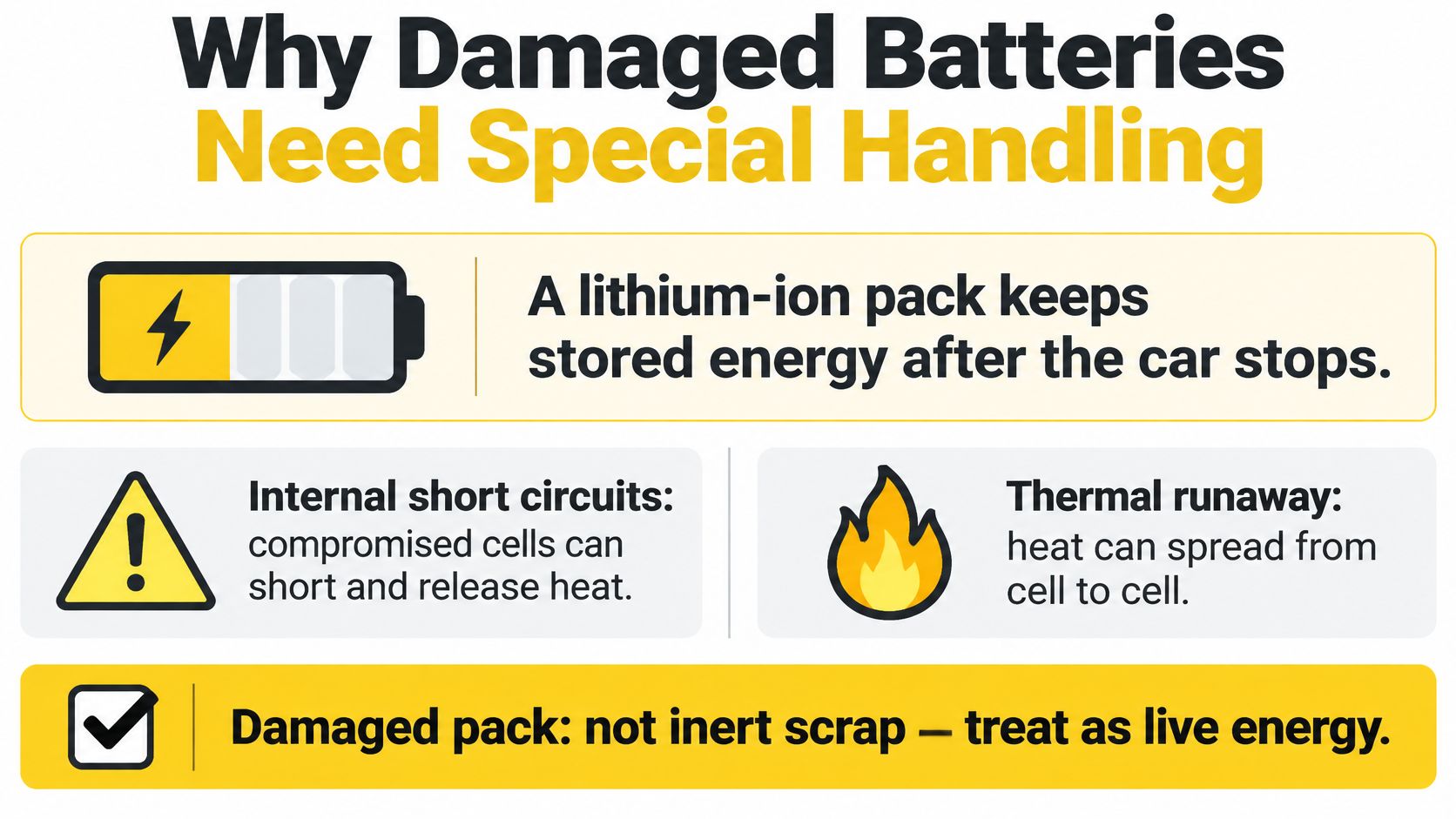
A written-off EV can still hold a large store of energy after the wheels stop. The insurer may have closed the file. The cells have not.
New Zealand treats this formally. Large batteries above 5 kg, which includes EV batteries, were designated a Priority Product under the Waste Minimisation Act 2008 in July 2020, as the VIA end-of-life battery report sets out. Damaged and end-of-life packs are not ordinary scrap, and the law says so.
Condition decides the route, not the year on the registration. A young car with a crushed casing or a flooded pack is a specialist-disposal job. An older pack that is intact, dry and stable can still be a reuse candidate. The odometer does not tell you which one you have.
The risks are specific. Compromised cells can develop internal short circuits and release heat, and that heat can move from cell to cell as thermal runaway. It works like a row of matches: once the first one catches, the neighbours follow. Floodwater can leave faults that appear days later, after the car has been moved, dried out and everyone has relaxed.
The controls that actually matter
- Quarantine separately. EV and hybrid packs stay well away from lead-acid batteries and general ferrous scrap, because mixing them creates a fire load nobody has assessed.
- Isolate before you touch. High-voltage isolation is the first task, carried out by trained staff, before a spanner goes near a terminal.
- Record what you know. Chemistry, damage history and where the pack came from travel with it. Those notes are what separate a reuse candidate from a pack that must stay on a specialist path.
- Store it properly. A ventilated area away from flammable material, checked for heat or swelling rather than parked and forgotten.
- Don't strip it for parts. A damaged pack is not a donor. Opening one for module value turns a contained problem into a hazardous one.
- Use a specialist pathway. Never the general scrap stream.
There is a capacity limit under all of this. New Zealand does not yet recover the key battery materials onshore, so packs that fail a condition check and cannot be reused still leave the country for processing. That offshore step raises freight cost, adds transport emissions, and leaves handlers exposed to international acceptance requirements that can change without notice. A swollen or water-damaged pack is harder to place than an intact one. Condition, not the age of the car, is what closes the reuse door and opens the specialist one.
What an EV Battery Is Worth and How to Read the Quote
Not every EV battery has a positive resale price. Some cost more to test, isolate and move than they return, and a quote that promises otherwise is a quote written by someone who hasn't opened a pack.
EECA states that used EV batteries retain economic value after removal, and sets out the three routes: refurbishment for continued vehicle use, repurposing for stationary storage such as capturing solar generation, or processing to recover raw materials. In some cases the owner receives payment for the old pack, according to EECA's guidance on EV range and batteries. EECA also notes that Motor Industry Association members follow a code of practice aimed at capturing, returning, refurbishing, reusing, recycling or safely disposing of these packs rather than landfilling them.
Whether you're paid, and how much, comes down to five drivers: condition, chemistry, damage status, remaining capacity, and the cost of testing and transport to reach whoever wants the pack. That last one catches owners out.
The uncomfortable bit: a pack can be too weak for road use and still too expensive to move. Both can be true of the same battery.
Put two examples side by side. A pack with a dead module and a cracked casing may consume more in assessment and freight than its recovered materials are worth, so the honest answer is that it carries a cost, not a value. A healthy pack from a lightly used car with balanced modules is a different proposition entirely, because it can serve years of stationary storage before it's ever processed.
That's why battery value belongs on its own line. A quote that folds the pack into one figure hides which part is salvage steel and which part is the battery, and if testing later finds impact damage you've got no way to see what changed. Ask for vehicle salvage value and traction battery value as separate lines, with the battery's condition stated. It's the format behind any honest cash for cars quote in Whangarei, and it costs nothing to request.
Then there's the testing question nobody has fully answered. Waka Kotahi's 2025 battery-electric bus whole-of-life study confirms these packs can be repurposed for stationary storage before final material recovery, but describes the country's second-life and recycling sectors as immature and in need of regulation, including tracking battery health across successive uses. Independent state-of-health testing, module balance checks and crash-history verification don't yet have an obvious national provider. Before accepting any battery value, ask who tests the pack, what the test covers, and what happens to the number if the pack turns out to be unshippable.
How to Arrange Safe EV Battery Removal
The Ministry for the Environment treats EV and hybrid batteries as their own category, outside ordinary kerbside recycling. Its national recycling guidance sends them to an appropriate transfer station, a retailer take-back programme, a vehicle manufacturer scheme or a metal recycler, and it warns that fees may apply at transfer stations. The list sits apart from ordinary lead-acid car batteries because a high-voltage lithium-ion pack is a different job from a 12-volt block.
A traction pack works like a sealed fuel system. You would not cut a fuel line on the driveway to "have a look," and you should not cut an orange high-voltage cable either. The pack's condition, not the car's age or odometer, decides the next step. A sound pack can be isolated and reused or sold on. A flooded, burned or impact-damaged pack is specialist waste, and local places that will take it are still scarce.
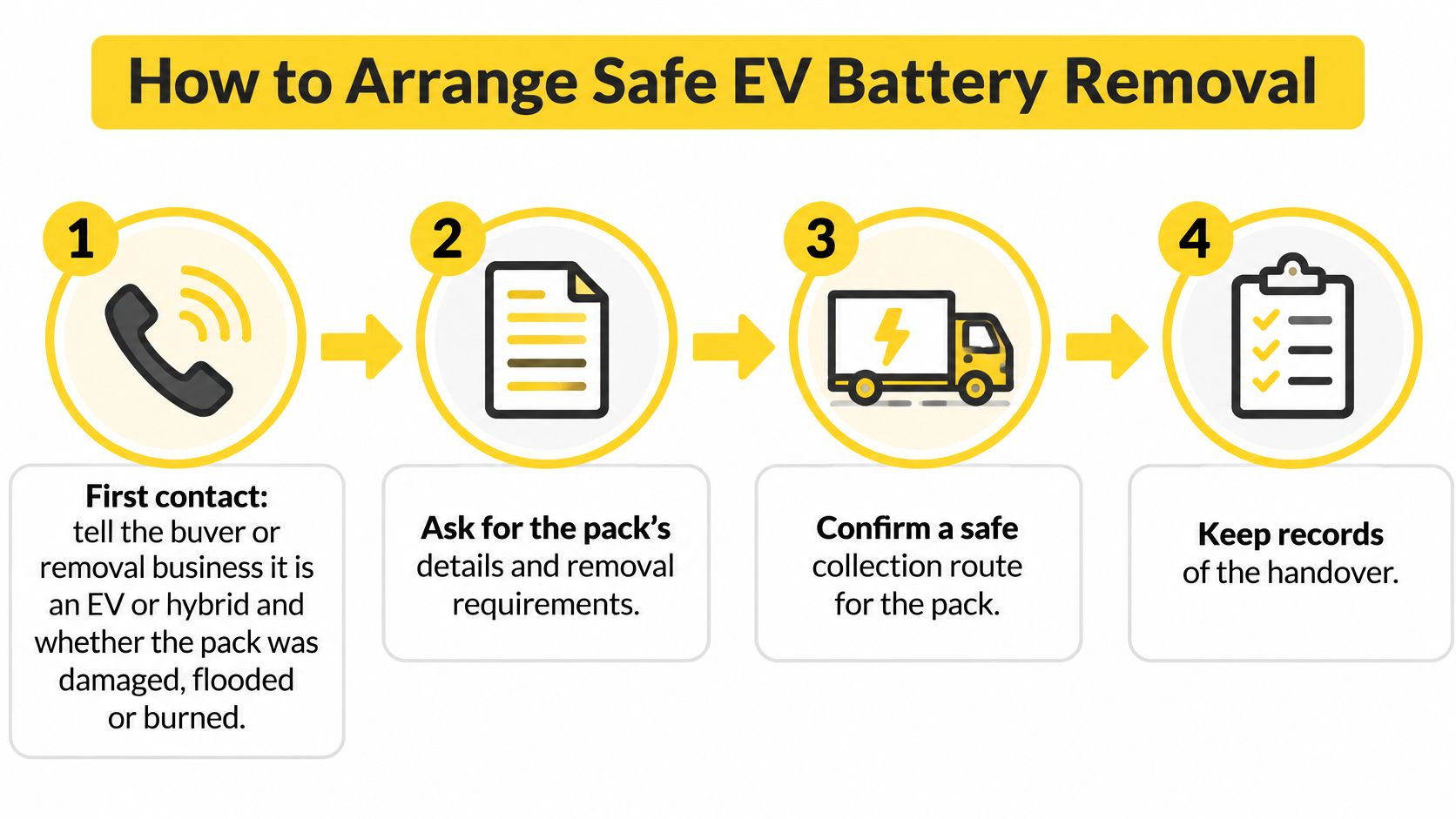
The eight steps, with the reason behind each
- Say what the vehicle is on first contact. Tell the buyer or removal business it is an EV or hybrid, and whether the pack was damaged, flooded or burned. That answer sets the route before anyone quotes a price. Booking it as a normal car and mentioning the battery when the truck arrives forces a late change of plan.
- Get the pack's chemistry and condition in writing. The record travels with the battery to whoever handles it next. A cheerful "yeah, it's fine" over the phone gives the next handler nothing they can act on.
- Confirm the disposal route before you book. Not every facility that takes a car battery takes a traction battery, and fees apply where the service exists at all. A transfer station that accepts household batteries can still refuse a Leaf or Prius pack.
- Leave the pack in the car and don't open it. High-voltage isolation is trained work. Cutting a cable to "make it safe" is how people get hurt, and how a pack that could have been reused becomes hazardous waste.
- Have ownership evidence ready. Bring proof of ownership and photo ID. If the car is at a panel beater or holding yard, the yard also needs its release and the registered owner's ID before anyone can load it.
- Watch the battery come out, not just the car go. At pickup, confirm the pack is isolated and recorded before the vehicle leaves the site. A car that departs with the pack still fitted, and no note on file, leaves the next handler guessing.
- Close the registration. Confirm the change-of-ownership notice to NZTA is completed on site rather than promised for later. That notification is done when the vehicle is taken, so it stops being your liability the moment it leaves.
- Keep the paperwork. Receipt plus pack record. If a question comes back months later about where that battery went, the paperwork is the answer.
A big city is not a guarantee either. Christchurch City Council states that its recycling facilities do not accept batteries from electric vehicles, e-scooters, e-bikes or solar panels, and notes there are currently no viable recycling options in New Zealand for those batteries, so they are sorted and prepared for shipment overseas, according to the council's battery recycling guidance. If a city that size cannot take them at the kerb, a rural transfer station is unlikely to either. Battery value has the same limit: a healthy pack can add to the offer, while a damaged one may only cover safe handling.
The three-question check
Before the car leaves your property, you should be able to answer yes to all three.
- Is the battery route confirmed in writing? Not described verbally, written down.
- Is its condition and chemistry recorded? Including whether it was impact-damaged or flood-exposed. That record, not the vehicle's year, is what separates a reuse candidate from a pack that needs specialist disposal.
- Is the battery's value included in the offer, with its condition stated? You want the pack counted in the figure, and you want its state written beside it.
For Northland owners, Car Removals Whangarei is a licensed vehicle dismantler that isolates high-voltage systems on hybrid and EV packs and includes the battery's value in the offer. Every vehicle is depolluted first, with fuel, oil, coolant and brake fluid drained and the battery and airbags removed, and the NZTA change-of-ownership notification is completed at pickup. Ask for the battery route and the pack's condition in writing before the car is booked.
If you're in Whangārei or anywhere in Northland with a hybrid or EV that needs to go, Car Removals Whangarei isolates the traction battery before anything else happens and includes the battery's value in the offer. We collect from homes, panel beaters and holding yards across the region, complete the NZTA ownership notification on site, and pay before loading. Tell us the make, model and whether the pack has been damaged, flooded or burned, and we'll give you a firm figure over the phone.
- EV battery recycling NZ
- EV battery disposal
- hybrid battery recycling
- lithium-ion battery NZ
- EV battery value