· Car Removals Whangarei
Vehicle Recycling Explained: How Cars Are Processed
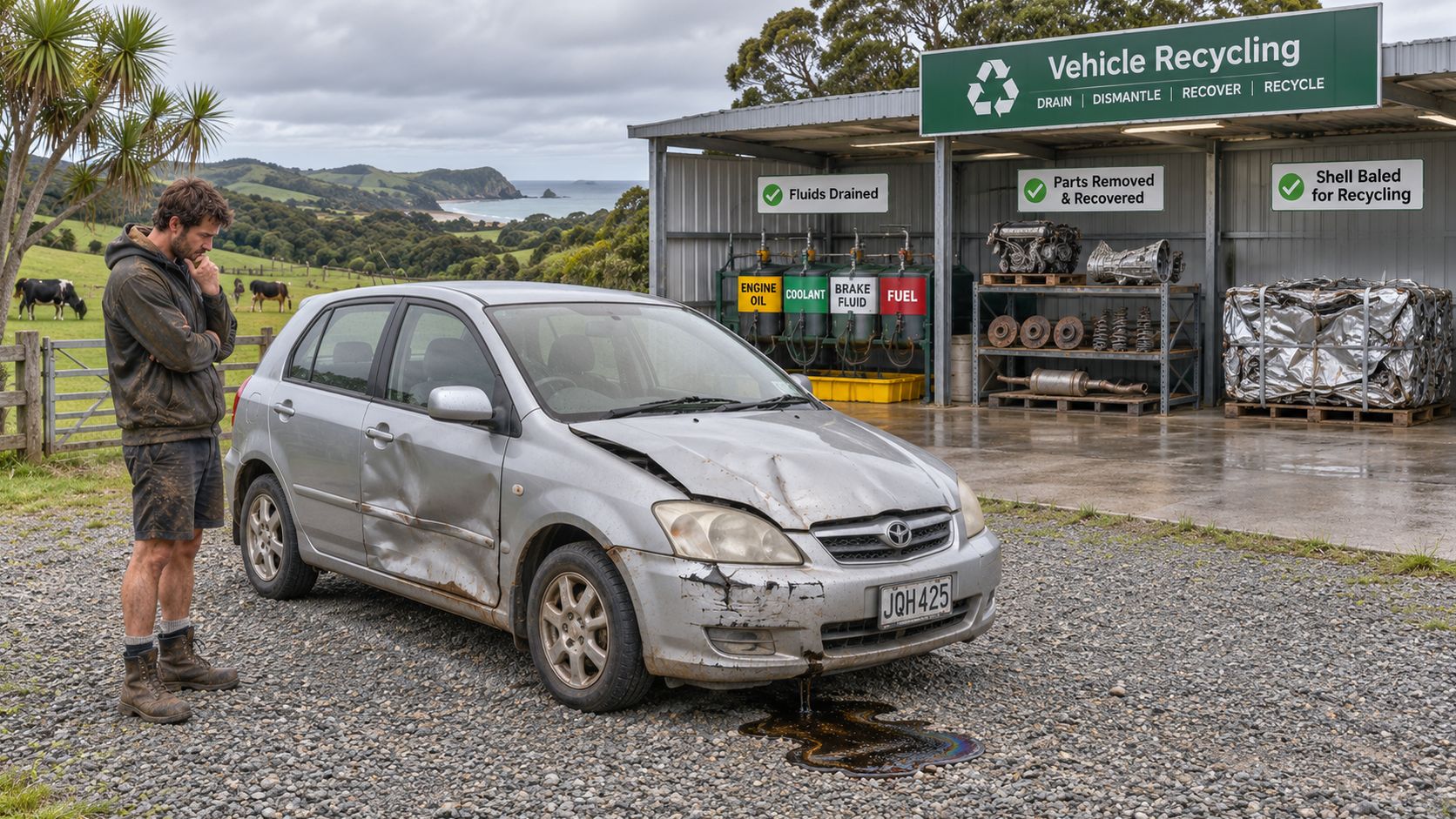
A dented hatchback sits beside the shed on your Northland property. It hasn't started for months, there's oil darkening the gravel underneath, and you're wondering whether it's worth anything beyond scrap. Getting it collected solves the space problem, but what happens next determines whether its remaining value is recovered without leaving pollution behind.
Table of Contents
- What Vehicle Recycling Really Involves
- The Stages a Car Passes Through
- Collecting and Logging a Vehicle Safely
- Draining Fluids and Removing Hazardous Parts
- Recovering Reusable Parts and Metals
- Handling Tyres and EV Batteries
- Choosing a Licensed Dismantler for Your Vehicle
What Vehicle Recycling Really Involves
Vehicle recycling is controlled deconstruction, not crushing an unwanted car. A dismantler identifies the vehicle, isolates hazards, removes fluids and hazardous components, recovers usable parts, then prepares the remaining materials for further processing.
Think of taking a building apart floor by floor rather than knocking it down with everything still inside. The materials might eventually reach similar destinations, but careful separation protects workers, preserves useful components and keeps contaminants out of otherwise recoverable material.
A car contains several waste streams
The Ministry for the Environment's priority waste streams discussion document identifies end-of-life vehicles as a mixture of metals, plastics, tyres, oils, solvents, air-conditioning refrigerants, mercury-containing switches and electronic waste. These materials can't all be handled in the same way.
The hatchback beside the shed might contain a reusable gearbox, a damaged battery, fuel in the tank and refrigerant in a closed air-conditioning circuit. Calling the whole vehicle scrap hides those differences. Its gearbox needs assessment, its battery needs controlled storage, and its refrigerant needs recovery equipment rather than an opened pipe.
A responsible process serves distinct purposes:
- Recover value: Keep sound components available for other vehicles and separate metals for recycling.
- Prevent pollution: Capture fluids and remove hazardous materials before destructive processing.
- Keep materials useful: Choose reuse where suitable, then material recovery for components that can't serve again.
Recycling isn't the same as repairing
A car that's uneconomic to repair isn't necessarily made entirely of worn-out parts. Accident damage may affect the body while leaving an alternator or transmission serviceable. Equally, a complete-looking vehicle may contain contaminated fluids or unsafe components that shouldn't be resold.
Practical rule: Assess the vehicle as a collection of materials and components, not just a weight of steel.
For the farm hatchback, the first useful decision isn't whether to crush it. It's how to collect it without worsening the leak, establish what can be saved and separate what needs specialist treatment. Each decision prepares a safer, more useful input for the next operation.
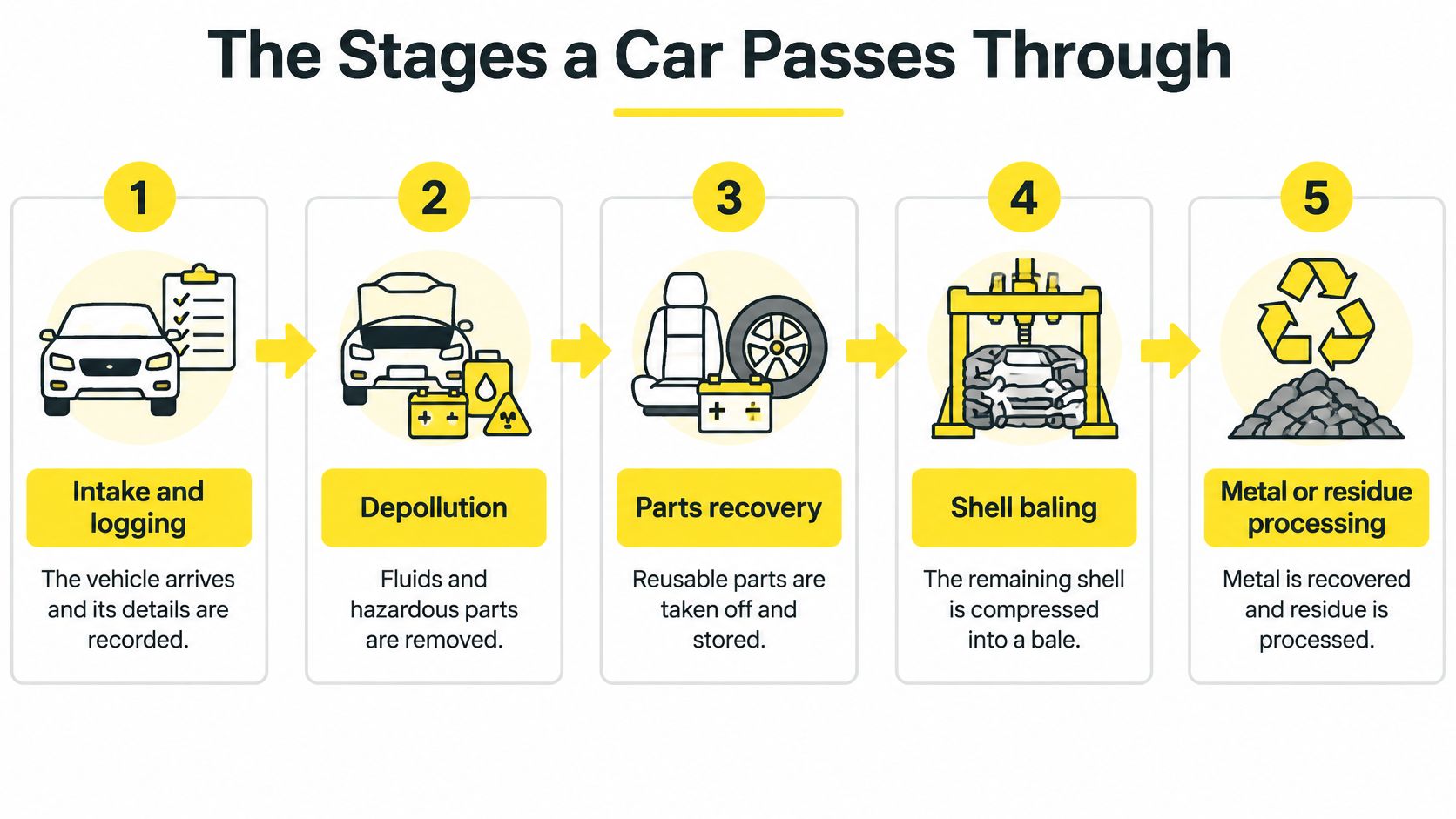
The Stages a Car Passes Through
| Stage | What happens | Main output |
|---|---|---|
| 1. Intake and logging | Vehicle identified, condition recorded and secured for transport | Logged vehicle at the yard |
| 2. Depollution | Fluids, battery, airbags and tyres removed and handled separately | Drained fluids, spent battery, removed airbags and tyres |
| 3. Parts recovery | Saleable assemblies such as engines, gearboxes and panels removed | Reusable parts for resale or reuse |
| 4. Shell baling | Bare shell compressed into a dense block | Baled steel shell |
| 5. Metal and residue processing | Shredding and separation of ferrous and non-ferrous metals | Recovered metals and residual material |
The sequence is deliberate. Fluids and hazardous components must leave before the shell is crushed, while parts intended for reuse must remain intact until someone can remove and assess them.
It's like unpacking a parcel before recycling the box. Crushing the unopened parcel would destroy useful contents and mix everything together. With a vehicle, that mistake can also release fuel, oil or other hazardous substances into machinery and surrounding material.
Different vehicles take different routes
The table is a process map, not a promise that every arrival needs identical work. A complete vehicle suitable for resale may leave the dismantling route after assessment, whereas a stripped shell may have little left for parts recovery.
Neither appearance nor a previous owner's description proves that a shell is ready for baling. Staff still need to check for trapped fluids, a remaining battery, an undepleted air-conditioning system or overlooked restraint components.
Consider a collision-damaged ute with straight doors and an undamaged gearbox. Its intake record identifies the damage and remaining equipment; hazard removal makes further work safer; parts staff then decide what can be recovered without introducing damage during removal.
A heavily stripped hatchback follows a shorter parts assessment. However, missing wheels or an absent engine don't eliminate the need to inspect the fuel tank, lines and remaining components. Less dismantling doesn't mean fewer safety checks.
Baling isn't the final recycling operation
A bale is a transportable form of prepared material, not finished recycled steel. Downstream processors still need to break up and separate the material into useful streams.
The Ministry for the Environment's infrastructure stocktake identifies end-of-life vehicles among the metal-containing items that shredder operators pre-process. Shredding and separation recover metals, but also produce residual material requiring its own management.
That distinction matters when assessing a recycling claim. A vehicle leaving a yard on a truck hasn't necessarily completed its recovery journey, and a crushed shell isn't evidence that every material has been recycled.
Each operator needs to know what they're receiving and what they're passing on. If intake staff miss damage, dismantlers may encounter an unexpected hazard. If depollution is incomplete, the metal processor receives contaminated feedstock. A missed check becomes someone else's handling problem.
Collecting and Logging a Vehicle Safely
Say a rural property has several non-running vehicles behind a workshop. One has a cracked sump; another has a failed lead-acid battery leaking onto bare soil. Collection is already an environmental-control task before the tow truck reaches the gate.
The historical consequences are substantial: the Ministry for the Environment's Environment New Zealand 2007 assessment reported approximately 25,000 illegally dumped cars in 2006, with illegal dumping estimated to cost local authorities NZ$6 million annually. Those are historical figures, not a current count, but they explain why an accountable collection route matters.
Prepare the vehicle before moving it
Record its identity. Note the registration plate, VIN, make and model wherever these can be safely read. Photograph identifying marks so the collection record matches the vehicle that arrives at the yard.
Describe its condition. Record visible leaks, collision damage, missing components and whether it rolls or steers. Tell the collection team about seized wheels, missing brakes or unstable bodywork before equipment is dispatched.
Establish the right to sell. A vehicle sitting on someone's land isn't automatically theirs to dispose of. We accept vehicles without plates or papers when the seller shows ID and confirms they're entitled to sell the vehicle.
Contain leakage before loading. Position drip trays or suitable absorbent material beneath accessible leaking points. Don't wash leaked oil or battery electrolyte into gravel, drains or nearby soil.
Choose controlled loading. Use an appropriate winch, recovery vehicle and restraints rather than pushing a damaged car across the property. Nobody should stand beneath an unsupported vehicle or in the path of a tensioned winch cable.
Unload into a controlled work area. Move the vehicle onto an impervious dismantling surface with spill-response equipment available. That keeps subsequent leaks accessible for containment rather than allowing them to soak into the ground.
Keep an auditable intake record
Waiting doesn't make a leaking vehicle safer. Corroded containers, damaged hoses and an exposed battery can continue releasing contamination while the vehicle remains unused.
Where several vehicles need removal, coordinated collection can reduce repeated site visits and unnecessary repositioning. Each vehicle still needs its own identification and authorisation record, even if they leave together.
Keep the vehicle record attached to the job, not just to the driver's memory.
A useful intake file contains the vehicle identity, seller details and authorisation, condition photographs, known hazards, collection location, pickup date and receiving-yard record. It should also flag anything unusual, such as flood exposure or missing identification, before dismantling begins.
Draining Fluids and Removing Hazardous Parts
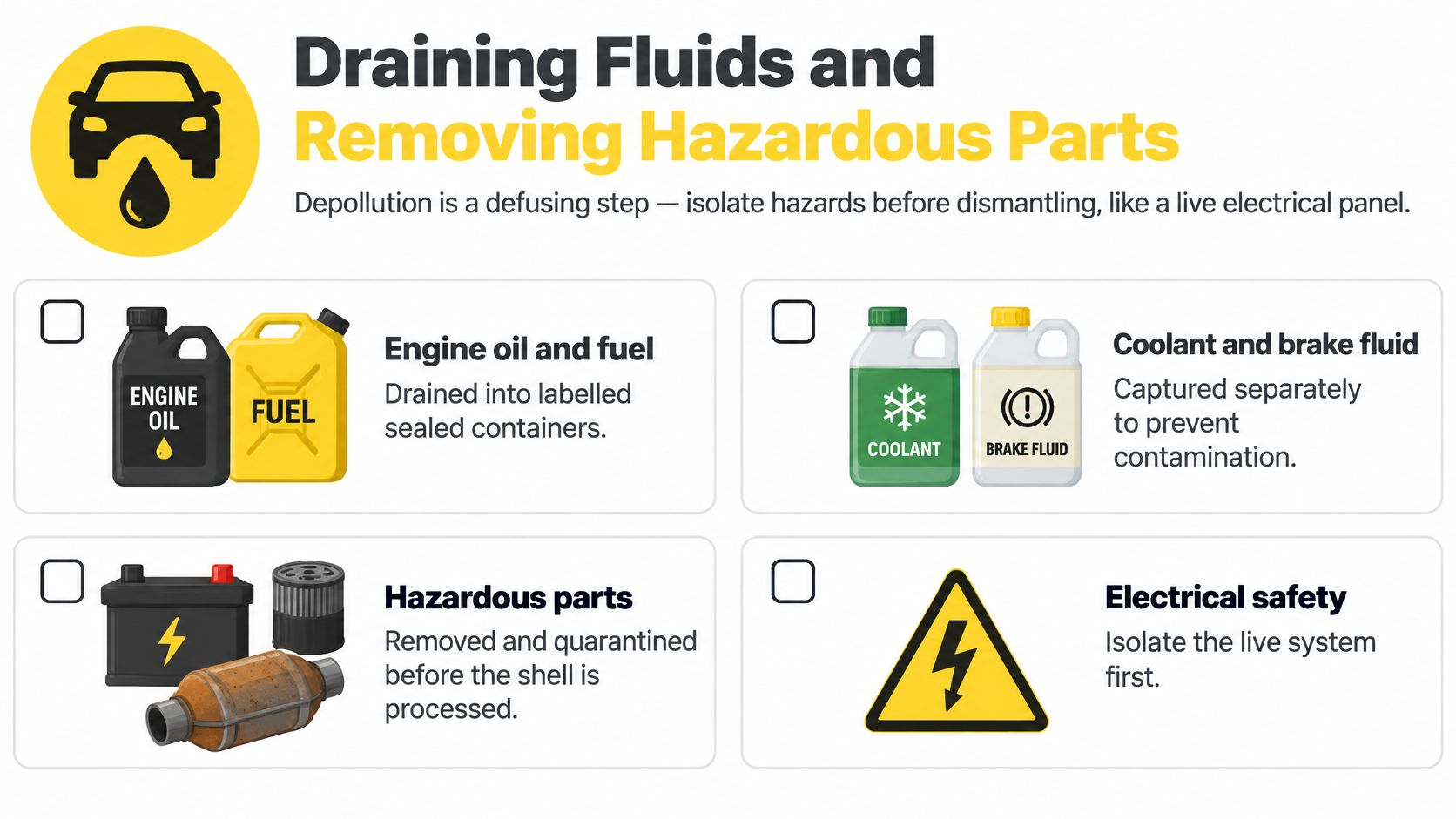
Depollution is the defusing step. Like isolating a live electrical panel before maintenance, it removes stored hazards before staff begin cutting, unbolting or moving major assemblies.
A car that won't start can still contain combustible fuel, pressurised refrigerant and undeployed restraints. Switching off the ignition doesn't make those systems harmless.
| Component | Why it matters | Standard handling |
|---|---|---|
| Engine oil and fuel | Fire risk and soil and water contamination | Drained and stored in sealed, labelled containers |
| Coolant and brake fluid | Toxic to waterways and wildlife | Drained and collected separately, never mixed |
| Air-conditioning refrigerant | Greenhouse gas and pressurised hazard | Recovered by a qualified technician before dismantling |
| Lead-acid battery | Acid and lead leakage | Removed and stored upright on a sealed surface |
| Airbags and pretensioners | Accidental deployment during handling | Disabled and removed by trained staff |
| Mercury-containing switches | Mercury release when crushed | Removed before shredding |
At our yard, every vehicle is depolluted first. Fuel, oil, coolant and brake fluid are drained, and the battery and airbags are removed before further dismantling.
Separate the fluids at source
Place the vehicle securely in the depollution bay and isolate relevant systems before opening drain points. Complete controlled drainage before unnecessary repositioning or major component lifts; where access requires lifting, use rated lifting equipment and secure supports.
Use suitable drain pans, fluid extractors and transfer equipment to capture liquids without splashing or overflow. Store each recovered fluid in its own compatible, sealed and clearly labelled container.
Never mix used oil with coolant. Mixing creates a contaminated waste stream that is harder to route appropriately. Fuel also needs suitable storage away from ignition sources, not an open bucket beside a workbench.
Treat the air-conditioning circuit separately. A qualified technician should identify and recover the refrigerant using appropriate equipment before lines are disconnected. Cutting a hose to release the pressure isn't recovery.
Remove stored-energy and toxic components
Airbags and seatbelt pretensioners need trained handling because they contain deployment mechanisms. Staff should follow the vehicle manufacturer's isolation and handling procedures, rather than assuming that disconnecting a battery immediately makes every restraint safe.
Mercury-containing switches, where fitted, must be identified and removed before shredding. Crushing can break their containment and disperse mercury into mixed material.
The Ministry of Transport's vehicle scrappage trial report found considerable variation in the environmental responsibility of companies dismantling and recycling vehicles. That finding supports checking the actual process rather than accepting a general environmentally friendly description.
A meaningful depollution record should demonstrate:
- Fluid recovery: What was drained and where it was stored or transferred.
- Labelled storage: Separate, identifiable containers with spill containment.
- Trained restraint handling: A defined method for airbags and pretensioners.
- Component removal: A vehicle-specific record of batteries and other hazardous items removed.
These are yard procedures, not a home dismantling checklist. Owners should report suspected hazards and leave removal to equipped staff. Skipping depollution can leave contaminated soil, polluted stormwater and unsafe material for shredding, even when the steel itself is eventually recovered.
Recovering Reusable Parts and Metals
A harvester gathers the useful crop before processing what remains. Vehicle dismantling follows a similar principle: preserve sound components first, then recover materials from items that can't be used again.
Reuse preserves the component's function. Metal recycling recovers its material. A working gearbox can do another job as a gearbox; once shredded, its value is limited to the separated materials.
| Component | Value stream | Practical note |
|---|---|---|
| Engine and gearbox | Reuse in other vehicles | Highest value when complete and tested |
| Catalytic converter | Precious-metal recovery | Removed early, before the shell is processed |
| Alternator and starter motor | Reuse or copper recovery | Tested before resale, otherwise recycled |
| Panels and doors | Reuse or steel recovery | Condition determines whether they sell |
| Copper wiring harness | Copper recovery | Separated from the shell before baling |
| Bare shell | Baled steel | Last stage, after parts and hazards are removed |
Condition and demand determine the route
An engine isn't saleable merely because it's present. Staff need to assess its condition, identify the correct specification and describe any limitations clearly. The same applies to electronic modules, where compatibility matters as much as physical appearance.
Panels need inspection for corrosion, distortion and previous repairs. A straight-looking door may have damaged mounting points, while a scratched but structurally sound panel may still be useful to someone repairing an older vehicle.
Our guide to used car parts in New Zealand explains the buyer's side of that decision. Clear identification and condition information help prevent the recovery of parts that can't be matched or used.
Complete scrap vehicles generally retain more value than stripped shells because more components remain available for assessment. That doesn't mean every complete vehicle is worth repairing or that every fitted component can be resold.
Value check: Compare the remaining parts and their condition, not just the vehicle's age or appearance.
Recover concentrated materials before baling
Consider a catalytic converter still attached to an accident-damaged car. Removing it separately preserves a concentrated stream for precious-metal recovery, rather than allowing it to disappear into mixed shredded material.
A copper wiring harness presents a different task. Accessible wiring can be separated for copper recovery, but removal needs to follow electrical isolation and avoid overlooked restraint circuits. The purpose is clean separation, not pulling cables until they break.
A heavy non-runner may have little appeal as a whole vehicle while still containing useful assemblies and substantial recoverable metal. Conversely, a newer write-off may derive much of its recoverable value from intact components rather than shell weight.
A Massey University study of New Zealand end-of-life vehicle recycling reported that at least 75% by weight of vehicles entering the recycling system was recycled, while noting that reuse wasn't systematically measured nationally. That distinction matters: a material-recovery measure doesn't tell an owner how many parts were reused.
In our process, roughly three quarters of a scrapped car by weight comes back into use. The bare shell of each vehicle is baled and sent for steel recovery, with parts-removal records helping distinguish component reuse from downstream metal recovery.
Handling Tyres and EV Batteries
Removing a tyre isn't proof that it has been recycled. At our yard, tyres are taken off each vehicle for separate recycling, so their destination isn't left to the shell-processing stage.
New Zealand's first national tyre recycling scheme began free nationwide collections on 1 September 2024, according to the Government's tyre scheme announcement, which also reported approximately 6.5 million tyres imported annually and around 40% recycled, reprocessed or exported. Those announcement-era figures describe the starting context, not a current recovery result.
Tyres need an identified destination
Tyre construction and condition affect the available recovery route. The Ministry for the Environment's tyre regulatory analysis explains that truck and larger tyres can be retreaded, while car-tyre retreading wasn't commercially economic at the time of that analysis.
Retreading requires a suitable casing, so it's not an option for every truck tyre. Tyres unsuitable for reuse need an appropriate processing route rather than an indefinite pile behind a workshop.
- Separate the material: Keep removed tyres out of the metal bale.
- Record the handover: Identify the collector or receiving processor.
- Distinguish collection from processing: A tyre leaving the yard hasn't necessarily reached its final recovery operation.
A traction battery needs assessment before a destination
An EV or hybrid traction battery is more like a live electrical panel than an ordinary loose part. A vehicle that doesn't drive may still contain dangerous stored electrical energy.
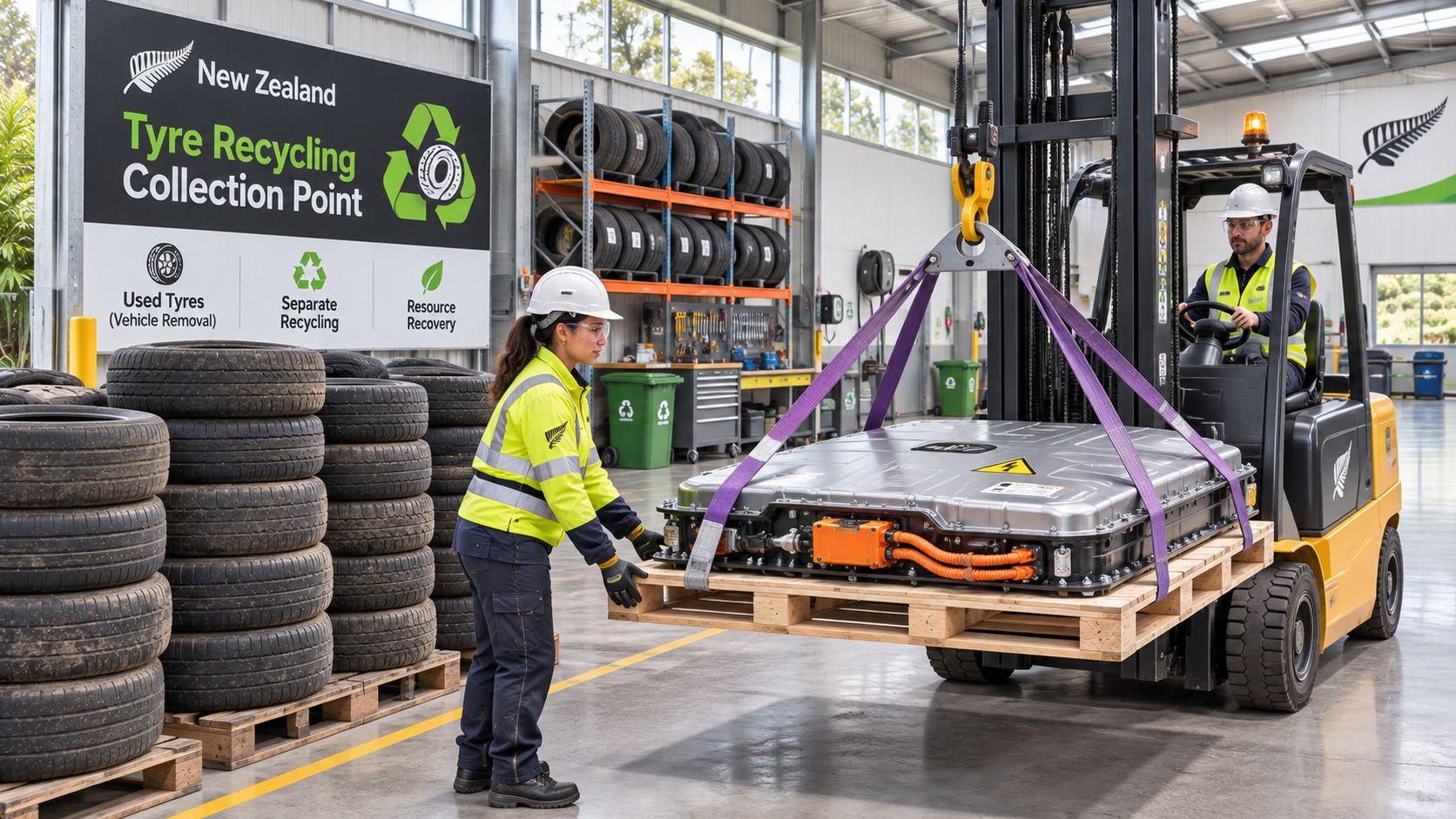
Trained staff must isolate the high-voltage system using model-specific procedures and verify the safe working condition. They then assess whether the pack is potentially reusable, damaged or suitable only for specialist recovery.
Flood-, fire- and crash-damaged packs need separate assessment because their hazards differ. Owners shouldn't disconnect orange cables, open a battery enclosure or attempt to charge a suspect pack before collection.
An RNZ report on New Zealand's EV-battery disposal challenges describes gaps in battery tracking and an incomplete end-of-life system. It's therefore misleading to assume every removed battery goes straight into recycling.
A reusable battery may retain value even when repairing the vehicle isn't economic, and recoverable motor and electronic components can also influence an assessment. Our EV battery recycling guide for New Zealand explains these routes further.
Request a written destination record that distinguishes reuse, assessment, storage and recycling. Those are different outcomes, not interchangeable descriptions.
Choosing a Licensed Dismantler for Your Vehicle
- Confirm licensing. We're a licensed Northland dismantler based in Port Whangarei.
- Check hazard controls. Establish how fluids, batteries, tyres and airbags are removed and recorded.
- Confirm downstream routes. Tyre and battery destinations should be identifiable.
- Complete disposal paperwork. Confirm the ownership notification at pickup; we handle the notice of disposal so a truck is removed from the seller's name.
- Keep written confirmation. We can supply removal confirmation for fleet or accounting records.
- Arrange a yard release. For collection from a panel beater or holding yard, we require the yard's release and the registered owner's ID.
Our guide to vehicle wreckers in New Zealand provides further selection guidance. A documented process is more useful than a broad promise to recycle responsibly.
Our dismantling scope includes cars, vans, utes, 4WDs, trucks, machinery, hybrids and EVs. Give the collection team accurate information about damage, access and missing components so they can plan safe handling.
Car Removals Whangarei offers vehicle removal and controlled dismantling, with hazardous materials separated, reusable parts recovered and shells sent for steel recovery. Visit Car Removals Whangarei for a firm quote, and include your vehicle's condition, location and any known leaks or battery damage so collection can be planned safely.
- vehicle recycling
- end-of-life vehicles
- car dismantling
- scrap car recycling
- NZ vehicle recycling