· Car Removals Whangarei
Buying an Electric Car in New Zealand for 2026

Ignore the popular advice to buy the cheapest electric car with the longest advertised range and pocket the savings. That advice was shaky when rebates softened prices, and it's worse now. When you're buying an electric car in New Zealand in 2026, the cheap listing can become the expensive car if you can't charge at home, you've forgotten road user charges, or the battery won't cover your real trip in winter. Price the household reality first, the car second. If the maths only works on brochure range, free public charging and a rebate that no longer exists, it doesn't work.
Table of Contents
- See Whether an Electric Car Fits in 2026
- Price Ownership Before You Compare Listings
- Check Home Charging Before You Commit
- Work Through the Purchase in Order
- Judge Battery Health and Exit Value
- Confirm the Car or Arrange a Safe Exit
See Whether an Electric Car Fits in 2026
The cheapest EV on the market can cost more in the long run if the household cannot charge at home, the rebate is gone, or a worn battery hurts resale. New Zealand's EV fleet kept growing, but registrations slowed after the Clean Car Discount ended in December 2023. The official vehicle fleet report recorded 113,715 light EVs in 2024, up from 103,665 in 2023. EVs were 8.0% of new vehicle registrations in the June 2025 quarter.
For buyers in Whangārei and Northland, judge each car on its condition and what your household can realistically spend, not on the headline price alone.
Five Questions That Decide the Purchase
Answer these before you haggle:
- Longest regular trip: How far is it, and does tested range cover it with a reserve?
- Charging location: Where will the car charge, and is the home setup adequate?
- Cost without a rebate: Does running cost still work with road charges included?
- Battery evidence: What does an independent state-of-health test show?
- Exit value: What might the car be worth if the pack is tired?
These questions narrow the field. A car that looks sensible beside a new Kia option may not suit your household once you account for charging and resale.
A low advertised price is a saving only if the car fits your use and budget.
Price Ownership Before You Compare Listings
Start with the full ownership picture, not the sticker. Different drivetrains pay for the road in different ways, use different energy, and carry different risks when you sell.
| Cost item | Petrol car | Non-plug hybrid | Plug-in hybrid | Battery EV |
|---|---|---|---|---|
| Road charge | Fuel excise in the pump price | No RUC | RUC licence from 1 April 2024 | RUC licence from 1 April 2024 |
| How the road charge is bought | Paid as fuel is bought | Not applicable | Prepaid in 1,000 km units by RUC weight | Prepaid in 1,000 km units by RUC weight |
| Everyday energy | Petrol | Petrol, no plug | Petrol plus some electricity | Electricity; home charging about half the public rate |
| Who this energy suits | Any parking | Any parking | A household that can plug in sometimes | A household that can charge where the car sleeps |
| Extra hardware | None | None | Charging cable | Possible dedicated circuit or wall charger |
| Main value risk at resale | Age and kilometres | Age and kilometres | Pack plus policy changes | Tested battery health and newer models |
Road Charges Are No Longer Optional
Budget for them up front. The Ministry of Transport road user charges information states the exemption ended on 31 March 2024, and from 1 April 2024 light EVs and plug-in hybrids weighing under 3.5 tonnes must purchase and display a RUC licence. RUC is prepaid in 1,000-kilometre units, and the amount depends on the vehicle's RUC weight and vehicle type. Don't guess a rate from a forum post. Look up the current rate for that exact weight band and type, then use your own annual distance.
A conventional petrol car pays through fuel excise at the pump and buys no distance licence. A non-plug-in petrol hybrid doesn't pay RUC under current rules, which is why it stays competitive for households without easy charging. Very light electric vehicles under 1,000 kilograms, such as some electric motorcycles or mopeds, remain exempt, but that exception won't help a normal passenger car buyer.
Work the 12,000 Kilometre Example
Say your household drives 12,000 kilometres a year. For a plug-in hybrid or battery EV, that's 12 RUC units a year. Multiply 12 by the current unit rate for that car, add the total to its annual running cost, and only then compare it with a petrol car or non-plug hybrid. If you drive far more, the distance charge grows with you. If you drive far less, the purchase price and battery condition matter more than small energy savings.
Now add energy. A battery EV charged at home on a suitable plan has a clear cost advantage. The same car parked on the street, charged publicly after work, and driven with a tired pack that needs more frequent top ups can lose much of that advantage. A plug-in hybrid sits between the two, but only if you plug it in. Left uncharged, it's a heavier petrol car carrying a battery you paid for and still owe road charges on.
The column that matches your parking, distance and charging habit decides the purchase. The greenest column on paper doesn't win if your household can't use it that way.
Hardware belongs in the same sum. A petrol car needs nothing extra at home. A plug-in vehicle needs at least a proper cable in good condition, and a battery EV with a bigger pack may need a dedicated circuit or wall charger before it's convenient. Price that work before you call the car cheap to run. Resale is the final row for a reason. Age and kilometres hurt every car, but an electric car also gets judged on tested battery health and on how it stacks up against newer models with better range and faster charging. If the saving over three years disappears in one weak resale, you didn't save money. You prepaid it.
Check Home Charging Before You Commit
The cheapest EV on paper can be the most expensive choice for a household without convenient home charging. Check where the car will park and how you will charge it before comparing listings. EECA's 2025 New Zealand EV charging research found that 46% of New Zealand EV drivers charge only at home, 57% of BEV drivers still use a standard three-pin plug, and 19% of home charging is done through a smart charger. Those figures show that home charging habits vary. A slow plug may suit modest daily driving, but your household's routine is what counts.
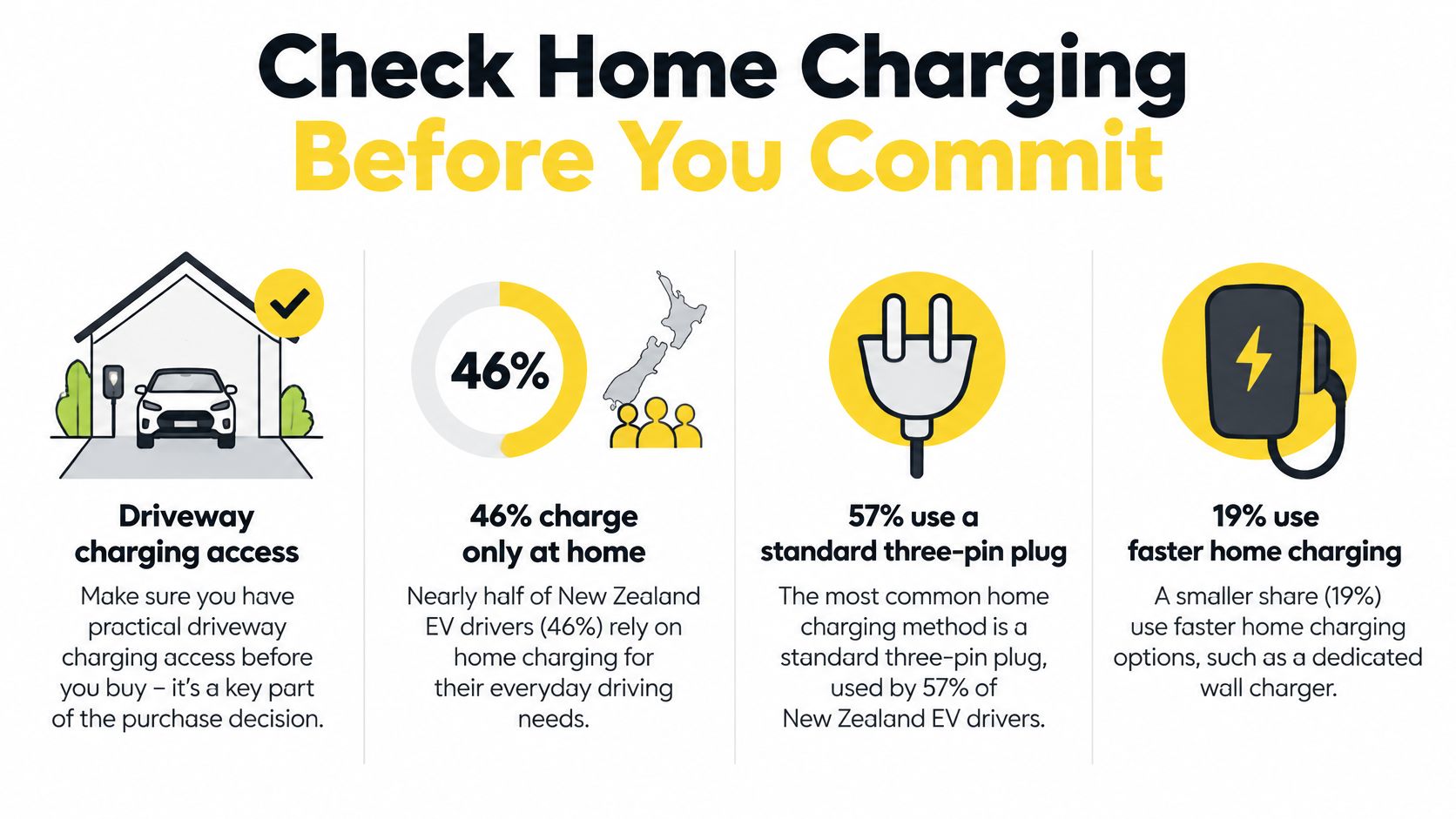
Run a Driveway Audit
Check where the car will be parked overnight. Is the space yours, or is it shared, rented or on the street? Is there a nearby socket on a circuit that can handle regular charging without sharing with heaters, pumps or workshop equipment? If you rent, get written permission for any wiring work and agree who pays.
A standard plug can suit short trips around Whangārei if the car stays connected for long stretches. It can fall short with a large battery, frequent long drives or late arrivals followed by early departures. If that sounds like your routine, price a dedicated circuit or wall charger before you sign. Ask an electrician to check the switchboard, cable run and parking spot. Don't rely on a casual assurance that the garage socket will cope.
Compare Home and Public Charging
EECA research on residential smart charging reports that 80% of New Zealand EV owners charged at home more than half of the time, and that home charging was generally about twice as cheap as public charging. Compare your actual household rate with the public charging prices on routes you use. A plan that depends on public chargers every day needs to work for both your budget and your schedule.
For regular Northland travel, mark the chargers on routes you drive each week, including journeys for work, school, sport and family. Check that the connector suits the car and that the stop fits your routine, especially if you're travelling with children, groceries or a trailer. A charger on a map is no help if it is inconvenient when you need it.
Three Rules Before You Pay a Deposit
- Match the car to your charging setup. A large pack and frequent driving can make a slow socket the limiting factor.
- Treat public charging as part of a real routine. Check the price, location and timing before relying on it regularly.
- Price electrical work before judging affordability. Include a dedicated circuit or wall charger if your setup needs one.
The cheapest EV to run on paper may cost more overall if you cannot charge conveniently at home, the rebate is gone, or a tired battery weakens resale value. A home charging plan that fits your parking, budget and daily routine is part of the car's true price.
Work Through the Purchase in Order
Use one sequence and don't skip ahead to price. The order matters because range, charging and battery evidence should set the offer, not follow it.
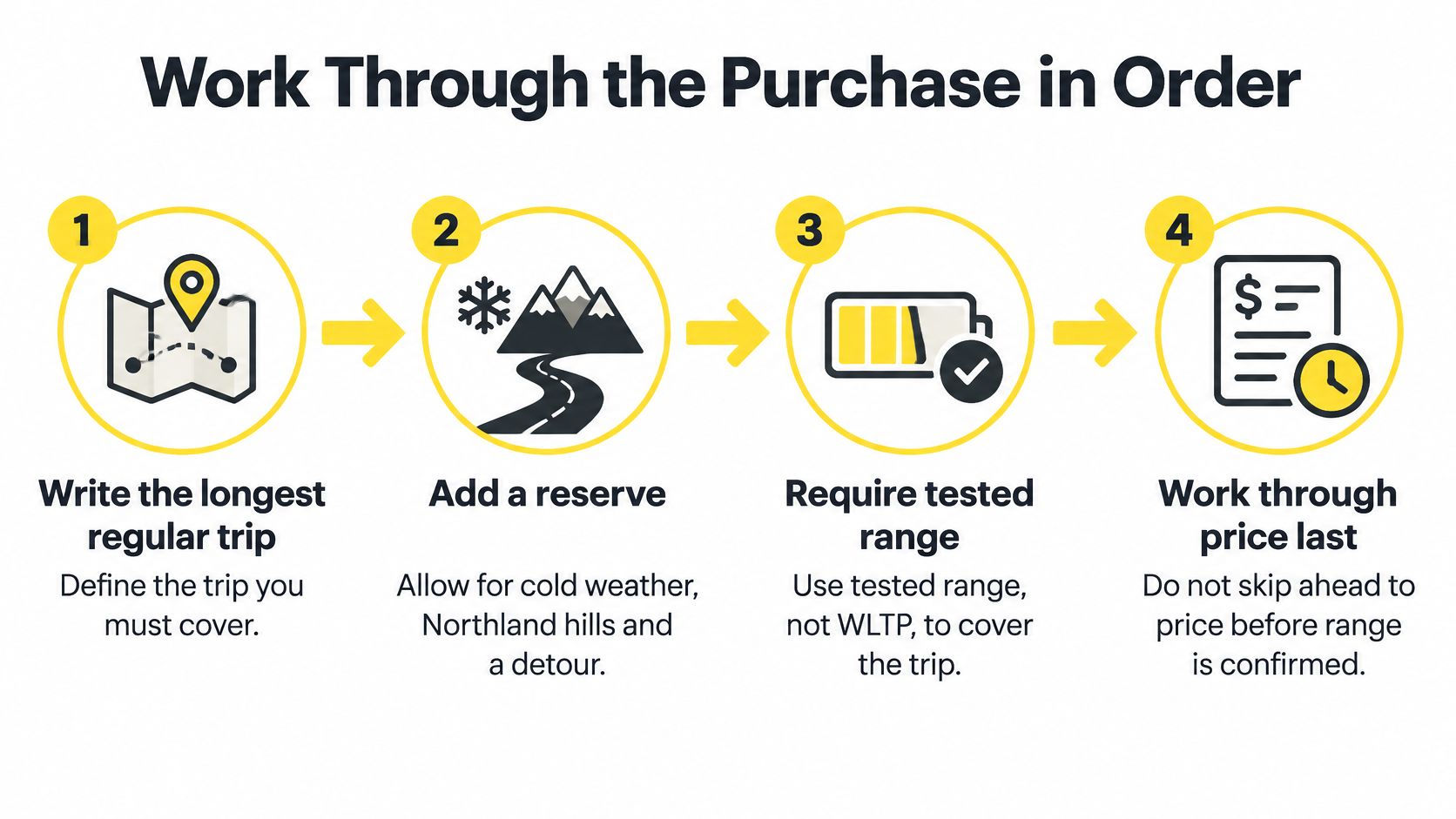
Steps 1 to 4 Set the Real Requirement
- Write the longest regular trip. Use the trip you must make without drama, then add a reserve for cold weather, Northland hills and a detour. Require tested range to cover that total, not the seller's best day or the official test figure.
- Record the charging facts. Get exact battery capacity, connector type, AC charging limit, DC fast charging capability and which cables are supplied. The Consumer Protection guidance on researching cars and sellers supports checking battery capacity, connector type, AC and DC limits and supplied cables before price, because not every EV rapid charges and not every cable suits New Zealand systems.
- Time a realistic charge. Charging can take roughly 20 to 30 minutes to several hours depending on charger type and battery size. Work out what that means at your home socket, at a wall charger if fitted, and at the public charger you'd use on a long day.
- Price the car with road charges included. Assume no Clean Car Discount. Add insurance, tyres, servicing and any charging hardware, then check whether the car still beats the petrol or hybrid alternative for your distance. It's useful to compare that total with what cars are worth in the Whangārei market so a low EV price isn't judged in isolation.
Range isn't a fixed badge on the boot. It changes with battery capacity, road conditions, terrain and driving style, and battery performance is affected by age, temperature exposure, long periods without use and frequent fast charging. That's why step 1 uses your route plus a reserve. A car that just covers the distance on a mild day will frustrate you on a wet winter night with a headwind, a full car and a diversion.
Steps 5 to 8 Prove the Car or Kill the Deal
- Commission an independent state of health test. Use a dealer or vehicle testing station, not the seller's screenshot. The report should show remaining capacity, fault codes and estimated full charge range, and the estimated range must be compared with the reserved trip from step 1.
- Get warranty terms in writing. Confirm duration, transferability and exclusions, and keep that paperwork separate from the test result. A warranty promise doesn't improve a weak pack today, and a strong test doesn't fix a warranty that won't transfer to you.
- Inspect the ordinary car properly. Check the charging port for damage, test the 12 volt battery, look at tyre wear, service history and warrant of fitness, and confirm finance or a security interest is clear before money moves. Electric drive doesn't excuse worn suspension, water leaks or missing service records.
- Set the final price only now. Renegotiate or walk away if tested capacity is materially below the seller's claim. A replacement traction battery can cost several thousand dollars, so a small discount doesn't cover a big health gap.
Use the battery bands that follow when you reach steps 5 to 8. A strong result supports a normal driving car price. A middling result cuts the offer because you'll pay in range, time and resale. A result well below the claim ends the transport purchase, whatever the seller says about future warranty help. Don't invent a softer threshold at the yard because you like the colour or the price has already dropped once.
Failure condition: If the independent test doesn't support the range the seller sold you, the advertised price is dead. Renegotiate from evidence or leave.
Judge Battery Health and Exit Value
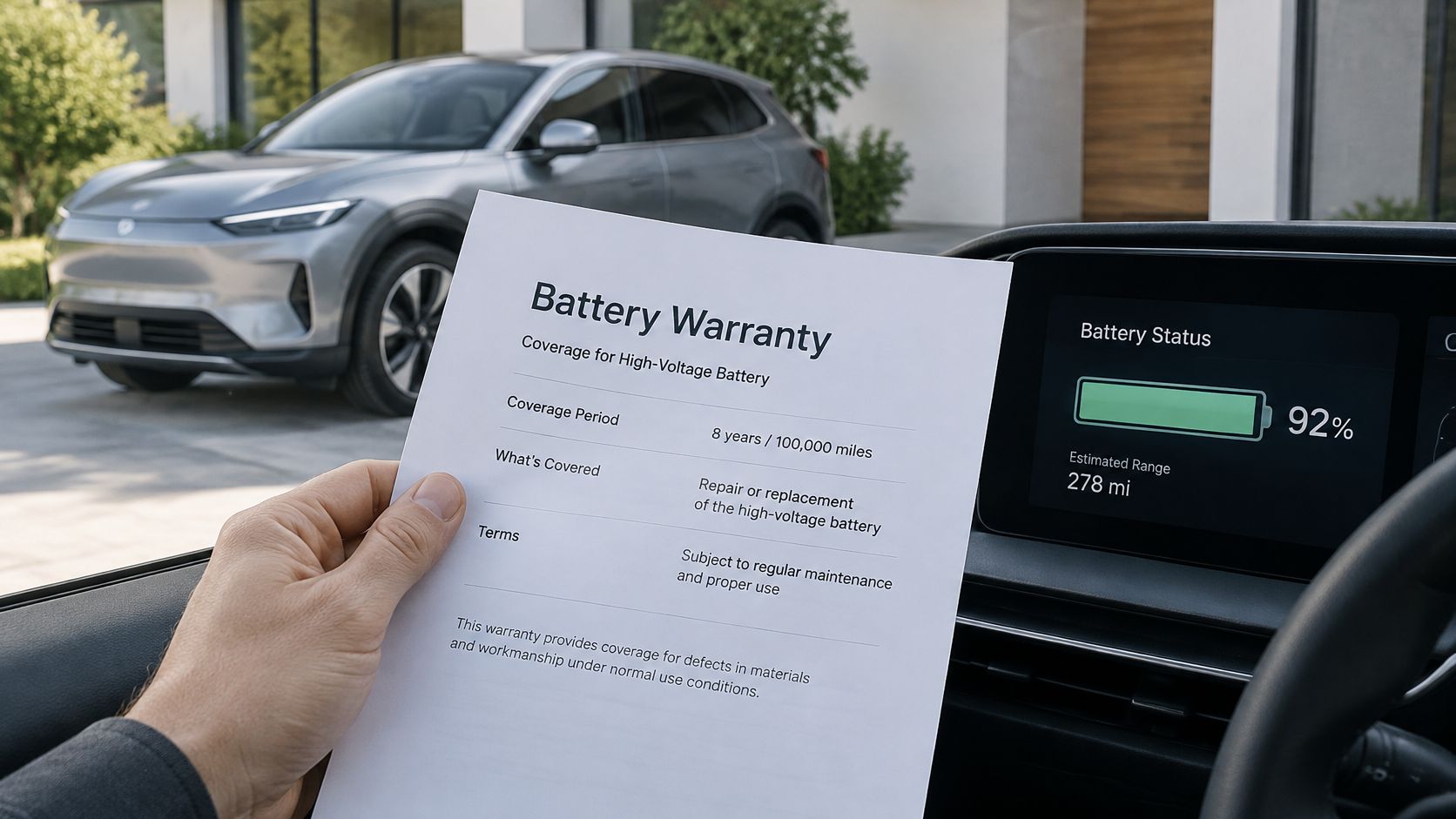
Separate the warranty on paper from the pack you're buying. A transferable warranty helps, but it doesn't restore usable range lost through age, heat, long storage or repeated fast charging. Consumer NZ guidance on second hand EVs recommends checking the battery's condition before purchase rather than relying only on the dashboard displayed range or the seller's claims. Follow that advice. The dashboard estimate can flatter the car after gentle recent driving, and it won't tell you fault codes or true remaining capacity.
Match the Test Result to One Price Action
| Independent SoH result | What it means | Price action |
|---|---|---|
| Strong, covers the reserved trip | Normal market price is supported | Pay a driving-car price if warranty paperwork is also clear |
| Middling | Range and charging speed fall on longer days | Cut the offer by the likely range loss and the cost of slower trips |
| Well below the seller's claim | Pack is failing or close to replacement | Walk away, or treat the car as a parts-and-steel purchase |
A strong result still needs paperwork. Confirm the warranty transfers, note exclusions, and check parts support for that model before you pay top money. A middling result isn't automatically a rejection, especially for a short distance second car, but the price must reflect shorter useful range and a smaller pool of future buyers. A poor result changes the asset class. You're no longer buying reliable transport, you're buying a project, parts source or exit problem.
Exit value belongs in the decision now, not when you're trying to sell in three years. Newer models can make an older electric car harder to move even while the national fleet grows, because buyers compare range, charging speed and battery evidence side by side. A sound car with a healthy pack, clean title and believable history stays on the private or dealer market. That includes cars sold through the same channels people use when they look at cash for cars in Whangārei, where condition still drives the number.
When the Car Stops Being Retail Stock
Structural damage, flood or fire history, a failed pack or no realistic private buyer pushes the car into a different category. Value then sits in reusable parts, recoverable materials and the traction battery rather than in a retail listing with fresh photos. That's not failure, it's honest pricing. Trying to sell a weak pack car as normal transport invites disputes, wasted advertising and a buyer who returns angry when winter range collapses.
Dismantling an electric or hybrid car also needs proper handling. Fluids, the 12 volt battery, tyres and airbags must be dealt with safely, and a high voltage pack must be isolated before the vehicle is moved or stripped. Don't let an unqualified buyer drag a damaged EV around a paddock or cut into wiring to see what happens. If the car is an exit, use an exit process that treats the electrical system as a hazard and an asset, not as scrap trim.
Pay a driving car price only when tested range, warranty paperwork and a believable second owner all exist. Otherwise price the car as an exit, not as transport.
That rule protects you on both sides. As a buyer, it stops you funding someone else's battery problem. As a future seller, it tells you which records to keep from day one, including charging habits, service invoices, battery reports and warranty documents. The next buyer will ask the questions you're asking now. If your answers are thin, your price will be too.
Confirm the Car or Arrange a Safe Exit
End with one of three outcomes. Don't drift into a fourth outcome where you buy hopefully, charge inconveniently and discover the range problem after the money's gone.
Buy, Renegotiate or Exit
- Buy: Tested range covers the reserved trip, home charging is realistic, road charges are in the budget, and the battery report matches the advert. Complete the ownership paperwork in your name and keep the report with the service history.
- Renegotiate: The pack is middling but the car otherwise fits. Return with the independent report and a lower figure based on range loss, slower trips and weaker resale. Don't rely on a possible warranty payout to justify paying the full ask.
- Exit: The car fails the test, won't charge where it must live, or is already a non runner, write off or flood damaged electric. Stop pricing it as family transport.
For that third case in Whangārei and wider Northland, we take hybrids and EVs including Prius, Aqua, Leaf and Tesla models, and we include traction battery value in the quote rather than pricing the car only as scrap steel. You can fill in an online form with your name, phone number, vehicle details and pickup address, and we'll call back with a cash figure. Payment is cash or instant bank transfer before loading, and high voltage systems are isolated during removal.
That process suits a car with a failed pack, accident damage or no realistic private buyer. It also suits an owner who has done the checks in this guide and realised the honest answer is not to keep pouring money into charging gear, repairs and advertising. A clean exit can be the financially sound move, especially before registration, storage or deterioration eats the remaining value.
Make your offer subject to the battery report, or request an exit quote before the car sits unused and loses more value.
If your checks show the electric or hybrid car is worth more as a safe exit than as your next daily driver, Car Removals Whangarei can quote it with traction battery value included, pay before loading, and remove it with high voltage isolation handled properly. Send your vehicle and pickup details today and get a firm Northland figure instead of leaving a tired EV sitting in the driveway.
- buying an electric car
- EV ownership
- road user charges
- battery health
- used EV