· Car Removals Whangarei
Value Cars Whangarei: A Practical Buyer's Guide
You've found a Whangārei car advertised at a price that looks almost too good to ignore. The seller says it drives, the photos hide most of the important details, and you're already picturing the trip home from a yard in Tikipunga, a private driveway near Onerahi, or an auction pickup around Kioreroa Road. The danger is treating the sticker price as the cost of ownership.
For value cars Whangārei, the number that matters is what you can afford to run for the next twelve months after the warrant, registration, tyres, repairs, insurance, fuel and towing are included. A cheap car can still be good buying, but only when its condition and paperwork support the price.
Table of Contents
- Why the Cheapest Whangārei Listing Is Rarely the Best Deal
- Where to Find Value Cars in Whangārei
- Inspecting the Car in a Yard or at a Private Address
- Working Out a Fair Whangārei Price
- Negotiating Without Overpaying
- WOF, Rego and Ownership Paperwork in Whangārei
- Your Reusable Whangārei Buying Checklist
Why the Cheapest Whangārei Listing Is Rarely the Best Deal
I once followed the familiar trail from a Tikipunga listing to a private driveway for an older sedan priced at $2,500. It looked acceptable online. In person, the WOF was close to expiring, two tyres were marginal, the brake pedal felt soft and rust had started along the lower body. The car wasn't cheap. It was an unpaid repair bill wearing a $2,500 label.
The first calculation is simple. Add the items you'll need before the car becomes dependable:
| Cost Line | $2,500 Listing | $4,500 Sorted Car |
|---|---|---|
| Purchase price | $2,500 | $4,500 |
| WOF and likely preparation | May require inspection and repairs | Usually included or recently completed |
| Registration | May need renewal | Current, subject to confirmation |
| Tyres and brakes | Risk of immediate replacement | Inspect condition before purchase |
| Rust or water damage | Potentially significant | Lower risk if inspected and disclosed |
| Towing | May be required from a private address | Less likely if road-ready |
| First-year position | Uncertain and potentially expensive | Higher upfront cost, clearer budget |
The planned figures often quoted by sellers for a new WOF, registration renewal, tyres, brake work and towing are only estimates until a qualified provider inspects the vehicle. A WOF failure can expose several problems at once, and rust repair can quickly move beyond what makes sense for an older car. Fuel and insurance can also be less forgiving on an ageing import, especially if the vehicle has a larger engine or an uncertain service history.
Practical rule: Price the car as though every unknown is your responsibility. If the total still works, you've found a candidate. If it only works when every defect turns out to be minor, walk away.
A $4,500 car with current WOF and registration may be the better purchase because you're buying information as well as transport. That doesn't make every sorted car good value. It means the seller has removed some immediate uncertainty, and you can spend your inspection time checking the vehicle rather than guessing which overdue jobs will appear after payment.
Where to Find Value Cars in Whangārei
Start with the buying channel that matches your mechanical confidence. Dealers and established yards generally suit buyers who want a road-ready vehicle and a clearer path if something goes wrong. Private sellers can offer lower prices, but you'll need to do more of the checking yourself.
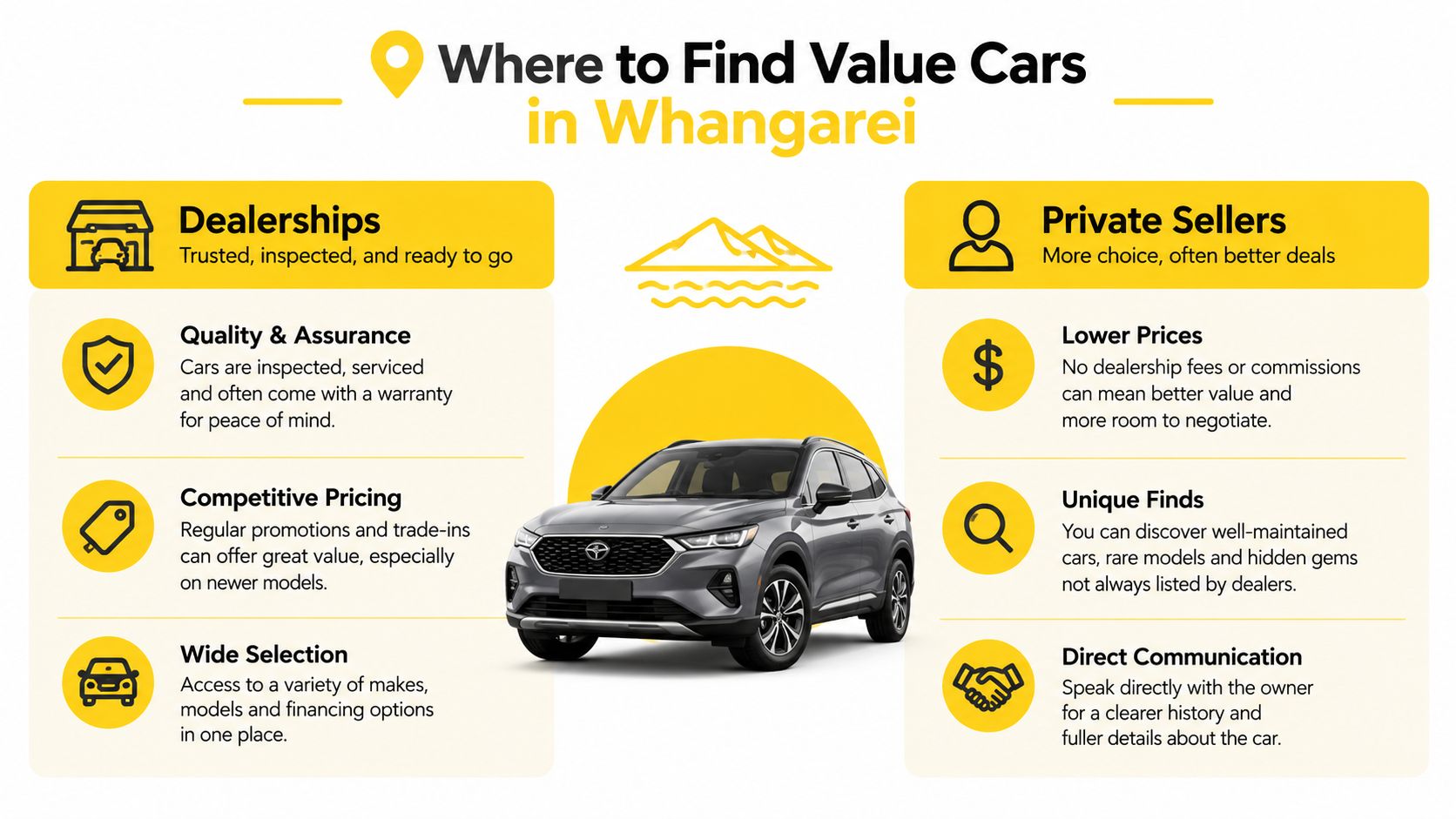
Match the channel to the buyer
Franchise and independent yards around Lower Tarewa Road and the Port: Start here if you're a first-time owner or an upgrader who needs a usable car rather than a project. Ask whether the WOF and registration are current, whether on-road costs are included, and what servicing has been done. Dealer pricing may leave some negotiation room, but compare the complete drive-away figure.
Smaller lots in Raumanga and Onerahi: These can suit buyers who know common faults on the models they're considering. Stock varies, so inspect each vehicle on its own merits instead of assuming a local yard means a local history.
Turners and Manheim auctions on Kioreroa Road: Auctions can work for mechanically confident buyers who understand that inspection time and buyer obligations matter. Preview the car, read the listing conditions, and set a hard ceiling before bidding. An auction price that looks low can stop being good value once transport and repairs are added.
Trade Me with a Northland region filter: This is the most efficient way to compare similar models without drifting into Auckland pricing. Search by year, kilometres, body type and engine size, then remove listings with vague descriptions or missing ownership information. The cars for sale in Whangārei guide can help you structure that local search.
Facebook Marketplace and local Whangārei or Northland groups: Listings can appear quickly and may come from nearby owners, but scam risk and incomplete information are higher. Never transfer a deposit before seeing the car and confirming the seller's identity and documents.
Word of mouth still matters around tradie contacts, rural properties and local iwi networks. Those leads can produce honest history, but personal familiarity isn't a substitute for an inspection, a vehicle history check and correct NZTA paperwork.
Inspecting the Car in a Yard or at a Private Address
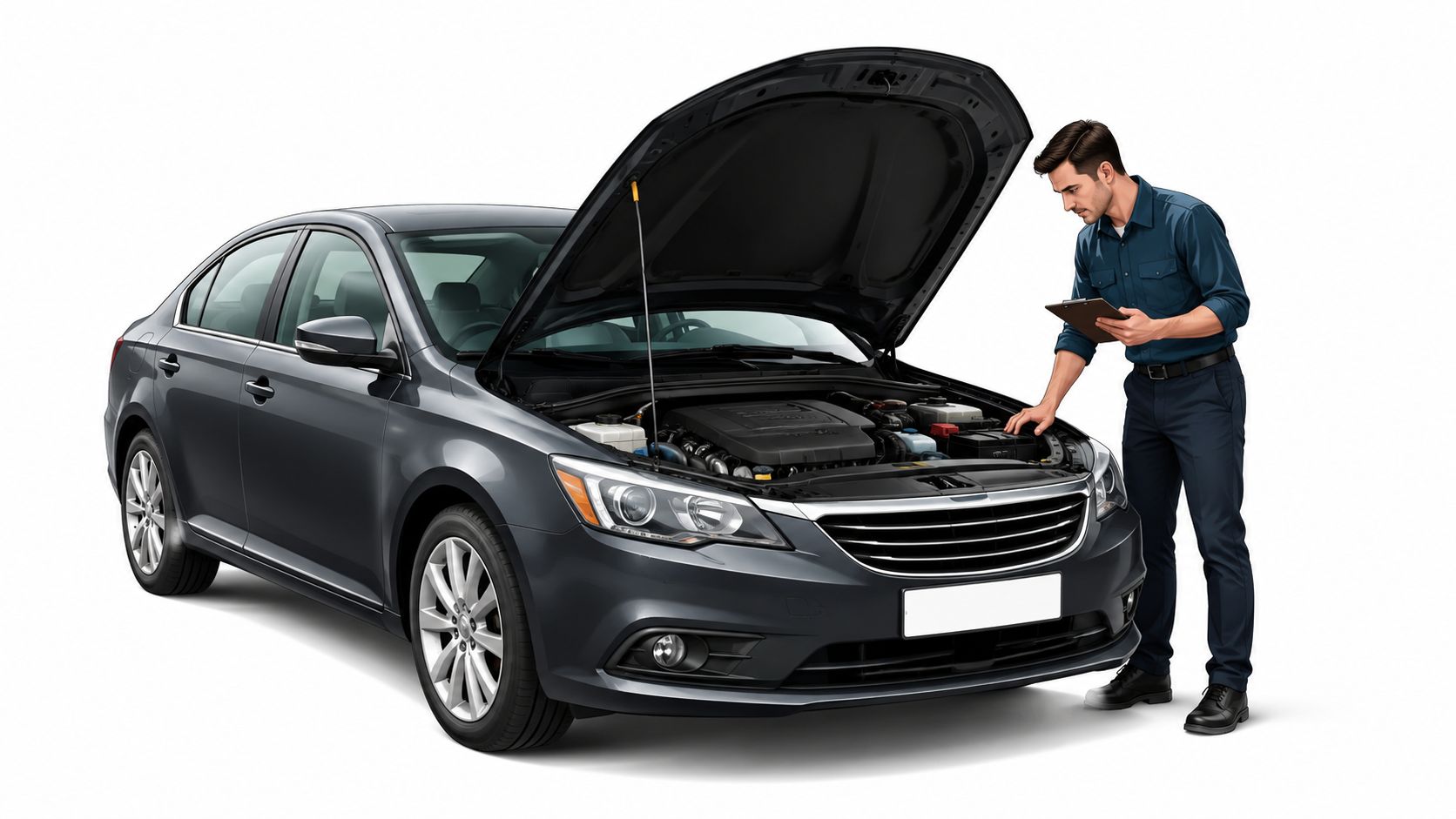
Take a torch, a small magnet and your phone. You don't need a workshop to reject a poor buy, and you should inspect the vehicle before discussing how much you like it.
Start cold and work from the cabin out
Ask the seller not to warm the engine before you arrive. A cold start reveals noises, smoke and difficult starting that can disappear once the engine reaches operating temperature.
Check the fluids. Look at the oil level and colour, coolant condition and brake fluid. Creamy residue under the oil cap can indicate coolant contamination and possible head-gasket trouble.
Scan the engine bay. Fresh paint, unusually clean areas, new hoses beside an old-looking engine, or visible oil residue can suggest recent preparation rather than a healthy mechanical baseline. Don't treat a clean engine bay as proof of quality.
Use the magnet carefully. Run it over steel panels, avoiding trim and plastic. Weak contact can indicate filler beneath the paint. Check whether panel gaps remain even around the bonnet, doors and boot.
Look for Northland-specific damage
Salt air, damp storage and coastal exposure can leave rust in places a quick walk-around misses. Crouch at each corner and check the sills, wheel arches, lower doors and rear quarter panels for bubbling, flaky metal or uneven repairs.
Lift the boot carpet and the spare-wheel cover. Dampness, silt, staining or a stale water smell can point to flood exposure, particularly in an imported vehicle. Check under the seats where practical, and look for corrosion around wiring plugs, seat rails and metal brackets.
A short drive should include gentle braking, turning and reversing. Listen for transmission clunks, suspension knocks and wheel-bearing noise. Watch for brake shudder, steering pull and dashboard warning lights that stay illuminated after startup.
If you can see serious rust or evidence of flooding, leave the car behind. A bargain price won't make hidden structural or electrical problems predictable.
Working Out a Fair Whangārei Price
A fair price starts with local comparisons, not a national average copied from a generic calculator. Sort similar Whangārei and Northland listings by model, year, kilometres, body type, engine and equipment. Then compare the asking price with vehicles offered through Turners Whangārei and Manheim Auctions on Kioreroa Road, while remembering that an auction result isn't automatically an all-in retail price.
Build the number in four passes
First, record the advertised figure. Second, identify what the seller has already included, such as a current WOF, registration, service or tyres. Third, price the work you'll need immediately. Finally, allow for transport if the vehicle is coming from outside the region, particularly from Auckland.
A listing can look fair and still be expensive once you add a fresh service, transfer costs, tyres, repairs or a tow. For a useful valuation framework, compare the seller's number with this Trade Me car estimate guide, then verify the vehicle in person.
Consider a 2010 Toyota Corolla 1.8G with 142,000 kilometres, advertised at $5,490 at a Kamo yard. The right question isn't whether $5,490 sounds reasonable. It's whether the vehicle's condition supports an all-in range of $5,600 to $6,300, after checking what the yard has included and what you'll need to spend.
| Line Item | Amount (NZD) | Notes |
|---|---|---|
| Advertised price | $5,490 | Starting point, not the final assessment |
| Immediate service allowance | Included only if documented | Confirm oil, filters and inspection history |
| WOF position | Confirm before agreeing | Check expiry and any recent repair work |
| Registration position | Confirm current status | Check the label and transfer requirements |
| Tyres and brakes | Inspect, then price | Don't accept verbal reassurance |
| Transport | Add if required | A distant purchase changes the calculation |
| Fair all-in range | $5,600 to $6,300 | Depends on condition and included work |
That range isn't a promise about every Corolla or every Kamo yard. It's a disciplined way to negotiate: pay more for documented condition, not for a clean photo set or a confident sales pitch.
Negotiating Without Overpaying
Don't open by asking, “What's the lowest you'll take?” That invites the seller to protect the sticker price while adding costs elsewhere. Use a drive-away question that forces the complete number into the conversation:
“What's your best drive-away price on this one, including a new WOF and rego?”
Then ask for concessions in an order that protects your budget:
- WOF: Request a new warrant if the current one is close to expiry or the seller can't explain recent work.
- Service: Ask for an oil and filter service, with the work recorded on the receipt.
- Tyres: If the tyres are legal but worn, ask the seller to replace them or reduce the price.
- Fuel: A half-tank is a small request, but it removes one immediate expense after collection.
- Same-day payment: Offer cash-on-pickup or an instant bank transfer only after the vehicle and paperwork check out.
A modest trade-in can also create influence in Northland. An old ute, lawnmower or unwanted vehicle that has little private-sale appeal may help reduce the cash difference, but get the value of both vehicles written into the agreement. Treat a trade-in as a pricing tool, not a reason to overlook defects.
Two conversations worth copying
At a Tikipunga yard
Buyer: “I'm interested, but I need the complete drive-away figure. Can you include a fresh WOF, service and the transfer costs?”
Seller: “We can do the WOF and service, but the price stays close to the advert.”
Buyer: “If those are included and the tyres pass inspection, I can complete payment today at the agreed figure.”
At a Kioreroa Road auction preview
Buyer: “I'm bidding only to my total budget. I've allowed for the WOF, transport and the repair risk.”
That second conversation is with yourself. Auction discipline prevents a low opening bid from turning into an expensive impulse.
Walk away if the seller can't produce a recent WOF when one is promised. Walk away if on-road costs appear after you've agreed on a handshake price.
WOF, Rego and Ownership Paperwork in Whangārei
Paperwork should happen at the handover, not sometime after the tow truck leaves. NZTA requires both the seller and buyer to notify a change of registered person without delay when a vehicle is sold, gifted or otherwise disposed of, and the online disposal process asks for the plate number plus the recipient's full name and address. See the NZTA registration change of ownership guide before you arrive.
Follow the handover sequence
Agree the written price. Get the seller's name, address, vehicle details, payment amount and condition recorded. Keep the receipt and photograph the odometer, VIN plate and registration label.
Confirm the seller's disposal notice. NZTA says the seller should notify it “straight away” at the time of sale, while the buyer registers the vehicle into their name online or through an agent. Don't rely on the physical handover as proof that liability has transferred. The NZTA ownership guidance explains the separate responsibilities.
Check the WOF. Confirm the expiry date on the windscreen sticker and ask for any recent inspection or repair paperwork. Rusty brake lines, worn wiper arms and tyres damaged by rough or shingle-road use deserve close attention in Northland.
Complete acquisition and registration details. Use the online process or an NZTA agent, such as an authorised post shop, and confirm where the registration label will be sent. The buyer's legal obligation starts at acquisition, so delaying the transfer creates avoidable risk.
The old MR13A paper form was removed from circulation in 2022, which reinforces the need for a digital or assisted process. Keep the receipt, confirmation screens and any seller messages together in a buyer pack.
Your Reusable Whangārei Buying Checklist
Save this list to your phone before leaving home. A good viewing should produce evidence, not just a feeling.
Before you leave
- Set the full budget: Include repairs, WOF, registration, fuel, insurance and transport.
- Filter locally: Compare similar vehicles in Whangārei and Northland rather than relying on an Auckland asking price.
- Bring inspection tools: Pack a torch, magnet, phone charger and notebook.
- Arrange help: Book a pre-purchase inspection at a Whangārei VTNZ or NZTA-licensed outlet if anything feels unclear.
In the car park
- Check the cold start: Ask whether the engine has been running before you arrive.
- Inspect the fluids: Look for contamination, low levels and unexplained residue.
- Scan for filler: Check panel gaps, paint texture and magnet contact.
- Search for moisture: Lift the boot mat and inspect the spare-wheel well for dampness, silt or smell.
- Photograph identity: Record the odometer, VIN plate, plates and WOF sticker.
- Test the drive: Listen for transmission clunks, brake shudder and warning lights.
Before paying
- Confirm the WOF expiry: Match the sticker with the seller's claims.
- Write the all-in price: Include every promised repair or on-road item.
- Verify the seller: Make sure the seller name matches the ownership information.
- Ask about keys: Record how many keys are included and who holds them.
- Complete NZTA notices: Make sure disposal and acquisition are handled at handover.
- Keep the buyer pack: Store the receipt, inspection report, photos and transfer confirmation.
The cheapest listing is only the cheapest deal when the condition, paperwork and next twelve months all line up. Judge value by the cost you can live with, not the number that first caught your eye.
If your unwanted car has failed its WOF, stopped running, suffered flood or accident damage, or is taking up space on a farm or rental property, contact Car Removals Whangarei for a firm quote and vehicle removal. The service handles cars, vans, 4WDs, trucks and machinery, with pickup arrangements and NZTA ownership notification completed during handover.
- value cars whangarei
- whangarei used cars
- cheap cars northland
- buy car whangarei
- wof check whangarei