· Car Removals Whangarei
New Kia Car Choices for Northland in 2026

Kia recorded 8,597 new passenger-car and SUV registrations in New Zealand in 2025, representing an 8.8% market share, according to Road Genius. That makes a new Kia car a familiar local choice, but popularity doesn't tell a Northland buyer whether its range, warranty or running costs will suit the driveway at home.
The useful comparison starts with your actual trips, not the largest number in a brochure. It also extends beyond buying day, because written cover, consumer rights and a safe exit from an uneconomic vehicle are different parts of ownership.
Table of Contents
- Where a New Kia Car Sits in 2026
- EV3 and EV4 Figures Side by Side
- Warranty Servicing and Rights That Outlast Them
- Choosing for Whangarei Roads and Distances
- How to Check the Driveaway and the Loan
- When a Newer Kia Is No Longer Worth Repairing
- Hand Over a Kia That No Longer Pays
Where a New Kia Car Sits in 2026
The national registration snapshot puts Kia firmly among mainstream choices. It doesn't establish that every model is equally suitable, readily available or priced attractively.

The monthly picture was uneven. Kia recorded 674 new-vehicle registrations in February 2025, up 59.3% year on year, according to Autotalk. In August, it registered 778 new vehicles, down 8% from August 2024, according to the Australasian Fleet Management Association.
November then brought 773 registrations, a 128.7% year-on-year increase and a 7.5% market share, as reported by the Australasian Fleet Management Association. Those movements describe registrations, not a reason to rush into a finance agreement.
What new means for your purchase
For this comparison, a new Kia car means a dealer-supplied vehicle entering its first New Zealand registration, rather than a used import or an already-owned local vehicle. A demonstrator or preregistered car deserves particular attention: a fresh-looking cabin doesn't establish when its warranty clock began.
Ask the dealer to identify the delivery and registration history in writing. Treat the model badge, exact variant and vehicle identification number, or VIN, as separate details that must agree across the quote and warranty documents.
The EV3 and EV4 offer useful published electric-vehicle comparisons. Other Kia choices, including hybrids and people-movers, should be checked against the current New Zealand range, rather than assumed available because they appear on an overseas website.
The questions that matter locally
A sensible shortlist answers these questions before colour or accessories:
- Published capability: Which electric models have range, charging and consumption figures for the exact variant being offered?
- Ownership protection: Which warranty, servicing conditions and Consumer Guarantees Act protections apply?
- Local suitability: Which powertrain fits Whangarei distances, hills, carrying needs and access to home charging?
Registration popularity helps establish context. Your route, parking arrangement and written purchase terms determine whether a particular car belongs on your shortlist.
EV3 and EV4 Figures Side by Side
Published EV3 and EV4 Light Long Range figures
| Model | Battery | Motor | Claimed range | Charge or consumption | Safety notes |
|---|---|---|---|---|---|
| EV3 Light Long Range, Kia NZ brochure | 81.4 kWh lithium-ion | Output not specified in the cited information | Up to 605 km | 10% to 80% in approximately 31 minutes using DC fast charging | Forward Collision-Avoidance Assist, Lane Keeping Assist, Highway Driving Assist and Reverse Parking Collision-Avoidance Assist |
| EV4 Light Long Range, Kia NZ specifications | 81.4 kWh NCM lithium-ion | 150 kW, front-mounted | Up to 633 km | Rated consumption of 14.4 kWh/100 km | The same assistance systems, plus a five-star ANCAP rating |
Ask a dealer for a written on-road quote for each EV3 and EV4 variant. Current New Zealand driveaway prices are not included in these published figures.
Read capacity and consumption separately
Battery capacity describes stored energy. Consumption shows how quickly a car uses that energy over distance. Claimed range combines capacity and efficiency under test conditions.
Both models list the same battery capacity, while the published EV4 range is higher. That is consistent with the way efficiency can help a car travel farther on stored energy, much like carrying a lighter load on the same tank.
The comparison does not establish an exact real-world efficiency advantage. No matched EV3 consumption figure is listed here, so the two range claims cannot be used to calculate a precise difference.
The charging and consumption entries also answer different questions. Charging time helps you plan a stop; consumption helps estimate how much energy a journey uses.
Practical rule: Compare range with range, consumption with consumption, and charging time with the conditions attached to that charging test.
Translate the claims into a journey
Both range figures are controlled-test claims, not guaranteed distances between charging stops. Cold weather, motorway speed, payload, Northland hills, wind, tyres, heating and air-conditioning can all reduce the distance available.
A charging time also depends on its test conditions. Check the battery's starting charge, charger capability and any other conditions attached to the manufacturer's figure before assuming a short stop will deliver the same result on your route.
For a family travelling with luggage, the useful question is whether the route still has comfortable charging options if energy use rises or a preferred charger is unavailable. A brochure figure is a comparison point, not a trip plan.
Understand what the safety equipment does
The listed assistance systems address forward hazards, lane position, highway driving and reversing risks. They may warn or intervene, but the driver still needs to watch the road and understand each system's limits.
During a demonstration, ask the salesperson to show the controls and explain warning sounds, dashboard symbols and operating restrictions. Confirm that the exact variant being quoted has the equipment listed in the comparison.
Before choosing, confirm the New Zealand variant and charger access. A familiar model name alone does not establish the battery specification, equipment or how conveniently you can charge the car.
Warranty Servicing and Rights That Outlast Them
Kia New Zealand warranty, service and legal limits
| Cover | Limit | What it covers |
|---|---|---|
| Standard new-vehicle warranty | 36 months or 100,000 km, whichever occurs first | Manufacturing and assembly defects; starts on the earlier of first delivery or first registration |
| High-voltage battery cover | For the EV3 and EV4, eight years or 160,000 km, whichever occurs first, subject to model terms | High-voltage battery cover; check the terms for the specific model |
| Scheduled service plan | First three years from first registration or 45,000 km, whichever occurs first | Included scheduled servicing under the plan; warranty validity requires maintenance to the required schedule |
| Consumer Guarantees Act guidance | No fixed expiry | Acceptable quality, fitness for purpose and reasonable durability, assessed using age, price, mileage, condition and fault timing |
Check the terms for your Kia
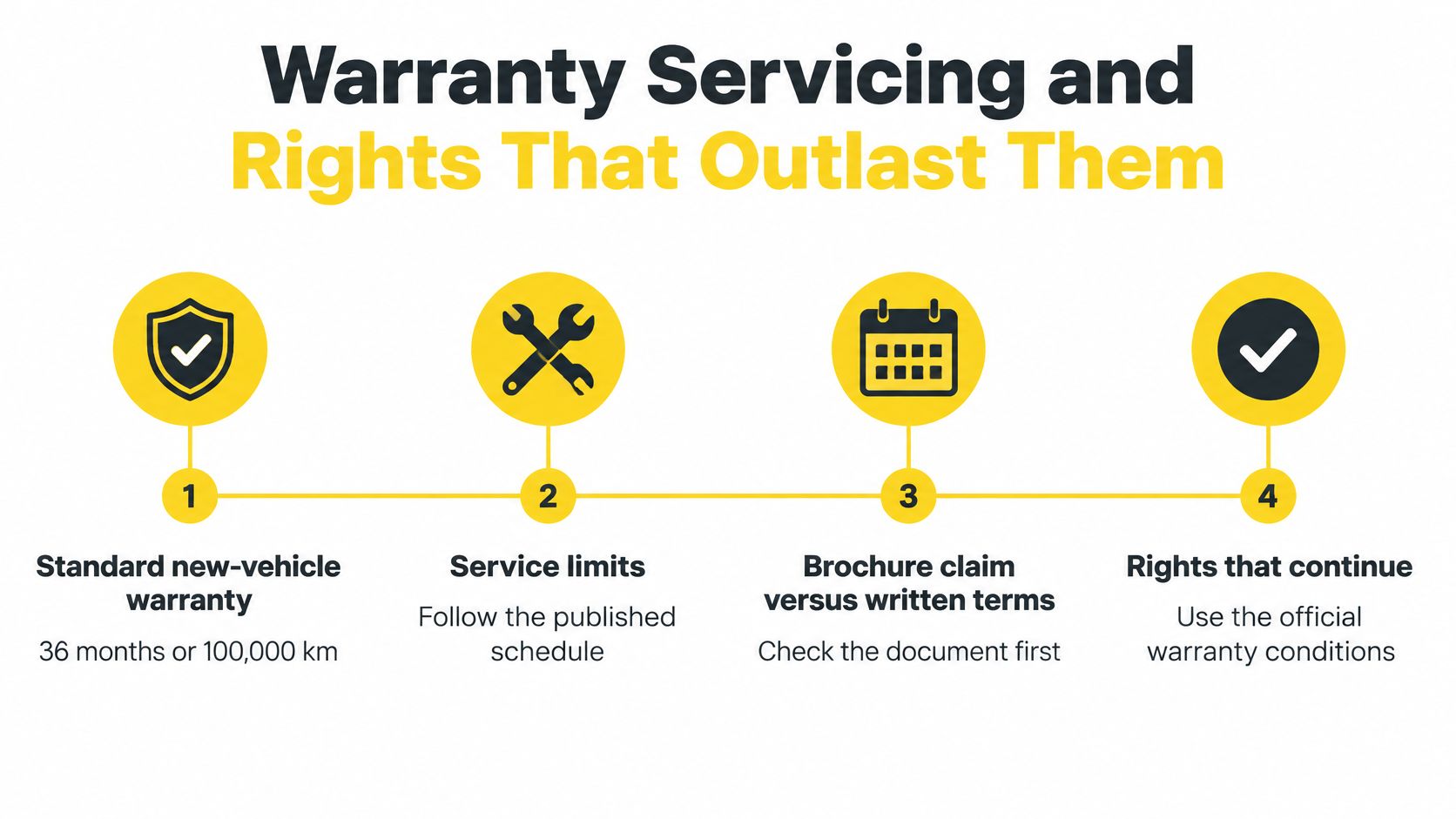
The table provides a starting point, not a promise that every Kia has identical cover. Kia New Zealand's general new-vehicle warranty is 36 months or 100,000 km, whichever comes first. Model-specific publications give the EV3 and EV4 seven-year/150,000 km vehicle cover and eight-year/160,000 km high-voltage battery cover, subject to their terms. The battery cover therefore has a different limit from the standard vehicle warranty.
Before signing, ask for the warranty terms that apply to the specific VIN in writing. A brochure figure is useful for comparison, while the applicable terms set out what is covered and which exclusions apply.
Kia's standard warranty conditions provide for repairs through an authorised Kia dealer during normal business hours, subject to exclusions and exceptions. Maintenance must follow the required schedule, including authorised-dealer servicing where extended coverage requires it. Keep the service plan and warranty conditions with the purchase paperwork.
Battery cover isn't a range guarantee
Battery cover concerns specified components and terms. It does not, by itself, promise that a car will retain its original driving range. Read the component definitions, exclusions and any capacity-retention wording rather than assuming all battery-related concerns receive the same treatment.
If a fault appears, note the odometer, symptoms and date, then contact the selling dealer before authorising substantial repairs elsewhere. Keep invoices and diagnostic reports, since they help establish the car's maintenance and the history of the problem.
Expiry of a written warranty doesn't, by itself, mean the owner has no remaining rights.
Rights beyond the contract
The Consumer Guarantees Act guidance explains that statutory protection applies separately from a manufacturer's warranty. Reasonable durability is not determined only by the date printed on a warranty certificate.
A dealer-supplied car must meet the Act's standards, but not every later failure automatically requires a free repair. The car's age, price, mileage and condition, along with the fault's nature and timing, all matter. An extended warranty or breakdown policy cannot replace or reduce those statutory rights. Read its benefits and exclusions before paying, especially where it may add little to existing protection.
A legal remedy normally concerns the selling dealer. If a newer Kia later becomes damaged or uneconomic to repair, deciding how to move or dispose of it is a separate practical matter from resolving a warranty or consumer-rights issue.
Choosing for Whangarei Roads and Distances
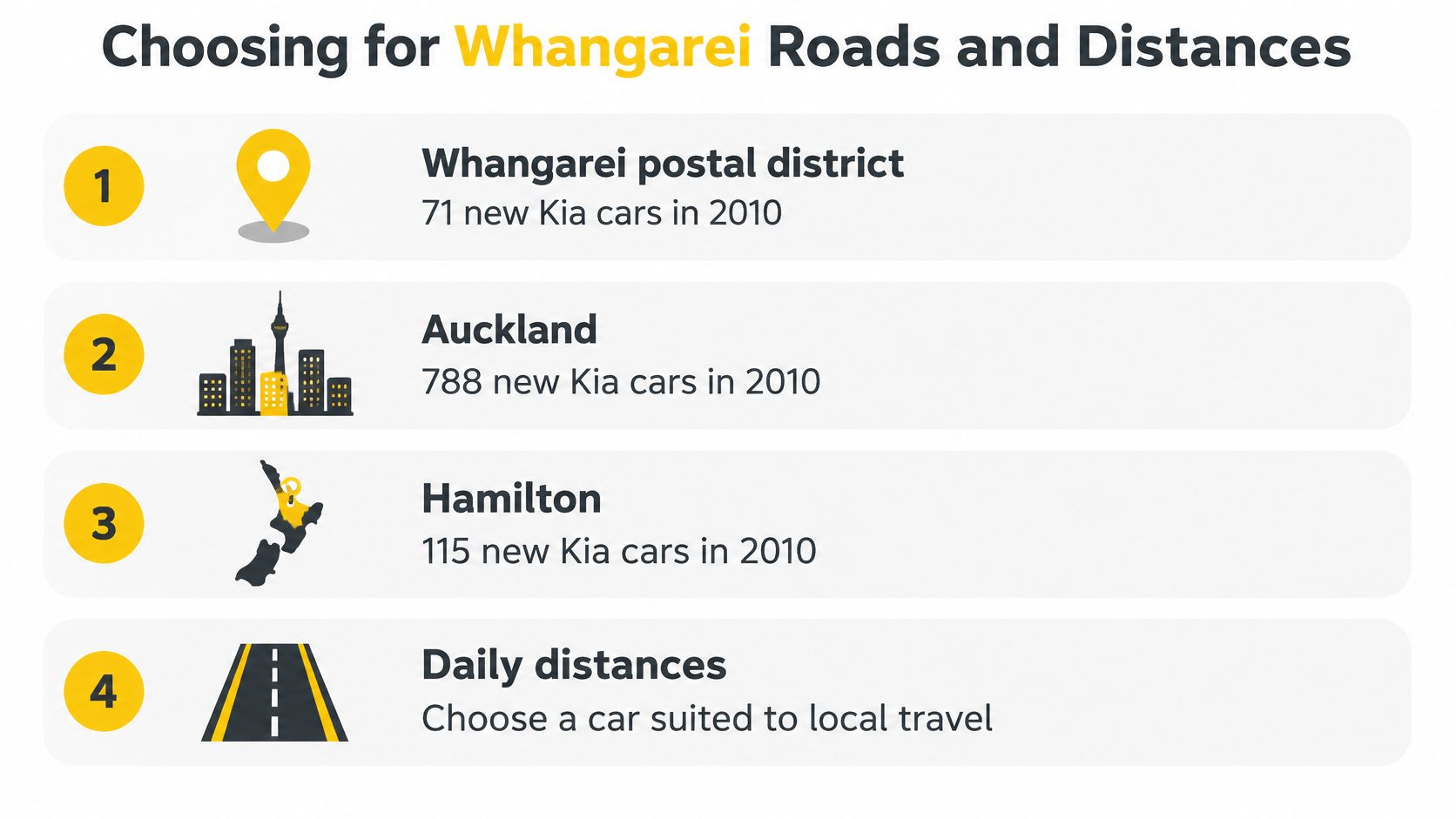
Kia already had a documented local presence when NZTA's 2010 registration statistics recorded 71 new Kia cars in the Whangarei postal district, compared with 788 in Auckland, 115 in Hamilton, 99 in Tauranga and 45 in Rotorua. These are historical registrations, not exact retail sales or a forecast of current demand.
The useful local question is less about how many neighbours chose the badge and more about what your own week requires. A car that suits short town trips may need a different charging routine when it regularly travels beyond Whangarei.
The town driver with home charging
Say you mainly drive between home, work, shops and school, with an occasional longer journey. Reliable charging where you park makes the day-to-day routine more important than extracting the maximum possible range.
For this driver, the EV3's published DC charging window helps assess the occasional longer day. Check whether a suitable stop fits naturally around a meal or break, rather than planning a journey around a best-case stopwatch result.
Before buying, have the proposed home charging arrangement assessed. Confirm parking access, cable routing and installation requirements instead of assuming an ordinary parking space is already a workable charging setup.
The regular intercity driver
A driver who frequently travels north or south should pay closer attention to the EV4's rated energy consumption. Use that published rate as a comparison benchmark, then test the budget against the electricity prices and charging locations you'll use.
Treat range claims like a fuel-economy sticker. They offer a consistent reference, but a Whangarei week can mix short urban runs, SH1 open-road speeds and climbs rather than repeat controlled test conditions.
Choose enough charging flexibility to handle a changed plan, not just enough battery to complete the ideal itinerary.
The rural driver with harder requirements
Gravel access, a heavy load, towing needs and no off-street charging can outweigh a brochure advantage. Check tyre suitability, load limits, towing approval and the exact variant's equipment before treating any model as a rural all-rounder.
A petrol or hybrid Kia may deserve comparison if convenient charging isn't available. A people-mover may answer the actual problem better if seats and usable luggage space dominate, but confirm current New Zealand availability and specifications.
Take the usual passengers and representative luggage to the dealership. Test the driveway access, seating position and loading arrangement where a demonstration permits, rather than relying only on exterior dimensions.
Finish your shortlist with this self-check:
- Weekly travel: What distance do you normally cover, including irregular errands?
- Charging location: Where will the car charge without disrupting your routine?
- Longer journeys: Do motorway trips north or south happen regularly or only occasionally?
How to Check the Driveaway and the Loan
A current New Zealand driveaway price isn't established by the specifications discussed here. Compare written quotes, not a guessed list price, and use the same ownership assumptions for every car.
Our guide to cars for sale in Whangarei can help frame the broader buying comparison. For a new Kia car, keep the following checks together rather than negotiating each in isolation.
Work through the complete quote
Identify the exact car. Ask the dealer to name the variant, include on-road costs and list exclusions. Keep the quote beside the VIN-specific warranty wording, and check whether accessories, charging equipment or delivery charges are included.
Compare the finance term and expected annual kilometres with the written warranty and service-plan cut-offs. A low monthly payment doesn't tell you whether repayments will continue after the protection you expected has ended. Ask for the interest rate, fees, deposit, total repayable and any final balloon payment.
Confirm servicing in writing. Establish whether a scheduled service plan is included, when its clock starts and which work it excludes. If you prefer an independent workshop, get a written explanation of the implications for the applicable warranty and any extended cover before agreeing to the purchase.
Add insurance, home charger installation where needed, and public charging along your usual SH1 route. Use the EV4's published consumption only as a planning benchmark, not as a household power bill: the charging price and the energy supplied still matter. Obtain an insurance quote for the exact variant rather than assuming the premium will resemble your current car's.
Separate the trade-in. Request the new-car price and trade-in allowance as distinct amounts. Otherwise, a weak trade-in offer can disappear inside an attractive-looking repayment, and you won't know which part of the deal needs negotiation.
Decline an extra product if it merely repeats rights you already have. If the dealer identifies a genuine additional benefit, read the conditions and exclusions before deciding whether that benefit is worth its cost.
Test the ownership budget
Include the costs that don't arrive with the finance payment. Tyres, insurance excesses, charging arrangements and maintenance outside an included plan still belong in the decision.
A useful comparison sheet has separate columns for purchase costs, borrowing costs and running costs. Keep optional accessories separate so you can remove them without losing sight of the car's underlying price.
The quote is ready to sign only when the variant, on-road total, warranty document and expected yearly kilometres all describe the same purchase. If the salesperson's explanation and the written paperwork disagree, resolve that before paying a deposit.
When a Newer Kia Is No Longer Worth Repairing
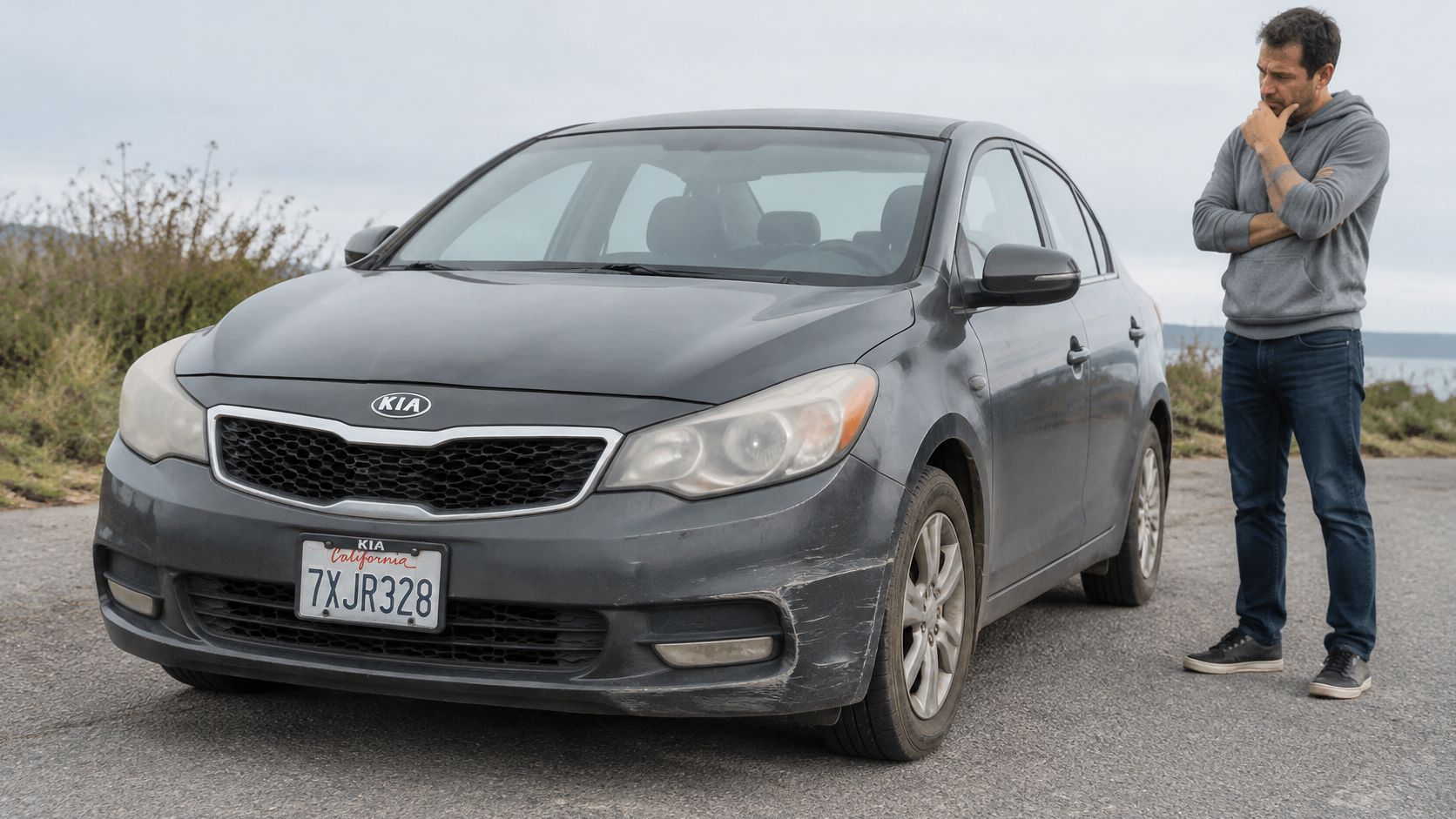
A Kia can still be registered even when it is unsafe, undriveable or uneconomic to repair. Registration records who is responsible for the vehicle, not whether it is fit to drive.
NZTA's registration material describes fleet registration information. It does not establish a Kia-specific Northland write-off count or a local dismantling pathway. An electric Kia is not automatically worth more or less than another damaged vehicle. Its identity, damage, recoverable parts and traction-battery condition all affect its potential salvage value.
Establish what has failed
A large repair estimate alone does not settle the decision. Find out what has failed, what work is proposed, whether an insurance or warranty claim remains unresolved, and what the Kia could reasonably be worth after repair.
With a damaged EV or hybrid, leave traction-battery isolation to qualified handlers. Tell the recovery operator about any impact, flood or fire exposure before the vehicle is moved or charging equipment is connected.
For general model context, see this guide to Kia hatchback cars. A badge or body style cannot establish salvage value by itself. The vehicle's identity, damage, recoverable parts and traction-battery condition all matter.
Prepare a safe recovery record
Before arranging a handover, note the details that affect safe access and the vehicle's condition:
- Movement and access: Does the Kia roll and steer? Can recovery equipment reach it?
- Damage history: Has it been flooded, burned or hit, including damage underneath?
- Vehicle category: Is it an insurance write-off, mechanical non-runner, hybrid or EV?
- Documents and equipment: Are the keys, charging leads, registration details and relevant insurer papers available?
- Ownership notification: Who will complete the NZTA notification, and what confirmation will you keep?
A failed warrant, flat battery or rural location does not remove the need for clear handover records. Keep a dated record of the vehicle's identity and transfer rather than assuming collection alone settles responsibility.
Do not spend more on repairs because diagnosis has already cost money. Compare the remaining repair expense with the likely outcome, while keeping any unresolved claim against the dealer or insurer separate from the repair decision.
When repair no longer makes sense, focus on a recorded handover, suitable loading arrangements, agreed payment and clear responsibility for the Kia.
Hand Over a Kia That No Longer Pays
At Car Removals Whangarei, we buy Kia and other makes in any condition, including non-running, crashed, rusted, deregistered, hybrid and electric vehicles. Our cash-for-cars service in Whangarei pays $200 to $15,000, with the amount determined by make, model, year, weight, completeness and current parts demand, not whether the car once carried a high showroom price.
Arrange the quote and access
For a phone quote, have the make, model, year, registration plate and rough condition ready. Explain whether the Kia rolls and describe access restrictions, missing major parts and any known battery damage so we can plan suitable collection.
Keep keys and charging leads available for the handover. If you already have an insurer's salvage offer, compare it with our quote before paying to store a vehicle that can't be driven.
We remove unwanted cars the same day for most Whangarei addresses and within 48 hours for wider Northland. Agree the collection arrangement directly rather than assuming a rural address can be treated like an easily accessed city driveway.
Confirm payment and responsibility
Payment is made before loading, by cash or instant bank transfer. Confirm the agreed amount and payment method before the vehicle goes onto the truck.
Our quote relies on the description you provide. If the vehicle differs materially, such as major components being absent or tow-truck access being unavailable, the quote may be revised; you can decline and have the vehicle left in place at no cost.
We complete the NZTA change-of-ownership notification when we take possession, so the vehicle becomes our responsibility rather than remaining the customer's liability. Keep your handover record with the purchase, service and insurance paperwork.
If your Kia is damaged, won't run or no longer justifies repair, Car Removals Whangarei offers a quoted purchase and collection with payment before loading and NZTA notification handled at handover. Visit Car Removals Whangarei with the registration, condition and whether it rolls, then arrange a collection that suits your Northland property.
- new Kia car
- Kia EV3
- Kia EV4
- Whangarei buyers
- car warranty