· Car Removals Whangarei
Scrap Metal Prices NZ: A 2026 Complete Pricing Guide
NZ scrap metal prices range from roughly NZ$200 to NZ$700 per tonne for steel, but a car's actual payout depends more on parts demand and contamination than the headline steel rate alone. A clean, heavy vehicle with reusable components can be worth more than a similar-looking shell that has been stripped, mixed with debris, or left difficult to load.
That's the part many vehicle owners discover only after asking for a quote. A price list might show a rate per kilogram, yet the amount offered for the car on your driveway can be lower because the buyer still has to account for fluids, mixed materials, transport, dismantling time and the condition of saleable parts.
For a Northland owner with a dead car, rusted ute or accident-damaged vehicle, the useful question is not just, “What are scrap metal prices in NZ today?” It's, “How will this particular vehicle be assessed, and what will I receive when it leaves?”
Table of Contents
- Understanding How Scrap Metal Prices Work in New Zealand
- Current Scrap Metal Price Ranges by Metal Type
- How Grade and Contamination Affect Your Payout
- Why Car Bodies Are Priced Differently Than Raw Scrap
- How Kerb Weight and Recoverable Parts Shape Car Scrap Value
- Timing Your Scrap Sale Around Price Volatility
- What to Expect From a Dismantler Quote in NZ
- Quick Reference for Getting the Best Local Scrap Car Deal
Understanding How Scrap Metal Prices Work in New Zealand
You've found an old car taking up space, checked a scrap price page and done a quick calculation using its weight. The result looks promising, but the dismantler's quote doesn't match your estimate. That doesn't necessarily mean the quote is unfair. It usually means the published metal rate and the vehicle's realised value are two different things.
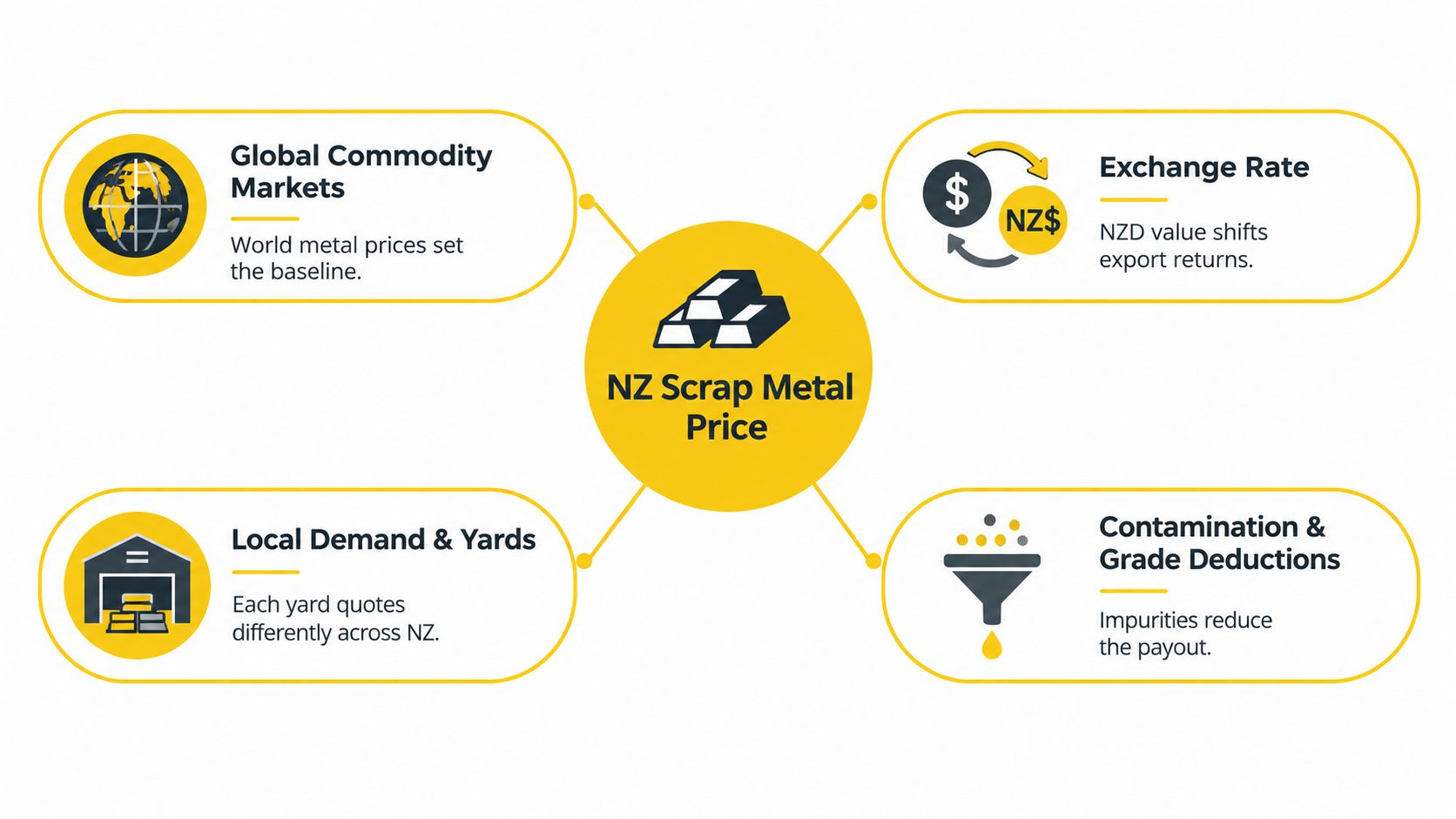
New Zealand scrap pricing begins with London Metal Exchange benchmarks, then moves through the USD to NZD exchange rate, shipping costs and local supply and demand. The local yard must also consider its own handling, sorting and transport costs before it can offer a vehicle owner a firm payout. The New Zealand scrap-metal pricing glossary describes this chain, while an industry paper submitted to the Ministry for the Environment records historical New Zealand scrap commodity values between NZ$200 and NZ$700 per tonne, including examples of NZ$255 per tonne in October 2015 and NZ$543 per tonne in May 2018.
Why a headline rate isn't a car quote
A market benchmark describes metal under particular conditions. A dismantler is valuing a complete object that may contain steel, aluminium, copper wiring, stainless components, glass, rubber, fluids, plastics and reusable parts. Those materials don't all enter the same recycling stream, and some require removal before the remaining shell can be processed.
Transport matters more in Northland than many online calculators suggest. A rural pickup may need special loading equipment, a non-rolling vehicle may take longer to secure, and a stripped shell may create more work without offering better material quality.
Practical rule: Treat an online rate as a market indication, not a guaranteed payout for a complete car.
The most useful comparison is between firm, all-inclusive quotes. Ask whether the offer already includes loading, towing, deductions and the vehicle's recoverable parts. A practical guide to vehicle disposal in New Zealand can help owners consider the disposal process rather than looking at the steel rate in isolation.
Current Scrap Metal Price Ranges by Metal Type
The 2026 New Zealand snapshots show why one universal scrap rate is misleading. Common ferrous grades cluster around NZ$0.08 to NZ$0.35 per kilogram, with cleaner and heavier material at the upper end. Light iron, heavy melt steel and reinforcing bar can all come from the same broad metal family, yet yards price them differently because their processing and resale characteristics differ.
A national pricing snapshot lists steel scrap around NZ$560 per tonne, while another listing gives steel at NZ$0.71 per kilogram, or about NZ$710 per tonne. These are useful benchmarks, but they shouldn't be applied directly to a whole vehicle. The 2026 New Zealand scrap price snapshot shows how categories and providers can produce materially different headline figures.
2026 NZ scrap metal price ranges by grade
| Metal category | Grade | Price range NZD |
|---|---|---|
| Steel | Heavy melt steel | NZ$0.25 to NZ$0.35/kg |
| Steel | Light iron | NZ$0.08 to NZ$0.18/kg |
| Steel | Reinforcing bar | NZ$0.15 to NZ$0.28/kg |
| Stainless steel | Stainless 304 | NZ$1.00 to NZ$1.40/kg |
| Stainless steel | Stainless 316 | NZ$1.80 to NZ$2.00/kg |
The higher stainless values explain why a vehicle containing valuable stainless or non-ferrous components can't be judged purely as a steel shell. Copper and aluminium also show wide regional and category spreads. The available New Zealand listings place copper at roughly NZ$10 to NZ$19 per kilogram and aluminium around NZ$0.80 to NZ$3.20 per kilogram, depending on grade and provider, as shown in this New Zealand scrap price comparison.
What the benchmark leaves out
London Metal Exchange pricing provides a global reference, not the amount a local buyer can pass directly to a seller. The NZD exchange rate changes the local value of exported material, while shipping and local demand influence what a yard can afford to pay. A yard with a ready outlet for a particular grade may quote differently from one that must store, sort and transport the same load.
For owners, the practical lesson is simple. Ask which grade the buyer is using, whether the vehicle is being valued as a complete car or a stripped shell, and whether the quote includes the parts that may be worth more than the ferrous content.
How Grade and Contamination Affect Your Payout
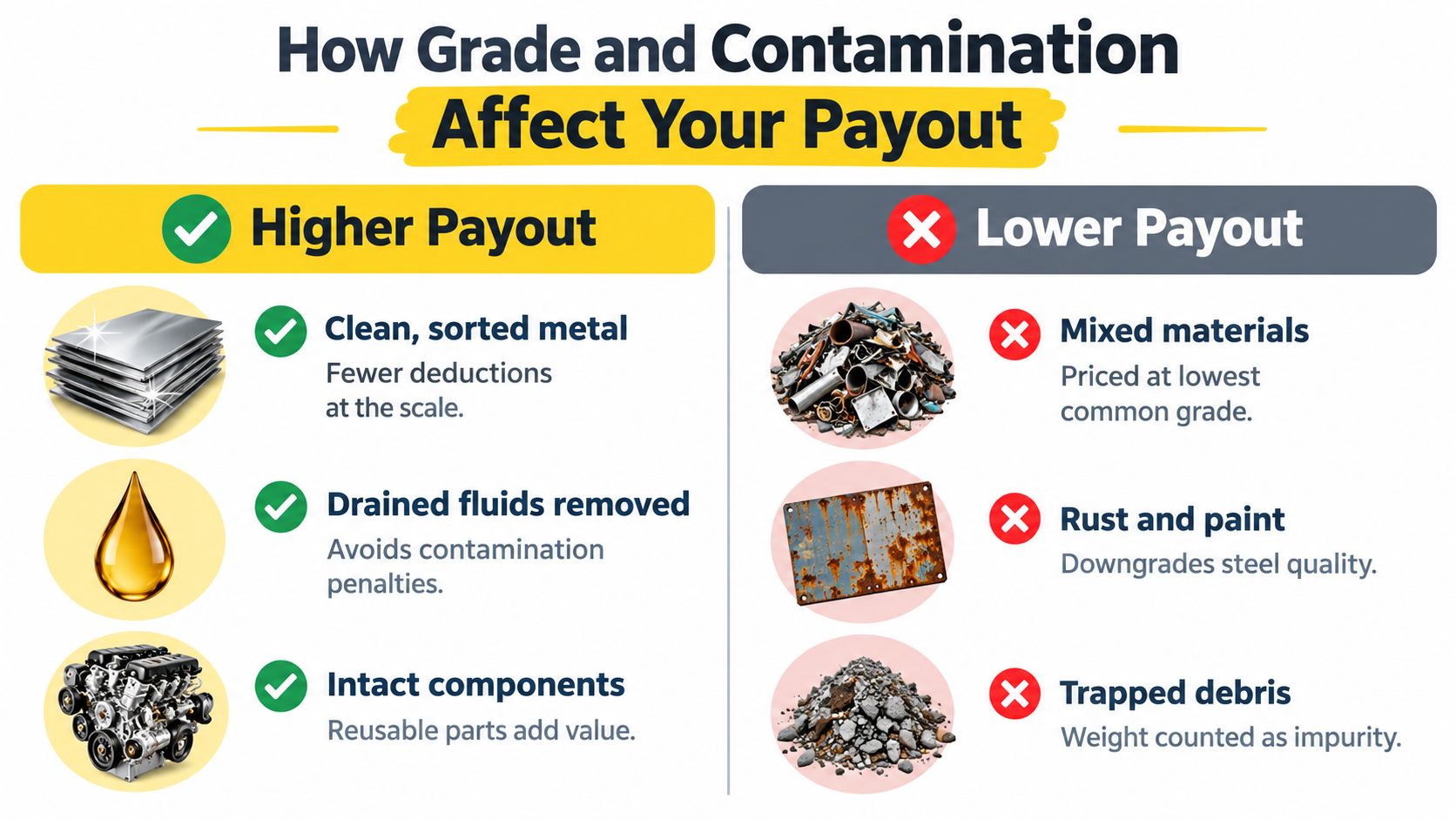
Two vehicles can look almost identical from the roadside and receive different offers at the scale. One may contain clean, heavy, accessible steel and intact components. The other may be packed with debris, missing key parts, contaminated with fluids or too large for the yard's preferred processing route.
A North Island price sheet lists heavy steel in-size at NZ$0.16 per kilogram, heavy steel oversize at NZ$0.11 per kilogram, reinforcing bar at NZ$0.09 per kilogram and steel swarf at NZ$0.09 per kilogram. The same New Zealand scrap metal price list gives stainless 304 at about NZ$1.00 to NZ$1.40 per kilogram and stainless 316 at about NZ$1.80 to NZ$2.00 per kilogram.
Clean material versus difficult material
Heavy steel in-size is easier to handle and more predictable to process than oversized pieces. Swarf and turnings can carry trapped oil, require careful handling and contain a high proportion of small particles, so a yard may place them in a lower-paying category.
A car body rarely arrives as one clean grade. Paint, rust, dirt, rubber, glass, wiring and plastics remain attached to the steel. A buyer must also manage batteries, airbags and fluids safely. Those tasks cost time and affect the amount of recoverable metal.
What owners should and shouldn't remove
Removing loose rubbish and personal belongings is sensible. Dismantling valuable components without discussing it with the buyer often isn't. An intact engine, catalytic converter, alternator, wheels or electronic module may have a stronger parts market than its weight as mixed scrap.
If you're separating material yourself, keep obvious non-ferrous items apart and don't mix copper, aluminium and stainless with a general steel load. Don't drain fluids casually onto the ground, either. Fluid removal needs to be handled safely and compliantly, and a buyer may prefer to complete that work at the yard.
Clean and organised material helps, but a complete vehicle can be worth more than a shell after valuable parts have been removed without a plan.
The right preparation depends on the quote. For a weight-only load, segregation can help. For a vehicle being assessed for parts, keeping components intact usually protects more value.
Why Car Bodies Are Priced Differently Than Raw Scrap
A car body isn't the same product as a bundle of clean structural steel. It arrives with materials that a processor must separate, items that can't be sold as ferrous scrap and components that may create environmental or handling obligations.
The first assessment is usually about the vehicle's condition. Is it complete, rolling and straightforward to load? Is it burned, flooded, crushed, stripped or sitting on a difficult rural site? A complete vehicle may offer parts value, while a bare shell may be judged mainly by its weight and the cost of collecting it.
The assessment before loading
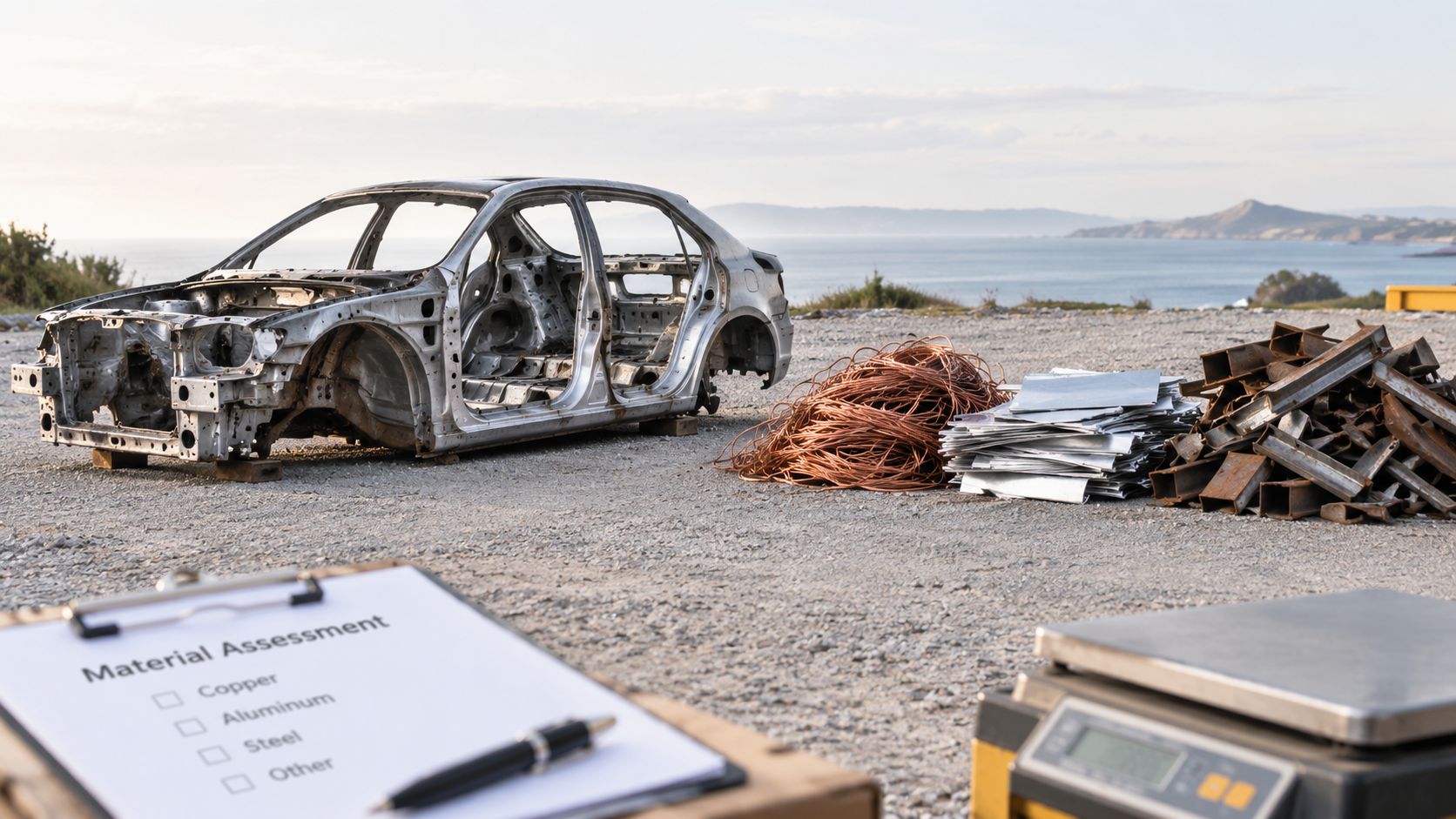
A sensible dismantler considers several elements before quoting:
- Condition and completeness: Missing engines, wheels, catalytic converters or electronics can reduce parts value, even if the shell remains heavy.
- Contamination: Fluids, trapped debris, excessive dirt and mixed materials reduce the amount of clean metal that can be recovered.
- Loading requirements: A non-rolling chassis may need different equipment from a car that can be winched or moved normally.
- Regional transport: Distance, road access and scheduling affect what remains after collection costs are considered.
- Current outlets: A yard's buyers and processing routes influence which grades are attractive on that day.
Complete cars and stripped shells
New Zealand pricing examples place complete car bodies at about NZ$120 per tonne and stripped cars at about NZ$100 per tonne, according to this New Zealand scrap vehicle price reference. Those figures illustrate the difference between a complete vehicle and a shell, but they aren't a promise that every car will receive the same rate.
A stripped shell can weigh heavily while offering little beyond ferrous recovery. A complete car may need more dismantling, but it can contain reusable parts that change the total valuation. That's why removing components for their apparent scrap weight can backfire if the buyer would have paid for the whole vehicle.
A realistic quote combines the material yield with the work required to recover it. Owners should ask whether the offer is for the car as presented, whether any deductions apply and whether the buyer will handle the fluids and loading.
How Kerb Weight and Recoverable Parts Shape Car Scrap Value
Kerb weight gives a dismantler a starting point, not always the final answer. It indicates how much material may be present, but it doesn't reveal how much of that material is clean, accessible or commercially useful. A heavy vehicle with a damaged interior and missing drivetrain may produce less value than a lighter car with intact parts that local buyers still need.
For a low-grade shell, steel yield tends to dominate. Rust, fire damage, severe corrosion and previous stripping reduce the opportunity to recover saleable components. In that situation, the buyer is mainly balancing weight against loading, transport and processing effort.
When parts matter more than weight
A complete non-runner may contain an engine, gearbox, wheels, tyres, lights, panels, control modules and other components that can be reused. The vehicle's make, model, trim and condition influence whether those parts have demand. A popular work ute or four-wheel drive may attract interest for components even when it can't be driven.
The reverse is also true. A rare, heavily damaged or extensively dismantled vehicle may have a high kerb weight but limited parts demand. The number on a scale doesn't compensate for missing components, inaccessible loading or expensive handling.
A practical valuation question
Ask the buyer which of these two models applies:
- Weight-led valuation: The car is being treated mainly as a ferrous load, with deductions for contamination and collection.
- Parts-led valuation: Reusable components, vehicle type and condition contribute substantially to the offer.
- Combined valuation: The buyer considers both the recoverable parts and the eventual scrap yield.
Don't strip a vehicle before receiving advice. An owner who removes the catalytic converter, wheels or electronics may think they're selling the valuable pieces separately, but the remaining shell can become harder to move and less attractive as a complete purchase. This guide to cars sold for scrap reflects the practical difference between selling a vehicle as a whole and treating it as a raw material load.
Timing Your Scrap Sale Around Price Volatility
A vehicle can lose practical value while you wait for a higher scrap rate. It may sit on a driveway, collect water, leak fluids or become harder to move. The best selling day depends on the local offer, collection conditions and the vehicle's state, not just a headline steel price.
Scrap markets can move quickly, but the rate published for clean, separated metal does not equal a car removal payout. A dismantler still has to account for contamination, dismantling time, transport and the proportion of the vehicle that can be recovered. The New Zealand scrap price overview illustrates how widely metal values can differ by category and yard.
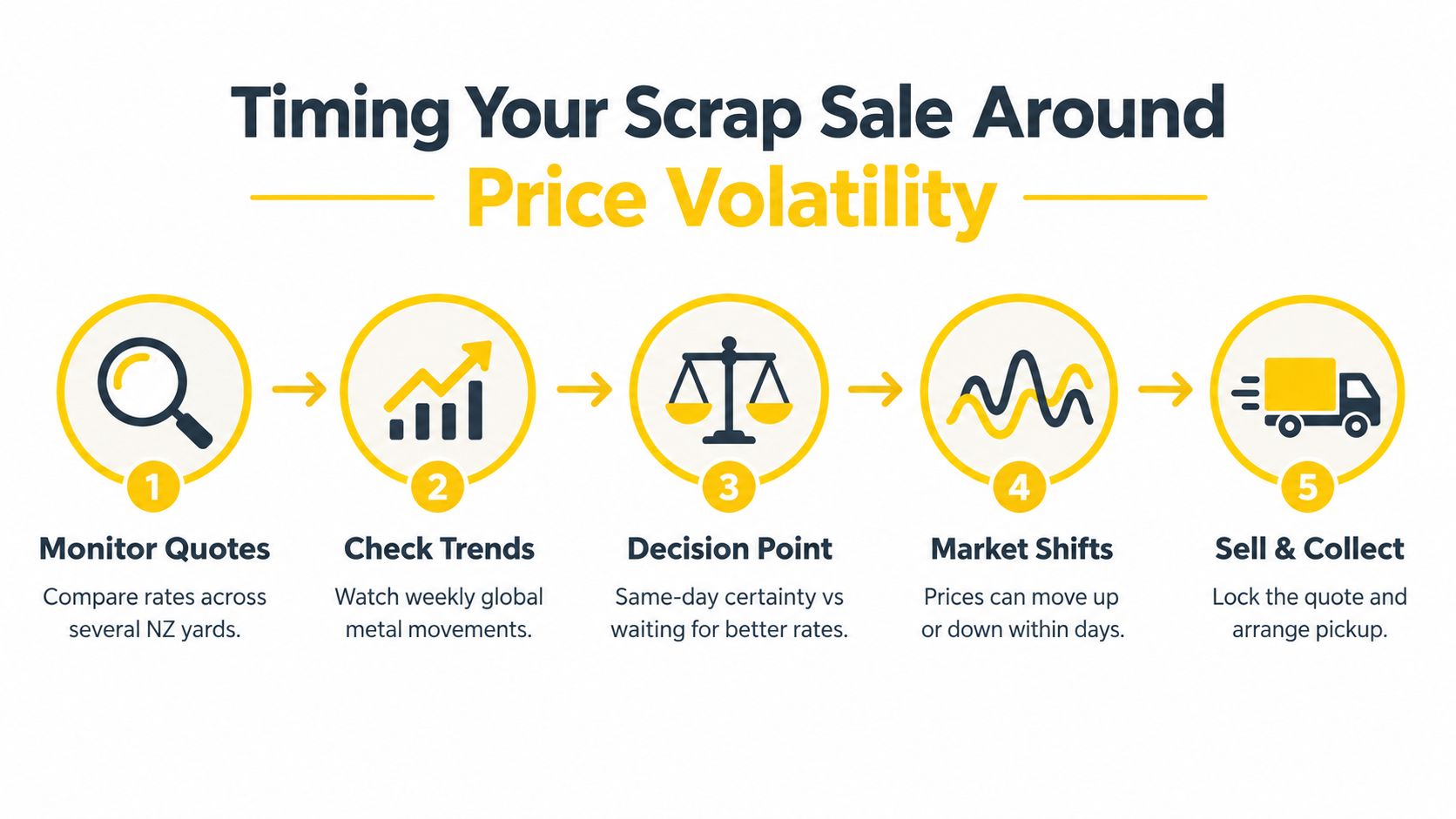
A Northland decision framework
Get a firm offer for the vehicle in its current condition, then seek another local quote if the possible difference justifies the delay. Ask how long each offer remains valid and whether the buyer can revise it after seeing the car. Comparing two real payouts today usually gives a clearer answer than following an international metal chart.
Waiting may suit a vehicle that is secure, dry and easy to collect later. Sell sooner when it blocks access, sits on private land, leaks, or creates registration and liability concerns. Further deterioration can reduce parts demand and make loading more difficult, even if the theoretical scrap rate rises.
An all-inclusive payout can beat a higher headline rate once towing, handling and contaminated material are accounted for.
Northland collection routes also affect timing. A buyer already working near your property may collect efficiently, while an isolated pickup can reduce the amount offered. Judge the complete payout, including the vehicle's recoverable parts, kerb weight and removal cost, rather than waiting for a market headline to improve.
What to Expect From a Dismantler Quote in NZ
A proper quote should describe the vehicle being bought, the amount offered and the conditions attached. It should make clear whether the price is based on parts, kerb weight, scrap metal, or a combination. If the buyer can't explain what happens if the car is stripped, non-rolling or contaminated, ask for clarification before agreeing.
A useful quote should cover:
- The vehicle identity: Confirm the make, model, registration details where available and the condition you described.
- The agreed amount: Ask whether the offer is firm and whether any inspection deductions are possible.
- Collection terms: Check whether loading and towing are included, particularly for a vehicle without wheels or a working engine.
- Payment timing: Establish whether payment is made before loading, at collection or after the vehicle reaches the yard.
- Disposal responsibilities: Ask who handles fluids, batteries, tyres, airbags and other regulated materials.
The scrap car price guidance for Northland owners is useful when comparing a quoted amount with the vehicle's condition and likely parts demand. A low headline steel rate doesn't automatically make a quote poor, and a high advertised rate doesn't guarantee a better total if the buyer later deducts transport or handling.
Complete the ownership transaction
NZTA says it doesn't record or handle vehicle ownership. It records the registered person, and the law requires the registered person to be changed when the vehicle changes hands. Both buyer and seller must tell NZTA straight away so the change is completed on the Motor Vehicle Register, as set out in NZTA's vehicle ownership guidance.
The change can be completed online or through the MR13B form, according to the NZTA buying and selling factsheet. Don't treat the tow truck leaving as the end of your responsibility. Complete the seller transaction promptly, keep the confirmation and ask the buyer to complete their side.
If licensing fees are owing, NZTA can send an invoice to the registered person. That's another reason to handle the notification at the time of disposal rather than assuming the paperwork will sort itself out later.
Quick Reference for Getting the Best Local Scrap Car Deal
The best deal depends on what your vehicle still offers. A stripped, badly corroded shell is usually judged mainly by its accessible metal and collection requirements. A complete non-runner may be worth more through parts demand, even when the owner initially thinks of it only as scrap.
Use this checklist before accepting an offer:
- Describe the car accurately. Mention missing parts, accident damage, flood exposure, fire damage, rust, flat tyres and whether it rolls.
- Ask what drives the valuation. Find out whether the buyer is using kerb weight, recoverable parts, scrap metal or all three.
- Keep useful components intact. Don't remove major parts before asking how they affect the whole-vehicle quote.
- Clarify contamination handling. Confirm who removes fluids and deals with batteries, tyres, airbags and mixed debris.
- Compare total offers. Look at the amount after towing, loading and any stated deductions, not just a published rate.
- Secure the paperwork. Notify NZTA promptly when the vehicle changes hands and retain confirmation of the transaction.
- Choose a practical collection plan. Rural access, non-rolling vehicles and route scheduling can influence the final offer.
Car Removals Whangarei is a licensed Northland dismantler that provides firm phone quotes based on parts demand and steel pricing, collects cars and machinery in varied conditions, and arranges towing within its service area. The business completes the NZTA change-of-ownership process at pickup, so owners can deal with the vehicle's value and paperwork together.
Car Removals Whangarei can assess your unwanted, damaged or non-running vehicle using its recoverable parts, condition and scrap value rather than relying on a headline steel rate alone. For a firm quote and collection details in Northland, visit Car Removals Whangarei and arrange a practical pickup plan.
- scrap metal prices nz
- car removal nz
- scrap car prices nz
- metal recycling nz