· Car Removals Whangarei
Vehicle Disposal NZ: The Complete 2026 Guide
You've got a dead car on the drive, a damaged vehicle taking up space after an insurance claim, or an old farm ute that hasn't moved in years. The obvious answer is to hand over the keys to whoever offers cash and let someone else deal with it. That's where owners create problems.
Vehicle disposal in New Zealand isn't just a towing job. Registration status, legal liability, hazardous fluids, batteries, tyres, airbags and recoverable parts all matter. A casual handover can leave the registered person exposed, while choosing a buyer who treats the vehicle as nothing more than scrap can mean losing value from usable components.
Table of Contents
- Understanding Vehicle Disposal in New Zealand
- Navigating NZTA Deregistration and Legal Liability
- Environmental Compliance and Fluid De-pollution
- Evaluating Scrap, Write-offs, and EV Battery Salvage
- Clearing Abandoned Vehicles from Private Property
- Regional Towing Logistics and Quote Timelines
- Final Checklist for a Secure Vehicle Handover
Understanding Vehicle Disposal in New Zealand
The usual story starts with a vehicle that has become more trouble than it's worth. The engine has seized, the WOF has expired, repairs cost more than the car's market value, or an accident has left the vehicle sitting behind a house. Weeks pass. The owner still sees it every morning, but the vehicle's legal and environmental status hasn't disappeared just because it's no longer being driven.
New Zealand's disposal system is closely tied to vehicle age, deregistration and regional fleet composition. A historical Transport Ministry scrappage study found that the average vehicle scrapped in New Zealand was 20 years old, with vehicles in Christchurch averaging 21 years and those in Wellington averaging 18.2 years at disposal. The same study recorded an average age at deregistration of 16.7 years in the Wellington Region and 18.6 years in Christchurch, as set out in the NZTA vehicle scrappage material.
That tells you something practical. End-of-life disposal usually happens after a long service life, not because every unwanted vehicle is immediately crushed. Some vehicles still have engines, transmissions, panels, catalytic converters, wheels, electronic modules or interior components worth recovering.
Disposal is more than removing metal
New Zealand's fleet is ageing. Fleet research places the average vehicle age at 14.8 years, with 63% of cars at least 10 years old and about 43% at least 15 years old, according to the New Zealand vehicle fleet statistics summary. The same source notes that the exact annual number of vehicles requiring disposal isn't known, so expired registrations have been used as an approximation.
That uncertainty matters. There isn't one simple national scrappage figure that tells owners where every unwanted vehicle goes. NZTA keeps deregistered vehicles on the Motor Vehicle Register for reference, while its fleet open data records monthly snapshots of registration activity. Disposal is therefore visible through administrative records, but it isn't captured by one complete national count.
Practical rule: Choose the disposal route based on the vehicle's legal status and recoverable value, not just its weight.
A sound vehicle may be worth more as a parts donor. A write-off needs correct documentation. A hybrid or EV requires high-voltage controls. A stripped shell needs suitable lifting equipment and a clear plan for remaining contaminants. Treating every vehicle as a pile of steel is poor dismantling practice and often poor financial practice too.
Navigating NZTA Deregistration and Legal Liability
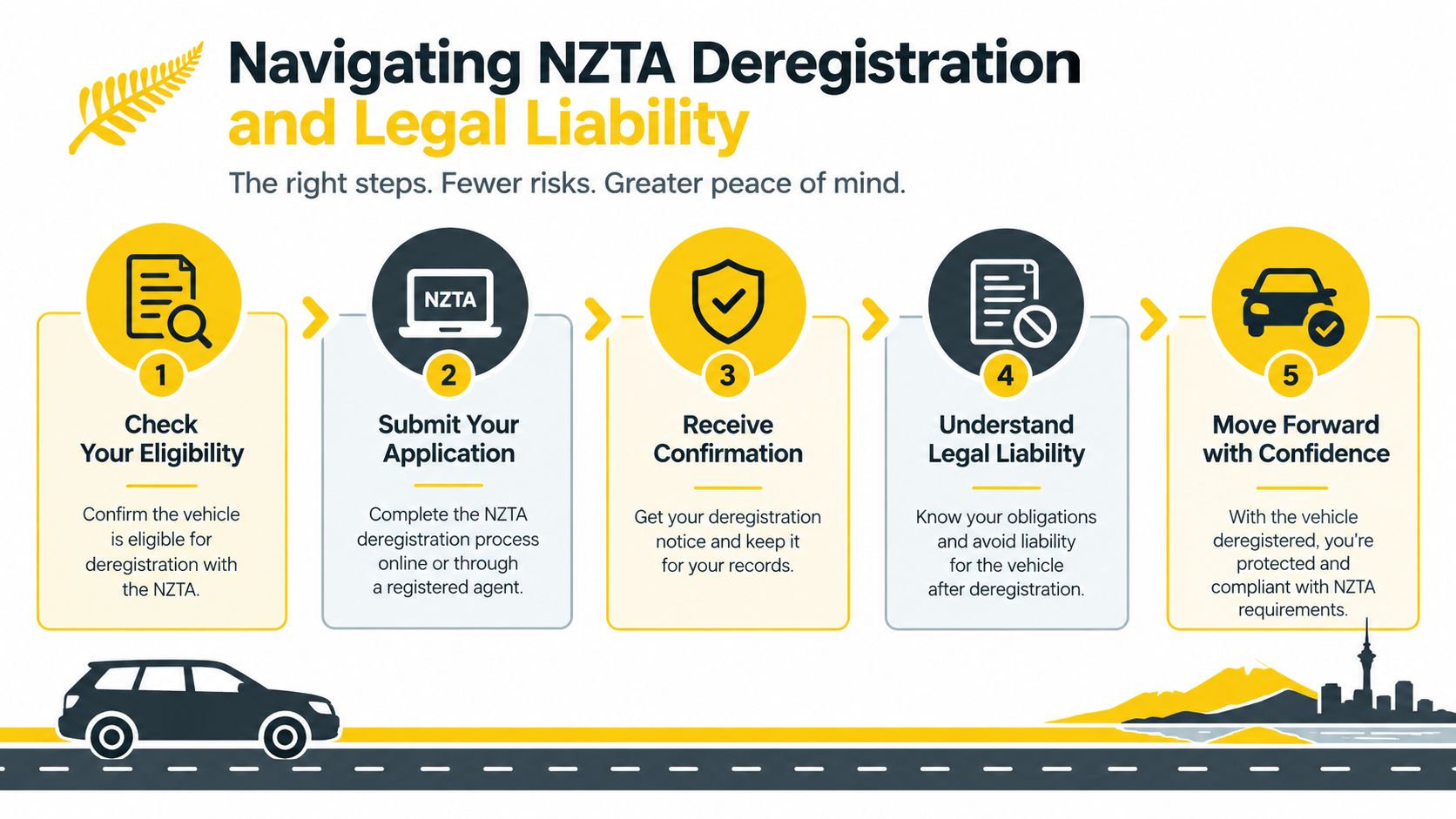
Handing over the keys doesn't automatically end your responsibility. If you're the registered person, you need to make sure NZTA receives the correct notice and that the vehicle's record reflects what has happened.
NZTA guidance says a registered person must notify the agency immediately when a vehicle is permanently taken off the road or disposed of. The formal MR15 process cancels registration in the Motor Vehicle Register, requires the surrender of the number plates and prevents legal road use unless the vehicle is later re-registered. The cancellation status becomes the administrative signal that the vehicle's road-use obligations have ended, while its record remains available on the register for reference. These requirements are detailed in the NZTA response on permanent vehicle disposal.
Follow the handover in the right order
Use this sequence rather than relying on a verbal promise from a buyer:
- Confirm who is recorded as the registered person. If the vehicle belongs to an estate, company, trust or finance arrangement, resolve authority before collection.
- Tell the buyer the complete condition. Disclose whether it runs, whether it rolls, whether it has plates, and whether it's an insurance write-off or a vehicle that has already been deregistered.
- Complete the required NZTA notice or cancellation process. For a vehicle permanently removed from the road, the MR15 process is the relevant formal route.
- Surrender the plates where required. Don't leave registration plates attached to a vehicle that has changed status.
- Keep evidence of the transaction. Retain the receipt, buyer details, date of collection and any confirmation that the ownership or disposal notification was completed.
A vehicle that remains associated with you can create avoidable administration if licensing records, ownership details or disposal status aren't updated. The NZTA change of ownership guidance for disposal situations explains the practical handover issues owners should address before the vehicle leaves.
Why on-site processing matters
The safest arrangement is to complete the relevant notification at pickup, before the vehicle is loaded. That gives both parties a clear transaction point and reduces the chance that the vehicle disappears while the record remains unresolved.
A wrecker or recycler may accept an unwanted vehicle, but the legal step still matters. Ministry of Transport guidance says an unwanted vehicle can be taken to a recycler or wrecker. If it's still registered and being sold as scrap metal, NZTA must be contacted first, and an owner cancelling registration before selling to a wrecker must complete an application to cancel registration. Read the Ministry of Transport guidance on scrapping a vehicle before agreeing to collection.
Environmental Compliance and Fluid De-pollution
A vehicle isn't ready for dismantling just because it has arrived at a yard. It first needs to be made safe for people, equipment and the environment. De-pollution comes before dismantling or shredding, particularly where the vehicle contains oil, coolant, brake fluid, refrigerant, fuel or other substances that can escape during handling.
The Ministry for the Environment's guidance requires vehicle fluids to be drained into compatible sealed containers. Operators should use drip systems, store fluids in covered bunded areas and prevent discharges to stormwater, the sewer, waste bins or bare ground. The requirements are set out in the Ministry for the Environment stormwater and trade-waste guidance.
What proper de-pollution involves
A responsible dismantler controls the vehicle before removing saleable parts. The exact sequence depends on the vehicle, but the work typically involves:
- Stabilising the vehicle: Secure the car before lifting, draining or removing heavy components.
- Separating fluids: Collect oils, coolant, brake fluids, fuel and refrigerants through suitable systems rather than allowing them to run onto a work surface.
- Protecting storage areas: Use covered, bunded areas that can contain leaks and keep contaminated liquids away from rainwater.
- Managing batteries: Isolate conventional batteries safely and identify hybrid or EV battery systems before anyone begins dismantling.
- Removing contaminated components: Handle filters, absorbent material, damaged tanks and other contaminated parts through controlled waste channels.
- Preparing the shell: Only move the vehicle towards parts recovery, crushing or shredding once pollution risks have been controlled.
Stormwater contamination isn't a minor housekeeping issue. Oil and coolant released on bare ground can move beyond the immediate work area, especially during rainfall. A yard that lacks sealed containers, drip control and covered bunding is showing you that it may not be equipped to process end-of-life vehicles responsibly.
Ask what happens after collection
The word “recycling” can hide too much. A vehicle may be dismantled for parts, processed for steel, exported, stored, or sent through another disposal chain. NZ guidance encourages owners to choose a scrap buyer that will recycle the vehicle and keep it off the road, but there's limited region-specific public detail on recovery rates and the number of vehicles diverted from landfill.
That information gap is one reason to ask direct questions. Find out whether the operator handles fluids, batteries, tyres and airbags through controlled processes. Ask whether the vehicle is assessed for parts before it's treated as scrap. Historical NZ research has also identified problems involving free-rider behaviour, weak information sharing and the need for licensed, monitored dismantling.
The highest cash offer isn't automatically the clearest environmental outcome. Ask how the vehicle will be de-polluted and dismantled before you compare the figures.
Evaluating Scrap, Write-offs, and EV Battery Salvage
The value of an unwanted vehicle depends on what can be recovered safely and legally. A rusted shell, an accident-damaged late-model car and a hybrid with an intact traction battery shouldn't be priced using the same logic.
A standard scrap car is usually assessed through kerb weight, steel recovery and usable parts. A vehicle with a blown engine may still have valuable panels, wheels, gearbox components, glass or interior parts. A stripped, seized or non-rolling vehicle follows a more equipment-heavy route, so access and loading conditions affect the practical assessment.
An insurance write-off needs more care. Flood, fire, hail and structural damage can change the value of components and may affect what can be reused. The owner should provide insurer documentation and complete the correct deregistration steps rather than assuming the insurer's decision has automatically updated every NZTA record.
Electrified vehicles need a separate safety process
Hybrid and electric vehicles contain high-voltage systems that aren't safe to approach like a conventional 12-volt vehicle. A trained operator needs to identify the traction battery, isolate the high-voltage system using the manufacturer's appropriate procedure and control the vehicle against accidental energisation.
That process matters even when the vehicle looks harmless. A crash-damaged EV may have compromised battery protection, while a flood-damaged hybrid can present electrical and contamination hazards that aren't obvious from the outside. The quoted payout should account for whether the traction battery is present, identifiable, accessible and suitable for controlled recovery.
Battery value also isn't guaranteed just because the vehicle is electric. Condition, damage, chemistry, demand for replacement units, and safe-handling requirements all influence the assessment. A buyer who offers one flat scrap rate for every EV is avoiding the core valuation question.
Vehicle Disposal Valuation Matrix
| Vehicle Category | Primary Valuation Factor | Special Processing Requirements |
|---|---|---|
| Standard scrap car | Kerb weight, recoverable steel and usable parts | Fluid drainage, battery handling and controlled dismantling |
| Non-running or stripped vehicle | Remaining parts, shell weight and loading difficulty | Safe recovery of non-rolling vehicles and de-pollution |
| Accident or insurance write-off | Damage profile, parts demand and documentation | Insurer paperwork, deregistration and assessment of damaged systems |
| Hybrid vehicle | Parts demand and traction battery condition | High-voltage isolation and battery-specific handling |
| Electric vehicle | Battery condition, recoverable components and market demand | High-voltage isolation, controlled battery removal and safe storage |
| Truck, machinery or plant | Component value, metal content and site access | Appropriate loading equipment and assessment of heavy equipment |
Get a firm valuation before collection and ask what the quote includes. A sound quote should account for towing, loading, paperwork and any condition that you disclosed. Hidden deductions at pickup usually indicate that the original assessment wasn't properly based on the vehicle details.
Clearing Abandoned Vehicles from Private Property
An abandoned car on private land quickly becomes a legal and safety problem. It can block access, attract further dumping, occupy a rental property, create hazards on a farm, leak fluids into the ground, or leave a landlord dealing with a vehicle nobody wants to claim. Treat removal as a documented disposal job, not an informal towing request.
Auckland Transport gives a useful New Zealand example of the abandonment process. A vehicle may be reported as abandoned if its registration has expired or it has no number plates attached. Once declared abandoned, it is legally deregistered and disposed of to recover costs. It cannot be sold to members of the public because it is sold only for disposal. The relevant rules are set out in the Auckland Transport abandoned-vehicle guidance.
Establish authority before moving anything
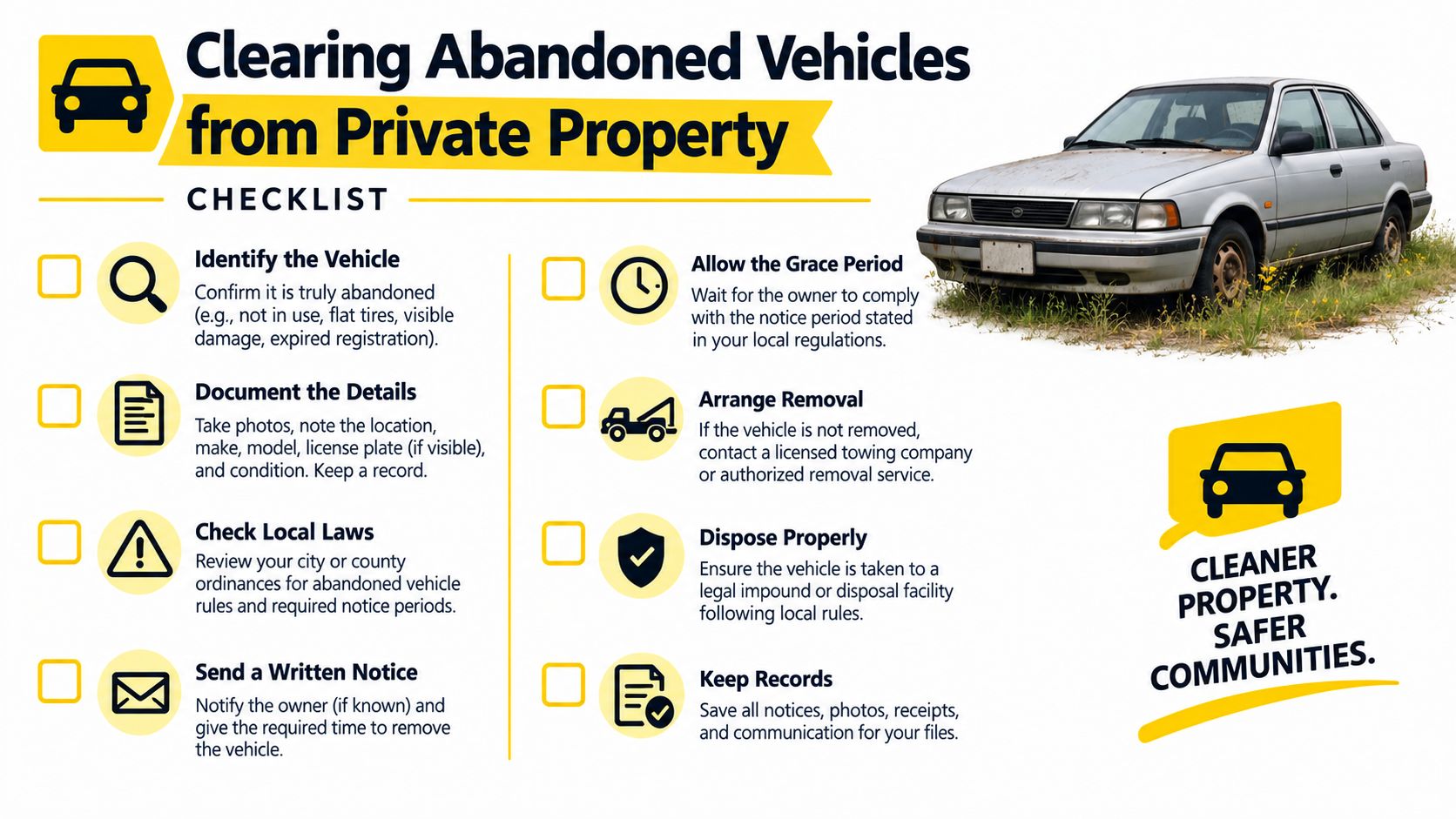
Do not drag away a vehicle just because it is sitting on private land. Establish who owns the land, who controls the vehicle and what authorisation permits its removal. The abandoned vehicle removal process explains the documentation and authorisation steps landlords and property managers should complete before collection.
For a rental property, record the vehicle's location and condition, note its registration or plate status if available, and retain messages with the tenant or former owner. Written evidence protects the property owner if the vehicle's ownership or disposal is later challenged.
Use this clearance process:
- Record the vehicle: Photograph its condition, plates, identifying features and exact position.
- Confirm authority: Obtain written approval from the owner, landlord, property manager or authorised representative.
- Check access: Tell the removal operator whether it rolls, sits in vegetation, has lost wheels or requires restricted access.
- Describe its condition accurately: A non-rolling shell, burnt vehicle, flood-damaged car or machinery item needs different loading preparation from a driveable car.
- Gather documentation: Collect any available registration, insurance or ownership information.
- Plan one controlled pickup: Grouping several vehicles or small plant items can reduce repeat access to the site.
- Confirm the handover: Agree the disposal paperwork and payment arrangements before loading starts.
- Keep the receipt: Store proof that the authorised disposal occurred.
Don't confuse roadside impoundment with private clearance
Roadside and police-related vehicles follow a separate process. NZTA's impound guidance states that a roadside vehicle is considered abandoned after 38 days. After police approval, the storage provider may sell or dispose of it to recover costs, subject to police conditions, as explained in the NZTA impounded vehicle factsheet.
For a farm, rental property or body corporate site, insist on clear authority, safe access and a licensed dismantler equipped for the vehicle's condition. That includes controlled fluid removal and proper isolation of high-voltage systems in hybrids and electric vehicles. It prevents an unauthorised disposal from becoming a dispute, contamination issue or unsafe recovery job.
Regional Towing Logistics and Quote Timelines
A good disposal quote is only useful if the vehicle can be collected without turning the job into a second problem. City pickups are usually straightforward. Rural Northland jobs need accurate directions, honest information about access and the right equipment for vehicles that may have sunk into grass, lost wheels or been parked behind machinery.
In the Whangarei area, an owned tow fleet can support same-day city collections and planned rural runs across the surrounding Northland service area. The collection route covers 46 suburbs and towns around Whangarei, with the yard based on Kioreroa Road. Free towing is available within roughly 100 km of Whangarei, subject to access and vehicle condition. Details of the collection process are available through the scrap car collection service information.
Give the buyer the details that affect value
A phone quote is only firm when the seller gives an accurate description. Send the registration, make, model, approximate year if known, photographs and the vehicle's location. State whether it starts, rolls, has keys, has plates, has been stripped or has damage from flood, fire or an accident.
The quote should reflect two separate value streams:
- Parts demand: A desirable engine, gearbox, panel, wheel set, electronic module or interior can increase value beyond basic metal content.
- Steel and material recovery: A heavily stripped or severely damaged vehicle may be assessed mainly through kerb weight and recoverable metal.
- Loading requirements: Non-rolling shells, machinery and vehicles in confined locations require different equipment and may need site preparation.
- Battery status: Hybrid and EV quotes should identify whether traction battery value has been included.
- Transport terms: Confirm that towing is included and ask whether the quoted amount is paid before loading.
Whangarei city collections typically operate on a same-day basis, while rural Northland routes are planned around regular runs. The practical advantage is controlled scheduling, not a vague promise that someone might arrive later.
Collection standard: The price should be agreed before the truck arrives, then honoured at pickup when the vehicle matches the description.
Payment should be settled before loading, by cash or instant bank transfer, rather than a cheque or an arrangement that leaves the seller waiting. That gives the owner a clean exchange: the vehicle is assessed, the paperwork is completed, payment is made, and the vehicle leaves under an agreed disposal pathway.
Final Checklist for a Secure Vehicle Handover
A secure handover has three outcomes. The vehicle leaves, the money is paid and your NZTA position is clear. If one of those is missing, the job isn't finished.
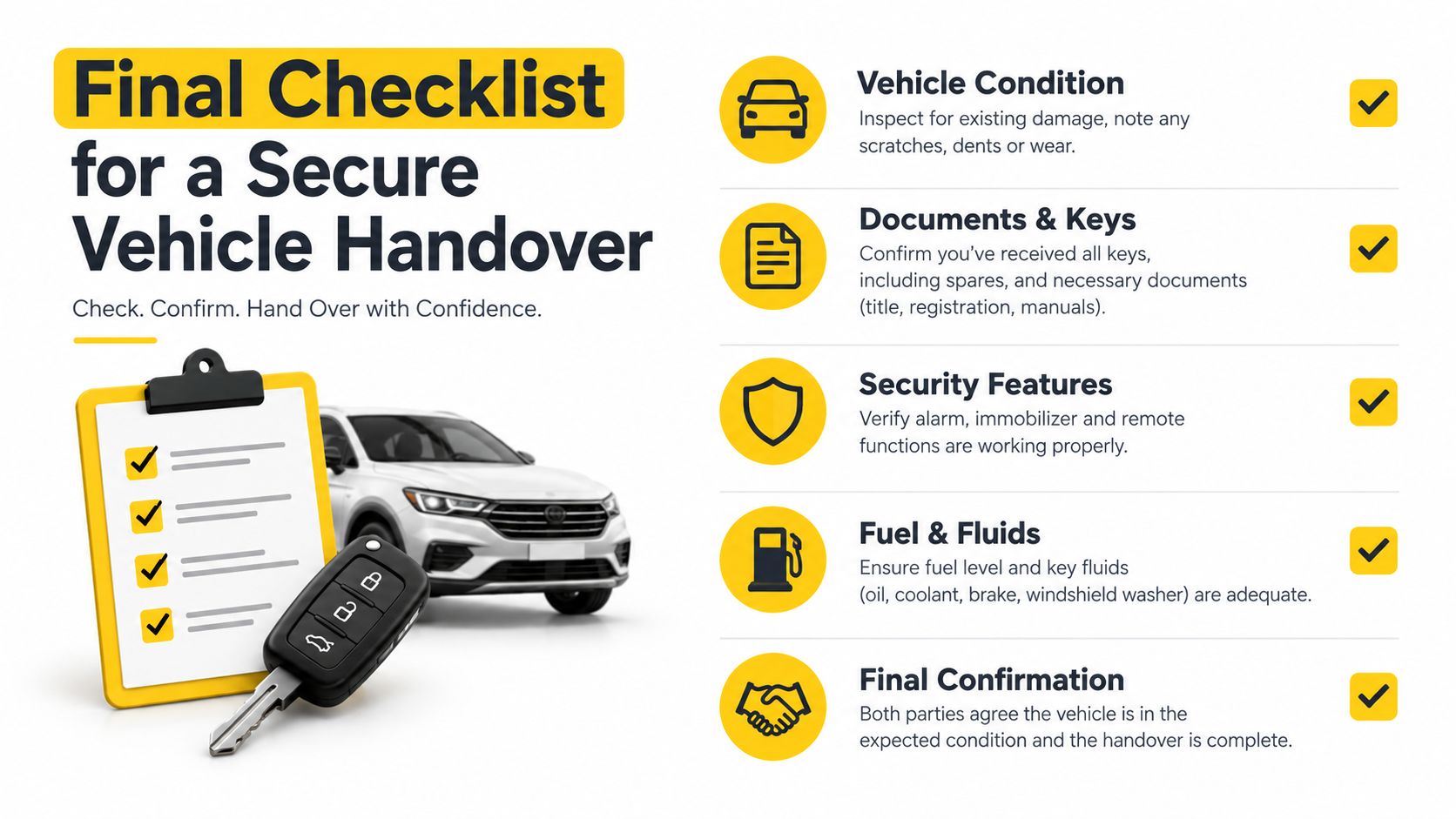
Start before the truck arrives. Remove personal property, check the boot, glovebox and storage compartments, and gather keys, plates and available vehicle documents. Photograph the vehicle and its condition, particularly if the car is damaged, stripped or being collected from private land.
Use this handover sequence
- Identify the vehicle: Confirm the registration, VIN where available, make, model and condition.
- Explain access: Tell the operator whether the vehicle rolls, whether it's locked, and whether the driveway, paddock or yard has restricted access.
- Disclose special risks: Mention flood damage, fire damage, damaged batteries, missing wheels, sharp metal and stored fuel or chemicals.
- Confirm the price: Get the agreed amount in writing or by message, including towing and any stated deductions.
- Check the operator's process: Ask how fluids, batteries, tyres and airbags will be managed after collection.
- Complete NZTA action: Make sure the appropriate notice, change of ownership or MR15 deregistration step is completed at the handover.
- Receive payment: Confirm payment before loading, using the agreed cash or instant bank transfer method.
- Keep proof: Retain the receipt, payment record and disposal or registration confirmation.
A licensed local dismantler should be able to explain its process without vague answers. Ask where the vehicle goes after pickup, how de-pollution is performed, whether high-voltage isolation is available for EVs and hybrids, and how the operator handles non-rolling vehicles.
The best payout doesn't come from hiding defects or chasing the first casual offer. It comes from presenting accurate information, separating parts value from scrap value and choosing a service that can complete the legal and physical work in one visit.
If you're in Whangarei or Northland, Car Removals Whangarei buys unwanted, damaged, non-running, scrap, write-off, hybrid and EV vehicles, with free towing within the local service area and NZTA handover paperwork completed at pickup. Get a firm quote, arrange a suitable collection time and visit Car Removals Whangarei to start a compliant vehicle disposal.
- vehicle disposal nz
- car removal
- scrap car
- nzta deregistration
- cash for cars