· Car Removals Whangarei
Cars Sold for Scrap in NZ: What Really Drives the Price
In New Zealand, a scrap payout is driven mainly by kerb weight plus whatever reusable parts the car still carries, which is why a heavy, complete vehicle can be worth more than a light, stripped shell. A complete car with a dead engine may still earn more than an empty body because the dismantler can recover parts before the remaining steel is recycled.
The situation is familiar around Whangārei. A car sits behind the shed, hasn't started for two winters, and its plates have been expired for years. You're clearing a property, a landlord wants an abandoned vehicle removed, or you've accepted that another repair bill doesn't make sense. The question is usually simple: will anyone take it, and what will they pay?
The answer depends on what remains useful, how much metal the vehicle contains, and how practical it is to collect. New Zealand's end-of-life vehicle system handles about 150,000 vehicles each year from a registered fleet of roughly 3 million vehicles, and research reports that at least 75% of each vehicle by weight entering recycling streams is recovered into reused materials (research on selling cars for parts in NZ). That makes a scrap car more than a rusty shell. It's part of a sizeable recovery stream.
Table of Contents
- What Cars Sold for Scrap Really Are in NZ
- How Scrap Value Is Actually Calculated
- Non-Rolling Shells and Wrecks
- Scrap vs Salvage and Insurance Write-Offs
- From Phone Quote to Pickup Without the Paperwork Headache
- Misconceptions Worth Leaving Behind
What Cars Sold for Scrap Really Are in NZ
A 2004 Nissan Sunny that hasn't turned over in two winters might look finished to its owner. It may have expired plates, flat tyres and moss around the windows. But a dismantler sees several possible sources of value: doors, lights, wheels, glass, electrical components, the catalytic converter, and the steel body once reusable parts have been removed.
“Scrap” describes the vehicle's next use, not necessarily its total worth. Its useful life on the road may be over, while its parts and materials still have a market.
Three practical categories
A vehicle usually falls into one of three broad groups when it stops earning its keep.
- Complete non-runner: The car doesn't start or isn't roadworthy, but most components are still present. This is often the strongest scrap category because the dismantler can inspect and recover parts before sending the remaining shell for processing.
- Partially stripped project: Someone has already removed the engine, gearbox, wheels, interior or catalytic converter. The car may still be collected, but every missing component reduces its parts value and can affect how easily it loads.
- Metal-only wreck: The vehicle has little or no reusable equipment left. The offer is then driven primarily by kerb weight, recoverable steel and the work involved in moving it.
A locked gearbox, failed engine or damaged hybrid system doesn't automatically make a vehicle worthless. It changes the balance between parts value, metal value and collection cost.
Who buys these vehicles
Licensed motor vehicle dismantlers, also called vehicle recyclers, buy end-of-life cars for dismantling and material recovery. They separate usable components from the body, manage fluids and batteries, and send metal fractions into recycling channels.
New Zealand's processing chain generally runs through dismantlers and scrap-metal recyclers before crushing, shredding and magnetic or physical separation. Ferrous metal can return to products such as reinforcing, nails, wire and fencing, while non-ferrous fractions are commonly exported for re-smelting (Statistics New Zealand publication on end-of-life vehicles).
That's why a quick call is normally enough to establish whether a vehicle can be collected. Give the buyer the registration plate, location, make and model, and an honest description of what works or is missing. The resulting quote comes from a calculation, not from the word “scrap” alone.
How Scrap Value Is Actually Calculated
A useful way to understand a quote is to separate it into three building blocks: the vehicle's kerb weight, the value of parts that still have demand, and the cost of collecting it.
The metal baseline is straightforward. A dismantler estimates how much recoverable ferrous material the vehicle contains and applies the relevant rate from local processors. New Zealand end-of-life vehicle research describes a highly metal-dominant stream, with roughly 75% of shredder input made up of steel and 2–4% made up of non-ferrous metal (Massey University research on end-of-life vehicles). The exact rate changes, so a quote made at one time may differ from a later quote for the same car.
The three parts of the quote
Kerb weight is the vehicle's ordinary weight with its standard equipment and operating fluids. A heavier complete car generally has a stronger metal floor than a small, stripped shell. Buyers may confirm the final weight on a certified scale, which gives both sides a clear basis for payment.
Parts demand can matter more than appearance. A working gearbox, undamaged alloy wheels, a sought-after engine, intact electronics or a catalytic converter may add value because the dismantler can sell those components separately. A dead engine doesn't remove the value of the rest of the car.
Collection logistics cover the time and equipment needed to reach, move and load the vehicle. A car beside a Whangārei road is simpler to collect than one down a narrow farm track with locked wheels. The quote should reflect the actual location and condition rather than assume the vehicle will roll freely.
Here's a simplified example using hypothetical figures, not a current NZ price promise. If a 1,400 kg Toyota Corona were assessed against a steel rate of $280 per tonne, the metal portion would be about $390. A working gearbox, alloy wheels and an intact catalytic converter could then lift the offer, depending on local demand and the dismantler's assessment.
| Component | Example | Contribution to payout |
|---|---|---|
| Kerb weight | 1,400 kg vehicle | Provides the metal baseline |
| Steel rate | $280 per tonne in this example | Converts estimated metal weight into a base amount |
| Reusable parts | Working gearbox, alloy wheels and intact catalytic converter | May increase the offer beyond metal value |
| Collection | Vehicle accessible for normal loading | Helps avoid extra handling deductions |
Independent NZ coverage places the average scrap-car value at about NZ$834, with a 12-month range of NZ$769 to NZ$957, while cited ferrous benchmarks for complete cars were around NZ$120 per tonne, compared with about NZ$100 per tonne for stripped cars (NZ scrap-car price update). Those figures are market references, not guaranteed quotes. For a practical sense-check of the factors behind an offer, see this guide to scrap car worth in Whangārei.
Practical rule: Don't remove parts before asking for a quote. A complete non-runner can be worth more than a lighter shell that someone has already picked over.
Non-Rolling Shells and Wrecks
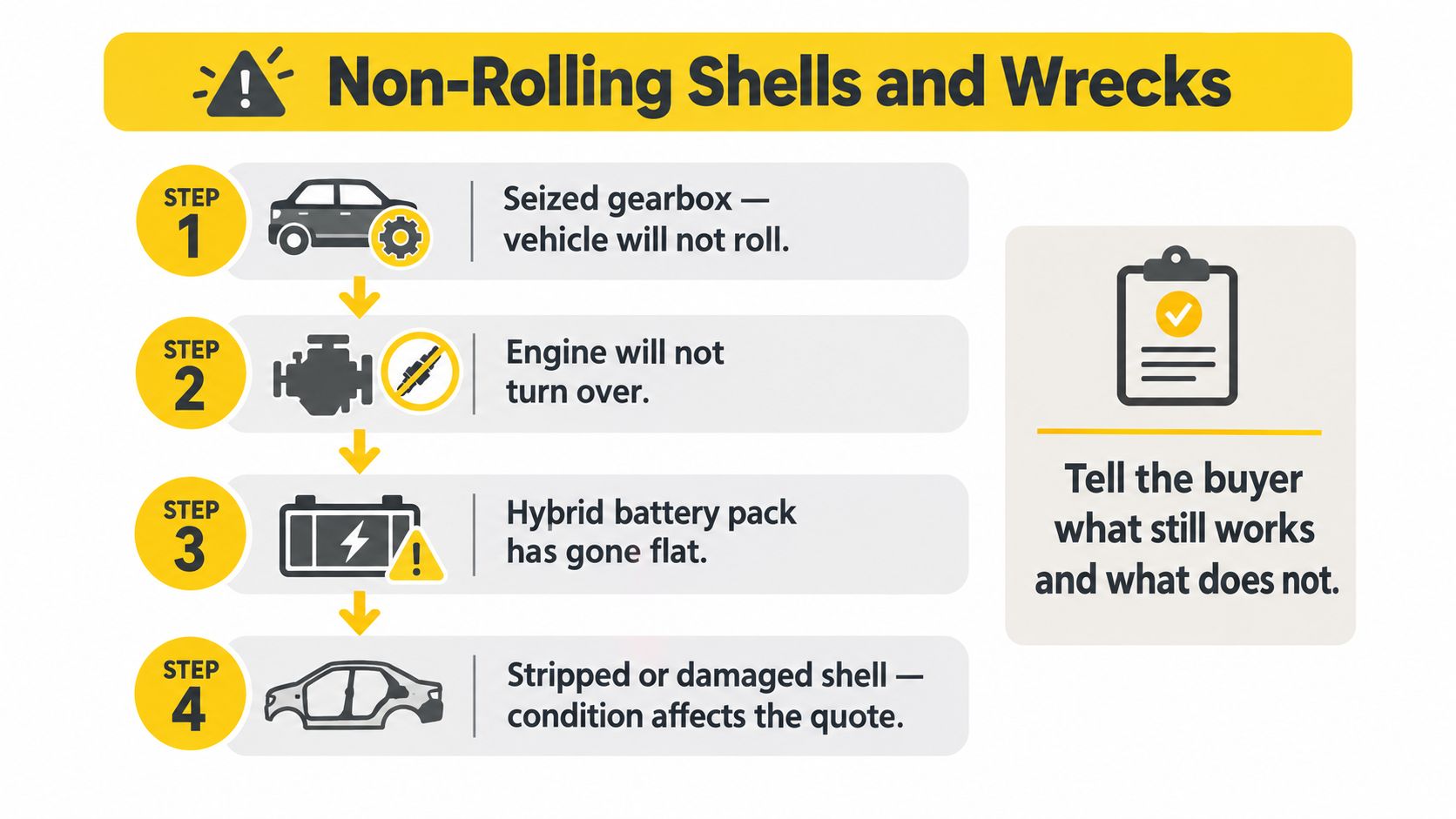
A car doesn't have to be pretty to have value, but it does need an honest assessment. The biggest complications are usually mechanical failure, missing components and access for the tow truck.
Consider a Daihatsu Charade with locked brakes parked on a slope in Kaitaia. The car may still contain useful doors, glass, lights and interior pieces, but loading it requires more care than a vehicle that rolls. A Mitsubishi Outlander hybrid that starts but displays a hybrid-system warning raises a different question. The high-voltage battery pack may still hold value, but its condition must be checked and isolated safely.
What reduces the offer
A seized gearbox matters because the vehicle may not roll and the gearbox itself may not be reusable. An engine that won't turn over can reduce parts value, although the transmission, panels, wheels and electronics may remain saleable. A flat hybrid battery isn't automatically worthless, but it changes the inspection and handling requirements.
A chassis rotted through at the outriggers is more serious than surface rust. Structural corrosion reduces the value of the body as a reusable vehicle and may make loading more difficult. A dismantler will want to know whether the vehicle can be winched, lifted or safely loaded without causing further damage.
Missing parts affect the quote in both weight and resale value:
- Missing wheels: The vehicle may be harder to move and has less recoverable material.
- Removed catalytic converter: A component with its own recovery value is no longer available to the buyer.
- Stripped interior: Seats, dashboard components, trim and wiring may be gone.
- Missing engine or gearbox: The vehicle loses substantial mass and possible parts demand.
- No usable access: Tight gates, soft ground or a steep slope can add loading time.
Distance changes the practical number
Collection in Kerikeri may be easier to combine with a regular Northland route than a separate trip to Kaeo or Doubtless Bay. A rural pickup can involve more travel time, specialised recovery equipment or a longer loading process. Tell the buyer the nearest town, driveway surface, slope, access width and whether the car rolls.
Don't describe a vehicle as “complete” if the engine, wheels or catalytic converter has already been removed. The quote depends on those details, and an accurate description prevents a last-minute change when the truck arrives.
Scrap vs Salvage and Insurance Write-Offs
A true scrap sale and a salvage sale are different routes, even though both may involve a damaged or non-roadworthy vehicle.
A scrap sale is usually the simpler option. The dismantler buys the vehicle for its parts and material value, arranges collection, and processes it through the dismantling and recycling chain. This route suits a car with severe rust, a non-rolling body, extensive missing parts or repair costs that make returning it to the road impractical.
A salvage tender or insurance write-off is different. The buyer may want the vehicle for repair, components, export or a specialist project. A written-off Corolla offered through a salvage auction such as Turners could attract someone who already has repair skills, access to panels and a plan for certification. The same Corolla taken directly by a Whangārei dismantler may produce a faster, clearer disposal outcome, particularly if structural damage makes repair uncertain.
Compare the responsibilities
| Route | Main source of value | Who carries the next risk |
|---|---|---|
| Scrap sale | Reusable parts and recoverable metal | Dismantler manages processing |
| Salvage tender | Potential repair, resale or specialist parts use | Buyer manages inspection and repair path |
| Insurance write-off disposal | Agreed settlement and vehicle condition | Owner or insurer must confirm disposal paperwork |
| Private salvage sale | Buyer's estimate of future value | Seller must describe condition and complete the transfer correctly |
A salvage vehicle can sometimes outprice a quick scrap pickup, but a higher headline offer may come with more paperwork and uncertainty. The buyer may need to manage repair documentation, inspections, re-registration or de-licensing, depending on the vehicle's status and intended use.
The seller should also consider time. A tender requires photographs, enquiries, bidding or negotiation, and a buyer who may not collect promptly. Scrap removal generally focuses on a firm offer and physical clearance. For an insurance situation, car valuation for insurance purposes can help separate a vehicle's repair or market potential from its end-of-life value.
A damaged car isn't automatically a scrap car, but a repairable car isn't automatically worth the effort of selling as salvage.
Match the route to the vehicle. Choose salvage when a credible buyer can use the car and the extra process is justified. Choose dismantling when you want a clear exit, the vehicle has little road-going future, or the cost and liability of holding it outweigh a possible higher return.
From Phone Quote to Pickup Without the Paperwork Headache
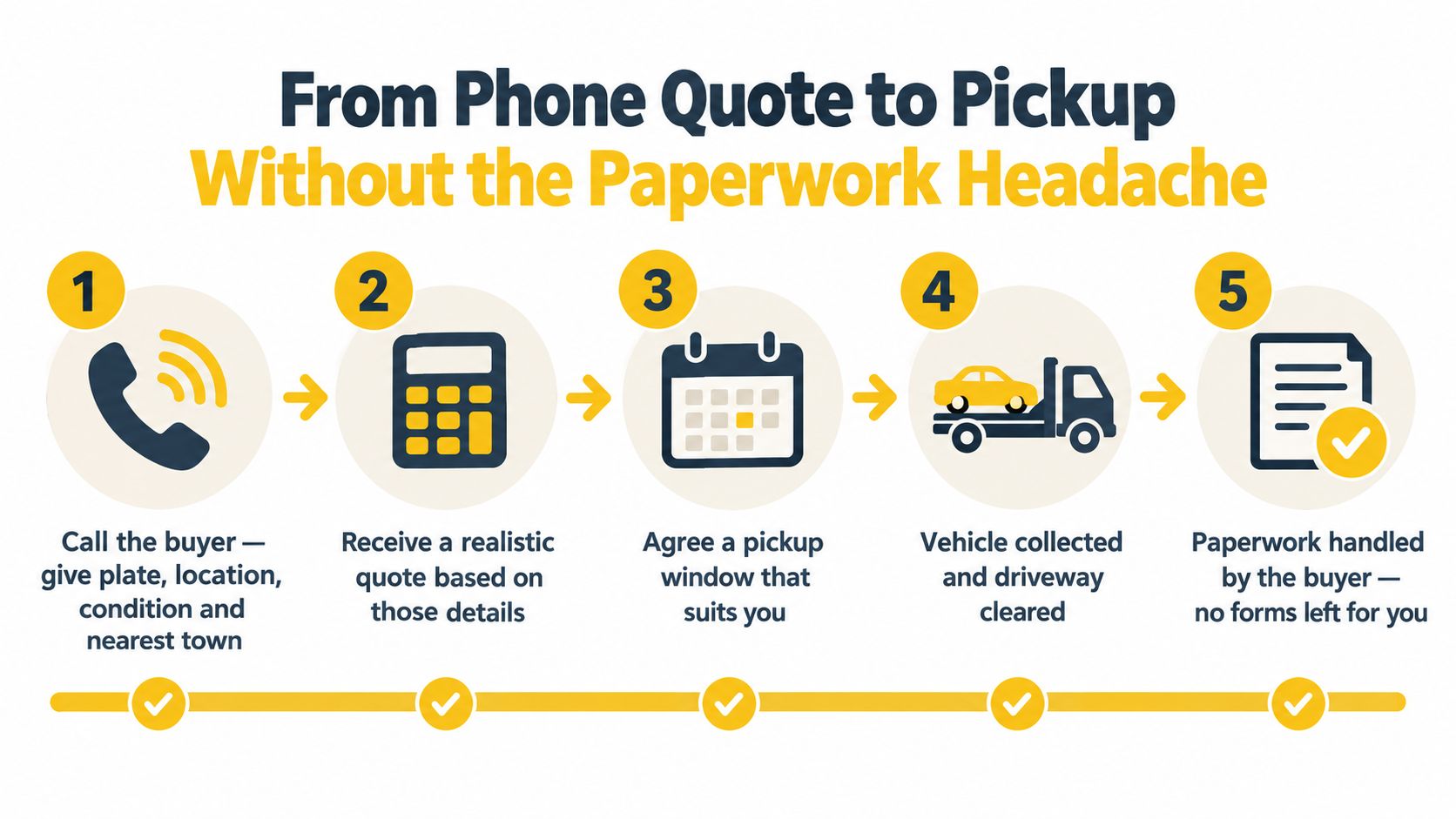
A smooth collection starts with useful information. Before calling, find the registration plate, make and model, exact location and nearest town. Note whether the car starts, rolls, steers, has all its wheels, and can be reached by a standard tow truck.
The buyer needs those details because “doesn't run” covers several different situations. A car with a flat battery may roll normally. A car with locked brakes may need skates, a winch or extra loading time. A vehicle without wheels may require different equipment altogether.
Give the buyer a complete picture
Send clear photographs if the buyer requests them. Include the front, rear, both sides, interior, engine bay, wheels and the access route. Mention flood, fire, major collision, severe rust or missing high-value components.
A realistic quote should state what happens at pickup. Confirm the agreed amount, payment method, collection window and whether towing is included. For rural Northland, ask whether the visit is part of a scheduled route or needs a separate appointment.
Use this short preparation list:
- Clear the cabin: Remove personal property, paperwork, toll tags and house keys.
- Gather ownership details: Keep registration information and identification available.
- Explain access: Tell the driver about locked gates, soft ground, slopes and narrow driveways.
- Photograph the vehicle: Record its condition before loading.
- Confirm payment: Agree whether payment is by cash or bank transfer and when it will be made.
Finish the NZTA notification properly
NZTA says it must be told immediately when a vehicle is sold, given away or destroyed. The notification is free and can be completed online through the buyer and seller change-of-registered-person process (NZTA vehicle-selling guidance).
This step matters because towing the vehicle away doesn't, by itself, end your responsibility. The New Zealand Government warns sellers to notify NZTA as soon as the vehicle changes hands so they don't receive speeding or parking tickets that belong to someone else (government guidance on selling a vehicle). NZTA's disposal form requires the plate number and the full name and address of the person or organisation receiving the vehicle.
Ask the buyer to complete the ownership notification at pickup, and keep a receipt showing the vehicle, date, buyer and agreed payment. Keep your photographs and any confirmation message. If a buyer says paperwork is unnecessary, refuses to identify the organisation, or changes the payment after loading, stop and clarify the arrangement before the vehicle leaves.
For a practical explanation of the transfer process, use this NZTA change-of-ownership guide. A responsible dismantler should make the transaction clear, document the collection and ensure the seller isn't left carrying an administrative problem.
Misconceptions Worth Leaving Behind
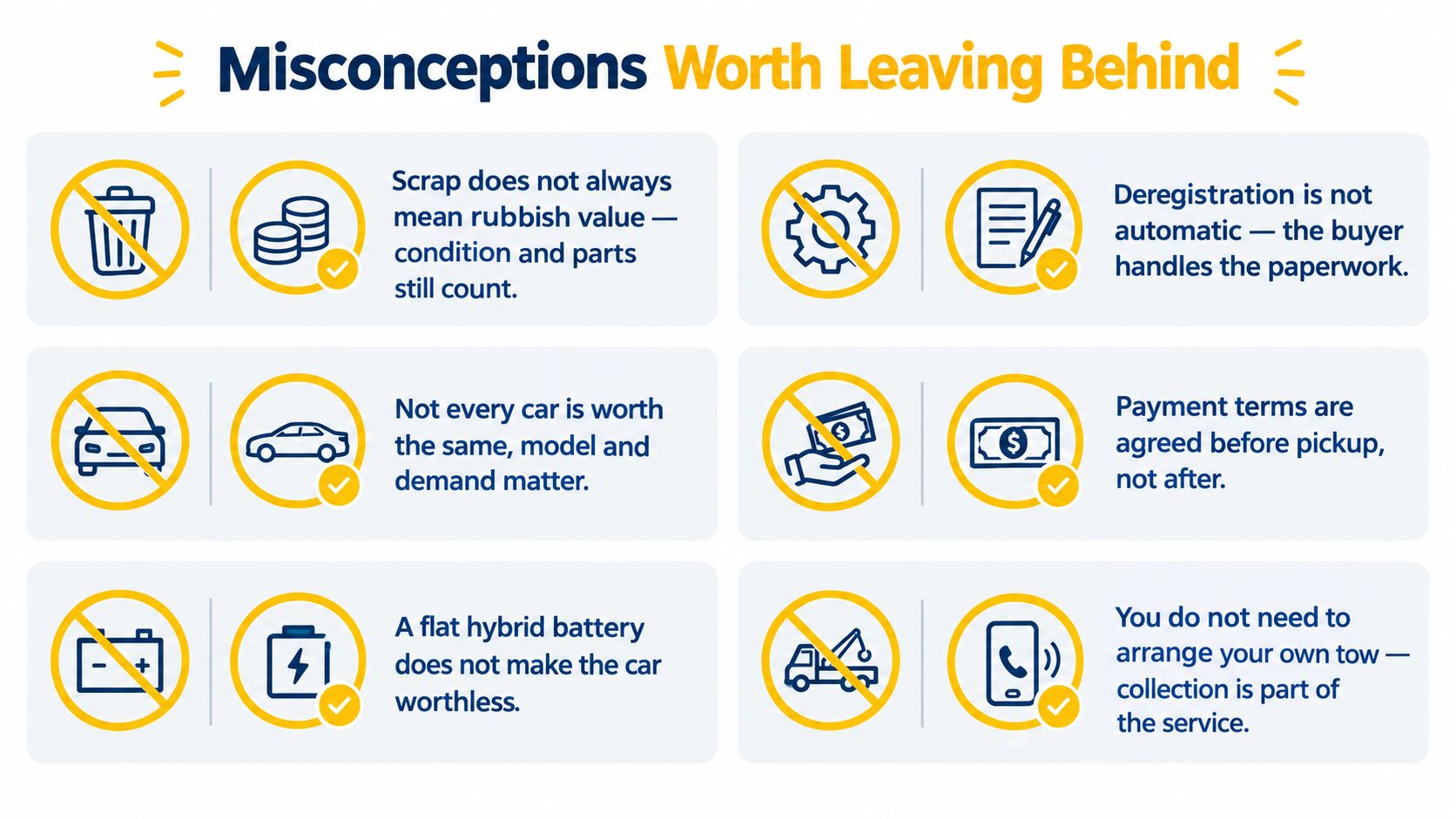
Many first-time sellers arrive with a simple idea of scrap value. They assume the car is either worthless or valuable, that towing solves the paperwork, and that the nearest buyer must offer the best deal. Northland vehicles often fall into the grey area between those assumptions.
Scrap always means rubbish value
A stripped-out Ford Laser in Dargaville may be close to a metal-only assessment, while a complete car with a failed starter could still contain useful parts. A hybrid Camry with a healthy battery may attract a different assessment from one with a damaged pack. Condition and demand decide which value stream matters most.
Deregistration happens automatically
It doesn't. If the vehicle is no longer roadworthy, NZTA guidance says it must be deregistered, and selling to a dismantler doesn't automatically remove the owner's obligations unless the transfer is properly notified. The buyer and seller need to complete the correct process.
Any car is worth more as parts
Not necessarily. A sought-after model with intact components may justify dismantling, but a rare or heavily damaged car can have limited local demand. A rusted Hilux chassis may carry useful wheels, engine components or accessories, yet serious structural damage can leave metal weight as the main value.
A free pickup is always free
Ask what “free” includes. Confirm whether towing, loading and paperwork are covered in the agreed offer, and whether the payment changes when the driver sees the vehicle. The written or texted amount should match the condition you described.
A written-off vehicle can never return to the road
Some write-offs may have a repair path, while others are unsuitable because of structural damage, flood contamination or uneconomic repair costs. The route depends on the damage category, documentation, inspection requirements and the buyer's intended use. Don't assume either outcome without checking the vehicle's status.
The local dealer will always pay more
A dealer may value a vehicle for resale or trade-in, while a dismantler values recoverable parts, metal and collection practicality. A car with no realistic resale future may receive a more direct assessment from a dismantler. Compare like with like, and ask whether the offer includes collection and payment without later deductions.
The sensible decision isn't always the one with the largest headline number. It's the route that reflects the vehicle's actual condition, clears it from your property, and ends your ownership responsibility correctly.
Car Removals Whangarei buys cars, vans, 4WDs, trucks and machinery in damaged, non-running, stripped and end-of-life condition, with quotes based on recoverable parts and metal value. If you're ready to clear a vehicle from a Whangārei or Northland property, visit Car Removals Whangarei to request a quote and arrange collection with the NZTA paperwork handled at pickup.
- cars sold for scrap
- scrap car value
- cash for scrap cars
- NZ car removal
- deregister a vehicle