· Car Removals Whangarei
How Much Can I Sell My Car for: Whangarei Guide
In New Zealand, most unwanted cars sell for somewhere between $200 and $15,000, depending on whether they're road-legal and what parts can still be recovered. In Whangarei, local demand often pushes older or damaged vehicles towards dismantler payouts rather than private-sale money.
How much can you sell your car for when one buyer sees a road car and another sees a parts shell? That gap is where most owners get caught out, because the highest number isn't always the true number.
Table of Contents
- Why New Zealand Car Values Seem Different
- Key Factors That Determine Your Car's Value
- Choosing the Right Selling Path for Your Situation
- Common Misconceptions About Repairs and Re-registration
- Preparing Your Vehicle Details for an Accurate Quote
- Understanding EV and Hybrid Battery Value
- Finalising the Sale and Updating Ownership Records
- Getting Your Firm Quote and Payment Today
Why New Zealand Car Values Seem Different
New Zealand's market confuses a lot of sellers because it doesn't behave like the markets people see in overseas valuation videos. A car that still looks “fine” on the driveway can already be deep into its economic decline here, especially once rust, age, and compliance costs start stacking up.
The country's fleet is old by developed-world standards. A 2025 Ministry of Transport release says there were approximately 3 million passenger cars actively registered in New Zealand as of July 2025, plus about 1.2 million forward-control passenger, off-road passenger and light-goods vehicles, and the average light-vehicle age is about 15 years. The same release compares that with 8.6 years in the United Kingdom, 9.5 years in Germany, and 10 years in Ireland (Ministry of Transport fleet release).
That age profile changes the way a seller should think. A vehicle's original purchase price matters far less than its current condition, service history, rust, accident record, WOF status, and whether someone in Northland wants the parts. A tidy old ute can still find a decent home, but a tired sedan with rust in the sills is usually priced off what it can contribute in parts and metal.
Practical rule: once a vehicle is old enough that buyers are asking about rust before trim level, you're no longer pricing a “car”, you're pricing risk, repair work, and parts demand.
What that means for Whangarei sellers
If you're in Whangarei, don't start with what the car cost new. Start with what it is now, whether it still moves, and whether a buyer can use it on the road or only in a yard. For a quick read on scrap and salvage demand, see this Whangarei guide on scrap-for-cash value.
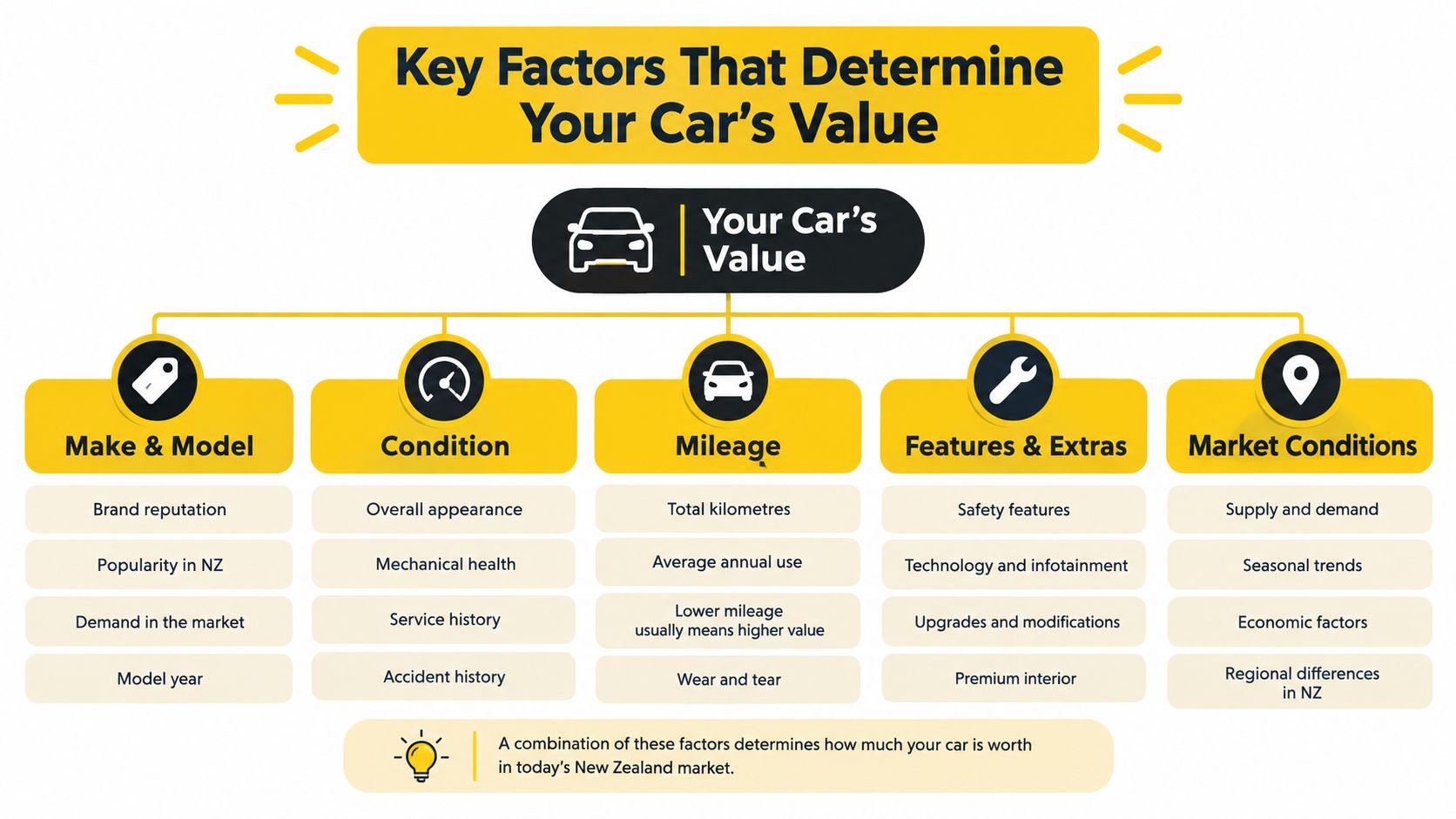
Key Factors That Determine Your Car's Value
A proper quote starts with the car's legal status, then moves through mechanical condition, body condition, and whether Northland buyers want the parts.
The rego and WoF discount changes everything
A current registration and valid WoF keep the vehicle in play for private buyers who want something road-ready. Once registration has lapsed, the buyer pool shrinks fast, because the vehicle may need inspection, certification, compliance work, or dismantling before it can be used again. NZTA says that if licensing lapses for 12 months, registration is cancelled automatically, so an expired plate is not a small deduction. It can push the car into a different sale category entirely (NZTA licensing and rego rules).
That is the hidden discount generic calculators miss. A car with current paperwork can be sold as transport. A deregistered car with structural issues is often bought as a project or parts donor. A non-runner with missing documents is harder to place again, because the buyer has to allow for towing, compliance risk, and parts recovery.
Parts demand matters as much as badges
In Northland, popular utes, vans, and 4WDs usually hold value better than obscure models because the parts get used. That does not make every Hilux, Ranger, Navara, or Hiace valuable by default, but it does mean common work vehicles often attract broader demand than a small hatchback with no current road use.
If the mechanicals are gone and the body is rough, the calculation changes again. Then the question is whether the vehicle has reusable components or whether it is mainly kerb weight and recyclable metal. A clean, complete older car can outprice a newer neglected one if the newer car has unresolved faults, poor history, or missing parts.
For a dismantling mindset, ask one question: is this car still a road asset, or is it now a parts asset? For a closer look at what wreckers factor into payouts, read how wreckers assess car payouts.
Choosing the Right Selling Path for Your Situation
Every seller wants the same thing, a fair payout without wasting time. The mistake is assuming every car should follow the same path, because the right route depends on whether the car is road-ready, repairable, or done.
Private sale, trade-in, or removal
Private sale usually gives the highest ceiling if the car presents well, the paperwork is tidy, and you've got time to advertise, answer messages, meet buyers, and handle the handover yourself. It suits clean, licensed vehicles where a buyer can drive away without a headache.
Trade-in is easier, but convenience costs money. A dealership has to allow room for reconditioning, margins, and resale risk, so the number is often lower than what you'd aim for in a private sale. It's practical if you're replacing the car quickly and don't want the hassle of managing enquiries.
Car removal is the route for vehicles that are non-running, rusted, deregistered, written off, or not worth repairing. It's also the most useful option when towing, compliance, and paperwork would eat into any private-sale gain. In Northland, a removal offer can still be strong when parts are in demand and the shell is complete.
Rule of thumb: if the car can't reasonably compete as a road vehicle, stop comparing it to road-vehicle prices.
There's no single best answer for every seller. A tidy commuter with current rego should be priced differently from a seized diesel ute or a flood-damaged hatchback. If you're comparing the simple vs hands-off route, this guide to selling a car in practical terms is worth reading before you choose.
Matching the route to the vehicle
Think in outcomes, not slogans. Maximum cash, minimum effort, or fastest disposal, you usually get to choose two. The right path is the one that protects the value left in the vehicle without burning it up in time, towing, and repair costs.
Common Misconceptions About Repairs and Re-registration
A lot of sellers assume that paying for a WOF or sorting registration always lifts the final payout. That can be true for tidy, repairable cars, but it often backfires on old, rusty, or non-running vehicles.
Why “fix it first” can backfire
Once licensing has been left too long, the numbers change quickly. NZTA licensing rules state that registration is cancelled after 12 months continuously unlicensed, and the vehicle then needs the proper inspection and re-registration steps before it can legally go back on the road.
That is where the repair bill can outgrow the price gain. A WOF, welding, tyres, brakes, or rust repair can cost more than the extra money a buyer will pay, especially if the shell has structural corrosion or the drivetrain is already tired. I've seen owners spend on updates only to find the market still treats the car as a dismantling job, because paperwork does not erase hidden damage.
Deciding whether road-worthy repair is worthwhile
If the vehicle is structurally sound, starts, stops, and can realistically be returned to legal road use, repairs may still make sense. If it is heavily rusted, damaged, non-running, or needs major metal work, selling it as-is is usually the better financial call. Buyers see that difference immediately, and they price it hard.
If the vehicle is not road-worthy and structurally sound, every repair dollar should be measured against the likely resale gain, not hope.
That is the part generic valuation tools miss. They cannot see corrosion, missing paperwork, or the cost of getting a deregistered car legal again. For Northland sellers, that gap matters more than a clean-looking estimate on a screen.

Preparing Your Vehicle Details for an Accurate Quote
A firm quote starts with clear information. Vague descriptions lead to vague numbers, and vague numbers usually get corrected later when the buyer sees the car in person.
What to gather before you call
Have the registration plate or VIN, the exact make, model, and year, the odometer reading, and an honest description of the condition. Include rust, missing parts, blown engine, gearbox issues, flood exposure, accident damage, and whether the car rolls or starts.
If you've got the logbook, old registration papers, service records, or receipts, keep them close. They help show the car's history and can support the value of a repairable vehicle. Clear photos matter too, especially of the exterior, interior, engine bay, chassis, tyres, and any obvious damage.
- Registration and VIN: These identify the vehicle properly and reduce back-and-forth.
- Condition details: Be blunt about rust, missing parts, and whether it runs.
- Damage history: State whether the car has been in a crash, flood, or fire.
- Documents and photos: These help separate a road car from a dismantling candidate.
The more honest the description, the less room there is for argument later. A buyer can price a damaged car fairly only when the damage is described clearly. That's how you get a quote that reflects the vehicle instead of a guess.
Understanding EV and Hybrid Battery Value
Electric and hybrid cars don't price the same way as petrol or diesel vehicles. The battery can lift the offer, or drag it down sharply, depending on its condition and whether it's safe to handle.

Battery health is value, battery uncertainty is risk
New Zealand's fleet now includes more than 100,000 battery-electric vehicles according to Ministry of Transport statistics, and November 2025 fleet data separately identified about 128,000 light electric vehicles (Transport statistics and insights). That means there's a growing market for EV parts and specialist buyers, but the buyer pool is still narrower than it is for common petrol cars.
A healthy traction battery can support resale, parts demand, or second-life energy storage use. A pack with crash damage, water damage, warning lights, or unclear diagnostics is a different story. Then the buyer has to price in safe transport, high-voltage isolation, testing, and disposal risk, which can pull the offer down.
What EV owners should provide
Battery health evidence helps. So does charging history, warning-light information, and any records showing the pack is intact. A low odometer reading doesn't automatically mean a strong offer if the battery is suspect, and an older EV with usable battery-related components can still be worth more to a specialist dismantler than a standard scrap assumption suggests.
For hybrids, the same logic applies, just with less public attention. Battery condition still matters, and a generic mileage-only estimate won't capture that properly. If the battery is healthy, value follows. If it isn't, the quote becomes a risk-adjusted dismantling figure.
Finalising the Sale and Updating Ownership Records
Getting paid isn't the end of the job. In New Zealand, the seller still has to complete the ownership side properly, or the vehicle can keep causing problems after it has left the driveway.
Notify NZTA straight away
Waka Kotahi says a seller must notify it immediately when a vehicle is sold, given away, destroyed, or otherwise disposed of. The notification is free and can be done online, and it records the change of registered person rather than proving ownership in a legal sense (NZTA vehicle ownership page).
That matters because failure to notify can leave the previous registered person liable for tolls, speeding fines, licensing fees, and other charges incurred by the new user. If the vehicle is overdue for registration, the seller can stay responsible for fees up to the date NZTA is told it was sold. For vehicles needing road-user charges, the timing is just as important, because the vehicle must have a valid RUC licence when the new owner takes possession (NZTA registered person responsibilities).
Keep proof of the handover
Save the confirmation of the seller transaction and keep a receipt or bill of sale. If the vehicle is scrap, damaged, or deregistered, that paperwork matters even more because you want a clean record that the car left your possession on a specific date.
Practical rule: if the keys have gone but the notification hasn't, the risk hasn't gone either.
Good paperwork closes the loop. It protects the seller, makes the sale cleaner for the buyer, and keeps the whole transaction straightforward if questions come up later.
Getting Your Firm Quote and Payment Today
The fastest way to get a real number is to give a real description. List the car accurately, note the rego and WoF status, explain whether it runs, and say whether it's being sold as a road car, a project, or a dismantling candidate.
For Whangarei and wider Northland sellers, a licensed local dismantler can turn that information into a firm phone quote, arrange towing, and handle the NZTA ownership change at pickup. At Car Removals Whangarei, that process is built around vehicles in any condition, with free towing within roughly 100 km, payment before loading, and same-day city pickups where scheduling allows.
The biggest mistake is waiting to see if a rough car will somehow become a better one by sitting in the yard. If the vehicle is old, damaged, deregistered, or battery-risky, the market already has a view on it. The right quote reveals that view in cash.
If you want to know what your car is worth in today's Northland market, gather the plate or VIN, a few photos, and a honest condition summary, then ask for a no-obligation quote. You'll get a clear answer much faster than you will from a generic calculator.
If your car is old, damaged, deregistered, or just taking space, Car Removals Whangarei can price it as a road car, parts vehicle, or scrap vehicle and collect it across Northland. Visit Car Removals Whangarei to request a quote and see what your vehicle is worth today.
- sell car whangarei
- car removal whangarei
- how much can i sell my car for
- cash for cars northland
- scrap car removal nz