· Car Removals Whangarei
Cash for Cars NZ: How the Process Actually Works
Most advice about cash for cars NZ gets the order wrong. It treats the payout as the whole deal, when the actual win is finishing with clean paperwork, no loose liability, and a vehicle removed in a way that won't boomerang back on you later.
A strong offer matters, but a good transaction is judged by what happens after the truck leaves. If the disposal isn't recorded properly, the price you got up front can be swallowed by tolls, licensing issues, or follow-up letters tied to a vehicle you thought was gone.
Table of Contents
- The Hidden Risks of Selling Your Unwanted Vehicle
- How Dismantlers Calculate Your Vehicle Payout
- Navigating the NZTA Change of Registered Person
- Environmental Compliance and End of Life Processing
- Choosing a Reputable Local Car Removal Service
- What to Expect on Pickup Day
The Hidden Risks of Selling Your Unwanted Vehicle
The loudest quote isn't always the safest one. A buyer can promise more cash and still leave you exposed if they skip the NZTA notifications or rush the handover without finishing the record properly.
That matters because NZTA tracks the registered person, not some casual idea of ownership. If the disposal isn't reported, the former registered person can still be the one holding the bag for tolls, speeding tickets, or overdue licensing charges tied to the vehicle after it has already been collected.
Price is only part of the deal
A lot of sellers focus on what gets paid at pickup and ignore what gets left behind in the system. That's a mistake with unwanted, deregistered, written-off, or long-stored vehicles, because the paper trail matters just as much as the tow truck.
Practical rule: if the buyer won't complete the disposal notification properly, the quote is incomplete no matter how high it looks.
The market also isn't the same for every vehicle. A passenger car, a van, a 4WD, a truck, or a hybrid doesn't follow the same end-of-life path, and the national fleet context shows why that matters across New Zealand, including Northland. The Ministry of Transport's 2024 fleet figure of 5,179,310 vehicles shows the scale of the vehicle base feeding resale, dismantling, and end-of-life recovery work, and the model's breakdowns by type and age help explain why different vehicles have different removal values and disposal routes (Ministry of Transport fleet statistics).
A seller should care about more than the headline number. The question is whether the handover closes the loop cleanly, or leaves your name attached to a vehicle that's already gone.
How Dismantlers Calculate Your Vehicle Payout
A proper quote starts with what can be recovered, not just what the shell weighs. Parts demand, condition, drivability, access to the vehicle, and the likely reuse of components all shape the figure, and a rusted ute doesn't sit in the same valuation bucket as a late-model accident write-off.
The best way to think about it is simple. A dismantler is buying a mix of metal, parts, and process efficiency, and each of those shifts with the vehicle's condition and type.
What changes the number
- Parts demand. A model with usable panels, lights, doors, or drivetrain parts can carry more value than a bare shell.
- Vehicle type. A light hatchback, a 4WD, a van, a truck, or machinery can trigger very different loading and dismantling costs.
- Condition. A complete car is easier to value than a stripped or seized one.
- Access. A non-rolling vehicle on a tight rural site takes more effort to recover than one parked on a driveway.
- Powertrain complexity. Hybrids and battery-electric vehicles need more careful handling because the battery system changes how the vehicle is isolated and stripped.
- Materials recovery. Once reusable parts are removed, the remaining body still carries scrap and recycling value.
- Compliance work. Safe draining, battery handling, and lawful disposal channels affect the economics too.
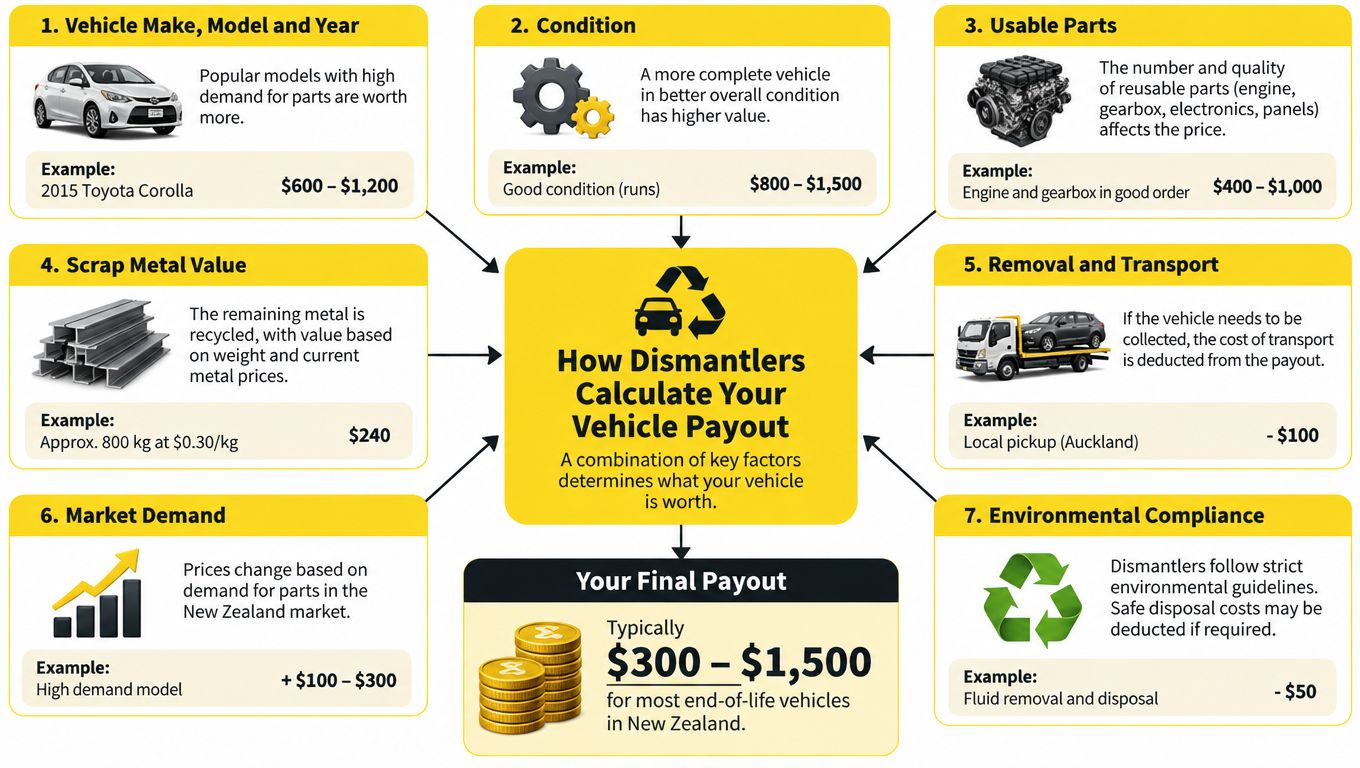
That's why a shell can still be worth something, even when it won't start and the tyres are flat. You're not selling a working vehicle any more, you're selling recoverable value and removal convenience.
Scrap value and salvage value are not the same thing
Scrap value is the floor. Salvage value rises when the dismantler can pull parts that still have demand and move them back into circulation. A vehicle with blown mechanicals can still hold value if the body, trim, electrics, or accessories are intact and useful.
For a deeper look at that pricing logic, this Northland scrap-for-cash guide is the right companion reading. It's the same trade in principle, but the quote changes once you move from simple scrap to a vehicle with reuse potential.
Navigating the NZTA Change of Registered Person
The clean handover starts before the vehicle is loaded. The seller and the buyer both need to complete the disposal side of the transaction, because NZTA records the registered person responsible for the vehicle, not a vague promise that “ownership” changed hands.
For a car that's being sold, scrapped, destroyed, or dismantled, the paperwork should happen on pickup day. That's the point where the physical removal and the legal change need to match, otherwise the old record can keep following you.
What should happen on pickup day
- Confirm the vehicle details. Make, model, registration details, and condition should match the quote.
- Complete the seller notification immediately. NZTA says the registered person must notify it when the vehicle is sold or disposed of.
- Complete the buyer or receiving party side as well. The transaction has to be closed from both ends.
- Keep written proof. A dated record of pickup, payment, and disposal is useful if any future question comes up.
- Check the registration status. A vehicle can be unregistered, lapsed, cancelled, written off, or destroyed and still have a live record in the system.
NZTA's registration history matters here. A lapsed vehicle is one whose licence has been invalid for 12 months and is automatically deregistered, while a cancelled vehicle is manually deregistered. The record doesn't vanish when the vehicle leaves the road, and NZTA retains motor vehicle records and related licensing documentation for at least 20 years before archival transfer (NZTA record and deregistration information).
A vehicle doesn't need to be roadworthy to need paperwork. If it's no longer fit for the road, it must be deregistered, and an unregistered vehicle can't just be put back into public-road use without the proper registration process. For sellers who want the disposal process handled properly on site, this NZTA change-of-ownership guide gives the practical version of what that looks like.
Environmental Compliance and End of Life Processing
Once a vehicle leaves the property, the work is only partly done. Proper dismantling means sorting what can be reused, what has to go through approved processing, and what needs careful handling because it does not belong in general waste.
Tyres are the clearest example. New Zealand's regulated tyre product stewardship scheme lets people drop end-of-life tyres at registered collection sites at no cost, with fees funding collection, transport, processing, reuse, recycling, and repurposing (tyre product stewardship scheme). The Ministry for the Environment also recognises reuse, crumbing, recycling, and energy recovery as valid end-of-life pathways, so tyres should be separated early rather than left on stripped shells.
Why separation matters
- Tyres need traceable handling. They are not ordinary rubbish.
- Reusable parts should come off first. That keeps useful components in circulation.
- Hazardous material needs controlled treatment. Fluids, batteries, and similar components need proper isolation.
- Storage risk drops when the vehicle is stripped correctly. That matters on busy yards and rural sites alike.
New Zealand's end-of-life tyre system sits under the government-backed Tyrewise scheme. Ministry for the Environment material estimates that about 6.5 million tyres reach end of life in New Zealand each year, and the regulations introduced in 2023 required tyre importers and manufacturers to register from 1 March 2024 and pay a stewardship fee when tyres enter the market (Tyrewise priority product stewardship). A Ministry work programme also estimates that only about 40% of end-of-life tyres were recycled or exported, with the rest landfilled, stockpiled, or illegally dumped.
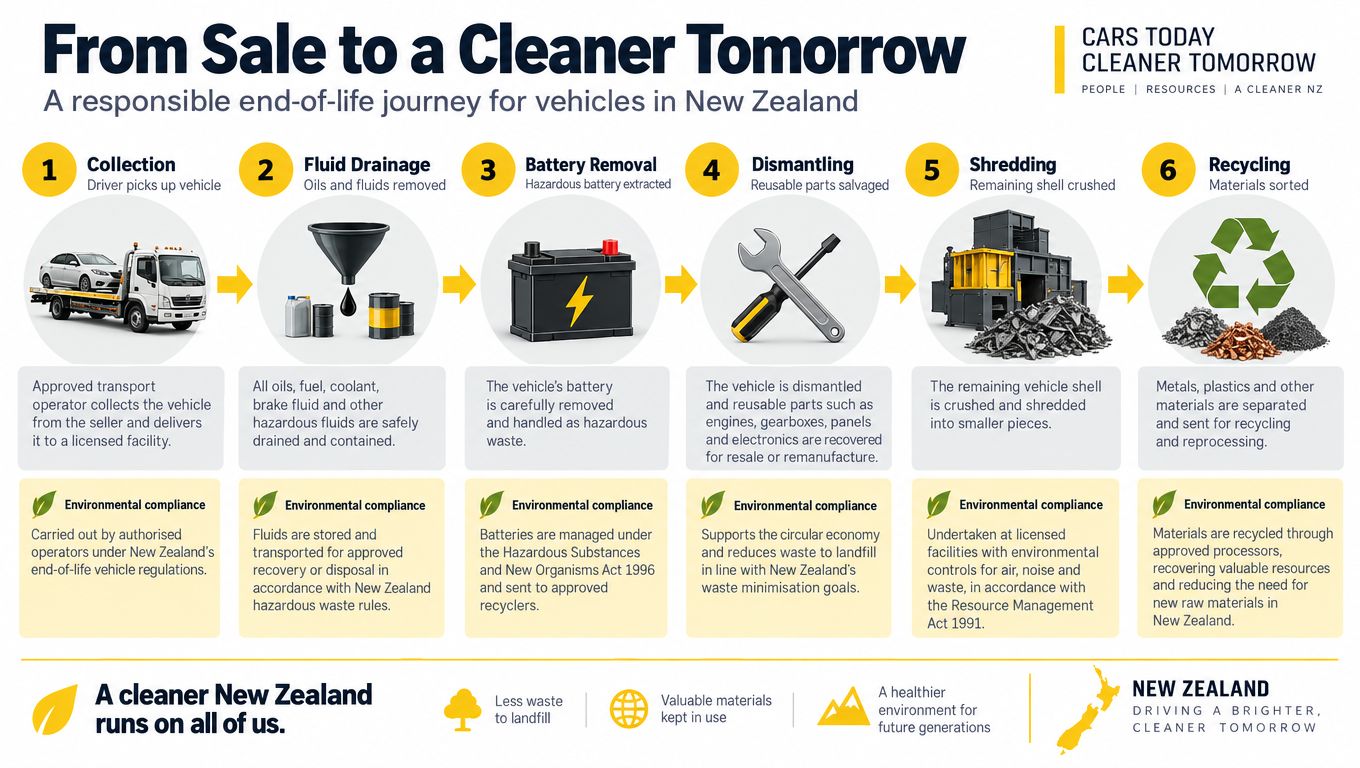
For sellers, the point is simple. A proper dismantler does not just tow the vehicle away, it routes the leftovers through systems that reduce environmental exposure and keep the disposal trail defensible. This vehicle disposal guide explains the wider end-of-life pathway in plain language.
Choosing a Reputable Local Car Removal Service
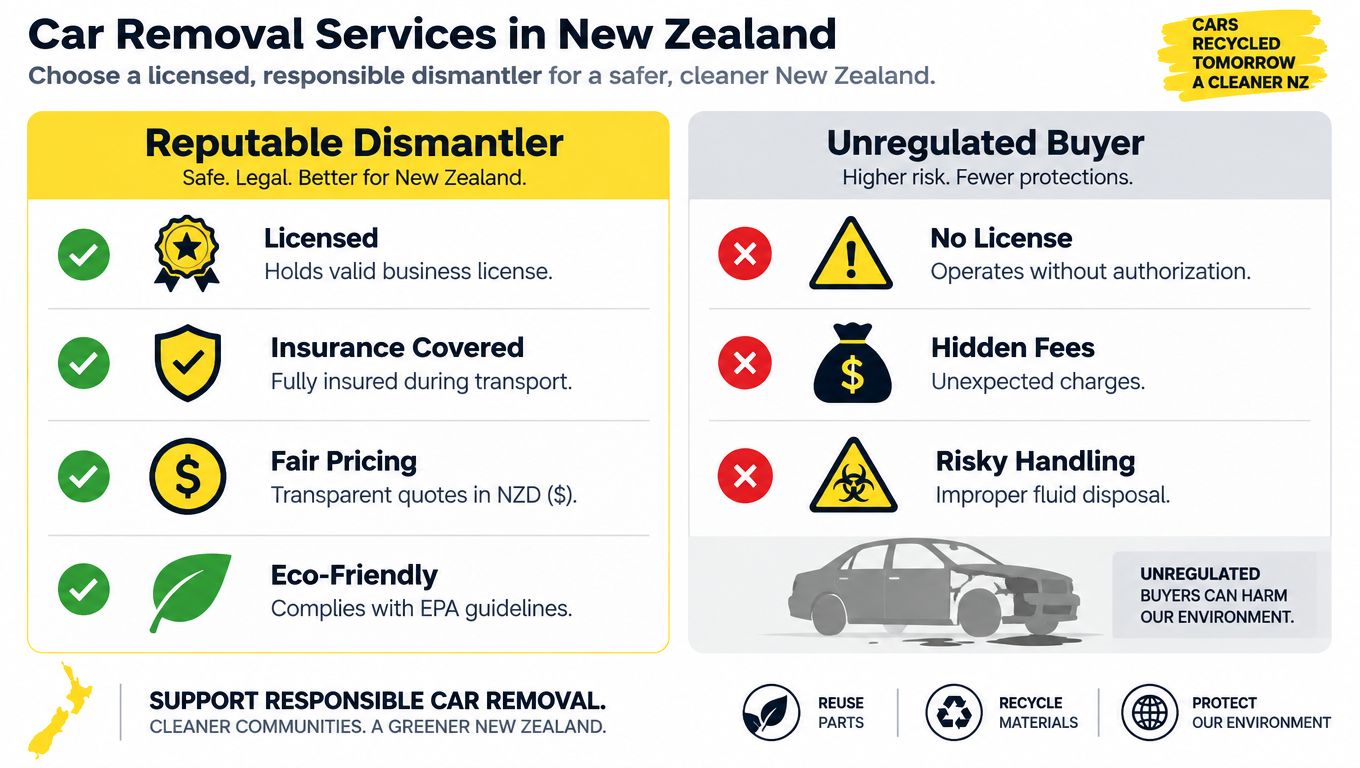
A good removal service does three things well. It gives a firm quote, turns up with the right gear, and finishes the paperwork without turning pickup day into a negotiation.
The weak operators tend to fail in predictable ways. They hide towing costs, keep the quote vague until they arrive, or stall on paperwork because they never intended to complete it properly in the first place.
What to look for and what to walk away from
| Reputable local dismantler | Unregulated buyer |
|---|---|
| Firm phone quote that matches pickup | Vague estimate that changes on arrival |
| Paperwork completed on site | Promises to sort it out later |
| Owned towing and loading gear | Depends on whoever's available |
| Clear handling of dead, damaged, or non-rolling vehicles | Relies on excuses when the vehicle is awkward |
| Transparent payment timing | Delays or conditions payment after collection |
A buyer who can't explain how the paperwork works usually can't be trusted with the liability side of the deal either.
That's where local infrastructure matters. A yard, an owned tow fleet, and people who know the Northland road network all reduce friction, especially for rural jobs, machinery, and vehicles that won't roll. It also makes same-day city collections more realistic, because the business isn't waiting on a third party to show up with the right trailer.
A local operator can also judge whether the vehicle is worth more as parts, scrap, or a mix of both. If you're comparing removal options in Whangārei or the wider district, Car Removals Whangarei is one example of a licensed Northland dismantler that buys unwanted vehicles and completes NZTA notifications at pickup. That's the kind of operational detail that matters more than a flashy headline offer.
What to Expect on Pickup Day
Pickup day should feel organised, not improvised. A proper collection starts with a quick check of the vehicle details, then the tow truck driver confirms the condition, matches it against the quote, and sorts payment before loading.
If the vehicle is as described, the handover is straightforward. The driver documents the collection, the seller completes the NZTA notification, and the vehicle is secured for transport without any drama.
A normal same-day collection flow
The driver arrives with the right loading gear for the job. On a flat driveway, that might be quick. On a farm track, in a tight driveway, or with a non-rolling shell, the process slows down a bit because the vehicle has to be handled safely.
Payment should be settled on the spot, either in cash or by instant bank transfer, before the vehicle is loaded. That timing matters because it removes the awkward middle ground where the car is gone but the money and paperwork still aren't final.
The best pickup is the one that feels boring. The quote holds, the paperwork gets done, and nothing is left hanging over the seller.
Once the vehicle is secured, the seller should keep a copy of the disposal record and any pickup note or receipt. That's the practical proof that the vehicle left in an authorised handover, not as an abandoned object or an unresolved registration problem.
For unwanted vehicles, damaged 4WDs, rusted utes, or machinery that needs a clean exit, the right operator makes the day short and orderly. That's the standard worth demanding every time.
If you want a removal that handles the quote, towing, and NZTA paperwork in one visit, contact Car Removals Whangarei and ask for a pickup-day process that leaves no loose ends. For unwanted vehicles, damaged machinery, and end-of-life cars across Northland, they provide the kind of local collection service that helps sellers close the file properly.
- cash for cars nz
- car removal
- scrap car value
- nzta transfer
- vehicle dismantling