· Car Removals Whangarei
Abandoned Car on Private Property: A Step-by-Step Guide
The tenant's gone, but their car is still in the driveway. Or there's a flat-tyred wreck in your paddock, nobody's answering messages, and you need the space back. Calling a tow truck feels like the obvious next move.
With an abandoned car on private property, the hard part usually isn't loading it. It's proving who can authorise removal, whether anyone else has an interest in it, and what should happen to the vehicle afterwards. A short, documented wait is safer than a fast tow based on an assumption.
Table of Contents
- What the Law Says About an Abandoned Car on Private Property
- Document the Vehicle and Its Condition First
- How to Confirm You Have Authority to Remove It
- How to Arrange Compliant Collection
- How to Complete Ownership Notifications
- Special Cases That Change the Process
- Your Next Step to a Lawful Removal
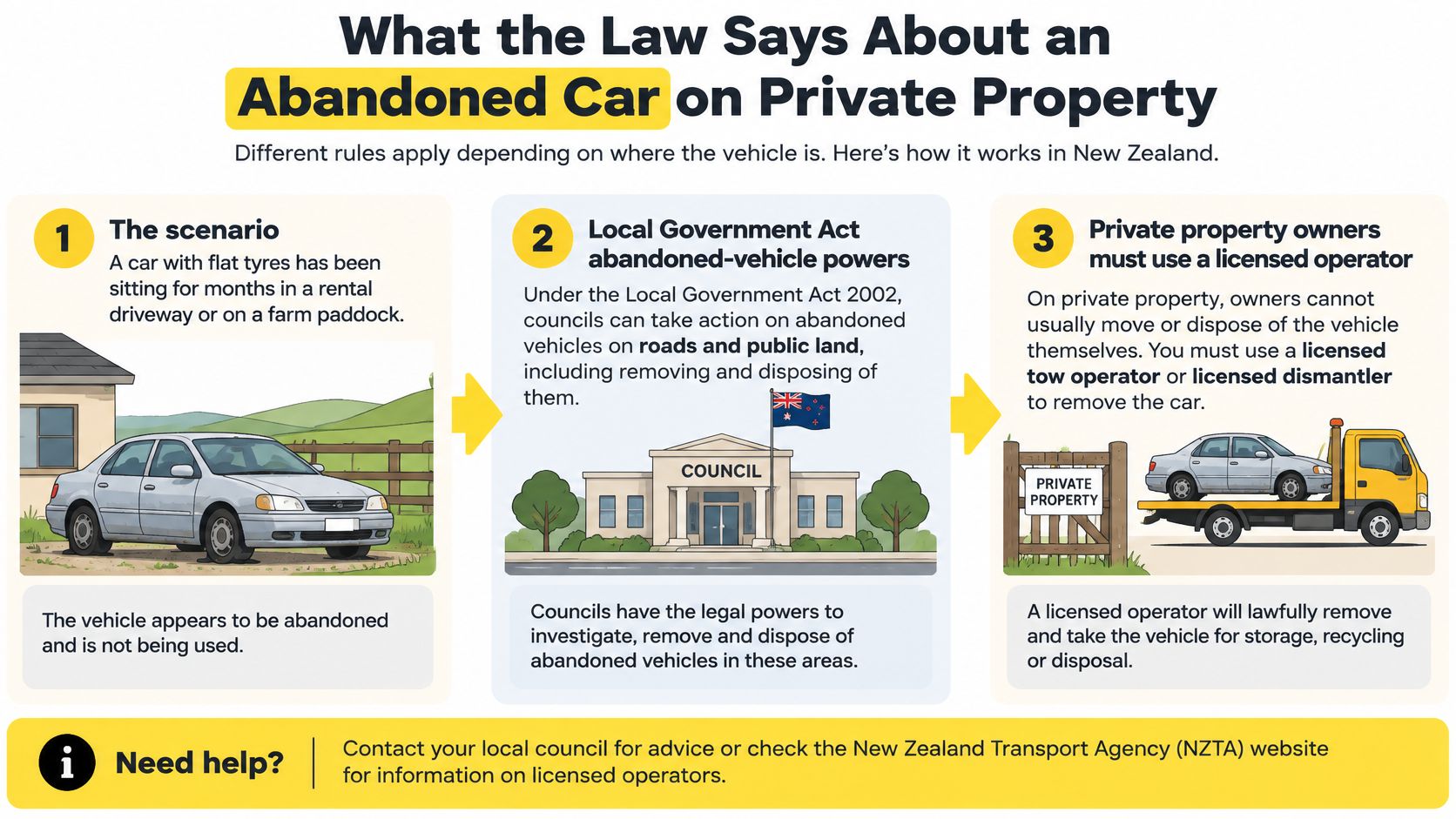
What the Law Says About an Abandoned Car on Private Property
A car has sat flat-tyred beside your rental garage for months, but its condition doesn't tell you who has the right to dispose of it.
Which removal pathway applies to your abandoned vehicle
| Vehicle situation | What it usually means | Your next move |
|---|---|---|
| Registered, owner known | Licence current or recently expired; owner traceable from the plate | Contact the owner, then get written removal authority |
| Unlicensed or deregistered, owner identifiable | Record still exists in the Motor Vehicle Register | Written notice plus owner authority before removal |
| Plates or VIN stripped | Ownership is hard to prove and theft is possible | Call Police before moving it, then trace by chassis number with a licensed remover |
| Suspected stolen | Police matter, not a removal job | Call Police and leave the vehicle untouched |
| Under finance or a security interest | A financier holds an interest in the vehicle | Check the PPSR and get the financier's consent |
| Leaking wreck, EV, hybrid or bogged vehicle | Safety or access hazard needing special gear | Use a licensed dismantler with isolation and loading equipment |
New Zealand's statutory abandoned-vehicle powers concern roads and road corridors, not an automatic right to clear someone else's vehicle from private land. Auckland Transport's abandoned-vehicle guidance explicitly says it cannot act on vehicles located on private property.
Condition is evidence, not ownership
Flat tyres, accumulated leaves, an expired licence label, a failed WOF and prolonged lack of movement can support an assessment that a vehicle has been abandoned. None of those observations tells you whether a former tenant, family member, insurer or financier still has rights over it.
Abandonment doesn't automatically transfer ownership to the landowner. Owning the driveway isn't the same as owning everything parked on it.
Say your former tenant left a damaged hatchback and texted that they would collect it. Their failure to return is useful evidence, but it isn't written permission to sell the car for scrap. Preserve that message, identify the vehicle properly, and seek a clear answer about collection or disposal.
Separate removal for storage from sale for dismantling, too. Permission to relocate a vehicle doesn't necessarily include permission to destroy it or receive its sale proceeds.
The practical workflow has distinct phases: document the vehicle, confirm authority, arrange compliant collection, and complete notifications. Getting those phases right protects both the property owner and the person loading the truck.
Document the Vehicle and Its Condition First
Build the evidence file before cleaning around the vehicle, shifting it or removing anything. You want an accurate record of what was there, where it sat and what condition it was in before anyone intervened.
Build a useful evidence file
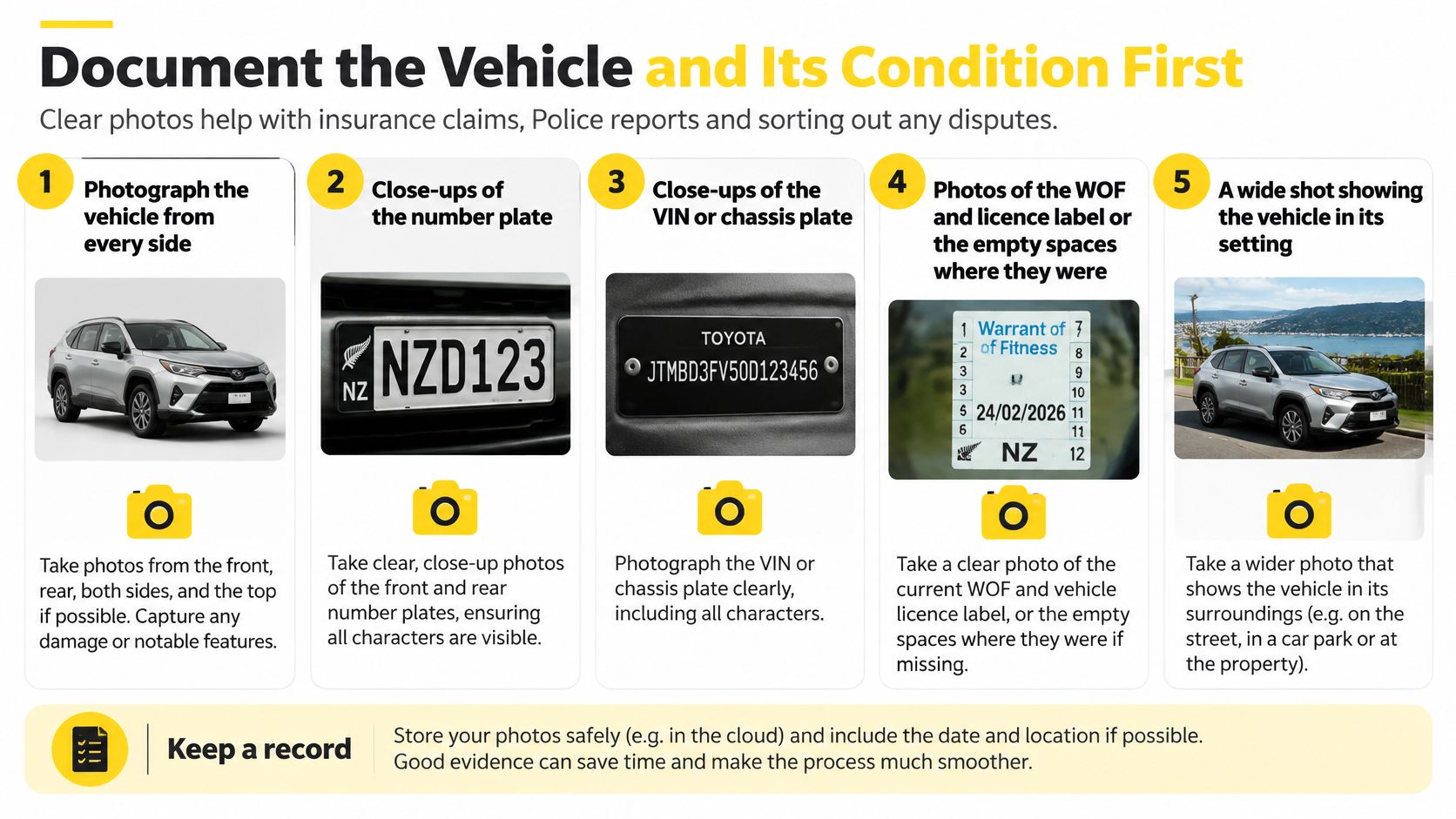
Photograph the whole vehicle and its identifiers. Take every side, then close-ups of the plate, VIN or chassis plate, WOF and licence label. Photograph empty mounting spaces where identifiers are missing. A VIN visible through a dusty windscreen is useful, but don't force entry to find one. Include wide shots showing the driveway, paddock or shared parking area.
Record dates and contact attempts. Note when you first noticed the vehicle and when each inspection occurred. If you don't know when it arrived, say so rather than guessing. Save messages in their original form, including a former tenant's promise to collect it.
Describe condition without exaggeration. Record flat tyres, missing wheels, rust holes, stripped trim, broken glass and visible fire or flood damage. Note whether you know it rolls and steers, or whether that remains untested. “Front wheel missing” helps a loader; “absolute wreck” doesn't.
Write down the vehicle details. Record make, model, year if known, colour and registration plate number. Mark uncertain details as unconfirmed. A badge and a guessed year aren't enough to identify a vehicle reliably.
Flag hazards from a safe distance. Photograph leaking fluid, unstable blocks or obvious battery damage without crawling underneath. Note fuel smells, scorched areas and exposed wiring. Don't touch orange high-voltage cables or attempt to investigate a damaged traction battery.
Keep everything together. Use a dedicated phone album and a dated note, with copies of correspondence stored alongside them. Give photographs meaningful filenames if several similar vehicles occupy the same property.
Photograph access as well as damage
A close-up of a rusty guard won't show whether a truck can reach the car. Include the entrance, tight corners, overhead branches, slopes and the ground between the gate and vehicle.
Practical rule: Photograph what you can observe safely. Don't move, dismantle or enter the vehicle just to make the evidence file look complete.
A clear file turns a vague complaint into something a remover, council officer, legal adviser or insurer can assess. It won't eliminate every question, but it gives people useful answers instead of impressions.
How to Confirm You Have Authority to Remove It
Treat authority as a chain of evidence, not a verbal assurance. Your right to manage the land, the vehicle owner's rights and the proposed destination all need to fit together.
NZTA's legal and statutory guidance identifies section 356 of the Local Government Act 1974 as the basis for abandoned-vehicle removal from roads. Its road procedures don't supply a blanket private-property disposal power, and abandonment isn't established by one universal waiting period.
Work through the authority chain
Establish your right to act for the property. Keep the relevant title, lease, management agreement or body-corporate authority available. If you manage the site for someone else, obtain their written sign-off. Check whether the proposed action is within your actual authority, not merely convenient.
Identify the vehicle's registered person and legal owner where possible. Seek information through the appropriate NZTA process rather than assuming personal details are publicly available. Registration information is a tracing lead, not conclusive proof of legal ownership. Missing plates may require Police assistance or tracing through other identifiers.
Send a specific written notice. Include the vehicle description, location, observed condition and your contact details. Ask the recipient to collect it or provide written instructions by a clear response date. Keep delivery evidence and record unsuccessful contact attempts.
Resolve finance and theft concerns. Search the Personal Property Securities Register, or PPSR, for a security interest, and check suspected theft with Police. Don't treat a clear finance search as proof that the person offering the car owns it. A financed or reported-stolen vehicle isn't something a landlord can authorise for scrapping.
Obtain authority for the actual transaction. The legal owner can book the removal themselves or authorise someone in writing to sell the vehicle. State whether the authority covers collection, sale and dismantling, and identify who is entitled to payment.
A deadline isn't permission
You might propose ten working days as a response window in a straightforward case. That's an administrative example, not a statutory private-land disposal deadline, and silence at the end of it doesn't create ownership.
When ownership or consent is unresolved, waiting a week can be cheaper than an unlawful tow that turns a nuisance into a conversion claim.
For abandoned vehicles, we need the registered owner's authorisation or evidence that the correct disposal process has been followed. The seller must be the legal owner or hold their written authority to sell; property-owner approval alone doesn't establish that right.
If the owner can't be found, obtain advice on the applicable lawful process before proceeding. No signed authority or documented lawful basis, no tow. A phone call isn't proof.
How to Arrange Compliant Collection
Choose the loading method around the vehicle and site, not the other way round. A truck suitable for a rolling car on concrete may be wrong for a wheel-less shell across wet grass.
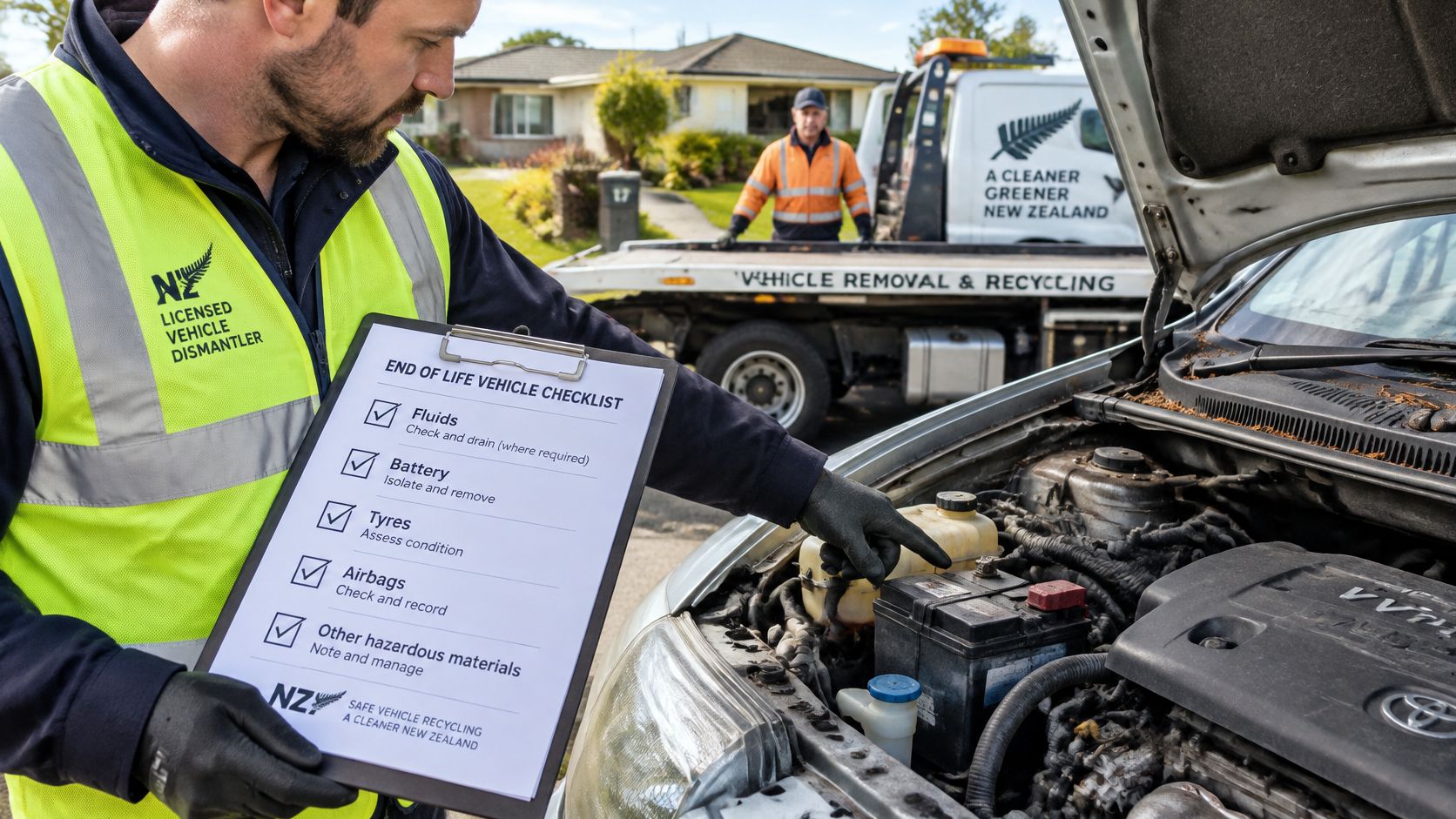
As a licensed vehicle dismantler, we handle fluids, batteries, tyres and airbags through compliant processes. For a vehicle destined for dismantling, collection needs to lead into responsible treatment, not relocation to another yard.
Get the quote inputs right
What to have ready before you request collection
| Item | Example | Why it matters |
|---|---|---|
| Vehicle details | Make, model, year, plate number and whether it runs, rolls or is stuck | Drives the quote and the right tow truck |
| Exact location and access | Rear paddock, single gate, soft ground after rain | Determines loading equipment and safety |
| Ownership evidence | Signed owner authority, your ID, registration papers if available | Lets the remover assess lawful collection |
| Condition notes | Stripped shell, no wheels, strong fuel smell | Flags hazards and possible quote adjustments |
| Items already removed | Personal items, tow bar, plates you are keeping | Nothing left inside should be treated as recoverable after pickup |
Explain gate clearance, slopes, soft shoulders and how close the tow truck can get. Photographs are particularly useful where a vehicle sits behind a building or fence. Our broken-car collection guide covers preparation for vehicles that can't be driven onto a truck.
Our phone quote is firm when the vehicle matches its description. If major parts are missing or truck access materially differs from what was described, the quote may be revised. You can decline that revision, and the vehicle stays where it is at no cost.
Prepare for a controlled handover
Remove personal belongings, aftermarket accessories you're entitled to keep and any licence plates being retained before pickup. Check the boot, glovebox and storage compartments. We're not responsible for items left inside after collection, so don't rely on retrieving something once the truck has gone.
The customer must provide safe, legal access. We're not liable for pre-existing damage to driveways, lawns, fences or surfaces where access is constrained. Photograph vulnerable surfaces and agree on a workable loading route rather than assuming a heavy truck can cross a soft lawn without consequences.
No wheels, keys or brakes doesn't automatically prevent collection. It changes the equipment and loading plan, so disclose it at booking rather than at the gate.
At handover, have the authorised person available with the paperwork. We pay before loading by cash or instant bank transfer, then complete the agreed collection process. Payment belongs to the person entitled to sell, not automatically to whoever owns the land.
How to Complete Ownership Notifications
A cleared driveway isn't the end of the job. If the vehicle record hasn't been updated appropriately, the last registered person may still receive enquiries about it, and the property manager may struggle to explain where it went.
Close the administrative loop
Complete the appropriate NZTA notification at pickup. We complete ownership notifications on site. Confirm the vehicle details and recipient are correct, and retain confirmation before treating the handover as finished. Our NZTA registration and change-of-ownership guide explains the notification process. Registration administration doesn't replace proof of legal title.
Understand what deregistration means. According to NZTA's register and records guidance, cancelling registration leaves the vehicle record marked deregistered rather than deleting it, and registration and licensing documentation must be retained for at least 20 years after becoming inactive before transfer to Archives. That continuing record is why accurate identifiers matter even for a dismantled wreck.
Store the complete removal file. Keep signed authority, notice copies, photographs, the accepted quote, receipt and pickup date together. Record the collecting business and what happened to the vehicle. Save a copy somewhere other than the phone used to take the photographs.
Close any insurance or salvage questions. If an insurer retained salvage rights, settle those rights before the vehicle leaves. We handle deregistration paperwork for accident and insurance write-offs, but administrative assistance doesn't override an insurer's entitlement to the salvage.
Account for the plates. Follow the agreed retention or return arrangement and note it in the file. Plates you intend to keep must already be removed before loading. Don't leave that decision until the vehicle is secured on the truck.
Keep evidence of completion
The receipt should identify the vehicle clearly enough to match it to your photographs and authority documents. For a site containing several similar wrecks, avoid a generic description that leaves you unable to distinguish them later.
Once the appropriate register action is confirmed, payment and receipt are recorded, and the file is stored, the routine clearance administration is complete. Retain the documents so a later query can be answered with evidence rather than recollection.
Special Cases That Change the Process
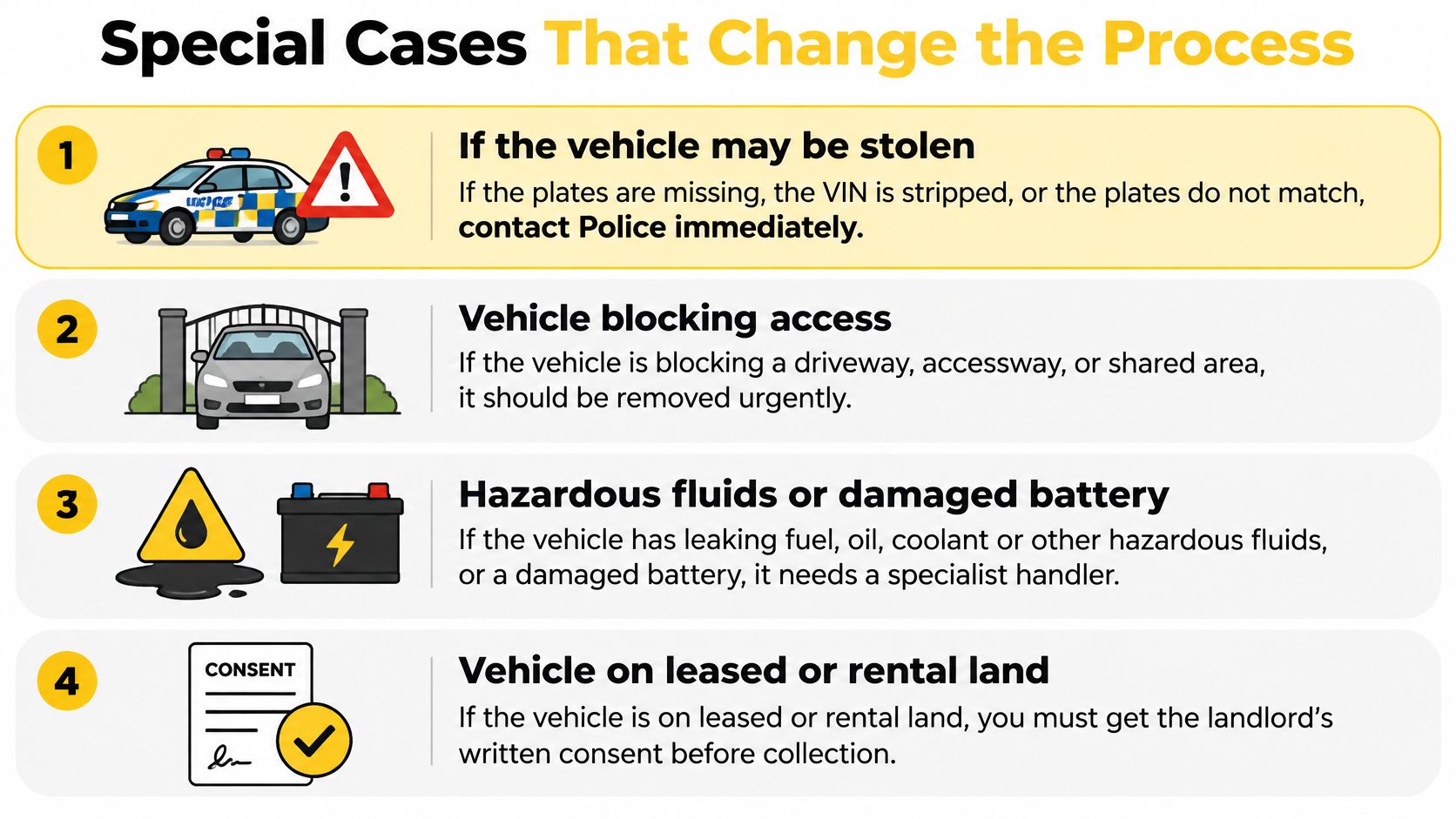
Suspected theft needs the quickest escalation, not the quickest tow. Missing identifiers, mismatched plates or signs of tampering justify stopping the collection process and contacting Police. Don't move the vehicle or disturb potential evidence.
A hazardous vehicle also needs a different response, but urgency doesn't make improvised handling safe. Keep people away from leaking fuel, an unstable shell or a damaged battery, and seek emergency assistance if there's immediate danger.
Untraceable owners and hazardous vehicles
An unanswered notice is evidence of attempted contact, not a disposal licence. Auckland Transport's abandoned-vehicle process includes ownership tracing, Police notification and formal disposal steps. Those public-sector procedures illustrate why identification matters, but their deadlines aren't a shortcut for private landowners.
For an untraceable owner, retain the notice history and property-owner authority, then establish the correct legal disposal basis. A licensed dismantler needs that basis before accepting a vehicle for destruction.
We don't purchase vehicles subject to finance, an active security interest or a stolen-vehicle report. Resolve those interests through the appropriate financier or Police process before offering the vehicle for sale.
Fire damage, flood damage and leaking fluids should be disclosed when arranging collection. Hybrids and EVs require safe high-voltage isolation and suitable loading equipment; don't attempt to isolate a traction battery yourself. Our guide to vehicle disposal in New Zealand explains the wider disposal considerations.
Rural access and shared land
A bogged vehicle, a shell in a paddock or a car behind a fence needs an access plan rather than an assumption that it can't be collected. We remove vehicles in those situations, but the booking needs to describe the obstruction and ground conditions accurately.
For a farm clean-up, identify each car, van, ute, 4WD, light truck, bus or machine separately. A single owner's consent shouldn't be assumed to cover every vehicle scattered around a property.
On body-corporate land, obtain the proper committee or delegated approval for the common area. A resident's complaint doesn't establish the body corporate's authority to sell another resident's car.
Avoid these mistakes:
- Moving it onto the roadside. Don't try to turn a private-property problem into the council's responsibility.
- Selling or stripping it prematurely. Valuable parts don't become yours because the vehicle looks neglected.
- Ignoring a leaking shell. Restrict access and arrange safe assessment before fluids spread into surrounding soil.
Your Next Step to a Lawful Removal
Document the vehicle, establish written authority and resolve theft or finance concerns with Police or the financier before booking collection. Then use a licensed remover, agree on safe access and finish the appropriate NZTA notification at handover.
Your next useful action is to assemble the photo file and ownership evidence. If either is incomplete, deal with the missing information before trying to secure the fastest pickup.
Have a collection-ready file
When you call, have these details ready:
- Vehicle identity: Make, model, year and registration plate.
- Loading condition: Whether it runs, rolls, steers or is stuck.
- Site details: Where it sits and how the tow truck can reach it.
- Authority documents: Who owns it, who can sign and what disposal authority is available.
Car Removals Whangarei is a licensed dismantler based on Kioreroa Road, serving landlords, property managers, body corporates and farms across Northland. We can clear multiple authorised vehicles in one visit, with same-week clearance available.
Pickup is available the same day for most Whangarei addresses and within 48 hours across wider Northland, with NZTA ownership notification completed at pickup. Getting the evidence and access details ready makes it easier to match that booking to the actual job.
Authority first, tow second, paperwork the same day. That's the whole job.
Car Removals Whangarei provides abandoned-vehicle clearance once owner authorisation or evidence of the correct disposal process is in place. Gather your photographs, vehicle details and authority documents, then visit Car Removals Whangarei to arrange a lawful collection from your Northland property.
- abandoned car on private property
- abandoned vehicle removal
- NZTA notification
- car removal Whangarei
- vehicle disposal