· Car Removals Whangarei
Sell My Ute in Whangarei: A Step-by-Step Guide
Your ute's parked beside the shed, the WoF has become a repair list, and you're wondering whether it's worth fixing or time to sell. Maybe it still drives, but the rust is getting ahead of you. Maybe the engine won't turn and you don't fancy paying to get it into Whangarei just to hear an offer.
If you're searching for “sell my ute”, start with what's on the vehicle, what paperwork you hold and how it can be collected. A useful offer accounts for reusable parts, recoverable metal and handling risk. A clean handover also needs more than a tow truck and a payment, because getting the ute off your property isn't the same as updating the NZTA record.
Table of Contents
- What Drives Your Ute's Price
- Gather the Paperwork Before You Call
- Towing, Rural Pickups and High-Voltage Safety
- Compare Offers and Hand Over Safely
What Drives Your Ute's Price
| Component | What the buyer checks | How it moves the offer |
|---|---|---|
| Engine and drivetrain | Running, seized or blown | A complete drivetrain has resale potential; a seized unit cuts the figure |
| Transmission and differential | Present, intact, leaking | Each resaleable unit adds value |
| Turbo and fuel system | Present and working | Turbo and injectors can resell separately |
| Catalytic converter | Present or missing | A missing unit adds compliance cost and lowers the offer |
| Chassis | Rolling, liftable or needs winching | Winching adds tow time and labour |
| Panels and body | Rust, crash or flood damage | Clean panels resell; heavy damage reduces value |
| Wheels and tyres | Full set, matching, usable | A complete usable set lifts the price |
| Airbags and battery | Present, deployed, or battery sound | Deployed airbags need careful handling; a sound battery adds value |
Read the table as an inspection checklist, not a promise that every component earns a separate payout. A buyer needs to establish whether a part is usable, whether someone wants it and what removing it will involve. An intact gearbox is more useful than one with a cracked casing, even when neither ute starts.
Reusable parts explain why a non-running ute can still carry material value. A blown engine doesn't automatically ruin the transmission, differential, tray, doors or wheels. However, complete doesn't mean tested, so describe what you know rather than calling every attached component good.
Parts value isn't the whole calculation
Recoverable metal provides another part of the valuation, particularly when the ute has little repair or parts potential. Disposal and logistics risk then affects what the buyer can pay after loading, transport and safe handling.
A stripped shell, missing drivetrain, heavy flood contamination or badly bent chassis leaves less to recover and more work to do. Don't compare that offer with an advertised retail price for a tidy, roadworthy ute. Our guide to online car valuation explains why the vehicle's actual condition matters more than an attractive listing.
There's also an administrative cost to leaving a vehicle unresolved. NZTA's selling-a-vehicle guidance says a vehicle that is no longer roadworthy must be deregistered, while an unlicensed vehicle can accumulate licensing fees. Resolve those obligations or have their treatment recorded explicitly in the written agreement.
Practical rule: Describe missing parts before discussing price. A complete ute and a shell wearing the same number plate aren't the same purchase.
Before calling, write down the make, model, year, rego and rough condition, then collect useful evidence:
- Photograph the underside and tray: Take pictures from a safe position, without crawling beneath an unsupported vehicle.
- List accessories: Identify the canopy, racks, toolbox and other equipment included.
- Record warning lights: Photograph the dash if it's safe to power up, and distinguish a warning from a confirmed diagnosis.
Gather the Paperwork Before You Call
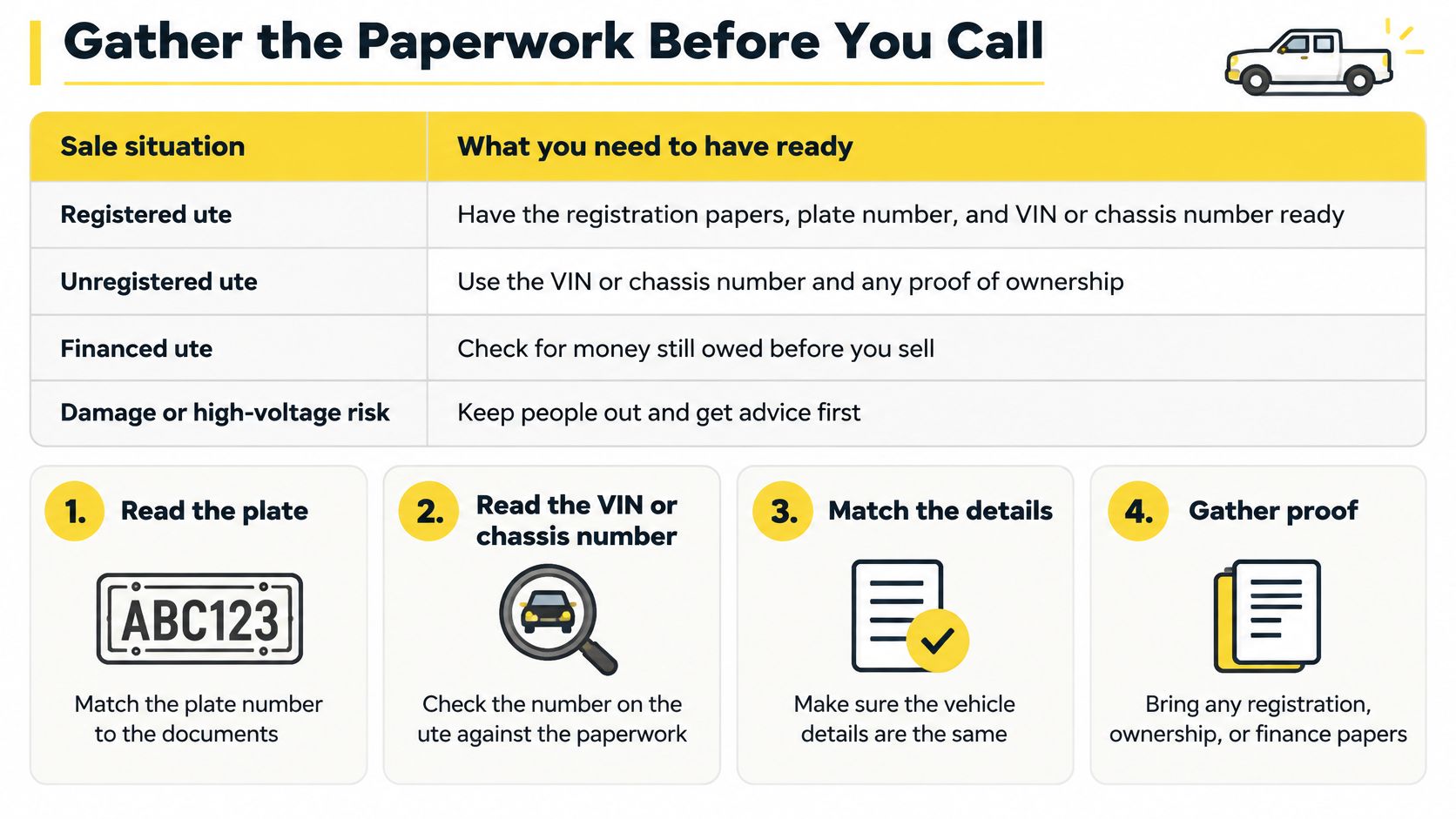
| Ute situation | Documents to hold | Extra check |
|---|---|---|
| Registered and roadworthy | Signed sale receipt, proof of payment, buyer name and address | Complete the NZTA change-of-registered-person notice straight away |
| Diesel with RUC owing | Current distance licence or written RUC agreement | Confirm RUC status in writing before the price is set |
| Not roadworthy or deregistered | Signed receipt and itemised written offer | Deregistration is required before disposal |
| Hybrid or EV | Battery condition record, warning light and crash or flood history | Establish how high-voltage isolation will be handled at pickup |
Get the documents together before agreeing to collection. Missing paperwork is easier to resolve while the ute's still beside your shed than when someone is waiting to load it.
Check identity before signing
- Read the plate and VIN or chassis number. Match the identifiers on the ute against the registration documents. Don't copy an old advertisement or assume the paperwork in the glovebox belongs to this vehicle.
- Check the registered-person details. Establish who's recorded and who has authority to sell. If you're handling an estate, business vehicle or someone else's ute, gather the relevant authority before making commitments.
- Write down the agreement. Record the price, disclosed condition, included accessories, keys, odometer reading and treatment of outstanding licensing or Road User Charges.
- Keep evidence of the sale. Retain a signed receipt and proof of payment, rather than relying on a text message saying collection is complete.
The distinction between registered person and legal owner matters. NZTA's vehicle-ownership guidance distinguishes registration responsibility from legal ownership and sets out the notification responsibilities when a vehicle changes hands. A registration update doesn't replace evidence that you were entitled to sell or that the agreed payment was made.
For a financed ute, establish what's still owed and how it will be settled before accepting a disposal arrangement. Don't let an unclear finance position become the buyer's discovery at pickup.
Settle RUC and disposal details
For a diesel ute, compare the odometer with the distance licence. If the licence isn't current, put the agreed treatment of outstanding RUC in writing before settling the price. A vague promise to sort it later leaves room for disagreement.
If deregistration is needed, arrange it before disposal rather than treating removal as the administrative step. An as-is sale isn't a substitute for completing the applicable duties.
Prepare a handover folder with:
- Vehicle evidence: Plate details, VIN, odometer photograph and condition photographs.
- Sale evidence: Written offer, signed receipt and payment confirmation.
- Notification details: Buyer's full name and address, with your identification ready.
Our NZTA registration change-of-ownership guide can help you prepare for the online transaction without scrambling for details beside the tow truck.
Towing, Rural Pickups and High-Voltage Safety
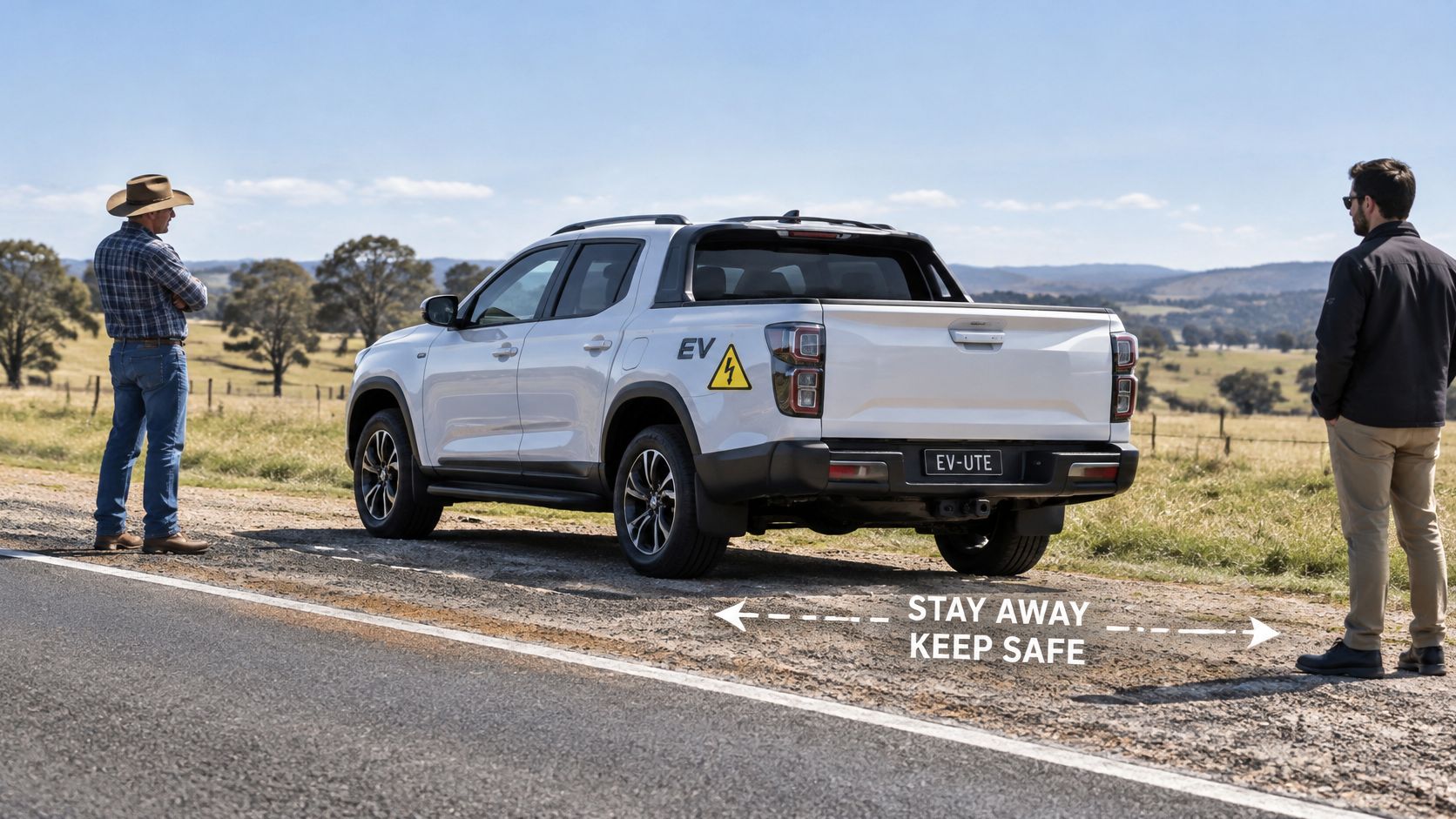
A damaged hybrid or electric ute needs a safety assessment before normal selling habits apply. After a crash, flood, fire, overheating event or battery fault, keep people out of the battery area. Don't jump-start it, open the battery enclosure or attempt to dismantle high-voltage components.
NZTA's electric and hybrid inspection guidance identifies insecure, damaged, deteriorated or leaking batteries and missing protective shields as rejection issues, and directs that vehicles with high battery temperature be removed from indoor premises, switched off and referred for diagnostics. Don't attempt to move a hot or damaged vehicle yourself if doing so exposes you to danger. Keep clear and seek urgent specialist help, particularly if there's smoke or an immediate fire risk.
Tell the buyer in writing about warning lights, battery faults and crash or flood history. Where practicable and safe, keep the vehicle outside and away from ignition sources while a qualified person determines the next step.
Battery condition changes the handling decision
A damaged electrified ute isn't automatically worthless. Electronics, drivetrain components and an assessed battery may contribute value, but safe isolation and loading come first. Don't accept a conventional scrap-weight discussion as an answer to a high-voltage safety question.
Our hybrid and EV collection process includes high-voltage isolation. Disclose the vehicle's condition before collection is arranged so the handling plan accounts for the actual fault, rather than just the badge on the tailgate.
Rural access needs an honest description
For a conventional ute that can't safely or legally be driven, plan collection rather than trying to nurse it into town. Northland recorded 22,093 inspection-related events in July 2025, according to NZTA's National Vehicle Fleet Inspections dataset. That's inspection activity, not a count of scrapped vehicles, but it shows the scale of regional compliance decisions.
Say a farm ute has failed its WoF, seized its engine and ended up parked in a paddock away from town. The loading problem isn't just the dead motor. Soft ground, locked steering, flat tyres and a narrow gate can stop a straightforward collection.
Use this access checklist:
- Clear the route. Move implements, secure livestock and provide any gate code.
- Mark the location. Send a map pin and photographs of the entrance, track and parking position.
- Describe movement accurately. State whether the wheels roll, the steering turns and the chassis is accessible for lifting or winching.
- Confirm loading arrangements. Tell us before booking if it's non-rolling or blocked in, so suitable equipment can be arranged.
A photograph of the access track can be more useful than saying the ute is easy to reach.
Winching adds labour and tow time, so disclose it before the figure is agreed. Our scrap-car collection guide gives further preparation advice for vehicles that won't move under their own power.
Compare Offers and Hand Over Safely
Compare firm written offers on the same basis, not the biggest number someone mentions on the phone. The agreement should identify the ute, the included components and accessories, removal responsibility, payment timing and any conditions that could change the figure. A verbal estimate or unexplained weight-only quote isn't equivalent to an itemised purchase offer.
A private sale may suit a roadworthy ute if you're prepared to manage advertising, inspections and negotiation. A dealer offer may fit when you're replacing it. A removal quote suits a different problem, particularly when repair, transport or storage makes keeping the vehicle inconvenient.
If you already hold an insurance salvage bid, use it as a benchmark rather than assuming it's the only available outcome. We often pay more than an insurance salvage bid, particularly on late-model utes, 4WDs and European cars, and comparing our number against an existing offer costs nothing. Give us the make, model, year, rego and rough condition, and we can provide a firm cash figure in about two minutes on the phone.
Compare what you'll actually receive
Check the treatment of the drivetrain, catalytic converter, agreed accessories and any outstanding RUC. An offer that assumes a complete vehicle needs correcting if the engine has already been removed. Equally, a buyer shouldn't discover that a canopy shown in the photographs isn't included only when arriving to collect.
Separate the headline amount from any proposed deductions. Establish whether towing is included, whether the figure is conditional on inspection and whether payment occurs before loading. Don't agree to an open-ended right to reassess the price once the ute's already on the truck.
Our quote can be revised if the vehicle differs materially from the description, such as major parts being missing or a tow truck being unable to access it. You may decline a revised offer, and the vehicle is left where it is at no cost. Accurate photographs and a frank description help prevent that situation.
Before handing over keys: Resolve any price change while the ute is still unloaded and you still control the decision.
Follow a controlled collection-day sequence
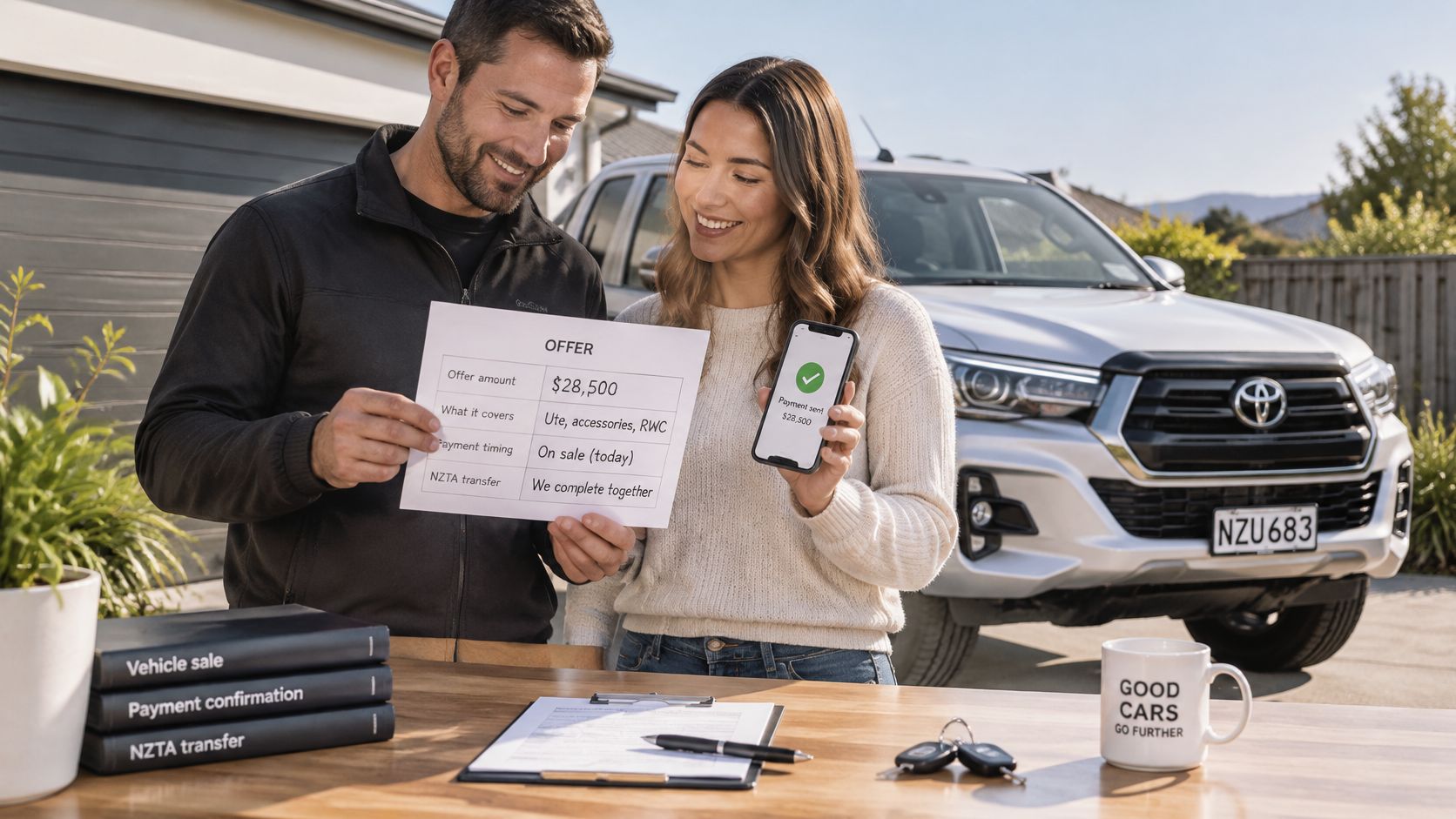
Have the itemised offer before booking the tow. Keep it accessible on your phone or printed with the receipt. If condition or access has changed since the quote, disclose that before the collection vehicle is dispatched.
Remove what isn't part of the sale. Empty the glovebox, door pockets, console, under-seat spaces and tray toolbox. Remove aftermarket accessories you're keeping and any licence plates you intend to retain, arranging the appropriate plate process rather than assuming they transfer to another vehicle. We aren't responsible for belongings left inside after collection.
Photograph the handover condition. Capture the odometer, VIN plate and the vehicle from each side, with the date visible or recorded in the pickup record. Include the tray and any existing damage. These photographs should show what was handed over, not just the flattering angle used to request a quote.
Confirm payment before releasing keys. We pay at pickup, before the vehicle is loaded, by cash or instant bank transfer at your choice. There are no hold-backs and no cheques in the post. For a transfer, check your own banking app for receipt rather than accepting a screenshot from the sender as proof.
Complete the NZTA notification at collection. NZTA's selling-a-vehicle guidance requires both buyer and seller to notify the agency, with the seller transaction completed straight away; the online seller notification needs a New Zealand driver licence and the buyer's full name and address. We complete the notification with the customer at pickup, so have those details ready.
Keep the completed record. Save the signed receipt, payment evidence, dated photographs and NZTA confirmation together. Check that the vehicle identifier and buyer details are correct before filing them away.
Don't leave the registration update until later
The notification matters, not just the tow truck leaving. An agreement that someone will sort the papers back at the yard leaves you without confirmation at the moment the ute departs. Complete your seller transaction rather than relying solely on the buyer's promise to update their side.
That registration step addresses the liability gap that's easy to overlook when the main concern is clearing space. It doesn't erase earlier obligations or replace the receipt, but it records the disposal instead of leaving the ute associated with you unnecessarily.
Never release keys on a verbal promise of payment or paperwork. If the buyer's identity, payment or notification can't be confirmed, pause the loading and resolve the issue while everyone is present. A proper handover should leave you with the agreed money and a usable record, not another job to chase tomorrow.
Car Removals Whangarei offers ute removal with a firm quote and payment before loading, by cash or instant bank transfer. Have your make, model, year, rego and rough condition ready, then visit Car Removals Whangarei to arrange a written quote and discuss collection from your Northland property.
- sell my ute
- sell ute Whangarei
- ute valuation NZ
- NZTA ownership notice
- ute removal Northland