· Car Removals Whangarei
Scrap Yards Near Me: What Northland Owners Need to Know
The car's been sitting beside the garage since its last failed WOF. Or there's a ute behind the shed that won't start, and you need the space back before another winter. Searching for “scrap yards near me” gets you plenty of promises about cash and towing, but the important questions are what you'll receive, how the truck will reach it, and who completes the paperwork.
Free removal isn't a completed legal handover. You need an agreed payment, a safe collection and a documented NZTA transaction, not just an empty driveway.
Table of Contents
- Which Vehicles Scrap Yards Accept and What to Prepare
- How Scrap Car Quotes Are Worked Out
- What Happens to Fluids, Tyres and the Shell
- How Towing and Pickup Work Across Northland
- Proof of Authority and Paperwork Before the Tow Truck Arrives
- Compare Quotes and Book Your Scrap Yard Removal
Which Vehicles Scrap Yards Accept and What to Prepare
Vehicle types scrap yards accept and what to prepare
| Vehicle type | Accepted | Handling before pickup |
|---|---|---|
| Sedans, hatchbacks, wagons and people movers | Yes, running or not | Confirm plates and papers |
| Rusted, stripped or seized cars | Yes, including non-rolling shells | Note whether the car rolls |
| 4WDs, utes and vans (Hilux, Ranger, Navara, Hiace) | Yes, including blown motors and rusted chassis | Note drivetrain and engine condition |
| Trucks, buses and machinery | Yes, after on-site assessment | Confirm loading equipment and weight |
| Hybrid and EV | Yes, with high-voltage isolation | Declare battery condition |
| Accident and insurance write-offs (hail, flood, fire) | Yes, with deregistration paperwork | Prepare insurer documents and registration status |
We buy all makes and models in any condition, including running or dead, registered or not, crashed or rusted. A seized engine, missing wheels or expired registration doesn't automatically rule a vehicle out. The preparation changes with the vehicle, especially when it can't steer, roll or be reached by a normal tow truck.
For an ordinary passenger car, locate the keys, registration details and any purchase or insurer documents you hold. Remove personal belongings from the glovebox, boot and under the seats. Don't forget toll tags, garage remotes and anything tucked into the spare-wheel well.
Prepare for the loading method
A Hilux with a blown motor is a different collection from a stripped hatchback resting on its floorpan. Tell us whether the steering is free, the handbrake releases and the wheels turn. Photographs of the vehicle and its access route help identify loading problems before collection.
Tractors, diggers, buses and trucks need an assessment of their weight, dimensions and position, followed by suitable loading equipment. For hybrids and EVs, declare traction-battery damage and leave high-voltage isolation to trained handlers. Don't cut orange cables or attempt to open the battery enclosure.
Before pickup: Describe what the vehicle can physically do, not just whether the engine starts.
Car Removals Whangarei pays $200 up to $15,000 in cash per vehicle at pickup. That's the business's vehicle-purchase range, not a promise that every bare shell commands the same amount.
Find your vehicle in the table and prepare the matching details. Weight, completeness and parts demand determine what moves the quoted number.
How Scrap Car Quotes Are Worked Out
Scrap car quotes start with weight plus remaining salvage value. A heavier vehicle offers more recoverable metal, while usable components can make a vehicle worth more than its shell alone. Two yards can quote differently because they assess parts demand, metal recovery and processing differently.
A complete vehicle is generally worth more than a stripped shell. An engine, gearbox, differential or ute deck may still have resale value even when repairing the whole vehicle makes no financial sense. Catalytic converters and alloy wheels also add value because their metals are assessed separately.
Factors that move a scrap car quote
| Factor | Effect on quote | Why it matters |
|---|---|---|
| Complete car with running motor | Higher | Engine, gearbox, diff and deck, where fitted, can resell |
| Stripped or seized shell | Lower | Weight and remaining recoverable metal form the baseline |
| Catalytic converter and alloy wheels | Adds to quote | Valuable metals are priced separately |
| Empty, flat or bogged car | No charge for removal with our service | Still priced on weight and remaining parts |
A seized vehicle may still contain saleable body panels or running gear. Don't assume that a dead engine makes every other component worthless, and don't strip parts after accepting a quote for a complete car.
Why assessment quality matters
The Ministry of Transport's scrappage trial report, covering 349 removed vehicles, identified substantial variation in the environmental responsibility of vehicle dismantling and recycling businesses. Responsible processing involves more than weighing a car and crushing it.
Reusable components and recoverable non-ferrous metals need assessment before the remaining shell enters steel recovery. That work carries handling costs, but it also identifies value that a weight-only offer can miss.
Give the yard the make, model, year, drivetrain, catalytic-converter status, battery condition and rolling condition. Saying only that you have a scrap car leaves too much unknown, particularly if the vehicle has been partly dismantled.
Our scrap car valuation guide explains how those details affect an assessment. Full, accurate information on the phone makes the agreed figure much closer to what the vehicle warrants at pickup.
What Happens to Fluids, Tyres and the Shell
A complete end-of-life vehicle is hazardous waste under code 16 01 04*, becoming eligible for non-hazardous code 16 01 06 only after liquids and hazardous components are removed, according to the Ministry for the Environment's waste classification. Being destined for recycling doesn't make a complete vehicle ordinary steel scrap.
Disclose fuel, LPG or CNG equipment, damaged batteries, refrigerant systems and leaking fluids before collection. Also identify loose oil filters, undeployed airbags or damaged components that could complicate handling. Don't drain fluids onto the ground or vent refrigerant to make the car easier to move.
Separate treatment before steel recovery
At our yard, fluids are drained, and batteries, tyres and airbags are removed and handled to New Zealand environmental standards. Reusable parts go back into Northland vehicles; the bare shell is baled for steel recycling.
Tyres come off each vehicle for separate recycling. They aren't part of the steel load, and their collection and downstream handling need their own arrangements.
Tell us about leaks and LPG equipment before the truck arrives, not when the winch cable is already attached.
The NZTA registration-fee schedule lists the following tyre stewardship fees from 1 July 2025, including GST, with passenger cars and light goods vehicles charged per vehicle and larger goods classes charged per tyre.
Tyre stewardship fees by vehicle class from 1 July 2025
| Vehicle class | Stewardship fee (incl. GST) | Charged per |
|---|---|---|
| Passenger car | $38.24 | Vehicle |
| Light goods vehicle up to 3,500 kg | $76.47 | Vehicle |
| Medium goods vehicle, 3,500 to 6,000 kg | $15.29 | Tyre |
| Vehicle 6,001 to 9,000 kg | $24.47 | Tyre |
| Vehicle 9,001 to 12,000 kg | $32.12 | Tyre |
| Large goods vehicle over 12,000 kg | $32.12 | Tyre |
These are registration-schedule fees, not extra scrap-removal charges. They demonstrate why tyres have a separate stewardship pathway rather than being treated as recoverable steel. Use the table to identify the listed fee basis for each vehicle class.
How Towing and Pickup Work Across Northland
A useful collection booking establishes the location, loading conditions, payment and timing before the truck leaves the yard. Our scrap car collection guide gives further preparation details.
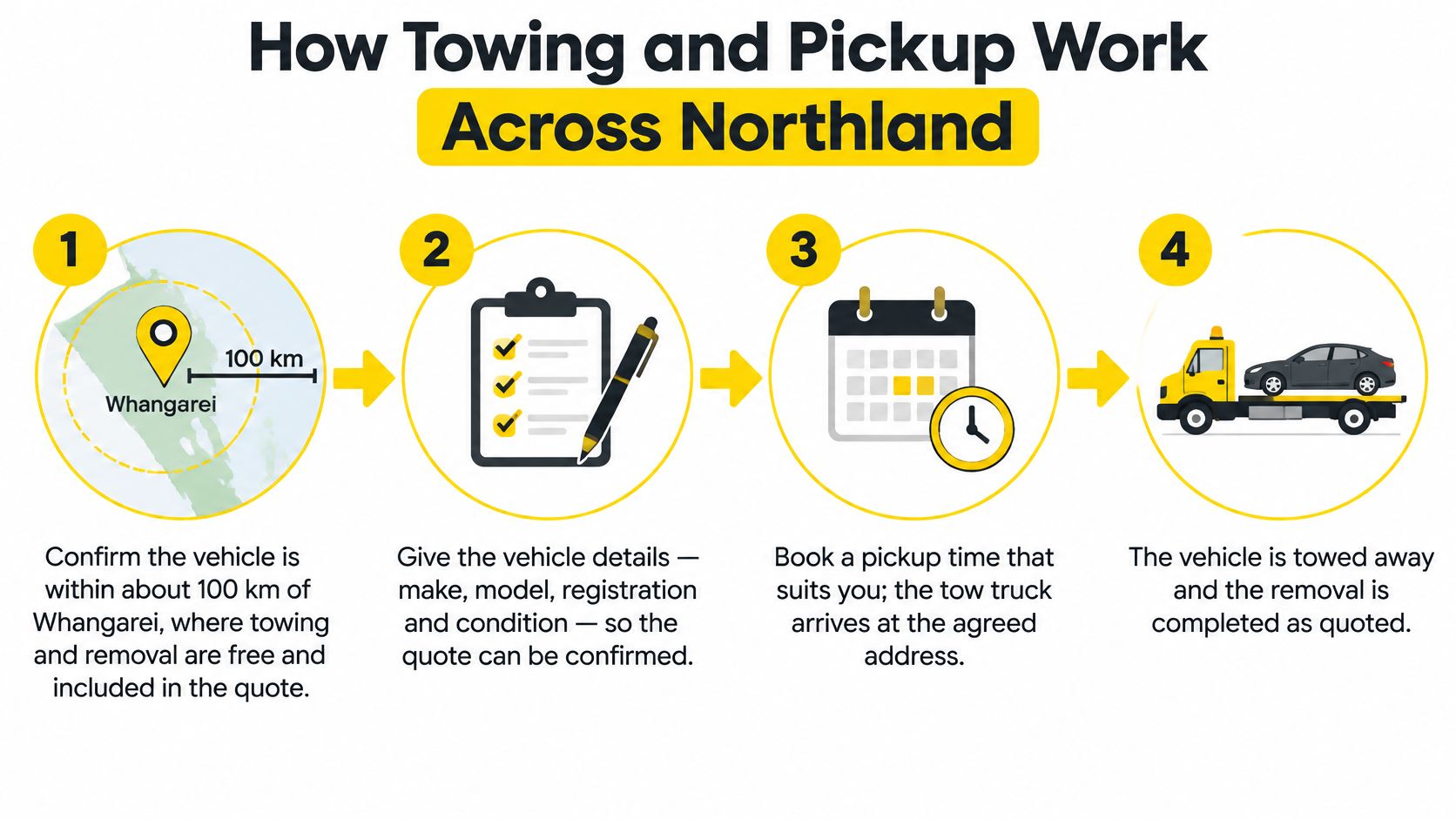
Confirm the collection address. Free towing and removal are included in our quote for vehicles within roughly 100 km of Whangarei. Give the actual vehicle location, including the rural driveway or paddock access, rather than just the nearest town.
Provide the make, model, year and condition, plus whether the car has plates and papers. Explain whether it rolls, steers or has sunk into soft ground so suitable loading arrangements can be made.
Accept the firm phone quote. We honour it at pickup without deductions, towing fees or unexpected adjustments. Accurate vehicle details let us settle the amount before either party commits to the collection.
Book the collection time and arrange access. Whangarei city pickups usually happen the same day, while rural Northland collections follow scheduled next-day runs on regular routes; urgent disposals can use our 7am to 7pm window.
Arrange release from a panel beater or holding yard. We collect damaged vehicles with a release from that yard and the registered owner's ID. Organise those documents beforehand so staff can lawfully release the vehicle when the truck arrives.
Receive payment before loading, by cash or instant bank transfer. We don't use cheques or hold-backs, so check the cash or confirm receipt of the transfer before loading begins.
Check the site and keep the receipt. We leave the site tidy, but you should still confirm that personal items and anything excluded from the sale remain with you. Retain the payment and collection record with your vehicle documents.
Finish the handover on collection day
Have the authority documents ready alongside the keys. The NZTA paperwork needs to be completed that day, rather than left as an unresolved task after the truck departs.
Proof of Authority and Paperwork Before the Tow Truck Arrives
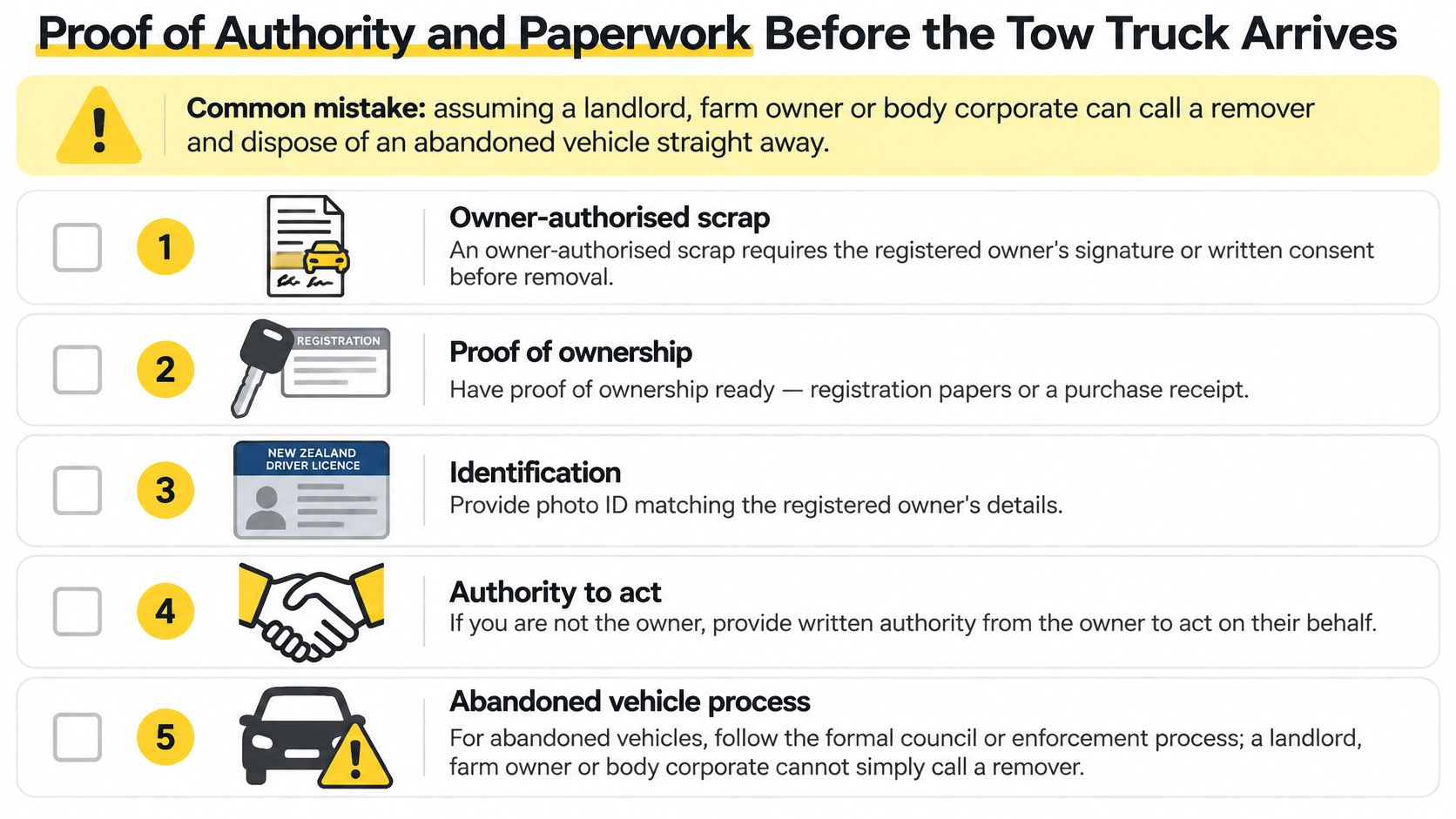
A landlord, farm owner or body corporate can't assume that a vehicle becomes theirs to scrap because somebody left it on their land. Owner-authorised collection and abandoned-vehicle clearance are different processes. Getting that distinction wrong can turn a routine clean-up into a disputed disposal.
Auckland Transport's abandoned-vehicle procedure illustrates the formal route: attempts to identify and notify the owner, advertising an intention to sell or dispose of the vehicle, and disposal only after the relevant process. It isn't a substitute for checking the appropriate Northland council or enforcement process for your situation.
Establish who can authorise disposal
A vehicle's location doesn't prove ownership. Finance interests, disputed ownership, estate administration and police matters can prevent disposal even when the car looks beyond repair.
Gather documents that explain both who owns the vehicle and why you're entitled to act:
- Ownership details: Registration information, purchase receipts and the owner's contact details.
- Written authority: Consent from the owner or authorised estate representative, with insurer or property-owner documents where relevant.
- Supporting records: Tenancy, repossession or insurance records that explain the circumstances.
- Photographs: Images showing the vehicle's location, condition and identifying details.
Property-owner permission establishes access to the land; it doesn't automatically authorise destruction of somebody else's vehicle. If ownership is disputed, resolve that issue before booking disposal.
We're a licensed Northland dismantler offering abandoned-vehicle clearance for landlords, property managers, body corporates and farms, including multiple vehicles in one visit. That service still requires lawful authority. Cars without plates or papers are accepted when the seller shows ID and confirms entitlement to sell, but missing documents don't remove that responsibility.
The checklist below helps organise an authorised handover.
Complete the NZTA transaction
NZTA's vehicle-ownership guidance says the seller must notify it immediately, the buyer must complete their transaction, and a seller must still report a sale to a wrecker, which cancels registration unless the seller does so first. The registered person isn't necessarily the legal owner, but failing to notify NZTA can leave the former registered person exposed to fees, tolls and infringements.
The disposal requirements summarised in NZTA's selling guidance include notification within 7 days for disposal of a registered vehicle, and outstanding licensing fees can still be invoiced after disposal. Treat the immediate notification guidance as your pickup-day standard, not the outer limit as a reason to delay.
Use this checklist at collection:
- Verify identity and authority to sell. Match the seller's ID to the documents and retain written authority when someone acts for the owner.
- Record the vehicle identification number, registration details and collection date. Check the identifiers against the actual vehicle, especially when several cars are being cleared.
- Collect written confirmation of payment and collection. Keep a receipt identifying the vehicle, buyer, amount and handover date.
- Complete the change-of-registered-person notification. We complete the NZTA ownership notification on site; retain confirmation using the checks in our NZTA registration and change-of-ownership guide.
- Establish who handles cancellation and plates. Don't leave responsibility unclear between the seller, insurer and dismantler.
NZTA's vehicle-selling guidance states that a vehicle no longer roadworthy must be deregistered, and a cancelled vehicle must come off the road with its number plates handed in; it can't legally return to road use until registered again. Transporting it on a truck doesn't change those administrative requirements.
Free removal is not administrative completion. Keep the notification confirmation as carefully as the payment receipt.
Correct notification helps close the registered-person responsibility gap. It doesn't erase existing debts, settle ownership disputes or provide a blanket release from every possible liability.
Compare Quotes and Book Your Scrap Yard Removal
Compare two or three quotes using the same vehicle description. An offer for a complete ute isn't comparable with an offer based on a stripped shell, and a headline payment tells you little if towing or collection terms remain unclear.
We often pay more than an insurance salvage bid, particularly for late-model utes, 4WDs and European cars. Comparing our number against an existing offer costs nothing. That doesn't mean every damaged vehicle beats its insurer's figure, but it makes a separate assessment worthwhile before you accept.
Make the decision on the whole transaction
Check that the yard is a licensed dismantler and covers your suburb or rural route before booking. Start with the collection address and towing range, then compare the net payment and documentation arrangements.
- Gather the vehicle details. Have the registration, plates if available, VIN and clear photographs ready.
- Call two or three yards with the same description, including missing components and loading restrictions.
- Confirm the final terms. Establish that the quote is firm, towing within range is included, and payment is cash or bank transfer at pickup.
- Book the collection day, allowing for same-day Whangarei city availability or scheduled next-day rural runs.
- Complete the NZTA notification on the day. Keep the written receipt and transaction confirmation together.
We turn scrap cars into cash the same week, with payment before loading. Choose the offer that combines a clear amount, workable collection and documented handover, rather than chasing a larger number that hasn't been confirmed.
Car Removals Whangarei is a licensed Northland dismantler offering firm phone quotes, payment before loading and free towing within roughly 100 km of Whangarei. Visit Car Removals Whangarei to request a quote, confirm your collection route and book removal with the NZTA notification completed at pickup.
- scrap yards near me
- scrap car removal
- Northland car removal
- scrap car quotes
- vehicle dismantler Whangarei