· Car Removals Whangarei
Salvage Cars NZ: Rules, Pricing and Where to Sell
The usual advice for salvage cars in NZ is to compare offers and take the highest payout. That skips the most important check: what is the vehicle's recorded status, and who has the right to sell it? A car that starts and drives may still need repair certification and re-registration, while an insurer may retain salvage rights after settling a claim.
Check the paperwork before agreeing to a quote, booking transport or buying a project. The useful comparison isn't damaged-car price against ordinary used-car price. It's the money you'll receive, or the total you'll spend, after release conditions, safe handling and compliance are accounted for.
Table of Contents
- Salvage Terms Explained at a Glance
- Registration and Certification Rules for Written-Off Cars
- How Salvage Payouts Are Worked Out
- Handling EV and Hybrid Salvage Safely
- Where to Sell and Which Route Fits Your Car
- Sell Your Salvage Car Step by Step and Avoid Costly Slips
- Buying a Salvage Car Safely
- Salvage Considerations for Insurers and Dismantlers
Salvage Terms Explained at a Glance
In New Zealand, salvage is a trade word for a damaged vehicle being sold rather than driven. It covers several practical and administrative states, so the word alone doesn't tell you whether a car can return to the road.
Salvage statuses and what each means for the car
| Status | What It Means | Can It Return to the Road? | What Usually Happens |
|---|---|---|---|
| Repairable write-off | Damage exceeds the insurer's repair threshold, but the car can still be fixed | Yes, after required repair certification and registration checks | Sold as salvage or repaired by the owner or buyer |
| Statutory write-off | Damage is described as unsafe or uneconomic to repair | Not without an accepted certification and re-registration pathway | Usually dismantled or sold for parts |
| Non-runner or scrap | Car cannot be driven and has little resale future | No, when sold for permanent dismantling; a non-runner alone isn't a legal prohibition | Priced on kerb weight and recoverable parts, then baled for steel |
| Deregistered or abandoned | Registration cancelled, or car left on private land | A deregistered car requires re-registration; abandonment doesn't establish road eligibility | Removed after authority to dispose of it is established |
| Flood or fire damaged | Damage to the interior, electrics or high-voltage system | Only if assessment establishes an acceptable repair and certification path | Specialist assessment before transport |
Separate the description from the decision
Repairable describes a possible outcome, not a promise that the repair makes financial sense. An insurer's decision may reflect repair labour, parts availability and the vehicle's pre-damage value, rather than an absolute inability to fix it.
Treat statutory write-off with particular care. Sellers and insurers may use different descriptions, and imported documents may use terminology from another jurisdiction. The same damage can attract different commercial descriptions, but the wording doesn't let an insurer override New Zealand's certification requirements.
Likewise, deregistered and abandoned aren't synonyms. Registration is an administrative status; abandonment concerns possession and authority to remove the car. A landlord shouldn't assume that finding a vehicle on their property makes it theirs to sell.
Practical rule: Match the vehicle's identity, recorded status and disposal authority before matching prices.
Start with these documents:
- Insurer's letter: Establish the loss decision, damage description and any retained salvage rights.
- Registration record: Match the registration plate and vehicle identification number to the actual car.
- Repair invoices: Identify completed work, replacement components and missing evidence.
If those documents disagree, resolve the discrepancy before accepting an offer. A quote for a complete repairable vehicle isn't comparable with a quote for a stripped shell carrying unresolved release conditions.
Registration and Certification Rules for Written-Off Cars
A cheap written-off car isn't automatically a bargain with some panel work attached. The compliance pathway is a separate job, and buying the vehicle doesn't establish permission to drive it.
NZTA's written-off and damaged vehicle guidance states that when a vehicle has been damaged in New Zealand, its registration should be cancelled. For a damaged or written-off vehicle, confirm the applicable cancellation position with NZTA rather than assuming its existing plates settle the matter.
The paperwork starts the process
Under NZTA's vehicle registration inspection requirements, a write-off recorded on an invoice, registration document or vehicle-history check triggers referral to a repair certifier, and body or structural damage requires the applicable structural inspection process.
The practical sequence is to establish the vehicle's identity and history, obtain the certifier's assessment, complete the prescribed repairs and inspections, then satisfy the entry and re-registration requirements. Repair certification isn't a substitute for every other registration or road-use requirement.
A deregistered car can't legally be driven on public roads unless re-registered. Don't organise collection on the assumption that a short drive from a holding yard is acceptable.
The explanation of what a statutory write-off vehicle means is useful when that wording appears in a sale description. The next question should still be whether a certifier accepts a pathway for that specific vehicle.
How the damage changes the job
- Hail-damaged ute: Establish whether the insurer recorded a write-off and whether registration was cancelled. With no structural damage, the work may centre on panels and the assessment requirements, but photographs don't replace the certifier's decision.
- Front-impact sedan with a bent chassis rail: Expect structural assessment, an agreed repair method and inspection at the stages the certifier specifies. Painting over a repaired rail before inspection can remove evidence the certifier needs.
- Flood-damaged van with electrical faults: Establish water exposure and affected systems before ordering replacement modules. A running engine doesn't clear wiring, restraints, corrosion or certification concerns.
For a buyer, obtain an initial assessment before paying for transport or authorising repairs. Actual repair certification comes after the required work and inspections, so it can't sensibly be demanded as a completed document before an unrepaired car is moved.
Keep the registration records, repair invoices and insurer letters together. Add assessment reports and photographs showing repair stages. A neat finished vehicle is much harder to assess when nobody can show what was underneath the replacement panels.
How Salvage Payouts Are Worked Out
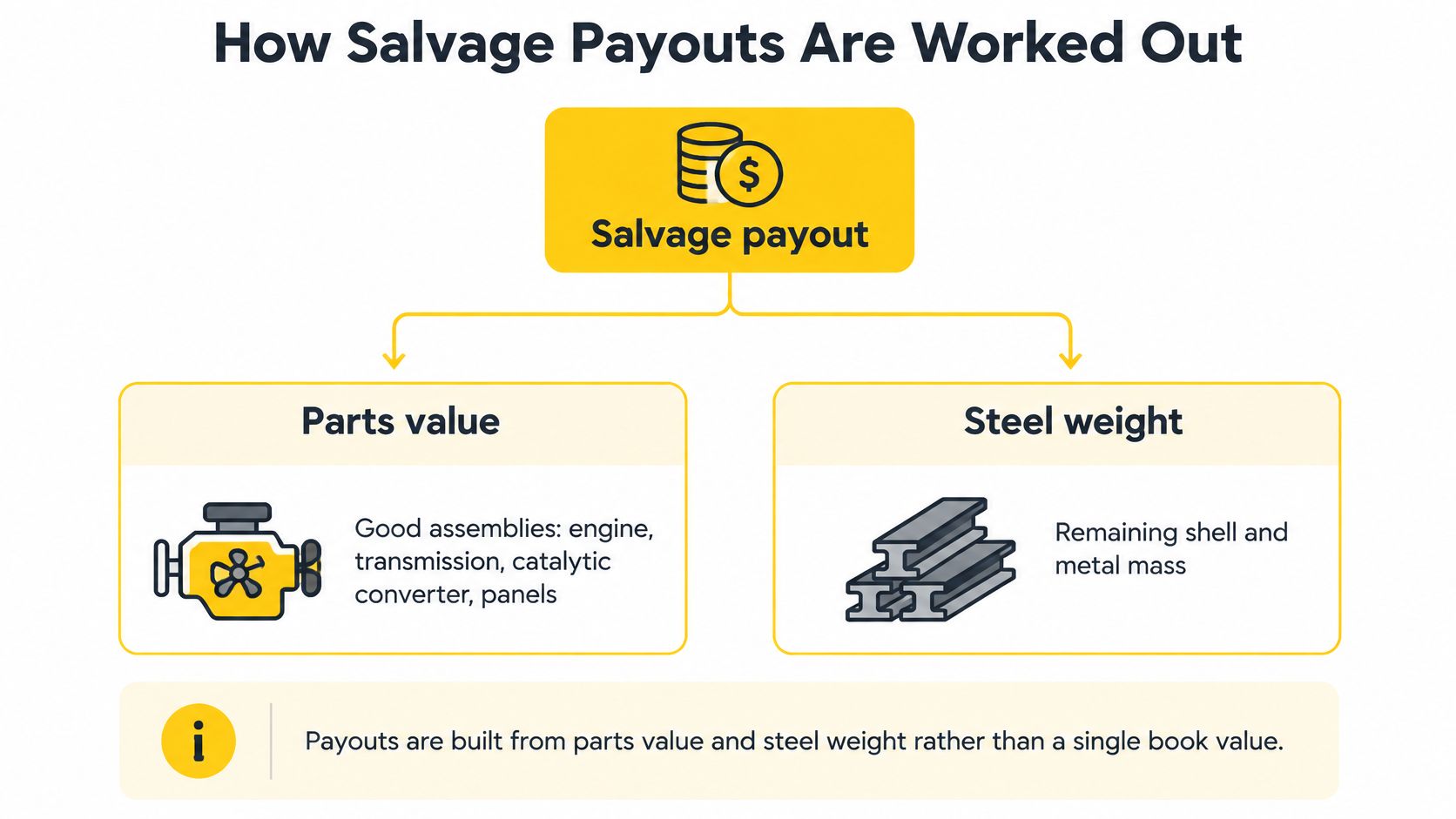
Salvage payouts are built from parts value and steel weight rather than a single book value. A dismantler evaluates what can be recovered, what buyers want and what it will cost to load, dismantle and process the vehicle safely.
The recovery order matters. Identify reusable engines, transmissions, catalytic converters, electronic modules, wheels and undamaged panels before draining and segregating fluids, removing the lead-acid battery and processing the remaining ferrous shell by weight.
Compacting first destroys reusable assemblies and makes clean material recovery harder. The Ministry for the Environment's priority product stewardship guidance identifies batteries as a priority product category because poor handling can cause fires, toxic releases and the loss of recoverable materials.
What changes the offer
- Model demand: A ute, 4WD or common sedan can offer useful assemblies, but exact model, engine and transmission compatibility matter more than the badge alone.
- Drivetrain condition: A tested gearbox has a different recovery prospect from one with unknown faults. An engine that turns over isn't automatically a saleable running engine.
- Completeness: Missing wheels, converters, modules or body panels remove potential value and may complicate loading.
- Damage location: A rear impact may leave the drivetrain intact; an engine-bay fire can affect several valuable assemblies together.
- Water and fire exposure: Components may need assessment rather than receiving ordinary reusable-parts value.
- Traction battery condition: An identifiable, testable hybrid or EV pack needs a different assessment from a damaged pack requiring specialist handling.
An insurance car valuation answers a different question from a dismantling quote. Don't expect the pre-loss market value to translate directly into a salvage payout.
An illustrative ute assessment
Say a utility has a blown engine, an intact cab and tray, and a gearbox with documented service history. This is an illustrative condition-based assessment, not a dollar estimate.
| Component | Illustrative treatment |
|---|---|
| Blown engine | Assess for rebuildable components or material recovery, not running-engine value |
| Gearbox | Assess separately for compatibility, condition and testing |
| Cab and tray | Check damage, corrosion and likely parts demand |
| Wheels and modules | Include only those present and recoverable |
| Remaining shell | Assess recoverable metal after dismantling |
Removing the wheels before collection doesn't just subtract their resale value. It can also change the loading method. Stripping the tray or gearbox after accepting a quote changes the vehicle the buyer agreed to purchase.
Before accepting, establish which parts are counted, what weight basis is used and whether the quote is firm at pickup. A kerb-weight estimate isn't the same as weighing a depolluted shell, so ask which basis the buyer means.
Handling EV and Hybrid Salvage Safely
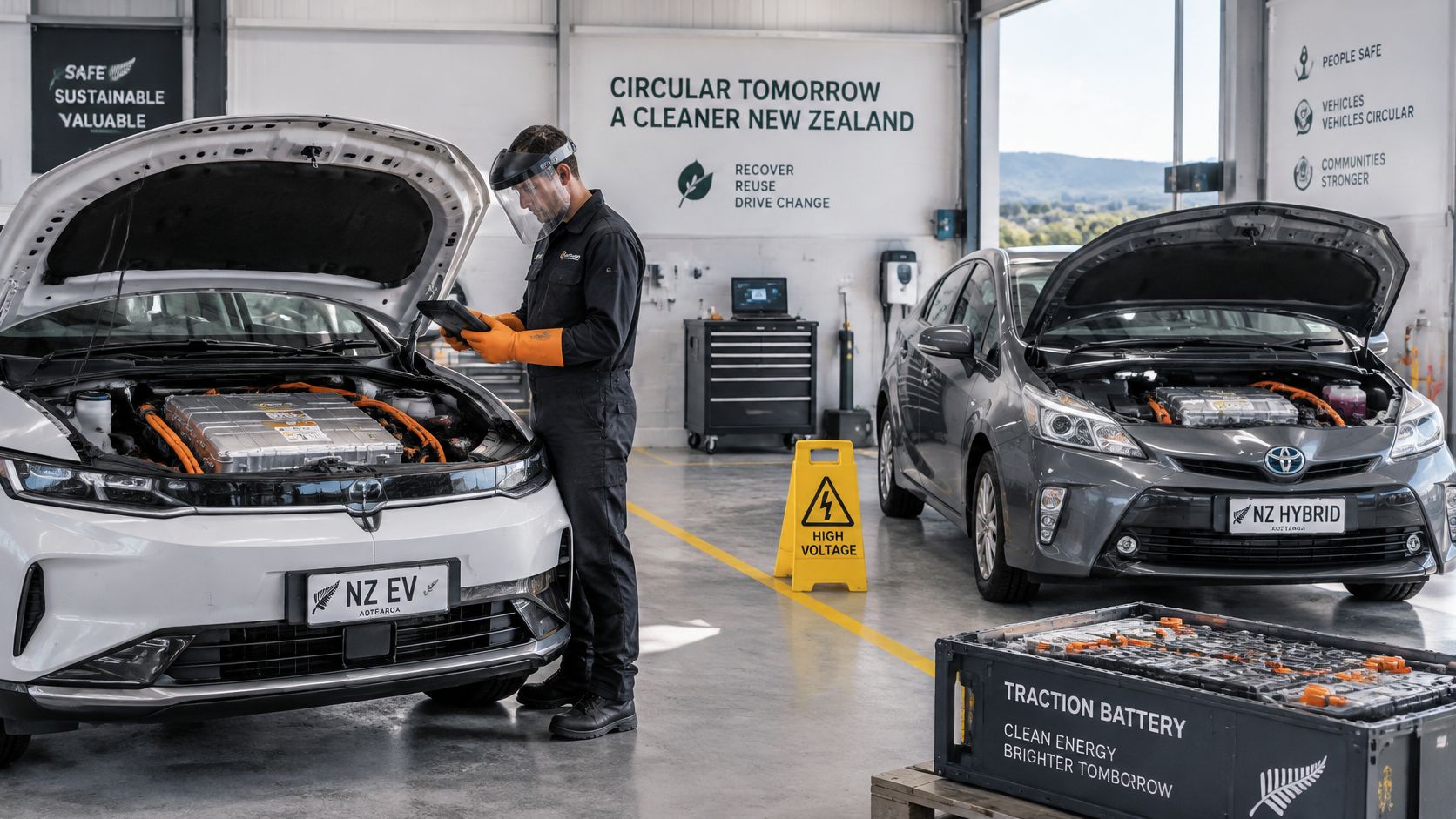
Don't treat a damaged EV or hybrid as ordinary scrap. Its traction battery stores high-voltage energy, and switching the vehicle off doesn't establish that damaged components are safe to handle.
An intact, testable battery may offer recoverable value. A crushed, swollen, burned or water-affected pack may instead require isolation, specialist loading and a suitable recycling channel. EECA's EV battery guidance explains that used batteries may have value through refurbishment, second-life storage or materials recycling.
Owner precautions before collection
- Leave damaged high-voltage equipment alone. Don't dismantle, puncture, charge or jump-start a visibly damaged high-voltage vehicle. Don't touch exposed orange cables or attempt battery isolation yourself.
- Avoid enclosed storage. Don't move a visibly damaged vehicle into a garage. Keep people away, and if it's smoking, heating or making unusual noises, move away and contact emergency services.
- Disclose the damage before quoting. Report warning lights, collision damage, flood exposure and whether the car is a hybrid or EV.
- Confirm the handling plan. The remover should establish immobilisation and manufacturer-specific isolation procedures before pickup, using someone competent to perform them.
- Supply available battery records. State-of-health information and service history help distinguish documented battery condition from an unsupported assumption.
What the handler needs to assess
NZTA's electric and hybrid inspection requirements identify insecure, damaged, deteriorated or leaking high-voltage batteries, defective shields, unsafe wiring and high-voltage coolant leaks as safety concerns in the inspection category covered by that guidance.
A handler should check battery security, wiring protection and visible leaks without treating an external inspection as proof that the pack is safe internally. Flood exposure needs particular attention even when the bodywork looks sound.
At our yard, fluids, batteries, tyres and airbags are removed and handled to New Zealand environmental standards. Reusable parts go back into Northland vehicles, and the shell is baled for steel recycling.
Battery condition changes the net payout, not just the headline parts value. A flood-damaged pack can reduce the return from an otherwise tidy car because the operator must account for the safe handling route.
Where to Sell and Which Route Fits Your Car
Salvage sale routes compared on the same criteria
| Route | Best For | Paperwork Needed | How the Payout Is Set |
|---|---|---|---|
| Insurer salvage auction | Insurance write-offs where the insurer holds rights | Insurer release and transfer documents | Bidding under the insurer's auction and release terms |
| Licensed dismantler | Non-runners, write-offs and cars with parts value | Photo ID, vehicle details, registration record where available and applicable release | Quoted from recoverable parts and steel, allowing for handling |
| Scrap metal yard | Stripped shells with little parts value | Photo ID, vehicle details and evidence of authority to dispose | Paid by accepted metal weight under the yard's terms |
| Private buyer | Running or genuinely repairable cars | Sale agreement, damage disclosure and applicable transfer documents | Negotiated against condition, demand and outstanding repair work |
| EV or hybrid specialist | Vehicles needing traction-battery assessment | Vehicle and release documents, plus battery records where available | Recoverable battery value balanced against damage and handling costs |
An insurer auction gives access to competitive bids, but the seller must work within the insurer's rights and release arrangements. A dismantler evaluates reusable components alongside the shell and needs suitable processes for fluids, batteries and tyres.
A scrap yard is a more direct fit for a stripped shell than for a complete vehicle with saleable assemblies. Private sales may produce a higher price for a genuinely repairable car, but the seller takes on enquiries, inspections, disclosure and the risk of a buyer misunderstanding road eligibility.
Choose by the vehicle's actual situation
Insurance write-off: Get the insurer's release position first. Car Removals Whangarei is a licensed Northland dismantler, and we often pay more than an insurance salvage bid, particularly on late-model utes, 4WDs and European cars; comparing our number against an existing offer costs nothing.
Non-runner or rusted car: Use a parts-and-weight assessment rather than advertising it as an easy repair without evidence. We accept scrap cars without plates or papers when the seller shows ID and confirms they're entitled to sell the vehicle.
Repairable car intended for road use: Establish the certifier's assessment and transport requirements before committing. Cheap towing doesn't make an uncertified vehicle roadworthy, and completed repair certification can only follow the required work.
Damaged EV or hybrid: Keep it immobile and out of enclosed storage, and disclose the battery condition before discussing value. Choose a route that can manage the specific damage, not merely collect the vehicle.
The decision to sell a car for parts should include the effort of dismantling, storage and selling individual components. A higher theoretical parts total isn't the same as money received for the whole vehicle.
Settle collection and paperwork together
We remove unwanted cars the same day for most Whangarei addresses and within 48 hours for wider Northland. Confirm site access, whether the vehicle rolls and any holding-yard release requirements when arranging collection.
Ask every buyer who prepares the transfer paperwork and when it's completed. Gather your registration record and insurer letter, then request two comparable quotes before committing.
Sell Your Salvage Car Step by Step and Avoid Costly Slips
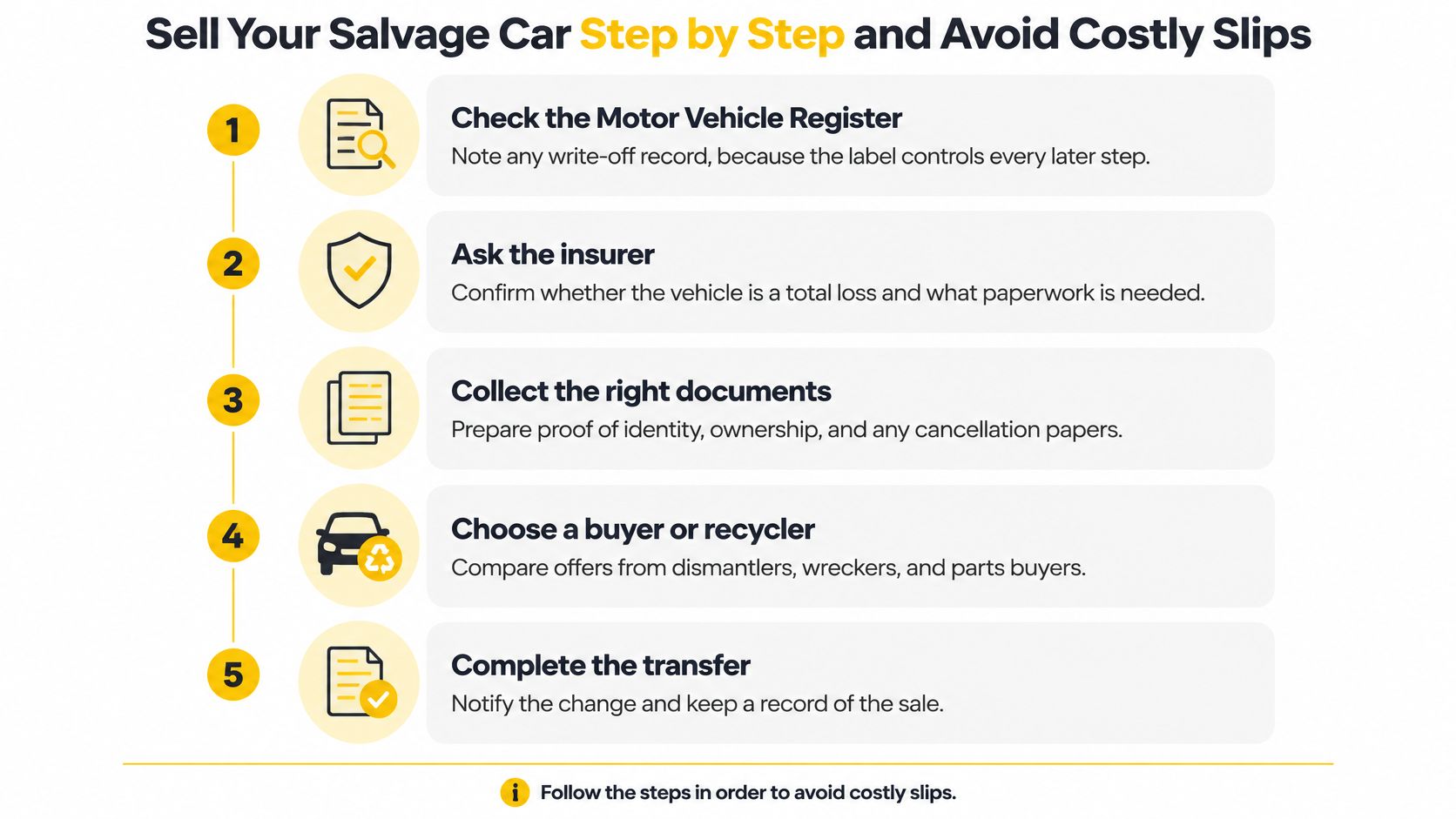
Follow the sale sequence in order. A generous offer won't protect you if the insurer hasn't released the vehicle or the collection yard won't authorise access.
NZTA's insurance-claim guidance explains that vehicles written off for fire, water or structural damage receive a safety flag and can't obtain a WoF or CoF while that flag remains; the required repairs and certification must be addressed before re-registration.
Complete the sale in a controlled order
Check the Motor Vehicle Register history. Match the vehicle identification number and note any write-off record. Identify why the vehicle was written off rather than relying on a broad auction description.
Ask the insurer about salvage rights. Confirm whether it retains the vehicle after settlement and obtain the required release before agreeing to sell. If the insurer retains salvage rights, check with it before proceeding.
Gather the documents. Prepare photo ID, the registration certificate or record, insurer release and repair invoices. Registration details help identify the vehicle and registered person, but don't substitute for evidence that you're entitled to dispose of it.
Describe the condition clearly. State whether it's complete or stripped, running or non-running, rolling or immobilised. Include flood exposure, fire damage, deployed airbags and whether it's an EV or hybrid.
Get firm, comparable quotes. Obtain at least two and compare them with any existing salvage bid. Give each buyer the same photographs, component list and collection details so you're not comparing different assumptions.
Arrange authorised collection. Confirm access with the panel beater or holding yard and resolve release conditions before dispatch. We collect damaged vehicles from these locations with the yard's release and the registered owner's ID.
Complete the disposal records. Confirm the applicable ownership notification and registration cancellation steps, and keep the sale receipt and copies of releases. Don't assume handing over the keys completes the administration.
The slips that reduce the return
- Stripping parts after quoting: The buyer priced a particular vehicle. Removing valuable assemblies means the original assessment no longer describes what's being collected.
- Concealing flood or fire damage: A buyer may reassess or refuse a vehicle when undisclosed damage changes the safe handling requirements.
- Putting a damaged EV in a garage: Enclosed storage creates an avoidable safety problem and can complicate recovery.
- Assuming old registration remains usable: Plates on the car don't authorise unlawful road use after cancellation.
- Releasing the car without records: Missing yard authorisation or disposal documentation leaves disputes harder to resolve.
Get the insurer's release in writing before promising the vehicle to anyone else.
The costliest slip is selling before the insurer releases its salvage rights, because that can breach the claim terms. Resolve that question before accepting payment or arranging collection, not after the tow vehicle arrives.
Buying a Salvage Car Safely
Start with the recorded status, not the asking price. A seller's description of minor damage is an invitation to inspect, not evidence that the vehicle has a straightforward route back to the road.
Pre-purchase checks in order
- Confirm identity and status. Obtain the Motor Vehicle Register history and match it to the vehicle identification number. Resolve mismatches before comparing prices.
- Identify the loss cause. Separate cosmetic damage from fire, water and structural damage. Each requires a different scope of investigation.
- Request the evidence. Obtain the insurer letter, repair invoices and proof of prior registration. Missing records should change your buying decision, not become paperwork to chase later.
- Commission a certifier's assessment. Use an NZTA-approved repair certifier before buying. Where body or structural damage is recorded, establish the applicable structural inspection process and inspection stages.
- Investigate electrified components. For a hybrid or EV, request battery service or state-of-health records and disclose warning lights, flood exposure and visible high-voltage coolant leaks to the assessor.
- Build a complete cost estimate. Include purchase, transport, assessment, certification, structural inspection where applicable, parts, labour and re-registration. Obtain quotes rather than inserting an assumed allowance.
- Compare the finished result. Check the asking price of an equivalent non-salvage vehicle, including condition and equipment, before deciding the project offers enough benefit.
Judge repair complexity rather than appearance
A ute covered in hail dents may be a more manageable project than a tidy-looking van with water inside its wiring connectors. Cosmetic damage can be visible and measurable; corrosion, restraint faults and intermittent electrical failures may require much more investigation.
Check repair access as well as replacement-part prices. A damaged mounting point behind a panel can matter more than the panel itself, particularly if the certifier needs to inspect it before assembly.
Buying test: If you can't describe the certification path and price the necessary work, you haven't established a bargain.
Don't use the price of a sound example as permission to spend the entire difference on repairs. Leave room for findings after dismantling, and walk away when the certification path is unclear.
Salvage Considerations for Insurers and Dismantlers
Insurers and dismantlers handle different parts of the same chain. The insurer establishes the loss and release position; the dismantler must preserve identity, recover usable components and manage the remaining materials safely.
Insurers need a clear documentary handover
Record the write-off accurately in the relevant register and vehicle documents. Describe the damage and retain the assessment evidence so the next party can identify why the vehicle entered salvage.
Terms such as statutory, written off, salvage and non-repairable can trigger specialist scrutiny. Avoid replacing a specific damage description with a vague label that leaves the buyer unable to establish the repair pathway.
Before release, confirm:
- Salvage rights: Identify who may sell or retain the vehicle under the settlement.
- Collection authority: Give the holding yard clear instructions about the authorised collector.
- Document consistency: Match the vehicle identity, loss description and release paperwork.
Dismantlers need a recovery sequence
Assess reusable engines, transmissions, catalytic converters, electronic modules, wheels and undamaged panels before destructive processing. Drain and segregate fluids, remove the lead-acid battery and keep contaminated materials out of the recoverable metal stream.
Keep component identity and condition records where parts are intended for reuse. A removed assembly with no traceable vehicle details or testing information is harder to assess and match to a buyer's vehicle.
EV and hybrid traction batteries require a separate workflow. Immobilise and isolate the vehicle using the manufacturer's procedure, protect the pack against short-circuit and impact, and use a channel equipped for damaged or end-of-life lithium-ion batteries.
NZTA's battery-electric bus whole-of-life study identifies the potential commercial value of second-life battery applications alongside the need for suitable end-of-life recycling facilities. That supports assessment for refurbishment, stationary reuse or material recovery, rather than assuming every pack has the same destination or value.
Record the registration position and complete the relevant NZTA steps for destroyed or written-off vehicles. Keep a file connecting the insurer's release, collection authority, vehicle identity and final recovery route so the transaction remains traceable.
Car Removals Whangarei offers salvage assessment and removal for damaged, non-running and written-off vehicles across Northland. Visit Car Removals Whangarei with your vehicle details, condition photos and insurer release position to request a quote based on the recoverable parts and steel.
- salvage cars nz
- written off cars
- sell salvage car
- EV salvage NZ
- car dismantlers NZ