· Car Removals Whangarei
Old Car Removal in Whangarei: Your Options and Next Steps
The old car's still beside the garage, the battery's flat, and the last repair estimate made keeping it hard to justify. You want the space back, but you're not sure whether to advertise it, donate it or arrange a truck.
Old car removal starts with the car's condition and your authority to dispose of it, not just the price. A useful runner deserves a different decision from a rusted shell. And whatever route you choose, don't mistake a tow truck leaving the driveway for the paperwork being finished.
Table of Contents
- Choosing Between Scrap, Donation and Private Sale
- Requirements for Damaged, Hybrid and Abandoned Cars
- How to Book a Car Removal in Whangarei
- Paperwork to Complete Before the Car Leaves
- What Happens on Pickup Day and at the Yard
Choosing Between Scrap, Donation and Private Sale
The best route depends on what the car can still do, what condition it is in and whether you can authorise its disposal. A useful runner may sell privately; a stripped, seized or rusted shell has little resale future and is better suited to scrap removal.
| Route | Best when | What you receive | Time to clear | Paperwork |
|---|---|---|---|---|
| Sell privately | Running, registered and roadworthy, with time to manage enquiries and viewings | Payment from the buyer | Days to weeks, allowing for advertising and viewings | Both parties notify NZTA |
| Sell to a licensed dismantler | Non-running, crashed, rusted, seized or failed WoF, with no worthwhile resale future | Cash at pickup, based on weight and recoverable parts | Same day to a few days, subject to booking | Notify NZTA when the vehicle changes hands |
| Donate to a charity | Running or repairable, and accepted by the charity | No payment; a receipt if offered | Collection depends on the charity's acceptance and transport | Notify NZTA of the transfer |
| Council transfer station | A small load the facility accepts and you can transport | No payment; a disposal fee may apply | Drop-off during opening hours, once acceptance is confirmed | Check the facility's rules |
Keep useful cars out of the scrap queue
A running, registered car with a current WoF may be worth selling privately, especially if its faults are minor and you can manage viewings. You'll handle enquiries, test drives and payment. The guide to selling a car privately explains how to prepare for that route.
Scrap removal suits vehicles with little resale value. Quotes are based on weight plus remaining salvage value, such as reusable parts. A failed WoF alone does not settle the question: compare the repair work with the car's usefulness before deciding.
Donation depends on the charity accepting the vehicle and arranging collection. Confirm both before handing over the keys, so an unwanted repair or transport burden does not become the charity's problem. A transfer station is generally more relevant to accepted small loads than a whole car requiring recovery. Confirm acceptance before arranging transport.
Dispose of the vehicle responsibly
The Ministry for the Environment's 2007 assessment of waste identified illegal vehicle dumping as a national problem and flagged used oil, refrigerants, batteries and circuit boards as hazards requiring proper treatment. A licensed dismantler can separate reusable parts and handle hazardous materials before the remaining shell is recycled.
Practical rule: Choose the route that fits the car's condition and your authority to dispose of it, not just the advertised price. Then complete the NZTA notification. Owners can mistake the vehicle leaving their driveway for the transfer being finished.
Ask yourself: Does it run? Is it registered? Does it have a current WoF? Is it complete, and can you prove you're entitled to sell it? Those answers help distinguish a private sale from scrap removal, while uncertain authority or paperwork needs sorting before collection.
Requirements for Damaged, Hybrid and Abandoned Cars
Requirements for special cases
| Case | What to prepare | What to disclose | Extra cost risk |
|---|---|---|---|
| Crash, flood or fire damage | Photos, release from the yard or panel beater, registered owner ID | Flood, fire or fluid leak history | Confirm recovery requirements before booking |
| Hybrid or EV | Model, year, any battery warning lights | Crash, flood or fire history, coolant or battery leaks | Specialist heavy recovery may carry a charge |
| Abandoned on private property | Vehicle-owner authorisation, landowner authorisation, property address, plate and chassis numbers if found | Landowner details and any finance interest | Charge may apply well outside the service radius |
| Deregistered or failed WoF | ID, keys if found, details of any plates retained | Current registration status | Usually none for pickup |
| Farm or rural non-runner | Gate access details, ID, details of removed plates | Fuel or oil leaks, any attached machinery | Distance affects scheduling; remote or heavy recovery may cost extra |
Damaged cars need a clear handover
For a vehicle at a panel beater or holding yard, organise the release before booking collection. We collect damaged vehicles from those locations with a release from the yard and the registered owner's ID. Photos should show the damage and loading access, not just the undamaged side.
Disclose floodwater exposure, fire damage and fluid leaks even if the car still starts. A collector needs to choose equipment and a loading position from the vehicle's actual condition, not its appearance in an old listing.
With hybrids and EVs, a quiet vehicle isn't necessarily safe to handle. NZTA's electric and hybrid vehicle inspection rules identify insecure, damaged, deteriorated or leaking high-voltage batteries, damaged or missing shields, and high-voltage coolant leaks as rejection reasons.
Report battery warnings and leaks before collection. Don't open, disconnect or move a damaged traction battery yourself. If it's safe to leave the vehicle where it is, keep it outdoors away from buildings pending specialist advice; don't try to reposition an unstable vehicle to satisfy that precaution.
Abandoned doesn't mean available to sell
Written landowner permission is necessary for access, but it doesn't automatically establish authority to sell somebody else's car. A landlord, farm owner or property manager should establish disposal authority before arranging removal.
The Ruapehu District Council's abandoned-vehicle guidance illustrates the distinction between vehicles on private property and those on public land or roads. For a Northland property, confirm the applicable local process rather than assuming a public-road removal procedure applies in a private yard.
A vehicle being unwanted is a reason to investigate its status, not proof that you can dispose of it.
We only charge for removal when a vehicle is well outside the service radius or needs specialist heavy recovery, and we disclose that before booking. Raise any situation not listed above during the booking call rather than guessing.
How to Book a Car Removal in Whangarei
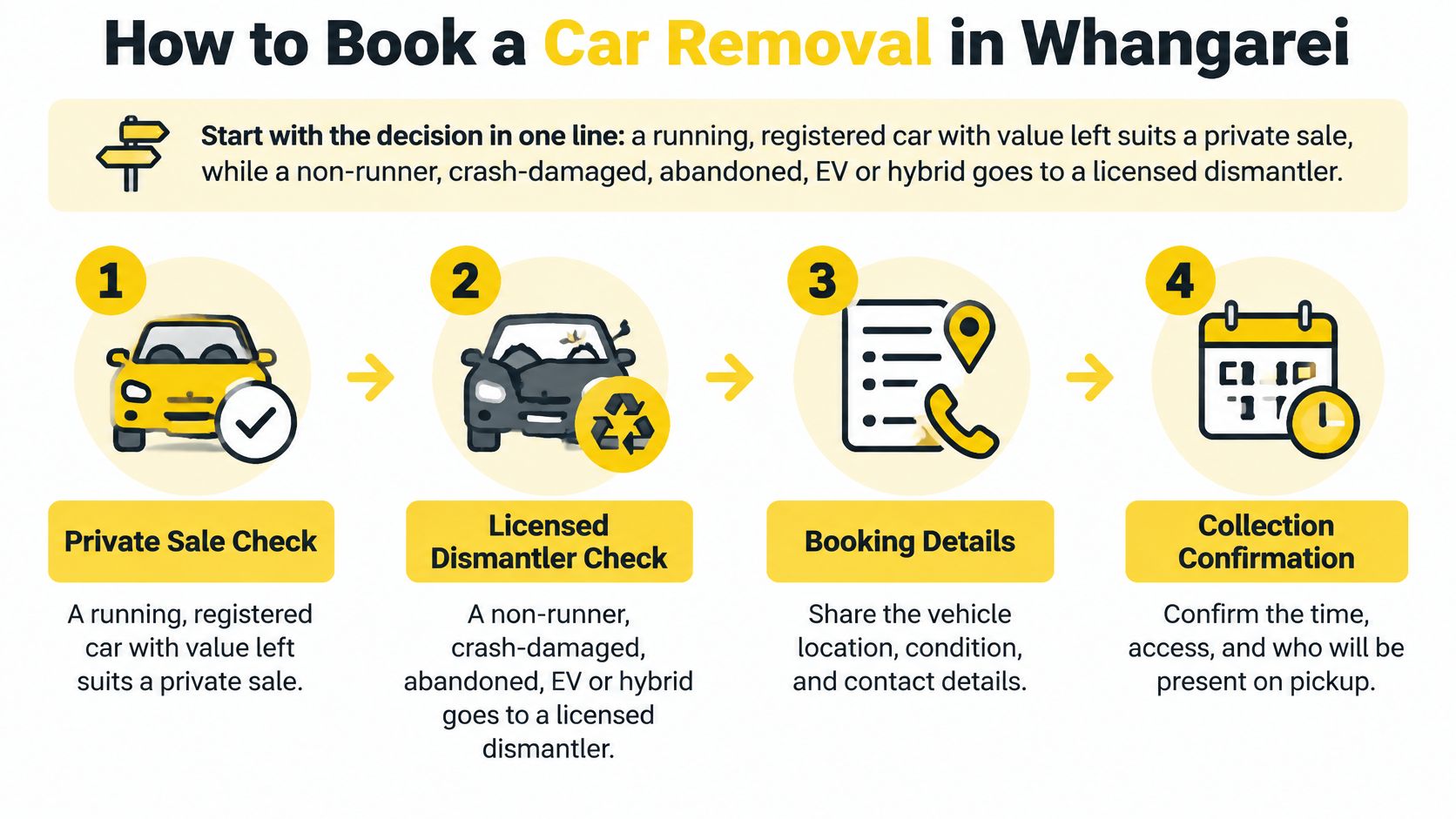
A running, registered car with value left suits a private sale; a non-runner, crash-damaged or end-of-life vehicle suits a licensed dismantler, with abandoned vehicles, EVs and hybrids needing the appropriate authority or handling arrangements.
Gather the vehicle details. Write down the make, model, year, odometer reading and plate number. Add a short condition note covering whether it starts, whether it holds a current WoF, and any crash, flood or fire history. If you don't know why it stopped running, say that. A plain description such as “turns over but won't start” is more useful than guessing that it needs an engine.
Call 0800 99 55 99 or send the online quote form. Booking a free removal starts with those vehicle details and its condition. Include the collection address and your contact details so the booking can be matched to the right location. If somebody else will meet the collector, identify that person and arrange their authority before the appointment.
Say whether it has keys, wheels and brakes. We still remove vehicles with no wheels, no keys or no brakes free of charge, subject to the remote-location and specialist-heavy-recovery exceptions. Tell us if the steering is locked, a wheel has collapsed or the car is resting on blocks. Those details help the collector prepare; there's no advantage in leaving them until the truck arrives.
Confirm the firm phone quote. Ask for the amount that will be paid at pickup, and confirm what information the quote is based on. Our phone quotes are firm and honoured at pickup, so give an accurate account of missing parts and damage before agreeing. The car removal quote guide explains how to prepare the information needed for a clear figure. Keep the agreed amount with the booking details rather than relying on memory.
Confirm the pickup window for your address. We remove unwanted cars the same day for most Whangarei addresses and within 48 hours for wider Northland. Give the actual collection location, not the nearest town. Tell us when the authorised person can be present, especially if the vehicle is at a workplace, rental property or locked yard.
Describe difficult access before booking. Mention remote sites, steep driveways, low branches, narrow gates, gate codes and soft ground. For a farm vehicle, explain whether the truck can reach it along a formed track and whether any implements remain attached. Confirm any charge for a location well outside the service radius or specialist heavy recovery before accepting the booking. Don't assume that a truck can safely follow the route used by a farm bike.
Clear the collection route. Move other vehicles, open the required gates and keep children and animals away from the loading area. If the old car can be moved safely, leave it where the truck can reach it without crossing soft ground. If it can't, leave it alone and explain its position. Pushing a brakeless car down a slope or dragging a damaged EV into place creates a much harder recovery job.
Make the collection instructions usable
The booking process follows a simple decision and confirmation sequence.
For a rural address, provide a recognisable entrance description as well as the address. If the car is behind a shed rather than beside the house, say so; a collector shouldn't have to search the property or reverse out of an unsuitable track.
Write the booking number, agreed price and collection window in one place. Keep any access instructions there too, so you and the collector are working from the same information.
Make the call this week with your vehicle details beside you, rather than waiting until the car has to be gone urgently.
Paperwork to Complete Before the Car Leaves
Establish authority before arranging the handover
Gather ID and evidence that you're entitled to sell. Have the registered owner's ID ready, or written authority appropriate to an executor, property manager or other representative. We accept scrap cars without plates or papers when the seller shows ID and confirms they're entitled to sell, but missing documents don't remove somebody else's legal interest.
Record the vehicle's identity. Note the plate number and VIN or chassis number, then photograph the identifiers, odometer and overall condition. These records connect the transaction to the actual vehicle, particularly where a property contains several similar shells.
Resolve finance and estate issues. Check whether a loan remains secured against the car or whether it belongs to a deceased estate. Being listed as the registered person isn't the same as proving legal ownership, and a property manager's authority to access a yard isn't necessarily authority to sell everything in it.
The step owners most need to get right is the NZTA notification. A signed receipt and a truck booking aren't substitutes for updating the vehicle record.
Close the record, then clear the cabin
Complete the disposal notification before or at pickup. The NZTA motor-vehicle transaction service requires the plate number and recipient's full name and address; online notification requires a New Zealand driver licence. Obtain the recipient's legal details, not just a driver's first name.
Deregistration doesn't erase the Motor Vehicle Register record or resolve finance and ownership disputes. If the plates are missing or the online transaction won't proceed, clarify the correct NZTA process before handover rather than treating the missing plate as a reason to skip notification.
Keep confirmation of the transaction. A late seller notification can leave registration fees attributed to you until NZTA is told. Our NZTA registration and change-of-ownership guide explains the distinction between updating the registered-person record and establishing ownership.
Remove what you intend to keep. Check the glovebox, boot, seat pockets and under the seats for personal items. Remove aftermarket accessories and licence plates you want to retain before pickup, and tell the collector about accessories being removed before the quote is finalised.
We aren't responsible for items left inside once the vehicle is collected. Sign the transfer at pickup, complete the notification and retain the confirmation rather than promising to sort it out afterwards.
What Happens on Pickup Day and at the Yard
The truck arrives, and the crew checks the car against the booking details. The registered owner or authorised person should be there, with the handover documents ready and the payment method agreed before loading.
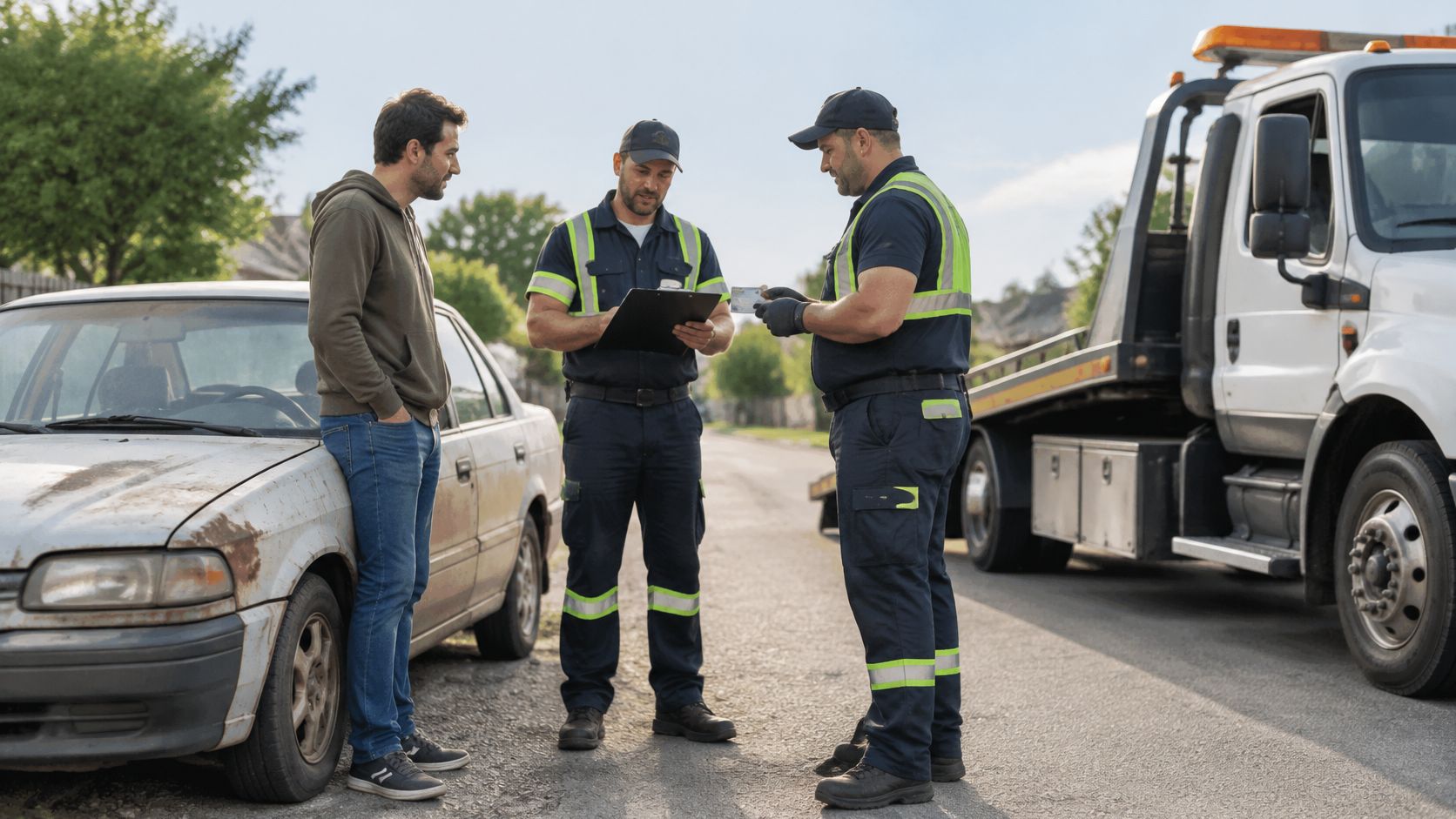
Once payment and paperwork are complete, the crew loads the vehicle using equipment suited to its condition. At the yard, processing should follow a controlled order, not an immediate trip to the crusher.
Depollution comes before the baler
The Ministry for the Environment's New Zealand Waste List classifies end-of-life vehicles containing hazardous components under code 16 01 04*. Removing liquids and hazardous components changes how the remaining vehicle is classified and handled.
A sound processing sequence is:
- Make it safe: Stabilise the car and disconnect the ordinary low-voltage battery. Hybrids and EVs require separate manufacturer-specific high-voltage isolation by appropriately trained personnel.
- Recover liquids: Drain fuel, engine oil, transmission fluid, coolant and brake fluid into suitable recovery equipment. Recover refrigerant through a closed system rather than releasing it.
- Remove hazardous components: Handle airbags, batteries, mercury-containing switches and other regulated components separately before further dismantling.
- Separate materials: Grade steel, aluminium and copper, with plastics and tyres directed into their own handling streams.
Crushing before depollution increases spill, fire and contamination risks. At our yard, fluids, batteries, tyres and airbags are removed and handled to New Zealand environmental standards before the shell is baled for steel recycling.
Ask about the destination
At pickup, useful questions include “Can you show me your Northland dismantler licensing?”, “Which reusable parts can go back into Northland vehicles?” and “Can I have a record of the fluids removed?” Those questions focus on the handling process rather than just the amount of metal recovered.
Keep the signed transfer record and a copy of the booking, together with your payment and NZTA confirmations.
Car Removals Whangarei offers old car removal across Whangarei and Northland, with firm phone quotes and collection arrangements matched to the vehicle's condition and access. Visit Car Removals Whangarei with your make, model, location and condition details to arrange a quote and confirm what you need ready for pickup.
- old car removal
- car removal Whangarei
- scrap car Whangarei
- NZTA vehicle disposal
- free car removal