· Car Removals Whangarei
Cars for Cash Near Me: A Northland Owner Guide

You should walk away with a firm phone quote based on parts and steel, free towing within roughly 100 km of Whangarei, and cash or an instant bank transfer before loading, with NZTA notifications completed on site to prevent ongoing registered-person liability. Don't accept a deal that leaves payment or paperwork until after the truck has gone.
The hatchback in your driveway won't pass its WOF, or the farm ute hasn't moved since the motor failed. You're tired of looking at it, but a private sale means messages, inspections and buyers who expect you to arrange transport.
Searching for cars for cash near me should solve that problem without creating another one. My recommendation is simple: sort out your authority to sell, agree the collection terms, and treat the money and NZTA confirmation as part of the handover, not something to chase afterwards.
Table of Contents
- What Cars for Cash Near Me Actually Means in Whangarei and Northland
- How a Cash-for-Cars Quote Is Actually Built
- Vehicles a Northland Remover Will Buy
- Service Area, Towing, and Same-Day Pickup in Northland
- What Happens at the Gate on Pickup Day
- Paperwork, Ownership, and the Legal Side of Letting Go
- How to Tell a Good Cash-for-Cars Quote From a Risky One
- Your Northland Cars-for-Cash Handover Checklist
What Cars for Cash Near Me Actually Means in Whangarei and Northland
You've got a vehicle that no longer fits an ordinary private sale. Perhaps it's a failed-WOF wagon parked beside the house, a deregistered car behind the shed, or a rusted ute sitting in a paddock with grass around the wheels.
These aren't customer success stories. They're the everyday situations a vehicle-removal service is built to handle: buying something the owner wants gone, assessing what can be recovered, and bringing the equipment needed to collect it.
A licensed vehicle dismantler provides a different service from a private buyer looking for cheap transport. The transaction can combine valuation, payment, towing and the relevant NZTA notifications, rather than leaving you to organise each job separately.
Disposal rather than another selling project
- Non-running vehicles: You don't need to get the engine started merely to ask for an assessment.
- Deregistered or damaged vehicles: Explain their status at the outset, especially if an insurer has been involved.
- Older vehicles: Describe what remains usable rather than assuming age makes the whole vehicle worthless.
- Vehicles stored on farms: Explain the access and ground conditions before anyone dispatches a truck.
For an owner, the useful distinction is between selling a vehicle for continued use and selling it for dismantling. Don't let a buyer blur that distinction when you ask what will happen to it.
Practical rule: Choose the buyer who can explain the whole handover, not just give you a price.
A local operator with its own collection equipment is often a better practical fit than an intermediary arranging transport through someone else. You can ask the person organising the job about loading, access and paperwork directly.
That doesn't make every local offer sound. Confirm the buyer's identity, dismantler status and collection arrangements, and make sure the person answering the phone can commit to what happens at your gate.
How a Cash-for-Cars Quote Is Actually Built
A useful quote starts with recoverable parts and steel, not a guess based on the vehicle's appearance. The buyer needs to know what's complete, what's damaged and what equipment collection will require.
The publisher advertises an overall cash-for-cars range of $200 to $15,000, but that's not a category-by-category price guide or a promise for your vehicle; use its guide to how much you can sell your car for alongside an individual assessment. Assigning narrower dollar bands without inspecting the vehicle would give you false confidence.
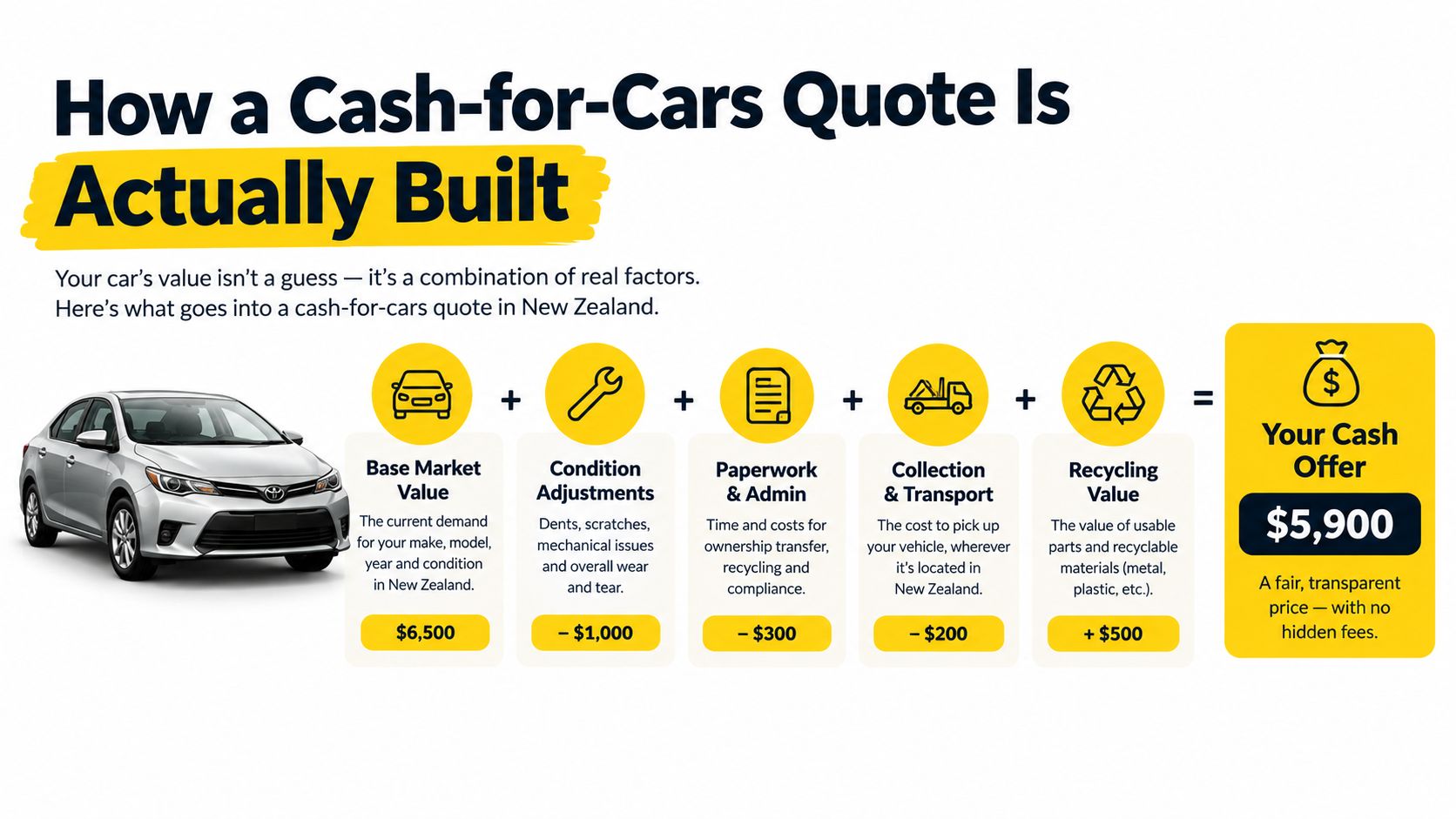
Give the buyer information they can price
Have the make, model, year, registration status and approximate kilometres ready. Say whether the vehicle starts, rolls and steers, whether you have keys, and whether the engine, transmission, wheels, catalytic converter and interior are still present.
Send photographs rather than trying to describe every dent. Include the damaged areas and any missing components, and disclose flooding, fire, structural impacts or previous stripping.
Typical Cash-for-Cars Value Bands by Vehicle Type
| Vehicle category | Condition range | Indicative payout |
|---|---|---|
| Sedans, hatchbacks and wagons | Complete and running through to damaged or non-running | Individual quote based on usable parts and metal |
| Utes, 4WDs and vans | Usable assemblies through to blown motors or corrosion | Parts-dependent assessment |
| Stripped cars and shells | Missing components, seized or non-rolling | Recoverable metal and remaining parts |
| Trucks and machinery | Complete units through to damaged plant | On-site assessment where needed |
| Hybrids and EVs | Intact through to accident or battery damage | Specialist assessment including battery condition |
Condition matters more than presentation
NZTA's repair-certification assessment process considers structural damage, significant corrosion, and water or fire damage, not whether a vehicle starts. A tidy exterior doesn't settle its suitability for road use.
Don't oversell the car over the phone. Accurate information lets the buyer price what's there and organise suitable loading equipment, giving you a firmer basis for accepting the offer.
Vehicles a Northland Remover Will Buy
A dead engine doesn't automatically make a vehicle unsuitable for collection. The important questions are what remains recoverable, how it can be loaded, and whether you have authority to sell it.
Different vehicles need different assessments. A complete people mover, a stripped shell and a damaged digger shouldn't be treated as interchangeable loads.
Ordinary cars and working vehicles
Sedans, hatchbacks, wagons and people movers fall within ordinary cash-for-cars work, whether they're running, unwanted or no longer roadworthy. Completeness matters: a non-running car with identifiable assemblies presents a different proposition from a shell with the drivetrain removed.
Utes, 4WDs and vans, including Hilux, Ranger, Navara and Hiace models, can be assessed with blown motors or rusted chassis. Tell the buyer which fault stopped you using the vehicle rather than describing it only as scrap.
- Stripped or seized vehicles: Identify missing parts and whether the wheels turn.
- Trucks, buses and machinery: Supply dimensions, photographs and access details for tractors, diggers and implements.
- Farm collections: Describe each unit separately so the operator can plan the load.
Write-offs, abandoned vehicles and electrified vehicles
Hail, flood, fire and statutory losses need their history disclosed. NZTA requires vehicles documented as statutory, written off, salvage, junked or non-repairable to undergo specialist repair-certifier assessment before re-entering service, so don't assume an ordinary inspection resolves their road-use status.
Abandoned vehicles require a separate authority check. A landlord, property manager, body corporate or farmer should disclose the circumstances before agreeing to clearance; having the vehicle on your land isn't a substitute for establishing permission.
Hybrids and EVs need high-voltage capability, not merely a tow truck. Ask how the operator will assess traction-battery condition, isolate the system and account for any recoverable battery value.
The publisher's stated scope includes these categories, but collection still depends on the actual vehicle and site. Send enough information for the operator to accept the job properly, especially when the load isn't an ordinary car.
Service Area, Towing, and Same-Day Pickup in Northland
Your address is only part of the collection question. The operator also needs to know whether the vehicle is beside a sealed driveway, behind a tenanted building or down a farm track.
The publisher's collection pattern is same-day Whangarei city pickup where scheduling allows, with rural work planned around regular runs, generally for next-day service. Its stated operating window runs from 7am to 7pm, with free towing inside approximately 100 km, as outlined in its scrap car collection information.
Treat that radius as a reason to ask, not as a guarantee based on a map. Give the exact address and get confirmation that your collection is included without a towing charge.
Establish the route and access together
- Whangarei city or Port Whangarei: Ask whether a truck can collect during the current city run.
- Rural Northland: Ask which scheduled route serves your address and what arrival window applies.
- Near the coverage boundary: Get explicit confirmation of the towing terms before accepting.
- Restricted access: Explain narrow gates, steep approaches, soft ground and limited turning space.
Don't rely on a general list of Northland place names to establish coverage. An exact address is more useful, particularly when the vehicle sits well away from the road.
Make the appointment usable
Ask for an arrival window you can work around, and provide a contact number the driver can reach. If you need to leave for work or arrange access through a tenant, explain that when booking.
An owned tow fleet gives the operator direct control over dispatch and equipment. It also gives you a clear contact when weather, access or a previous collection changes the timing.
For a tenanted property, agree who will meet the driver and which areas the truck can enter. Discreet removal is easier to organise before arrival than while a driver waits outside a locked gate.
What Happens at the Gate on Pickup Day
The driver should first check the vehicle against the information used for the phone quote. That means confirming condition, components present and the agreed loading arrangement, not starting a fresh negotiation over faults you already disclosed.
If something differs, resolve it while the vehicle is still on your property. Don't let loading begin while the price remains disputed.
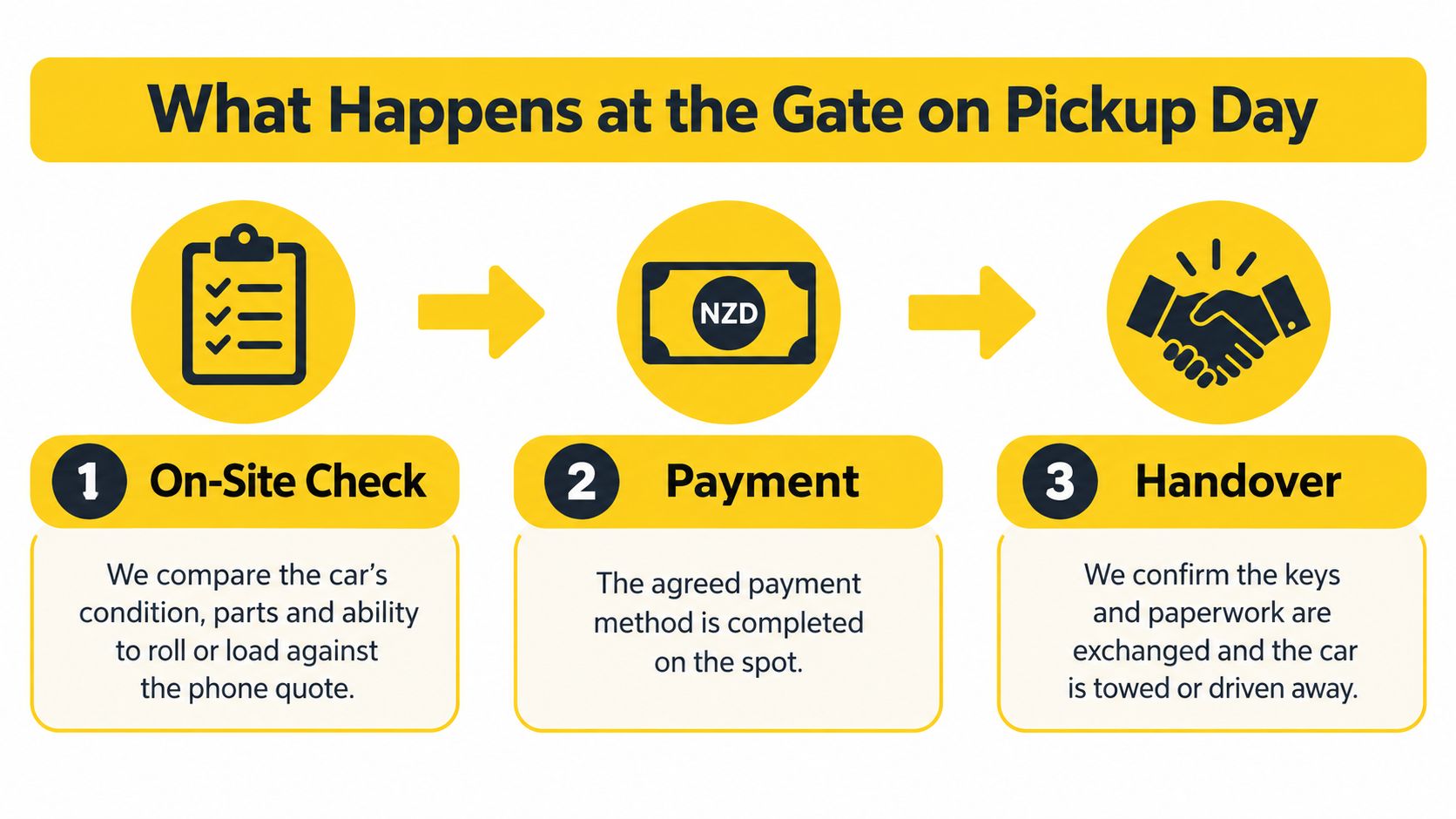
Inspection, payment and handover
- Check the agreement: Confirm that the inspected vehicle matches the accepted description and that the agreed amount stands.
- Complete payment before loading: Receive the cash or confirm the instant bank transfer in your own account. A screenshot from someone else's phone isn't your confirmation.
- Finish the transaction record: Exchange the receipt, keys and relevant paperwork, and complete the appropriate NZTA notification on site.
The publisher states that it pays before loading, without cheques or hold-backs. Make that sequence explicit when you book, especially if someone else will be present on your behalf.
Don't exchange a vehicle you control for a promise you'll have to chase.
Before handover, photograph the vehicle, VIN and plates. Keep a written receipt identifying the buyer, vehicle, agreed payment and date of disposal, along with the notification confirmation.
Let the driver manage the load
Show the driver the access route and any hazards before the truck moves into position. Stand clear of winching and loading, and don't try to help by towing or pushing a damaged vehicle unless the operator has agreed a safe arrangement.
A non-rolling vehicle needs that information disclosed beforehand. Missing wheels, locked steering or a shell resting on the ground can change the equipment required.
For several vehicles on a farm or rental property, identify each one clearly. A consolidated visit should still leave you with an understandable record of what was collected and who authorised its disposal.
Paperwork, Ownership, and the Legal Side of Letting Go
Legal ownership and NZTA registered-person status aren't the same thing. NZTA's vehicle ownership guidance explains that sellers must notify the agency immediately on sale, gift or disposal, and that both parties must complete their respective notifications; failing to update the register can leave the former registered person exposed to speed-camera tickets, licensing fees and other compliance liabilities.
That's why a truck leaving your driveway doesn't, by itself, settle your responsibilities. Completing the correct notification reduces registered-person risk, but it doesn't erase earlier liabilities or cure a dispute over who had authority to sell.
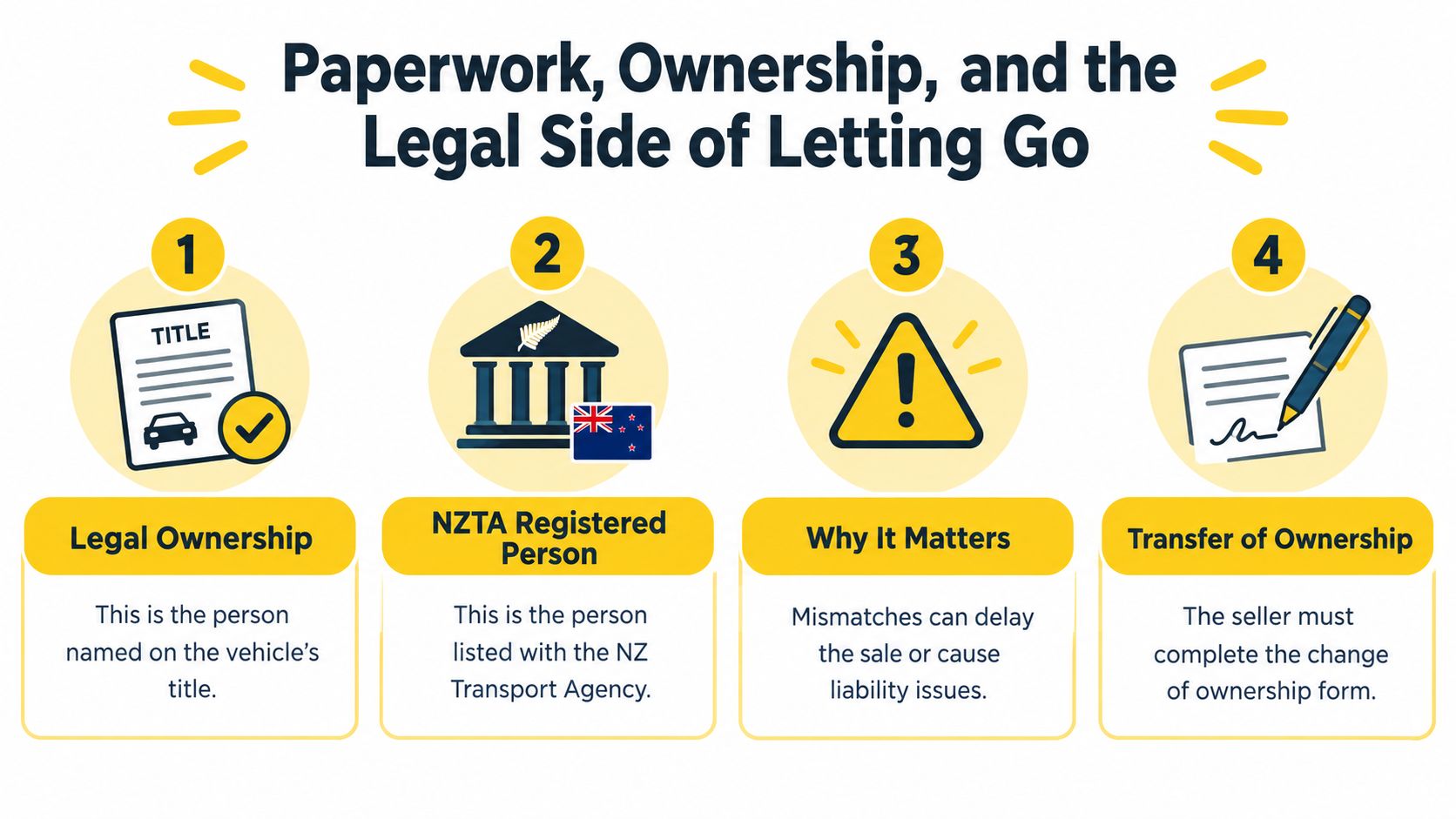
Establish authority before collection
Gather identification, the plate number, VIN or chassis number, buyer details and any relevant insurer or estate documents. Use the NZTA registration and change-of-ownership guide to prepare your questions before pickup.
- Deceased estates: Establish executor or administrator authority and gather estate documents where relevant.
- Privately bought farm vehicles: Find the purchase receipt and any records connecting you to the vehicle.
- Inherited vehicles: Explain missing documents and establish who can authorise disposal.
- Abandoned vehicles: Obtain appropriate owner authorisation or establish another lawful basis before removal.
Don't mistake possession for permission. If ownership is disputed, pause the collection and resolve the authority question rather than asking a dismantler to work around it.
Missing papers and cancellation are different issues
NZTA lists a signed receipt, auction invoice or statutory declaration as acceptable evidence for re-registering a vehicle, alongside identifying details such as the VIN or chassis number, purchase date and seller information, in its re-registration documentation requirements. Those requirements concern future re-registration, not blanket permission to dispose of any undocumented vehicle.
A dismantler may assess a shell with incomplete records after confirming authority. Missing papers can still affect verification, valuation and any prospect of returning it to the road.
Permanent disposal may require registration cancellation, rather than an ordinary registered-person change. NZTA's registration cancellation factsheet identifies permanently useless, destroyed and permanently off-road vehicles, explains the MR15 process and normally requires plates to be surrendered to a plate agent; insurers may cancel registration for write-offs.
How to Tell a Good Cash-for-Cars Quote From a Risky One
The highest advertised amount isn't automatically the strongest offer. Compare what you'll receive with what you'll have to organise, pay for or follow up after collection.
A lower offer with a confirmed net payment, included towing and a documented handover can be more useful than a larger headline figure with unresolved conditions. That's a practical judgement, not a promise that every lower-priced buyer is safer.
Compare the commitments, not the headline
| Question | Clear answer | Reason to pause |
|---|---|---|
| Is the quote firm? | Written confirmation tied to your description | A number that remains provisional without explanation |
| Is collection included? | Explicit confirmation for your address | Transport charges left undecided |
| When will I be paid? | Agreed payment completed before loading | Payment deferred until processing |
| Who handles notification? | Clear buyer details and on-site completion | A vague promise to sort it later |
| Who is collecting? | Identified operator and suitable equipment | Unexplained handoffs between parties |
Ask for the agreement by text or email. You don't need a lengthy contract to establish the amount, address, payment method and collection terms clearly.
My recommendation: Reject an offer if the buyer won't explain what you receive and what remains your responsibility.
Check the person behind the offer
Ask whether you're speaking to the dismantler buying the vehicle or someone passing the enquiry elsewhere. Neither arrangement answers the quality question on its own, but you should know who will appear on the receipt and who is responsible for collection.
Confirm the business identity and its stated dismantling capability. For a damaged hybrid, machinery load or disputed-authority vehicle, ask the relevant specialist question before discussing urgency.
A good operator should be willing to hear about the awkward details. If the buyer discourages photographs, dismisses missing ownership records or pushes you to load before payment, stop and clarify.
Don't confuse speed with certainty. Accept the offer you can verify at the gate, rather than the one that sounds impressive over the phone and leaves you relying on goodwill afterwards.
Your Northland Cars-for-Cash Handover Checklist
Prepare the handover before the driver arrives. A folder on your phone for photographs and confirmations, plus the necessary documents in one place, makes the appointment easier to manage.
Use this checklist as a final check, not as a substitute for resolving missing authority or disputed terms. Those problems belong before collection day.
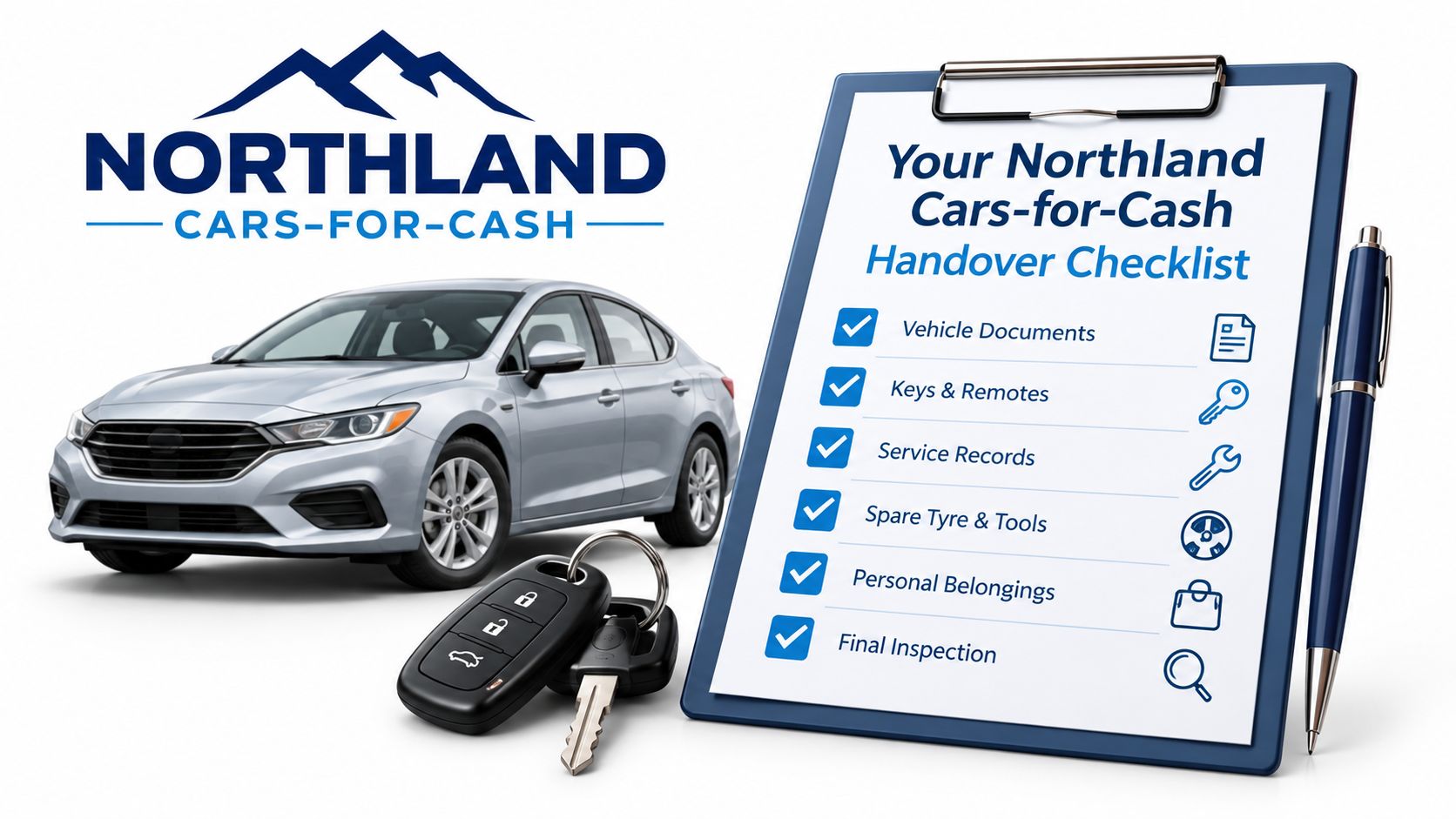
Before the truck arrives
- Agreement saved: Keep the accepted quote, payment method and towing confirmation accessible.
- Documents gathered: Have identification, vehicle identifiers and relevant estate, insurer or owner-authorisation records ready.
- Photographs taken: Save clear vehicle, VIN and plate images before handover.
- Access cleared: Open the gates and remove obstacles from the agreed loading route.
- Personal items removed: Check the cabin, glovebox and load area for belongings.
- Digital information checked: Where possible, remove paired devices and saved personal settings before handing over keys.
Don't dismantle hazardous components yourself to tidy the vehicle for collection. Leave damaged batteries and other suspect parts for the operator to assess, and disclose loose components you want included.
Before you consider the job finished
- Payment verified: Check receipt of the agreed funds yourself.
- Receipt retained: Keep the buyer and vehicle details with the disposal date.
- Notification confirmed: Save your NZTA transaction confirmation and establish the buyer's corresponding action.
- Plates accounted for: Follow the cancellation process where applicable, rather than treating leftover plates as ordinary scrap.
Responsible processing matters after the tow as well. The Ministry for the Environment estimates that New Zealand generates about 99,000 tonnes of e-waste annually, with 98% going to landfill or illegal disposal, in its waste and resource-efficiency work programme; ask about controlled handling of batteries, fluids and other removed components rather than assuming collection alone guarantees responsible disposal.
Keep the handover records together in case a later compliance query concerns the vehicle. If the registration record doesn't reflect the intended transaction, follow up with the buyer and NZTA promptly using those records.
Finally, organise replacement transport if you still need it and clear the space safely. The useful outcome is a removed vehicle, received payment and a transaction you can prove.
Car Removals Whangarei offers firm phone quotes, payment before loading and vehicle collection across its Northland service area, with NZTA notifications handled at pickup. Visit Car Removals Whangarei with your vehicle details, photographs and collection address to confirm the quote, towing arrangements and paperwork before booking.
- cars for cash near me
- whangarei car removals
- cash for cars northland
- scrap car removal
- vehicle removal