· Car Removals Whangarei
Car Removal Service Explained: A Complete Guide
That old ute in the driveway has turned into part of the scenery. It won't start, the registration's due, and every month it's still there is another reminder that getting rid of it is not just about tidying up, it's about doing the job properly.
A car removal service exists for exactly that point in a vehicle's life. It collects unwanted, damaged, non-running, or uneconomic vehicles, pays for them on agreed terms, and moves them into lawful dismantling and recycling instead of leaving them to rust, leak, or take up space.
Table of Contents
- What a Car Removal Service Does
- How the Service Works from Quote to Handover
- Vehicles and Equipment That Qualify for Removal
- How Valuations Are Calculated and What Affects the Price
- Why a Car Removal Service Exists in Northland
- Towing, Pickup Timing, Payment and Ownership Paperwork
- Abandoned Vehicles and EV or Hybrid Removal Done Safely
- Your Pre-Pickup Checklist and What Happens After
What a Car Removal Service Does
A Northland farm often tells the story best. The old ute has sat by the shed since winter, the battery is flat, and nobody wants to pour more money into it than it will ever return. A car removal service handles that handover as a structured process, from owner to dismantler.
The job in plain English
The operator comes to your property, inspects the vehicle, agrees the price, and loads it with the right equipment. The vehicle then goes to a yard where usable parts can be recovered, fluids can be managed, and the shell can be processed responsibly. For an owner, it is the last practical stop for a car that has reached the end of the road.
That service is different from a scrap-metal buyer who only wants weight and may not handle vehicle-specific waste correctly. It is also different from private selling, where you would be advertising, answering calls, arranging viewings, and hoping someone wants a problem vehicle. Council clean-up services are a separate matter too, since they usually deal with roadside or public-space vehicles, not the one sitting on your driveway, farm track, or rental section.
Practical rule: if the vehicle still has a legal person tied to it, still sits on private land, or still contains vehicle-specific hazards, it needs more than a casual “take it away” arrangement.
For a first-time seller, the simplest way to read the process is this. The removal truck is there to take a known vehicle, with known details, into a controlled disposal path.
That matters because a car is not just metal. It can still contain fuel, oil, batteries, tyres, airbags, and paperwork issues that need to be handled in the right order. A proper car removal service connects those steps so the owner does not have to become a dismantling expert overnight.
How the Service Works from Quote to Handover
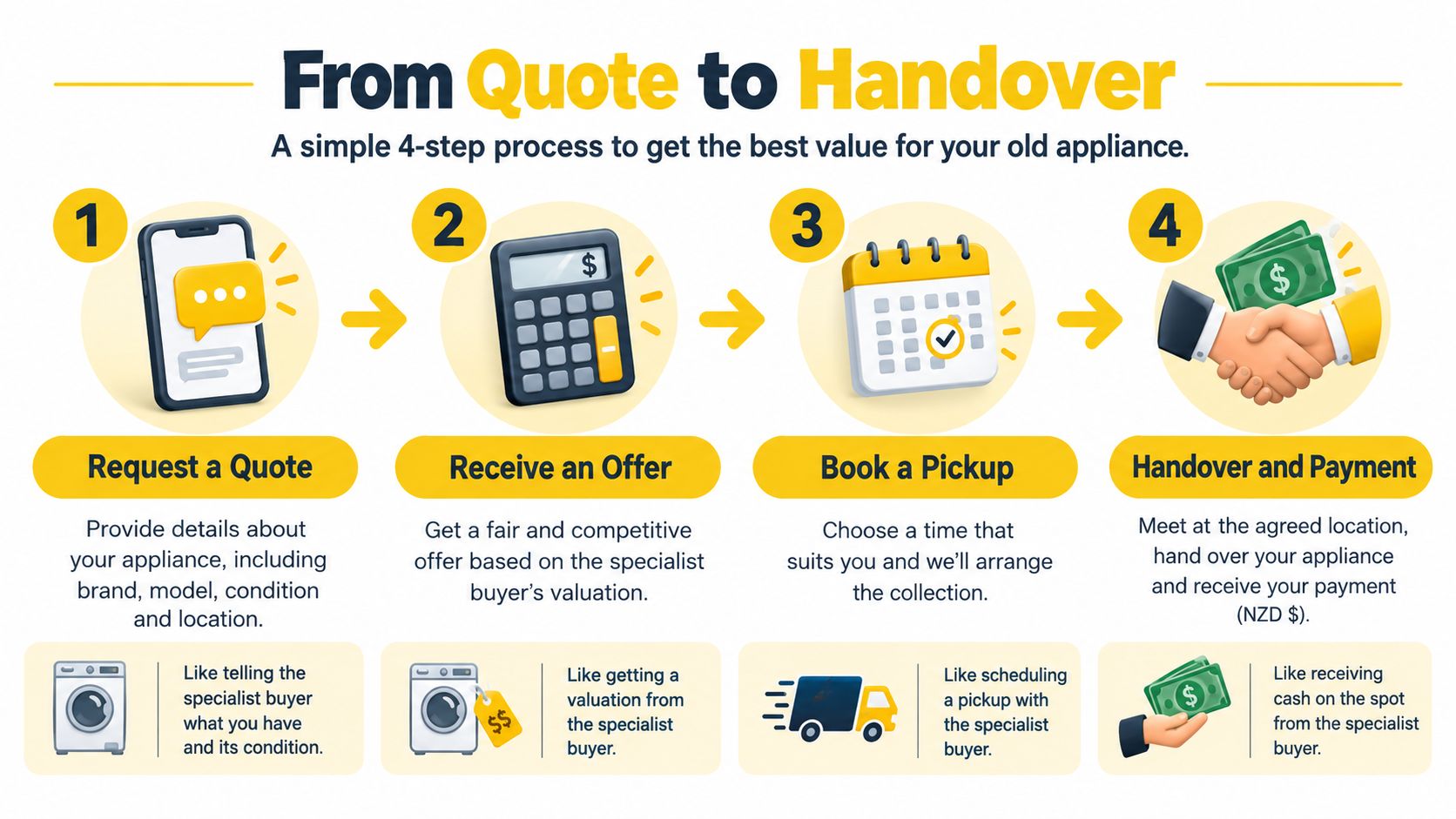
Every clean removal follows the same four stages, and knowing them helps you spot an operator who cuts corners.
The four stages you should expect
First comes the quote. You give the make, model, year, condition, location, and whether it runs, rolls, or has been crashed. That lets the operator judge likely parts demand and scrap value before a truck ever leaves the yard.
Second comes the pickup booking. A good operator sets a time that fits the vehicle's location and the truck's route. Rural jobs are usually planned differently from city jobs, because access, distance, and loading conditions are rarely the same.
Third comes on-site verification. The driver checks that the vehicle matches the description and that the condition is what was discussed. That step protects both sides, because the quote should reflect the actual vehicle, not a polished version of it.
Fourth comes payment and handover. Payment should be settled before loading, then the vehicle can be taken away and the paperwork completed. If the operator wants to change the price at the end, or delay payment until later, something is off.
Watch the order carefully: quote first, booking second, verification on arrival, payment before loading, paperwork at handover. If the sequence changes, ask why.
The removal truck takes a known vehicle, with known details, into a controlled disposal path. The seller should also treat the notification step as part of the handover, not an afterthought. A clean handover keeps the rest of the process straightforward. If the details are vague, small problems can turn into avoidable headaches.
Vehicles and Equipment That Qualify for Removal
A lot of owners think removal services only want obvious scrap. That's too narrow. In practice, a car removal service can deal with anything from a faded family car to a farm ute, as long as the operator has the right equipment and the vehicle fits the yard's handling rules.
| Vehicle Category Accepted by a Car Removal Service | Typical Condition | What Is Usually Needed at Pickup |
|---|---|---|
| Standard cars and people movers | Running, non-running, failed WOF, damaged, or worn out | Basic vehicle details and seller identification |
| Scrap and non-rolling shells | Stripped, seized, rusted, or missing major parts | Access for loading and confirmation of location |
| 4WDs, utes, and vans | Blown motor, rusted chassis, flood or accident damage | Details of condition and any known hazards |
| Light trucks, tractors, and small machinery | Old, unused, or uneconomic to repair | Clear access and equipment information |
| Accident and insurance write-offs | Crash damage, fire damage, flood damage, or statutory loss | Insurer paperwork or deregistration details where relevant |
| Abandoned vehicles on private land | Left behind on a driveway, farm, rental property, or body-corporate site | Written authorisation and proof of control of the property |
| Hybrid and electric vehicles | Damaged, end-of-life, or battery-question vehicles | Disclosure of battery history and safe access at pickup |
What changes the quote
Condition matters because it changes both parts value and handling effort. A complete vehicle with usable panels, interior parts, or drivetrain components often has more recovery value than a stripped shell. On the other hand, a badly rusted or non-rolling shell may be valued more for its recoverable metal and whatever parts remain.
Documentation matters too. A deregistered vehicle, an insurance write-off, or a property-clearance job can each need a different paper trail. That's why the operator should ask questions before quoting rather than offering a vague number to get the booking.
A useful rule is simple. If the vehicle still has useful parts, clear identity, and easy access, the quote process is usually more straightforward. If it's buried on a farm, partly dismantled, or caught up in ownership questions, the job needs more care.
How Valuations Are Calculated and What Affects the Price
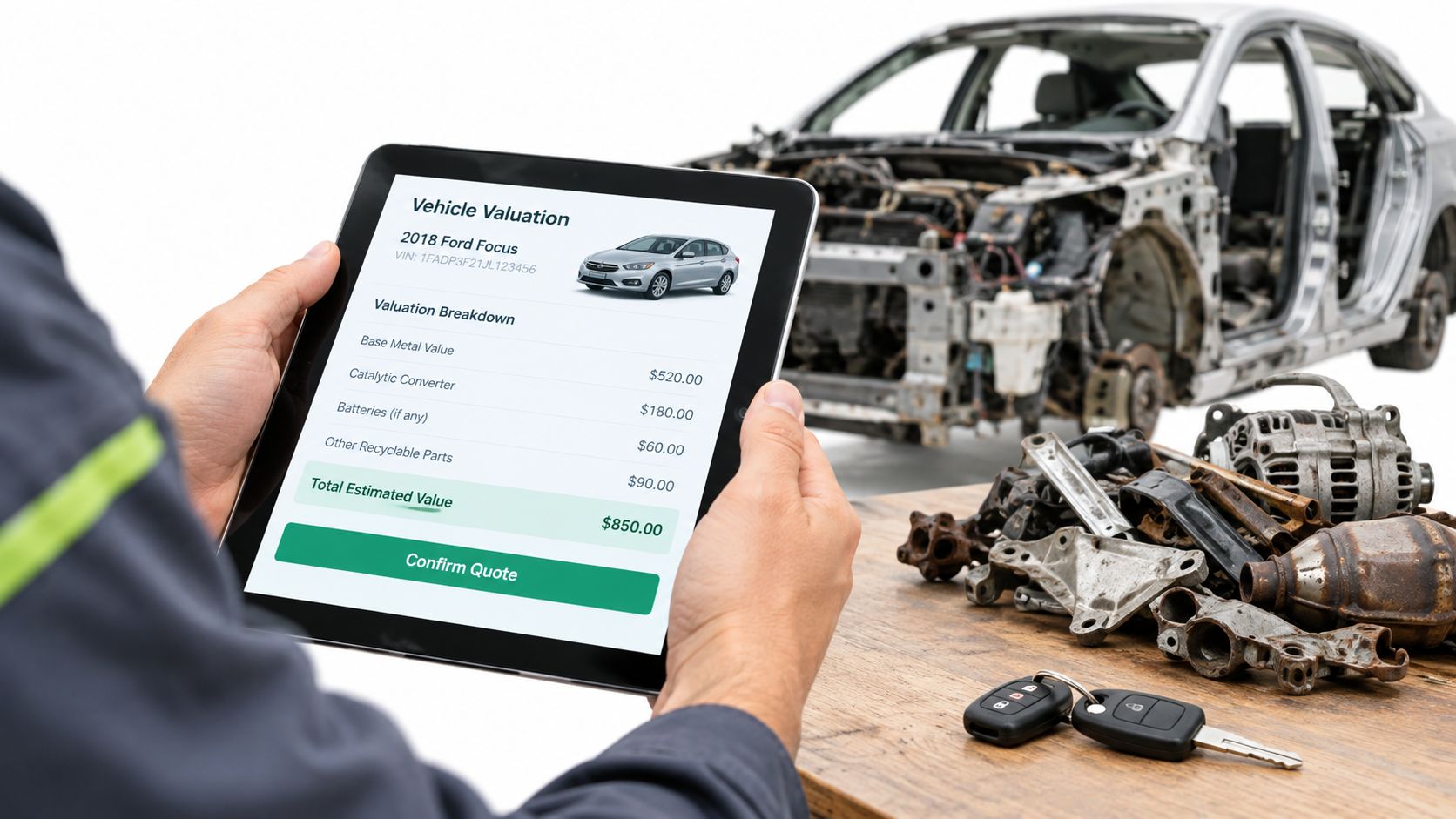
A proper cash offer is built from two things, recoverable parts demand and scrap-steel value. Everything else, including condition, loading difficulty, missing parts, and whether the vehicle has a usable battery or drivetrain, adjusts the number up or down. The quote should make sense before the truck arrives, not change shape once the owner is standing beside it.
What a proper phone quote covers
A legitimate operator will ask for the basics, make, model, year, condition, location, and whether the vehicle runs or rolls. That's enough to form a realistic offer without inventing a number out of thin air. If the vehicle is unusual, damaged, or incomplete, the operator should ask a few more questions.
The quote should also be clear about what's included. If towing is part of the service, the seller shouldn't later see a separate deduction for the pickup itself. A firm quote is only useful if it survives the actual collection.
If you want a sense of how value is assessed in practice, this guide is a useful companion read: how much you can sell your car for.
What should raise a red flag
If the price is only described as “up to” a number, that's not a firm offer. If the operator leaves room for “adjustments on arrival” without explaining what might change, the seller is carrying the risk. And if fees appear after the truck arrives, the quote wasn't really final.
Good quotes sound boring. They're specific, repeatable, and easy to confirm again before pickup.
A solid quote process also respects the seller's time. You should not need to chase three different people to find out whether the price still stands. The best test is direct, ask whether the number is final, what it includes, and whether there are any deductions you'd need to know about before the truck turns up.
Why a Car Removal Service Exists in Northland
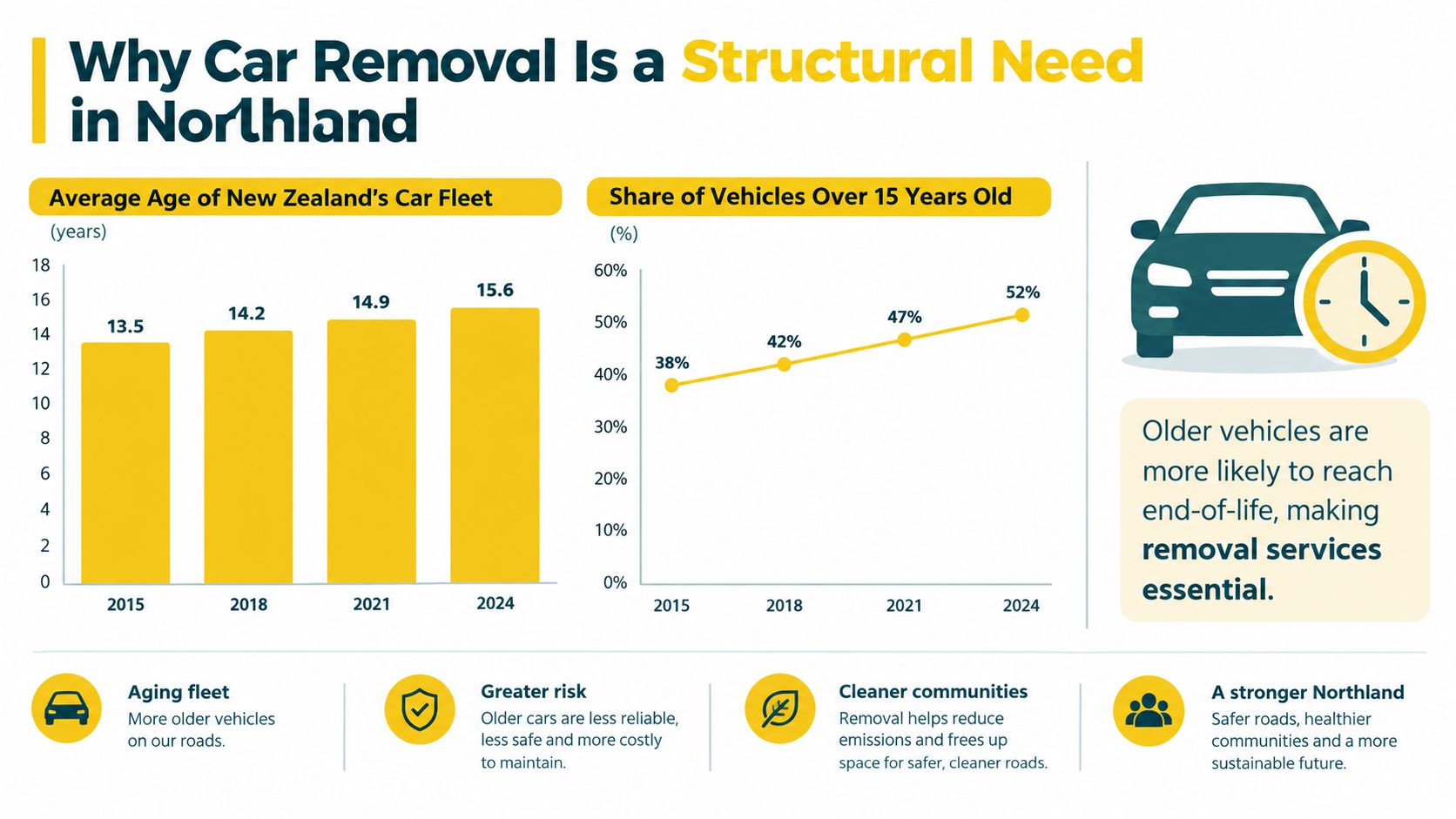
A car removal service exists because old vehicles do not disappear on their own. New Zealand's fleet keeps ageing, and by 2024, 43.3% of the country's light-vehicle fleet was at least 15 years old. The same report shows the average age of light passenger vehicles at 15.3 years, light commercials at 13.0 years, trucks at 17.8 years, and buses at 16.4 years (Age of Vehicles report, 2025).
Why age matters for Northland owners
Older vehicles are more likely to fail inspection, corrode, break down, or cost more to repair than they are worth. The fleet was already ageing a decade ago, so the backlog of end-of-life vehicles is still building.
For Northland, that shows up in the places people keep vehicles. Farms, back sections, workshop yards, rental properties, and driveways often hold cars long after road use no longer makes sense. A ute may still be useful on a property while being too costly to return to the road. That is the point where removal becomes a practical service, not just a sale.
The wider pattern also explains why dismantling matters. When a vehicle leaves the road, usable parts can be recovered and materials can be sorted instead of left to rot. That is the public value of the service, it turns an uneconomic vehicle into parts, metal, and controlled waste streams.
A vehicle removal yard is part of the transport system's final stage. In Northland, where older work vehicles are common and distance makes private transport important, that final stage needs to be easy to access.
Towing, Pickup Timing, Payment and Ownership Paperwork
A pickup should feel organised, not rushed. If the truck is coming from the local service area, the owner should know whether it is a same-day city job or a planned rural run, the time window, and whether the vehicle needs to be left easy to reach for loading. A blocked driveway or a car parked nose-in to a tight fence line can slow a job that should otherwise be straightforward.
What happens when the truck arrives
The driver checks the vehicle, confirms the condition, and settles the price as agreed. Payment is handled before loading, so the handover is clear from the start.
Cheques and hold-backs are warning signs. They add delay to a process that should already be settled, and they leave the seller exposed if the deal drags on.
The paperwork matters just as much. NZTA says the seller must notify the agency when the vehicle is sold, given away, or otherwise disposed of, and the buyer must complete the matching step so the change of registered person is finished on the Motor Vehicle Register. A practical guide to the NZTA change-of-ownership process is here: the seller notification and ownership update step. Keep MR13 and MR14 in mind as the forms often used for that notification. That process is separate from deregistration, and it is also separate from the physical act of taking the car away.
Keep this straight: deregistration stops road use, notification updates the registered person, and disposal is the physical removal of the vehicle. They are related, but they are not interchangeable.
If the seller has the right details ready, the handover moves faster. A registration number, the correct seller information, and a clear access path can save time at the gate. If the vehicle is on private land with tight access, sorting that out before the truck arrives helps avoid confusion. A tidy pickup usually comes from preparation, not luck.
Abandoned Vehicles and EV or Hybrid Removal Done Safely
Two situations cause trouble because people assume they're simpler than they are. One is the vehicle left on private land. The other is a damaged EV or hybrid. Both need more than a basic tow.
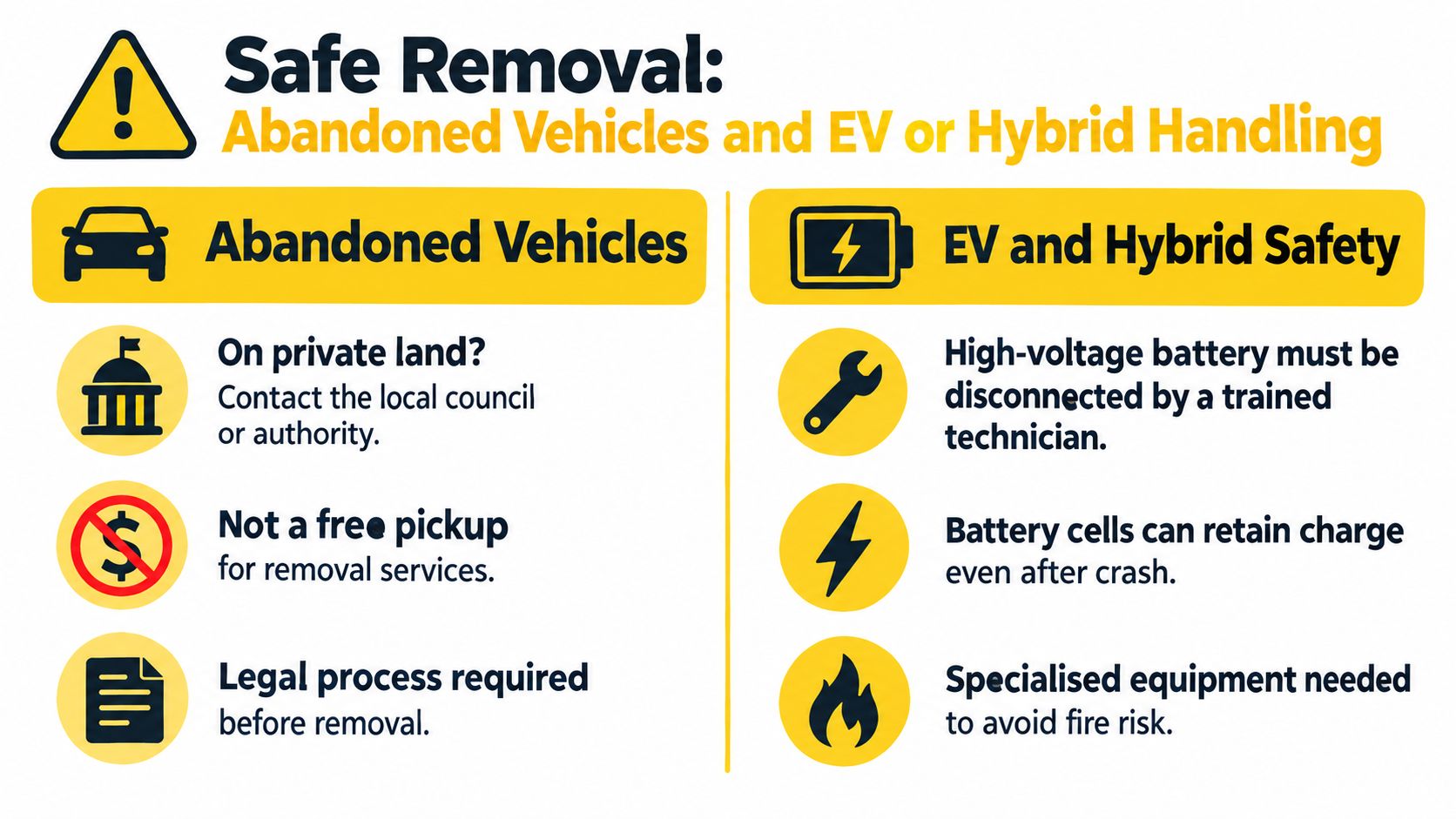
Abandoned on private land is not the same as free to take
If a vehicle is sitting on a driveway, farm block, rental property, or body-corporate site, the key issue is authority. Landlords, farmers, and property managers need a clear paper trail, because the vehicle is not automatically free for removal just because it looks neglected.
A sensible process starts with documenting the vehicle, the location, and who controls the land. If the registered person can be identified, that helps too. The point is to avoid disputes later over trespass, ownership, or who authorised the removal in the first place. For a practical walkthrough, this guide on abandoned vehicle removal fits well alongside the legal checks.
EV and hybrid removal needs battery caution
Fire and Emergency New Zealand warns that a damaged EV battery can become a delayed fire risk after collision, fire, or water exposure, and it advises against using or charging the vehicle until it has been professionally inspected (FENZ lithium-ion battery guidance). That means owners should not treat a crash-damaged EV like a normal petrol car waiting for a tow.
The battery itself may still have value, and EECA notes that used batteries can retain value through refurbishment, second-life use, or recycling, provided qualified providers handle the work (EECA battery guidance). That's why the right question isn't “is the battery worth anything at all?” It's “what condition is it in, and how should it be handled safely?”
A vehicle with high-voltage components, flood history, or a crash-damaged battery needs disclosure before pickup. That lets the remover bring the right equipment and avoid turning a recovery job into a fire risk.
Your Pre-Pickup Checklist and What Happens After
Before you book, ask the questions that keep the deal clean. Confirm that towing is included in the quoted price, ask whether the quote is final, check that payment is made before loading, and make sure the seller notification will be handled at collection. If the vehicle is on private land, get the authority question sorted before the truck turns up.
A good final check is practical, not technical. Make sure the vehicle is accessible, clear out personal items, and mention anything unusual, like flood damage, missing wheels, or battery issues. If it's an abandoned vehicle, have the paperwork ready so the handover doesn't stall at the gate.
After the truck leaves, a responsible dismantler separates fluids, batteries, airbags, tyres, and usable parts instead of pushing the burden onto someone else. Tyres are a national waste problem, with about 6.5 million reaching end of life each year, and the government's Tyrewise scheme aims to divert them away from landfill, stockpiling, and illegal dumping (Tyrewise and tyre stewardship). That's the other half of a proper removal service, the part you don't see once the truck drives away.
An informed owner is in a strong position. You can tell the difference between a rushed cash offer and a lawful, structured service that handles the vehicle properly from driveway to dismantling yard.
If you want a straightforward Northland pickup with firm quoting, safe collection, and the paperwork handled at handover, contact Car Removals Whangarei and ask how your vehicle fits the service area, the quote process, and the disposal steps.
- car removal service
- cash for cars
- scrap car removal
- vehicle disposal NZ
- free towing Whangarei