· Car Removals Whangarei
Truck Wreckers NZ How Removal and Payouts Work
A truck that no longer runs can become the largest object in a Northland yard, and the problem rarely ends with finding someone to tow it away. Perhaps the truck failed its WOF, suffered accident damage, developed an expensive engine or transmission fault, or reached the point where repair costs no longer make sense. The same situation affects utes, vans, buses, tractors, diggers and other machinery.
Truck wreckers in New Zealand provide more than a cash-for-scrap transaction. A responsible dismantler removes pollutants, identifies reusable components, manages tyres and other controlled materials, then sends the remaining shell for material recovery. For a first-time seller, the important questions are practical. How is the truck valued? Which documents are needed? Who tells NZTA? What happens if the vehicle won't roll, has no current registration, or is sitting on a rural property?
This guide explains the process in plain language, with Northland conditions in mind. You'll see how dismantling works, why parts demand and recoverable steel influence a quote, which legal steps protect you, how heavy-vehicle movement can affect collection, and what to check before accepting an offer.
Table of Contents
- Introduction to Truck Wreckers in New Zealand
- What Truck Wreckers Do and How Dismantling Works
- Legal and Environmental Requirements You Must Know
- How Truck Wrecker Pricing Is Calculated in NZ
- How to Choose a Reputable Truck Wrecker
- How Truck Removal Works From Quote to Pickup
- Getting the Best Outcome With a Northland Truck Wrecker
Introduction to Truck Wreckers in New Zealand
A non-running truck can occupy valuable space for months. On a farm near Whangārei, it might be parked beside a shed because moving it would require specialist equipment. In town, a failed light truck may be blocking a driveway or taking up room in a workshop yard. An insurance write-off may be waiting for paperwork, while a rusted ute or van has become too costly to return to the road.
Truck wreckers offer a route from that uncertainty to a completed disposal. The operator assesses the vehicle, agrees on a price or collection arrangement, loads it with suitable equipment, completes the required ownership steps, and dismantles it through an organised recycling process. The outcome isn't “the truck goes for metal”. Reusable parts may be worth more than the shell, particularly where a drivetrain, cab component, hydraulic assembly, axle, wheel or body fitting remains suitable for another working vehicle.
New Zealand has an unusually old vehicle fleet. Fleet summaries derived from Ministry of Transport and NZTA information put the average vehicle age at 14.8 years, with 63.5% of vehicles more than 10 years old and 43.3% more than 15 years old, as reported in this New Zealand vehicle fleet statistics summary. That profile creates regular work for dismantlers because older commercial vehicles are more likely to become uneconomic to repair while still containing usable components.
The practical starting point: don't judge the truck only by whether it starts. A non-running vehicle can still have valuable parts, recoverable weight, or both.
The process becomes easier when you treat the disposal as three connected tasks. First, establish what the truck is and what condition it's in. Next, confirm the paperwork and collection requirements. Finally, choose a wrecker that can handle depollution, loading and NZTA notifications properly. That approach helps a private owner, farmer, fleet manager or property professional avoid surprise deductions and delays.
What Truck Wreckers Do and How Dismantling Works
Many people picture a truck wrecker crushing an entire vehicle immediately. That approach misses where much of the value comes from. A professional dismantler treats the truck more like a parts library than a single lump of steel. The vehicle is inspected, made safe, depolluted and disassembled so components with resale potential can be separated from material that belongs in downstream recycling.
The depollution-first sequence
The usual flow starts with making the vehicle safe for handling. Fuel, oils, coolants and other fluids need controlled removal, while batteries, filters, airbags and other potentially hazardous items require appropriate management. This stage protects workers, the yard and the surrounding environment.
The dismantler then removes reusable parts. Depending on the truck, that may include engine accessories, gearboxes, differentials, axles, wheels, suspension components, electrical equipment, body panels, mirrors, seats, hydraulic parts or specialised attachments. Parts are assessed for condition, identified and stored so they can be matched with future repair requirements.
A Massey University study on end-of-life vehicle management in New Zealand describes a process that begins with value-bearing vehicles moving to automotive dismantlers, followed by reusable-parts removal and controlled handling of the remaining shell. That model applies to commercial vehicles as well as passenger cars.
Why trucks are assessed differently
A truck often contains more material and larger original-equipment components than a car. That doesn't automatically make every truck valuable, because condition, completeness, model demand and removal difficulty still matter. It does mean the quote usually reflects two separate assets:
- Parts value, based on components that can be tested, reused or sold.
- Recovery value, based on steel, aluminium and other materials left after dismantling.
A complete gearbox from a commonly operated work truck may attract interest even if the cab is damaged. Conversely, a stripped chassis with missing wheels and major components may be valued mainly for its recoverable material. A bus, van, machinery unit or light commercial vehicle follows the same principle, although the parts mix differs.
This is why a wrecker shouldn't quote from a single scrap-metal assumption. The operator is estimating what can be safely recovered, what buyers may need, how difficult the removal will be, and what the remaining shell is worth after depollution and dismantling.
Legal and Environmental Requirements You Must Know
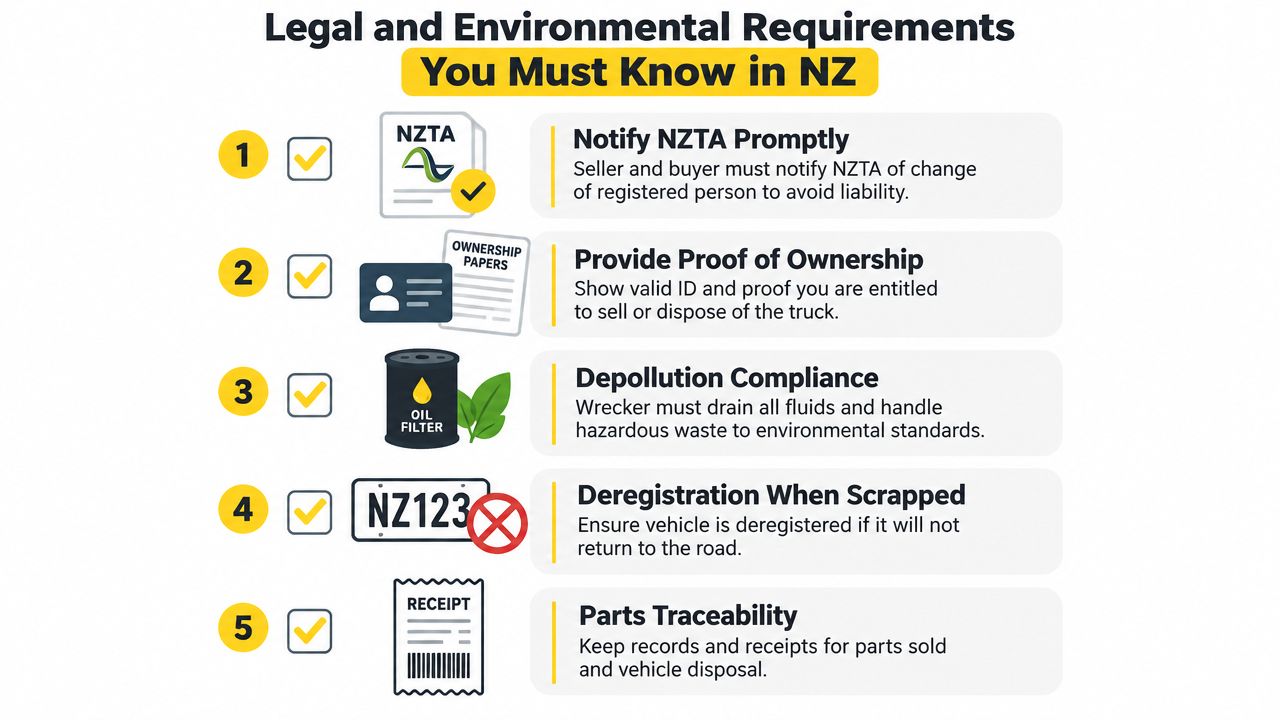
The paperwork matters as much as the mechanical condition. In New Zealand, both the buyer and seller must tell NZTA when a vehicle changes hands, and NZTA says the change is complete only after both parties have completed their parts. The NZTA vehicle ownership guidance warns that a seller who fails to notify the transfer can remain exposed to the buyer's tolls, speeding tickets, fees or fines.
The seller should notify NZTA promptly when the truck is sold, given away or otherwise disposed of. If the vehicle has overdue road user charges at the time of sale, the seller may be committing an offence under the Road User Charges Act 2012. NZTA also explains that delaying notification can leave the previous registered person responsible for licence fees on an unlicensed vehicle until the notification date. The NZTA selling a vehicle guidance sets out these responsibilities.
Collection routes need heavy-vehicle planning
A truck that can be driven away is different from one that needs lifting, winching or specialist loading. NZTA's VDAM permitting manual provides the framework for vehicle dimensions and mass, including general-access limits and permitted configurations for higher loads.
Northland routes can add another layer. Local bridge notices may impose axle limits such as 7,300 kg or 5,000 kg, so a tow operator must consider the route, axle loading and collection equipment before setting out. A large truck may be easy to reach in the yard but unsuitable for a particular bridge approach when loaded for transport.
Tyres deserve a separate check
Tyre handling is becoming a more visible part of end-of-life vehicle compliance. The Waste Minimisation (Tyres) Amendment Regulations 2025 tighten fee exemptions for tyres attached to imported vehicles, with the changes taking effect on 11 December 2025, according to the New Zealand legislation record.
For an imported truck or mixed fleet, ask how attached tyres will be handled and whether tyre-related charges, proof of replacement or identification details affect the final quote. Before collection, have your identification, registration or chassis details, ownership evidence, insurer paperwork where relevant, and any information about outstanding charges ready. If the truck is being scrapped rather than returned to service, ask how deregistration and disposal records will be completed.
For a plain-language overview of related dismantling considerations, see this NZ car wrecker guide.
How Truck Wrecker Pricing Is Calculated in NZ
A Northland truck can look valuable because it is heavy, yet its quote may depend more on one reusable gearbox than on the steel shell. Truck-wrecker pricing usually has two parts: the likely value of usable components and the value of material recovered after dismantling. Separating those parts makes the offer easier to understand.
Parts value increases when the truck is complete, identifiable and fitted with components still wanted in the local repair market. A working engine, gearbox, differential, hydraulic system, cab panel or specialised attachment may be worth more than the vehicle's age suggests. Missing parts, fire damage, contamination, water damage and difficult access can reduce that value. A heavy truck is not automatically a high-value truck.
Scrap value is based on recoverable material and the work needed to prepare it. Kerb weight, steel content, non-ferrous metals, tyres and the amount of cutting, lifting or loading all affect the calculation. A non-rolling shell may contain plenty of steel, but it is like moving a safe without handles: extra equipment and labour can reduce the final offer.
The main quote variables
| Vehicle Attribute | Effect on Parts Value | Effect on Scrap Value |
|---|---|---|
| Complete drivetrain | Can support demand for the engine, gearbox and related components | Adds recoverable metal and reduces missing-material deductions |
| Severe accident damage | Some undamaged parts may remain useful, while crushed assemblies lose value | The shell may still contain steel, but loading can be harder |
| Missing wheels or major components | Removes resale opportunities | Reduces recoverable weight and may increase handling difficulty |
| Hydraulic body or specialised equipment | May attract buyers if the equipment is identifiable and reusable | Adds metal and equipment mass after dismantling |
| Non-rolling condition | Requires a practical assessment of what can be safely removed | Loading, winching and route planning become more important |
| Hybrid or EV system | A traction battery may have separate value when safe isolation is possible | Battery handling changes the recovery process rather than simply adding scrap weight |
Parts demand and steel weight pull the quote in different directions. A complete truck with sought-after equipment may receive a stronger offer even before its metal is weighed. A stripped or badly damaged truck may be priced mainly on recoverable material, less the cost of depollution, dismantling and transport.
New Zealand's older commercial fleet helps keep demand for serviceable components active. Light commercial vehicles can remain in use to high mileages, so a worn work truck may still provide a needed differential, hydraulic pump, cab fitting or engine accessory. The vehicle's identity, condition and location help the wrecker judge whether those parts can be removed safely and sold.
Provide the registration, make, model, approximate year, engine or drivetrain details, running status, damage, missing parts, location and clear photos. State whether the truck rolls, steers and can be accessed by loading equipment. Ask whether the amount is fixed at pickup and whether towing, loading, tyre handling or other work can be deducted. For payment expectations, see this cash for truck guide.
How to Choose a Reputable Truck Wrecker
A low initial figure isn't useful if the final payment changes when the truck is loaded. Compare operators by the complete service, not just the first number mentioned over the phone. The right questions reveal whether the wrecker controls the collection or passes the job to an uncertain third party.
Questions that separate a clear service from a vague one
Ask whether the operator is a licensed dismantler, whether the quote is firm, and whether the price includes towing, loading and ordinary handling. Confirm how payment is made and when it happens. A straightforward arrangement pays before loading by cash or instant bank transfer, rather than leaving you waiting for a cheque or a later adjustment.
Equipment is equally important. A truck that won't roll may need a winch, crane, heavy-duty tow vehicle or suitable loading gear. An operator with an owned tow fleet can usually control the booking more directly than a business that depends on a separate contractor's availability.
Ask for the final number in plain language: “What will I receive before the truck is loaded, and are there any towing, tyre or condition deductions?”
Environmental handling should be specific rather than decorative wording. Ask who drains fluids and manages batteries, tyres, airbags and contaminated parts. If the truck is an imported model, ask how tyre obligations are considered. If it's a hybrid or EV, ask how the high-voltage system is isolated before loading and dismantling.
Warning signs at the comparison stage
- Unclear pricing: The operator won't explain what changes the quote or refuses to confirm whether deductions apply.
- Third-party uncertainty: The booking depends on an unnamed towing provider with no reliable arrival window.
- Incomplete paperwork: The operator is reluctant to complete the NZTA ownership notification at pickup.
- Unsafe loading promises: The operator hasn't asked whether the truck rolls, where it sits, or what access the property provides.
- Payment delays: The seller is expected to release the vehicle before receiving the agreed payment.
Northland scheduling also deserves attention. City access, rural roads, bridge restrictions, gates, slopes and soft ground can all affect collection. A reputable operator will ask about those details before confirming a time, not after arriving and discovering that the planned equipment can't reach the truck.
How Truck Removal Works From Quote to Pickup
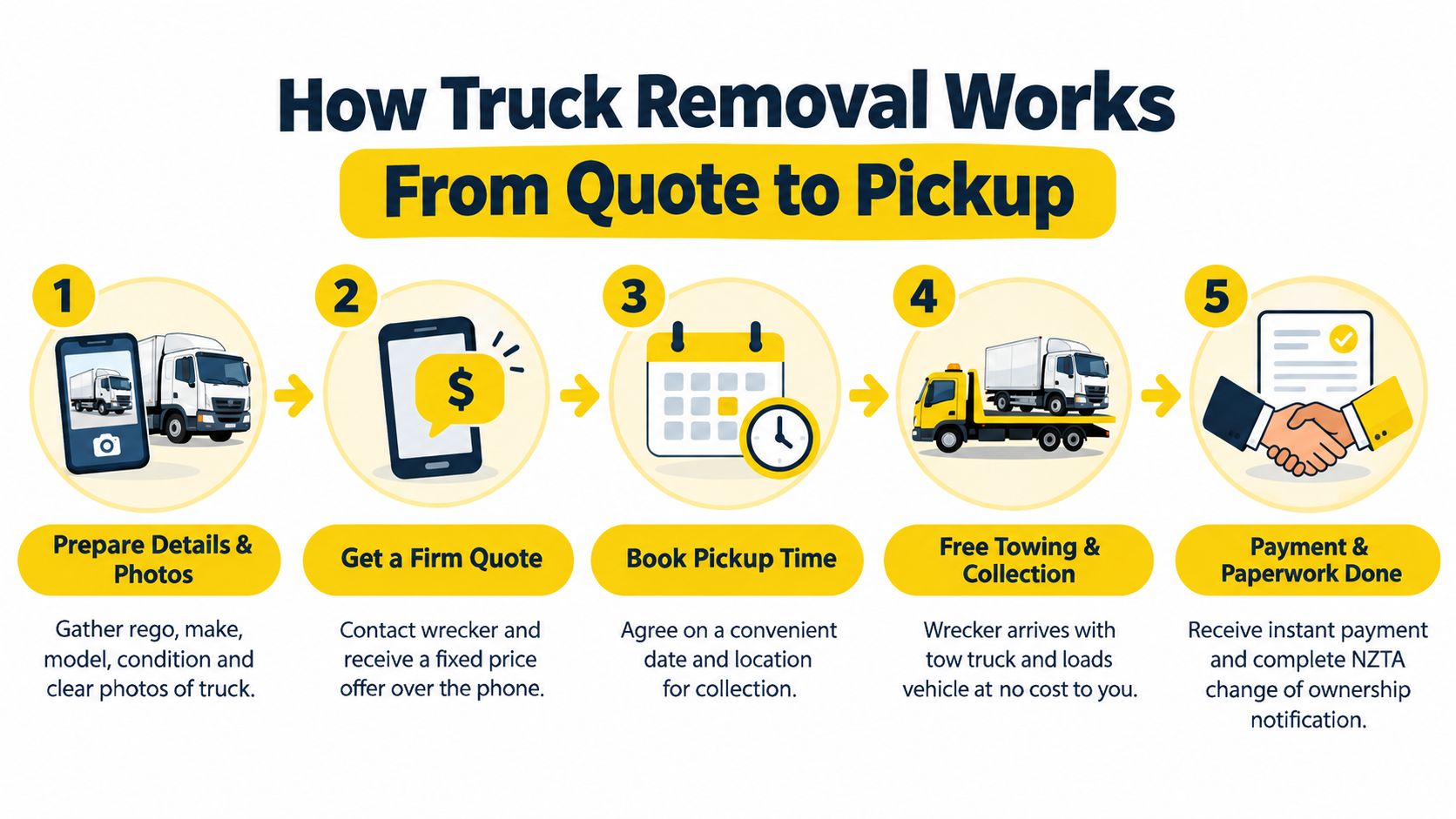
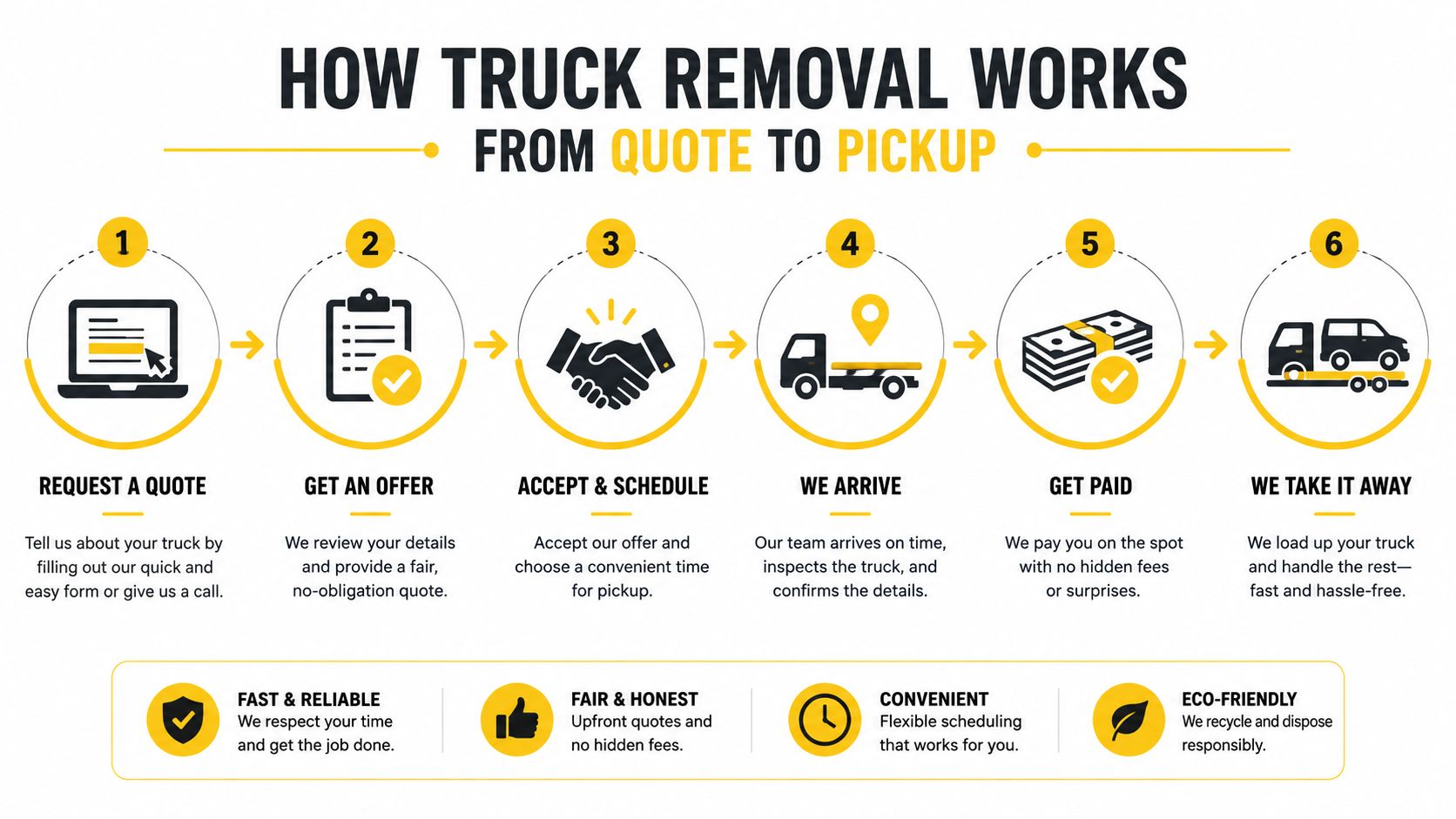
The smoothest collection starts with accurate information. Send the registration, make, model, approximate year, location and condition, then explain whether the truck rolls, steers and brakes. Photos of the front, rear, sides, cab, wheels, damage, engine bay and access route let the operator distinguish a straightforward tow from a recovery job.
A firm phone quote should account for likely parts demand, recoverable material, condition and collection difficulty. Ask whether the amount is honoured at pickup, with no towing fee or unexpected deduction. For local Northland work, planned timing may include same-day Whangārei city collections and next-day rural runs, subject to access, route and equipment requirements. Free towing within roughly 100 km of Whangārei is a service condition to confirm directly before booking, not an assumption to make about every operator.
What happens on collection day
The operator checks the truck against the information provided, confirms the location and prepares the loading method. If the vehicle is non-rolling, the crew may need to winch it into position or use appropriate lifting equipment. Keep gates open, remove personal belongings and clear loose items from around the truck so the crew can work safely.
Payment should be completed before loading when that forms part of the agreed arrangement. The seller and buyer then complete their respective NZTA notifications. An on-site process is useful because it reduces the chance that the seller forgets to notify the agency after the truck has left.
Accident write-offs may require insurer or ownership documentation. An abandoned truck requires lawful authority from the owner or property controller, not permission from someone who happens to occupy the site. Hybrid and EV collections need high-voltage isolation before dismantling, and the battery's condition and handling requirements can affect the assessment.
For a related explanation of collection arrangements, see this vehicle pickup guide.
The final destination is a controlled dismantling yard, where depollution comes before parts removal and material recovery. That sequence gives the seller a documented disposal path instead of leaving a damaged vehicle to deteriorate on private land.
Getting the Best Outcome With a Northland Truck Wrecker
The best outcome isn't necessarily the highest scrap estimate. It is a clear transaction that matches the truck's parts potential, recoverable material, collection difficulty and compliance requirements. A complete work truck with a wanted drivetrain may deserve a parts-based assessment, while a stripped, non-rolling shell may be better understood through its weight and loading requirements.
Before requesting quotes, gather the registration or chassis details, ownership evidence, photos, damage information and exact location. Be honest about missing parts, flat tyres, locked wheels, soft ground and restricted access. Accurate details help the wrecker bring the right equipment and reduce the chance of a disagreement at pickup.
For Northland owners, local practicalities matter. Bridge axle limits, rural access, distance from Whangārei and the condition of the yard can all shape the collection plan. A suitable operator should explain the quote, confirm whether towing is included, manage fluids, batteries, tyres and airbags responsibly, and complete the NZTA notification process.
Historical removal data shows why this service exists at scale. A Ministry of Transport scrappage trial recorded an average scrapped-vehicle age of 20 years, with Christchurch at 21 years and Wellington at 18.2 years, while New Zealand-new light vehicles averaged 18.7 years at scrappage compared with 16.7 years for used imports, according to the NZTA vehicle fleet research record. Industry reporting citing NZTA figures also recorded 156,000 vehicles written off or removed from the road in one year, showing the wider scale of the removal and recycling pathway.
If your truck, ute, van, bus or machinery is occupying space and no longer makes financial sense to repair, request a firm assessment rather than guessing from generic scrap prices.
Car Removals Whangarei buys trucks and machinery in almost any condition, provides free towing within roughly 100 km of Whangārei, and completes NZTA ownership notifications at pickup. Visit Car Removals Whangarei to request a phone quote, describe the vehicle and arrange a practical Northland collection.
- truck wreckers nz
- truck wreckers
- truck removal NZ
- truck salvage NZ
- cash for trucks