· Car Removals Whangarei
Scrap Car Removal Whangarei Cash Towing and Paperwork
A dead car can turn a tidy Whangārei driveway into a storage problem surprisingly quickly. Perhaps it's a deregistered hatchback that hasn't moved for years, a ute with a blown motor on a Northland property, or an accident-damaged vehicle that's too far gone to repair. You may know you want it removed, but still wonder what it's worth, who pays for towing, and whether your responsibility ends when the truck arrives.
Scrap car removal is more than lifting a vehicle onto a tow truck. A proper handover covers qualification, valuation, access, payment, ownership notification, deregistration questions and responsible dismantling. The price usually reflects a combination of kerb weight, reusable parts and current steel pricing, not the vehicle's age.
This guide follows the process in the order a first-time seller experiences it. You'll learn how to identify a genuine scrap vehicle, describe it accurately for a firm quote, understand what happens to fluids and hazardous components, prepare for pickup, and deal with the NZTA paperwork that protects you after removal. It also compares scrap removal with private sale, salvage and abandonment, so you can choose a disposal route that fits the vehicle and your property.
Table of Contents
- Introduction to Scrap Car Removal in Whangarei and Northland
- What Qualifies as a Scrap Car and What Does Not
- How Scrap Value Is Calculated From Weight Parts and Steel
- Environmental Disposal and Responsible Dismantling Practices
- Payment Towing and NZTA Paperwork From Quote to Pickup
- Choosing the Right Disposal Option for Your Situation
- Final Checklist for a Smooth Scrap Car Removal
Introduction to Scrap Car Removal in Whangarei and Northland
Consider a common Northland situation. A non-running car sits beside the shed, partly covered by a tarp. The tyres have lost pressure, the registration has lapsed, and the owner has stopped checking whether the engine will turn over. It occupies useful space, but moving it feels like a job requiring a trailer, machinery and several phone calls.
A dismantler looks at a different set of questions. Is the vehicle complete? Can it roll, or will it need skates, a winch or specialist loading equipment? Does the model have parts that are still wanted? Is the body mostly metal, or has someone already removed the engine, gearbox, catalytic converter or panels? Those details help determine whether the vehicle is mainly a parts asset, a metal load or a combination of both.
New Zealand's end-of-life vehicle system is substantial. Research estimates that about 150,000 end-of-life vehicles are generated nationally each year, while a separate study estimated 25,500 vehicles are abandoned annually and recorded at least $6 million a year in local-authority recovery and disposal costs. The same research estimated that roughly one in five deregistered vehicles is dumped. Those figures are reported in research on New Zealand's end-of-life vehicle and abandoned-vehicle system.
That context matters locally. Scrap car removal gives private owners, farmers, landlords and repair businesses a lawful route between an unwanted vehicle and its eventual recycling or dismantling. It isn't merely a tow-away service. The handover should leave the site clearer, the seller paid, and the vehicle's ownership record handled properly.
The following sections answer the practical questions in sequence. First, you'll identify what qualifies as scrap. Then you'll see how weight, parts demand and steel prices interact, followed by the environmental dismantling process. After that comes the pickup workflow, including payment and NZTA notification, before a comparison of alternative disposal paths and a final preparation checklist.
What Qualifies as a Scrap Car and What Does Not
A scrap car is generally a vehicle whose repair cost, condition or remaining usefulness makes normal resale impractical. It might be rusted, stripped, seized, deregistered, accident-damaged or unable to roll. A vehicle doesn't have to be completely crushed or missing every valuable component to qualify.
Start with the vehicle's practical condition:
- Non-running vehicles: A blown engine, failed transmission or severe electrical fault can make a car uneconomic to repair.
- Rusted shells: Structural corrosion, especially around the chassis, floor or suspension mounts, can make a vehicle unsuitable for road use.
- Stripped vehicles: Missing engines, gearboxes, wheels, catalytic converters or interior parts reduce what a dismantler can recover.
- Seized or non-rolling vehicles: Locked wheels, missing tyres and vehicles sitting on their hubs require different loading methods.
- Deregistered or failed-WOF vehicles: These may still contain useful parts, but they aren't necessarily suitable for a straightforward private sale.
A farm paddock shell is a clear example. It may have started as a repairable ute, but years outdoors can leave the body corroded, the tyres flat and the steering seized. A flood-damaged insurance write-off presents a different risk. It may look complete, yet water can affect wiring, control modules, safety systems and the interior. A ute with a blown motor may have much more recoverable value because its gearbox, panels, wheels, differential and other components may still be wanted.
Age is only one clue
Older doesn't automatically mean worthless, and newer doesn't automatically mean valuable. New Zealand transport material records that the average scrapping age rose from 17.2 years to 19.5 years since 2000, while useful-life estimates are commonly placed at about 15 to 16.9 years and 150,000 to 250,000 km, depending on vehicle type and use. These figures appear in Ministry of Transport road-safety and vehicle data material.
A separate New Zealand scrappage-trial paper found an average removed vehicle was 20 years old and had travelled 214,500 km, which reinforces an important point. Many vehicles reaching dismantling still contain mechanically complex systems and usable components. A car's age helps establish context, but condition, completeness, model and distance travelled matter just as much.
If you're unsure whether your vehicle is scrap or unwanted, describe it plainly and include photographs. Guidance on removing unwanted, damaged and abandoned vehicles is also available through local advice about junk car removal. Accurate information prevents a mismatch between the phone quote and the condition found at pickup.
How Scrap Value Is Calculated From Weight Parts and Steel
A scrap quote is built from three related sources of value. Kerb weight provides the metal foundation, recoverable parts create additional value, and steel pricing affects what the shell is worth when it reaches the recycling stream. A dismantler considers all three rather than applying one flat amount to every old vehicle.
Kerb weight establishes the metal base
Kerb weight is the vehicle's mass in normal operating condition, excluding occupants and cargo. A heavier van, 4WD or truck usually contains more steel and other recoverable material than a small hatchback. That doesn't mean weight alone sets the payout, because a complete vehicle may also contain parts with stronger demand.
A stripped shell can therefore be worth less than a complete vehicle of the same model. Missing wheels, drivetrain components, panels or other major items reduce the material and parts available for recovery. A non-rolling shell may still be collected, but loading takes more planning and the quote needs to reflect its actual condition.
Parts demand changes the calculation
A dismantler checks whether components can be tested, stored and resold. Engines, gearboxes, panels, doors, wheels, differentials and interior parts may carry value when a matching model remains common on Northland roads. A Hilux or Hiace, for example, may attract parts interest that a less commonly supported vehicle doesn't, even when the vehicles appear similar in size.
The condition of each component matters. A blown engine doesn't automatically make the rest of the ute worthless, while a flood-damaged vehicle may require careful isolation before any parts decision is made. Tell the buyer what you know, including whether the engine turns, whether the vehicle ran before storage, and which components have already been removed.
Steel pricing completes the picture
Steel and other metal enter a changing recycling market. Current steel pricing affects the value assigned to the shell, but the quote also reflects handling, transport, depollution and the labour needed to separate usable components. The aim is a realistic total, not a number based on the body shape alone.
Practical rule: The most useful quote description includes the make, model, approximate year, location, registration status, running condition, completeness and whether the vehicle rolls.
Honest disclosure protects both sides. If a seller says the car is complete and rolling, but the pickup team finds a shell with locked wheels and missing drivetrain parts, the original valuation may no longer match the load. For a deeper explanation of the factors that influence an offer, see scrap car prices and valuation considerations.
Environmental Disposal and Responsible Dismantling Practices
A vehicle is not ready for the scrap pile because it no longer drives. It contains oils, coolant, fuel, refrigerants, batteries, airbags, tyres, plastics and electronic components. Responsible dismantling removes or isolates those materials before the metal shell is processed.
The easiest analogy is dismantling a house. You wouldn't begin by flattening the building if you still needed to recover the doors, wiring and fixtures, or if water pipes were full of contaminated liquid. A vehicle is handled in the same broad order, valuable and hazardous items first, bulk metal afterwards.
Recovery starts before crushing
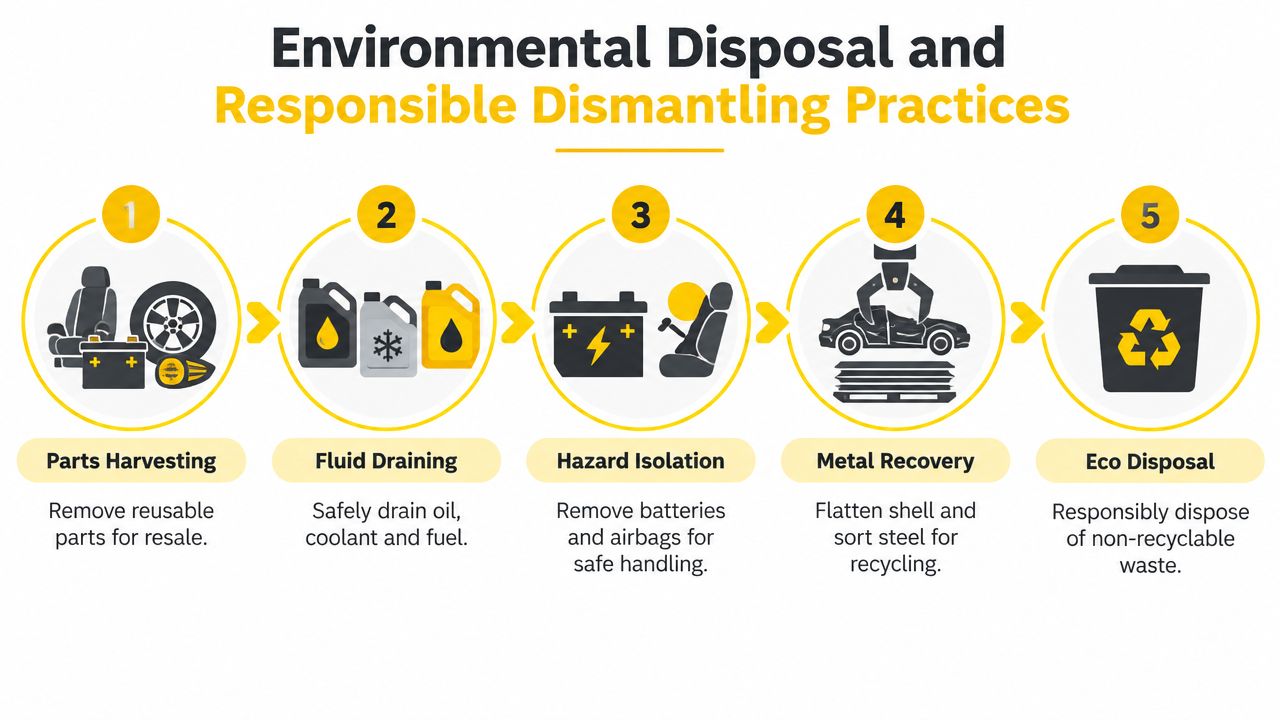
The usual sequence is:
- Reusable parts are removed. Panels, engines, gearboxes, wheels, lights and other components are assessed for safe recovery and potential reuse.
- Fluids are drained or contained. Oil, coolant, fuel and similar liquids need controlled handling rather than release onto a driveway or yard.
- Hazardous components are isolated. Batteries, airbags and other safety-related items require suitable procedures before the shell is moved through the next stage.
- The shell is flattened and shredded. Once useful and hazardous components have been dealt with, the remaining body is prepared for metal recovery.
- Residual material is managed. Non-metallic fraction that can't be recovered is typically sent to landfill.
This process is described in New Zealand's statistical overview of end-of-life vehicle processing. The same overview notes that lead-acid batteries can be recycled domestically at a dedicated plant in Wellington, including batteries from electric cars.
Containment protects the property
Dismantling should take place on a surface that prevents fluids from soaking into soil. Official waste-management guidance used within South Africa's environmental framework states that dismantling should occur on a concrete floor connected to an oil-water separation system. Although that guidance isn't New Zealand-specific, the control reflects a sensible vehicle-dismantling principle, keep contaminants contained and prevent pollution from reaching drains or waterways. The technical requirement appears in the official waste-management guidance.
For a Northland seller, responsible disposal means the job doesn't end when the truck leaves. It includes appropriate handling of oil, coolant, batteries, tyres, airbags and contaminated components. Hybrid and electric vehicles need particular care because their high-voltage systems and traction batteries aren't treated like ordinary 12-volt batteries.
A clean handover protects more than the vehicle's resale value. It also protects the ground beneath the vehicle and the people handling it.
Payment Towing and NZTA Paperwork From Quote to Pickup
The smoothest pickup begins with a complete phone description. Give the dismantler the vehicle's make and model, location, registration status, running condition, completeness and rolling status. Mention access restrictions, steep driveways, narrow gates, soft ground and whether another vehicle blocks the car.
For Northland collections, the advertised service model includes free towing within roughly 100 km of Whangārei, same-day city scheduling and planned rural runs. The exact appointment depends on the vehicle, access and route. A suitable operator should confirm the quoted amount, pickup timing, payment method and any special loading requirements before dispatch.
What happens at the property
A practical handover usually follows this order:
- The driver checks the vehicle. This confirms that the condition matches the description and that the loading plan is safe.
- Payment is made before loading. The service provides payment by cash or instant bank transfer, rather than leaving the seller waiting after removal.
- The ownership notification is completed. The registered person and buyer complete the required transaction details before the vehicle departs.
- The vehicle is loaded. Winches, skates, lifting equipment or other suitable methods may be needed for seized or non-rolling vehicles.
- The seller keeps a record. Retain the payment confirmation and any paperwork supplied for your own files.
The ownership step deserves more attention than the tow itself. NZTA says the registered person must notify it immediately when a vehicle is sold, given away or disposed of, and a change of registered person isn't complete until both parties have completed their part. The process can be completed online or with the MR13B paper form, and NZTA's vehicle buying and selling factsheet says the buyer's certificate of registration is mailed within 10 days.
Formal cancellation is different from transfer
A vehicle being towed away doesn't automatically mean its registration has been formally cancelled. NZTA says a registered vehicle being scrapped should be handled through a vehicle recycler or wrecker, and the owner must contact NZTA if selling a registered vehicle as scrap metal. If the owner wants to cancel registration first, an application to cancel it is required.
NZTA also keeps deregistered vehicle entries on the Motor Vehicle Register for historical and enforcement purposes. When the registered person or insurer confirms that a vehicle is no longer to be registered, the record can be cancelled in the register while remaining available as a legal reference. The NZTA guidance on scrapping a vehicle explains the formal MR15-style request and the difference between cancellation and lapse through prolonged non-renewal.
On-site completion reduces the liability gap. Before the truck leaves, have your identification and ownership details ready, confirm who is completing each NZTA step, and ask for evidence that the transaction was submitted.
For more detail on the handover process, see NZTA change-of-ownership guidance.
Choosing the Right Disposal Option for Your Situation
The right disposal route depends on what you're trying to achieve. A private sale can suit a roadworthy, complete vehicle with a realistic repair or resale market. Scrap removal is usually more practical when the car is non-running, heavily damaged, stripped or expensive to transport. A salvage tender may suit a vehicle with identifiable repairable value, but it can involve more waiting, inspections and paperwork.
| Disposal Option | Best For | Payment Timing | Towing and Paperwork |
|---|---|---|---|
| Private sale | Complete vehicles with a plausible repair or resale path | Usually arranged with the buyer | Seller and buyer organise transport and ownership steps |
| Salvage tender | Insurance or accident vehicles with assessable salvage value | Depends on the tender process | May require inspection, collection arrangements and insurer documents |
| Scrap car removal | Rusted, seized, stripped, non-running or non-rolling vehicles | Confirmed before loading with the dismantler | Towing and ownership handover are arranged as part of the pickup |
| Abandonment | No legitimate disposal situation | No lawful payment route | Creates recovery, notification and disposal problems rather than solving them |
A farmer clearing a paddock may value certainty more than waiting for a private buyer. A landlord or body corporate dealing with an abandoned vehicle needs written owner authorisation and a clear record of the removal. A panel beater holding an insurance write-off may need insurer documentation alongside the vehicle details.
Hybrids and EVs require another layer of care. The traction battery can affect value, but high-voltage isolation must be handled by people with suitable procedures and equipment. Don't attempt to strip a battery or move a damaged electric vehicle without explaining its condition to the removal service.
A simple decision test
Choose private sale if the vehicle is complete, accessible and likely to interest a buyer who understands its faults. Choose salvage if you can support an inspection process and the vehicle has a clear repair or component market. Choose scrap removal when the main priorities are safe collection, prompt payment, lawful handover and relief from storage or transport work.
Abandonment isn't a disposal strategy. New Zealand research links abandoned vehicles with substantial local-authority recovery and disposal work, as covered earlier. If a vehicle is on private land, get the owner's authority where possible and use a documented removal route.
Car Removals Whangarei is one local option for cars, vans, 4WDs, trucks and machinery in varied conditions, with towing and NZTA notification handled as part of its stated pickup process. Compare any provider by checking the quote terms, payment timing, loading capability and paperwork responsibilities rather than relying on the headline offer alone.
Final Checklist for a Smooth Scrap Car Removal
Before booking, make the vehicle easy to describe and the pickup easy to complete. You don't need to make an abandoned or non-running car look presentable, but accurate information prevents avoidable delays.
- Confirm the condition: Note whether it starts, rolls, steers, has keys, and still contains its major parts.
- Record the location: Give the exact address and explain gates, slopes, soft ground, tight access or blocked driveways.
- Describe the paperwork: State whether the vehicle is registered, deregistered, insured, held in an estate or subject to another person's ownership.
- Ask for the complete quote: Confirm whether towing is included and whether the amount is firm if the described condition is accurate.
- Remove personal property: Check the glovebox, boot, door pockets, under-seat areas and storage compartments.
- Prepare access: Clear obstacles and make sure the truck can reach the vehicle or that the driver knows where specialist loading will be needed.
- Confirm payment: Agree whether you'll receive cash or an instant bank transfer and ensure payment is made before loading.
- Complete NZTA notification: Don't assume the tow itself transfers responsibility. Finish the ownership step at pickup and retain confirmation.
- Check special risks: Identify flood damage, fire damage, airbags, hybrid systems, EV batteries, leaking fluids or unstable ground before the truck arrives.
Non-rolling shells, seized vehicles and machinery can be handled when the removal team knows what it is collecting. The important detail is disclosure, because the right equipment and loading plan depend on the vehicle's actual state.
Once the price, access, payment and NZTA responsibilities are clear, scrap car removal becomes a straightforward property-clearance job rather than an uncertain tow-away. You get space back, the vehicle enters an organised dismantling process, and the handover leaves a useful record.
Car Removals Whangarei provides firm phone quotes, free towing within roughly 100 km of Whangārei, payment by cash or instant bank transfer before loading, and on-site NZTA ownership notification for eligible pickups. To discuss a rusted car, non-rolling shell, damaged ute, hybrid, EV or machinery removal, visit Car Removals Whangarei and arrange a pickup.
- scrap car removal
- Whangarei car removal
- cash for scrap cars
- car towing Whangarei
- NZTA deregistration