· Car Removals Whangarei
Private Number Plates NZ: Buy, Move and Keep
The advice you hear most often is simple. Sell the car, tick the ownership box online, and the private plates leave with the keys. That advice is wrong, and it is why people around Whangārei still open toll and infringement mail after the ute has already gone.
A private plate in New Zealand is a regulated right to a set of characters. It is not a sticker that follows the vehicle by default. Notifying a sale, keeping or selling the plate, and taking an unroadworthy vehicle off the register are three separate NZTA actions. Miss one, and the registered person can stay on the hook.
If you want the combination, the physical plates have to come off before a dismantler collects the vehicle. A pickup note does not move the entitlement. What follows is how private number plates NZ work, from the right itself through the charges, the forms, the display rules, and the morning a tow is booked.
Table of Contents
- What a Private Plate Actually Is
- Personalised Plate Fees to Budget For
- How to Buy or Move a Private Plate
- Display Rules a Custom Plate Still Follows
- Selling or Scrapping a Car With Private Plates
- How Common Private Plates Are in Northland
- Remove the Plates Before the Tow
What a Private Plate Actually Is
Say a household in Kamo has a sedan with a short word on the plate and a caption underneath. The family treats that plate as part of the car. It isn't.
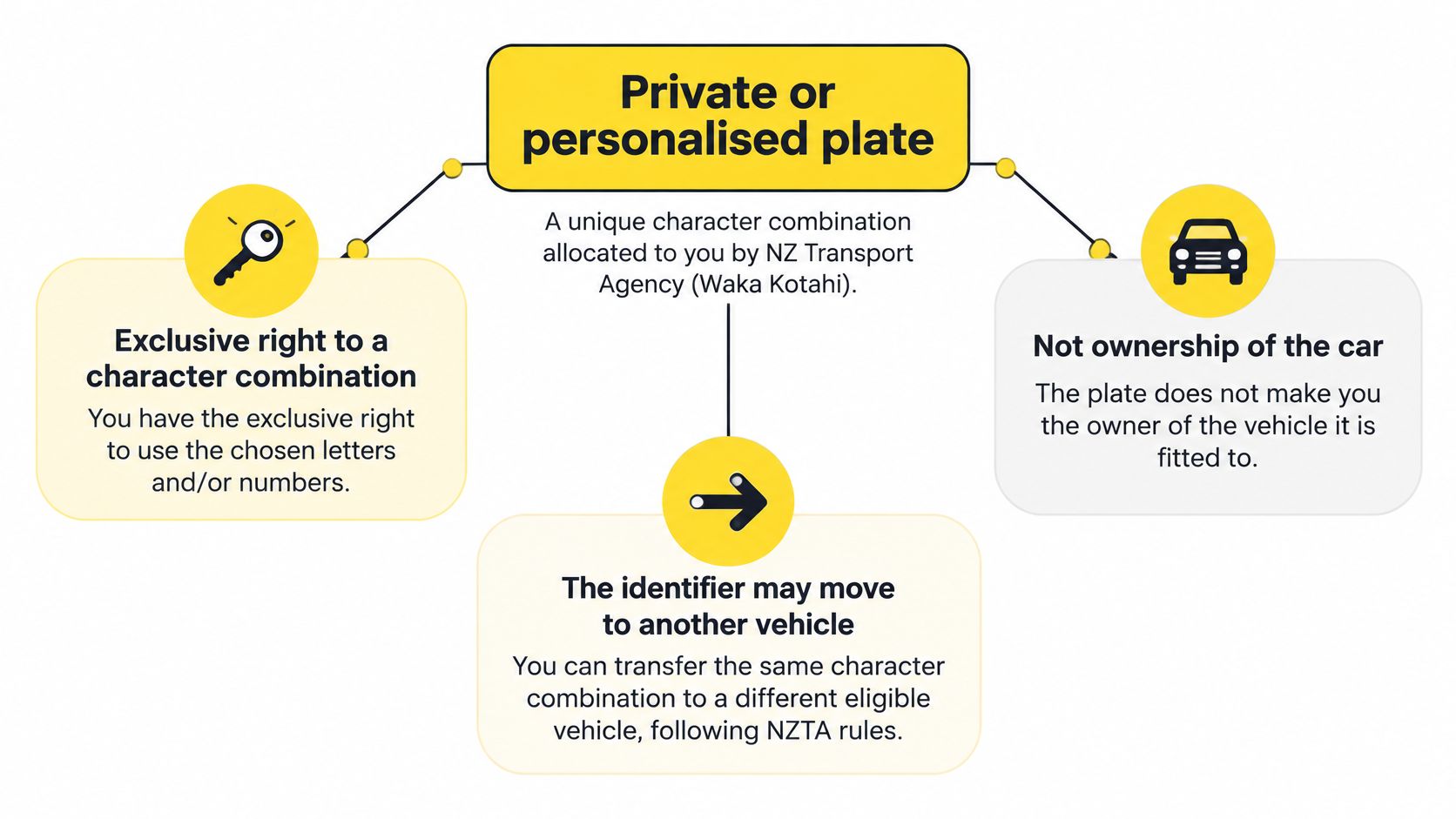
In New Zealand, a private or personalised number plate is an exclusive right to a specific character combination, not ownership of the vehicle it is bolted to. The NZTA number plates guidance states that the identifier can contain up to six letters, numbers, or a mix, and may include an approved caption, message, or slogan.
Think of the plate as a reserved name, and the car as the house where that name is currently displayed. Selling the house, dismantling it, or writing it off does not cancel the name. You can keep the entitlement and later put it on another vehicle. Ordinary registration, and any change of registered person, stays a separate job from that right.
The Motor Vehicle Register counts three relevant types together: PERSONALISED, SPECIAL ISSUE, and INVESTMENT. You don't need a history lesson on each label. You need to know your combination sits in that regulated group, not in the paint or the bumper.
To move the personalised plate onto another vehicle, the holder completes the NZTA Application for replacement plate (MR6A) and presents the physical plates at an approved registration agent. If the plates go with the sale, NZTA requires a separate transfer of entitlement. Handing over the car, or even handing over the plates, does not finish that legal transfer.
Practical rule: If you intend to keep the identifier, deal with the physical plates before the vehicle is handed over.
Personalised Plate Fees to Budget For
Price the plate charge before you fill in a form or book a truck. The NZTA regulatory fee schedule lists personalised plates for standard vehicles at $34.96 per pair and personalised plates for motorcycles, mopeds, tractors, and trailers at $30.72 per plate. The personalised-plate exchange tied to form MR17 is a distinct item. Moving a plate you already hold is not the same purchase as ordering a new combination.
NZTA personalised plate charges
| Transaction | Applies to | Published charge | What it is not |
|---|---|---|---|
| New personalised plates | Standard vehicle | $34.96 per pair | Not the price of a rare combination sold privately |
| New personalised plate | Motorcycle, moped, tractor or trailer | $30.72 per plate | Not a pair charge |
| Personalised-plate exchange (MR17) | Moving an existing plate between vehicles | Listed as its own transaction | Not the same as buying a new plate |
| Ordinary vehicle licensing | The car itself | Separate from plate fees | Not included in the plate charge |
These figures are the scheduled plate charges. They are not what a private seller may ask for a sought-after combination. Someone can pay far more for the right to the letters than NZTA charges to issue the physical plates. The schedule also leaves out licensing the vehicle, a replacement certificate, and any towing.
A sedan, then a bike
Take a standard car. You are buying one pair, so the published plate charge is $34.96. This fee is for issuing the pair of plates. It does not include the year's licensing, nor does it cover any amount the previous owner may have paid for the word itself.
Take a motorcycle, moped, tractor, or trailer. The schedule uses $30.72 per plate, not a pair price. A farm trailer or a commuter bike should not be budgeted on the car figure. The unit on that line is a single plate, so the invoice looks different even when the characters are the same length.
Why the exchange sits on its own line
Ordering fresh characters and shifting characters you already hold are different jobs at the counter. MR17 appears as its own transaction, which is the signal that an inter-vehicle exchange is administratively separate from a new issue. You should not assume the pair price includes the move.
Confirm the current schedule with an NZTA agent before you pay. A later change to the dollar amount would not change the rule that an exchange is its own item, distinct from buying a new plate and distinct from licensing the car.
How to Buy or Move a Private Plate
A private plate does not follow the car automatically. Buying a new combination and transferring one you already hold are separate NZTA processes.
Buying
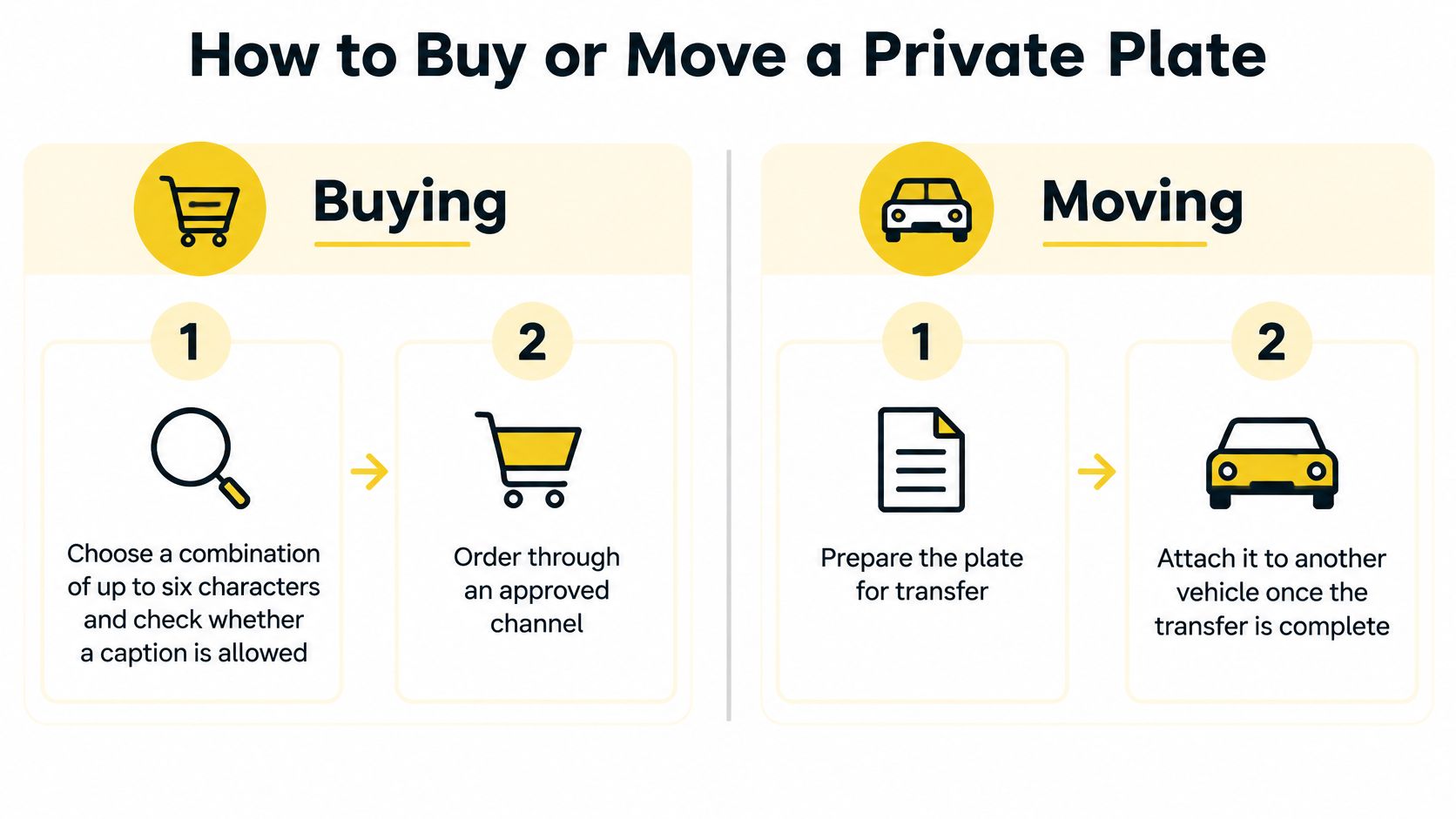
- Choose the characters. Select a combination of up to six letters, numbers, or both. Check whether a caption, message, or slogan is allowed with your chosen design.
- Order and pay the plate charge. For a standard vehicle, the published pair charge is $34.96. For a motorcycle, moped, tractor, or trailer, the published charge is $30.72 per plate.
- Fit the plates. Once issued, mount one plate at the front and one at the rear of a normal motor vehicle.
Buying creates a new plate entitlement and new plates. It does not move an existing combination from another vehicle, or replace the change-of-registered-person notice when a vehicle is sold.
Moving a plate you already hold
To move a plate you already hold, complete the NZTA MR17 exchange form at a registration agent. MR17 is the exchange process. MR6A is a separate application for replacement plates, not an alternative way to complete an exchange.
- Complete MR17. Take the form and one plate from each vehicle to the registration agent.
- Provide a New Zealand address. The process requires a physical and mailing address in New Zealand.
- Receive the new licence label. The agent issues a label showing the new plate number for the vehicle.
- Wait for the certificate. Once NZTA accepts the exchange, it posts a replacement certificate of registration to the registered person within seven days. The exchange is complete when NZTA accepts it; the certificate records the change.
An exchange does not replace the ordinary change-of-registered-person notice. The buyer and seller must still notify NZTA when ownership changes. Deregistration is separate too. If the vehicle is going to a dismantler, complete the exchange and remove the plates before collection, even if the vehicle is a non-runner or statutory write-off.
Display Rules a Custom Plate Still Follows
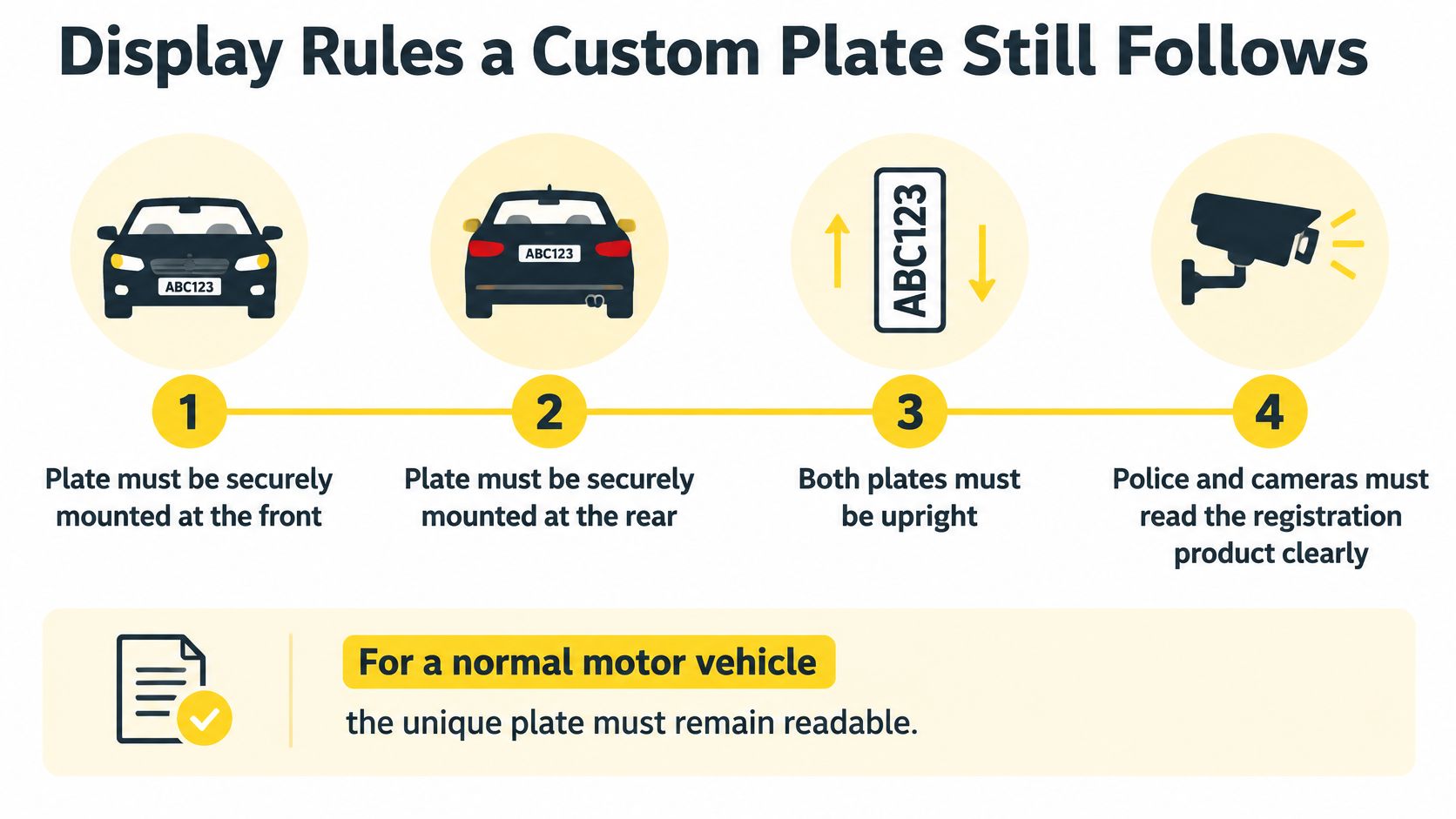
A custom layout does not get a softer reading test. For a normal motor vehicle, one plate is securely mounted at the front and one at the rear, both upright, so the unique identifier stays easily visible at all times. The Land Transport (Motor Vehicle Registration and Licensing) Regulations require personalised plates to be displayed in the same manner as ordinary plates. A clever character mix does not allow bending, covering, tinting, or parking the plate where it cannot be readily read. A caption, message, or slogan is part of that readable face.
Why the face has to stay camera-readable
Private plates are registration products, not decorations. A silver-fern directional security mark was added in 1998. The modern plate typeface dates from March 2006, and the matching font for personalised plates from February 2006. Police later tested a black-backed reflectorised personalised format in 2021 and 2022 at 31 existing automatic-number-plate-recognition sites across Auckland, covering several camera manufacturers. The Waka Kotahi decision documents record that 100% of those cameras could read standard white reflectorised plates in daytime and nighttime testing. The black-backed plates went on sale on 1 September 2022 after joint approval by Police and Waka Kotahi.
Mount both plates upright, fixed, and clean. Don't obscure a caption with a frame, and don't lean a plate in the windscreen as a stand-in for a proper mount. If you are also sorting ordinary plates on a car you no longer drive, the notes on plates for cars sit alongside these display rules.
A custom design never licenses a hidden, bent, or loose plate.
Selling or Scrapping a Car With Private Plates
A car sale, a plate transfer, and deregistration are three separate NZTA actions. Completing one does not complete the others. Before the vehicle changes hands, notify NZTA that you have sold it. If you do not, tolls, tickets, and other charges may still be linked to you as the registered person.
Three jobs when a plated car changes hands
| Action | What it does | What it does not do |
|---|---|---|
| Notify change of registered person | Tells NZTA who holds the vehicle so tolls, tickets and licensing follow the right person | Does not transfer the private-plate entitlement |
| Transfer of entitlement | Moves the character right to the buyer when the plates are part of the sale | Is not completed by handing over the car or the plates |
| Retain and exchange the plates | Keeps the identifier for the current holder via MR6A or MR17 before disposal | Is not done by deregistering the vehicle |
| Deregister an unroadworthy vehicle | Takes a vehicle that will not be driven off the register | Does not end sale liability or move the plate |
The order depends on what you want to happen to the plate. If the buyer is getting the characters, complete the transfer of entitlement. If you are keeping them, remove the plates and complete the MR6A or MR17 exchange before the car is disposed of. Deregister only if the vehicle will not return to the road.
Notify the handover, transfer or retain the plate, and deregister only if the vehicle will not return to the road.
Write-offs, abandoned cars, and scrap
A tow truck may arrive before the paperwork is finished. For a write-off, remove the plates if you intend to keep them, then continue with the insurer or buyer process. If a car has been abandoned, the registered person should decide what happens to the plates rather than leave that decision to a collector. For a scrap sale, choose whether to retain or transfer the plate before booking pickup.
At collection, Car Removals Whangarei completes the NZTA change-of-ownership notification. From the time it takes possession, the vehicle is the business's responsibility. That notification does not transfer a private-plate entitlement, so handle the plate separately. Remove any plates you are retaining, as well as personal items and accessories you want to keep. The business is not responsible for items left in the vehicle after collection. Find the steps for NZTA registration and change of ownership.
How Common Private Plates Are in Northland
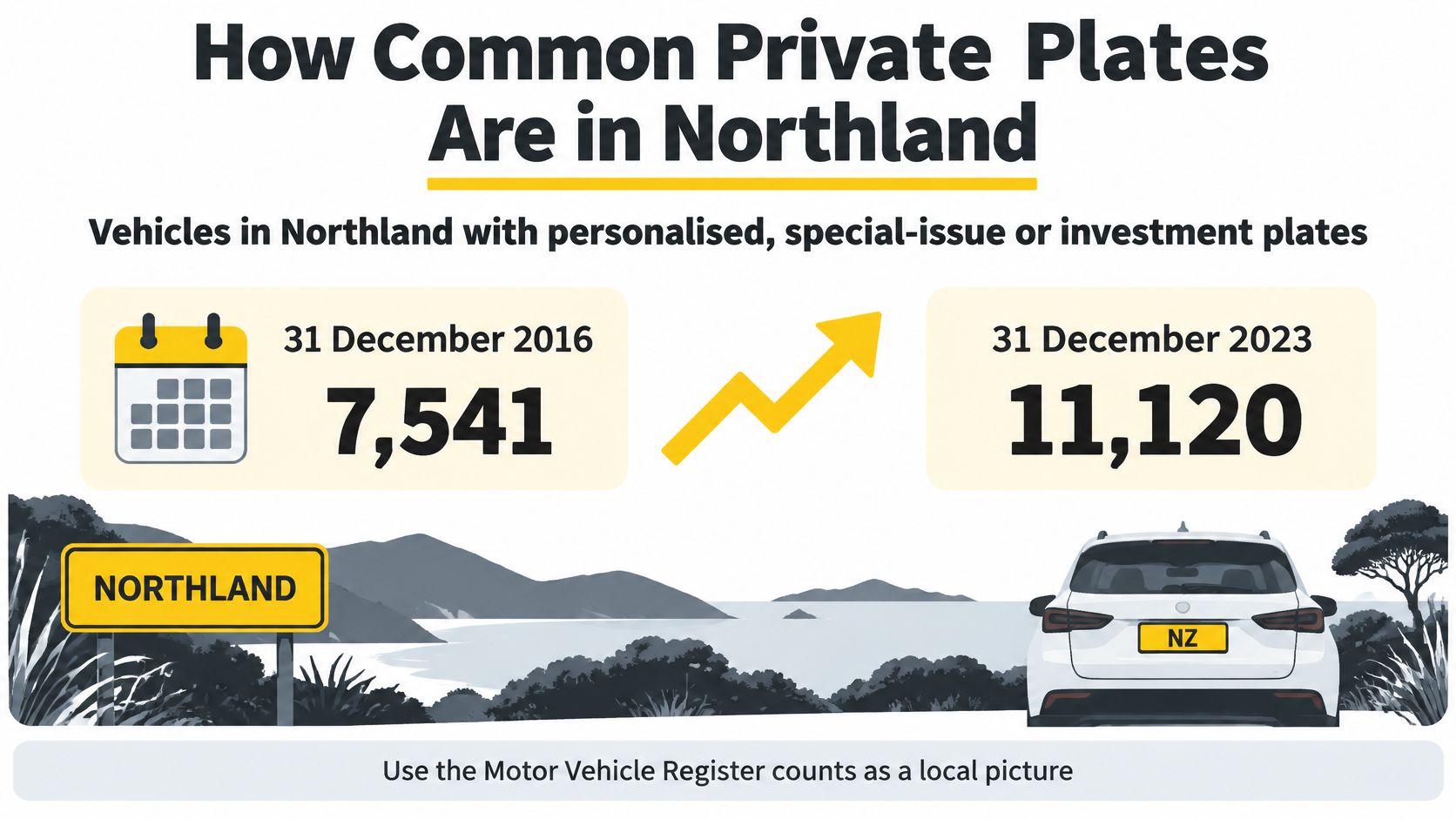
A private plate can be easy to overlook when a vehicle is headed for sale or collection. Yet the Northland register shows that these plate types are part of local motoring: vehicles with personalised, special-issue, or investment plates increased from 7,541 at 31 December 2016 to 11,877 at 31 December 2025. That is 4,336 more vehicles, or approximately 57.5%. The total rose every year across that period. Waka Kotahi Motor Vehicle Register data records the change.
What the count actually measures
The figures count vehicles with active registration in Northland at each year-end. The category groups PERSONALISED, SPECIAL ISSUE, and INVESTMENT plates together, so it does not show personalised plates alone.
By the end of 2025, nearly 11,900 actively registered Northland vehicles carried one of those plate types. That is a regional count, not a count of plates sold in Northland or of owners who plan to keep their plates.
What that means on a driveway
A written-off ute in Kamo or a deregistered car on a farm could still have a plate combination its owner wants to retain. The register count gives useful context, but it does not change the steps: the vehicle sale, the plate entitlement and deregistration are separate NZTA actions. A private plate does not transfer with the car by default, so remove it before a dismantler collects the vehicle.
Remove the Plates Before the Tow
Finish the physical handoff the same day you book collection, after you have already decided whether the combination stays or goes.
- Unbolt both plates if you are keeping them. Put the plates with the MR6A or MR17 paperwork before the truck arrives, not in a box you meant to fetch from the shed.
- Photograph the evidence. Shoot the front plate, the rear plate, the VIN, and the odometer so the pickup record matches this vehicle and not a similar one in the yard.
- Clear what you want to keep. Personal items, child seats, and accessories stay your property only if they leave the car first. Leftovers are not the collector's responsibility once the vehicle is loaded.
- Bring identity and ownership proof. Photo identification and proof the vehicle is in your name, such as the registration papers or the rego record, are what we need at the door.
- Tell the driver the plate decision out loud. Say whether the plates stay with you or travel with the car. Don't assume collection completes a transfer of entitlement.
For Whangārei and wider Northland, we collect unwanted, damaged, or non-running vehicles and complete the NZTA change-of-ownership notification when we take possession. That ends the seller's vehicle liability from that point. It still does not move a personalised plate. Phone 0800 99 55 99 for a firm quote. Most Whangārei addresses are collected the same day, and wider Northland within 48 hours, with payment of $200 up to $15,000 in cash at pickup before loading. The yard is at Unit 8E/50 Kioreroa Road, Port Whangārei. If the car is a non-runner or a shell, scrap car removal in Whangārei is the collection path, with the plates already off if you are keeping them.
Car Removals Whangarei buys unwanted, damaged, and non-running vehicles around Whangārei and Northland, and we complete the NZTA change-of-ownership notice when we take possession. Bring the private plates off first if you are keeping the combination, because our pickup ends the vehicle liability and does not transfer that plate right. Visit Car Removals Whangarei to arrange a quote and a collection time.
- private number plates nz
- personalised plates
- NZTA plate transfer
- plate fees
- vehicle deregistration