· Car Removals Whangarei
Insurance Write Off NZ: What It Means and Your Options

Does a write-off mean the car is scrap? Stand at a damaged-vehicle auction and you'll hear a dozen confident answers, most of them wrong for the specific car in front of you. Some vehicles there will never hold a registration again. Others will be back on Northland roads within weeks, carrying a damage note on their file and a valid warrant. The word "write-off" doesn't separate those two cars. The recorded category does.
Insurance write off NZ rules split into two questions, and mixing them up is where owners lose money. The first is who pays for the damage. The second is what the vehicle can legally do next. Your insurer answers the first. The Motor Vehicle Register answers the second.
Table of Contents
- Write-Off Categories at a Glance
- Register Flags and What Buyers Must Check
- Which Damaged Vehicles Can Be Repaired
- Comparing Your Options
- How to Transfer a Written-Off Vehicle
- Choose Your Write-Off Path Before You Sign
Write-Off Categories at a Glance
Does an insurance write-off mean a car is unsafe, or only that its repair costs exceed its value? The answer depends on the category recorded and, for safety, whether the damage has compromised the vehicle's safe tolerance. An insurer's payout decision and the vehicle's registration status are separate parts of the record.
NZTA's guidance on insurance claims explains when an insurer must cancel a vehicle's registration: the vehicle has been damaged, the insurer decides not to repair it, and the damage has compromised its safe tolerance under the Land Transport Rule: Vehicle Repair 1998. When all three conditions apply, it is a statutory write-off. The registration is cancelled. A repairable economic write-off is different: its safe tolerance remains intact, even though the insurer has decided repair is uneconomic.
The payout description alone does not identify the category. Nor does a single register code explain what can happen next. Check the insurer's recorded decision and the vehicle's registration information together, rather than treating a write-off label as a complete guide to road use.
Understanding the distinction matters as total losses become more common in insurance claims. Insurance Business New Zealand's roundtable report reports that around 13% of motor-insurance claims in New Zealand were total losses in 2025, compared with approximately 3% ten years earlier. A category on the vehicle's file can affect its legal path, regardless of the payout figure.
| Category | What it means | Registration outcome | Road return path |
|---|---|---|---|
| Economic repairable write-off | Repair cost exceeds the insurer's value, but safe tolerance is intact | Registration is not automatically cancelled | Repair and inspection, with a WoF or CoF once compliant |
| Statutory write-off | Damage compromises safe tolerance and the insurer decides not to repair | Registration cancelled | Return to the road only after repair and LT308 certification by an approved repair certifier |
| Salvage or non-repairable | Vehicle judged not safely or economically repairable | Cancelled; recorded as unsuitable for normal use | Dismantling or parts recovery |
| Fire, flood or water damage | Damage may affect electrical, drive or structural systems and create safety risks | A safety flag may apply; specialist assessment may be required | Assessment first; some severe cases cannot be certified |
Fire, structural and water damage can raise safety concerns, but the cause of damage alone does not establish the vehicle's category or whether it can return to the road. Compare the insurer's letter with the register record before deciding what the next step can legally be.
Register Flags and What Buyers Must Check
Could a car pass a visual inspection and still be barred from registration? Yes. An insurer's write-off decision can leave a record that affects what happens when the vehicle is repaired, sold or transferred. The number plate and odometer will not show that history, so check the register and paperwork before agreeing a price.
The flag that outranks a clean inspection
A structural damage flag prevents a vehicle from obtaining a WoF or CoF while the flag remains. It can be removed only after proper repair and inspection establish that the vehicle meets the manufacturer's safe-tolerance specifications, as explained in NZTA's written-off and damaged vehicles guidance. Fresh tyres and tidy panels do not alter the register. A repair that has not been assessed by the appropriate certifier does not clear the flag either.
Check three records before committing money:
- Search the Motor Vehicle Register. Look for a damage or safety flag before discussing price. The result can affect the vehicle's legal path and value.
- Ask for the insurer's cancellation and loss documents. These identify the recorded cause and category. A seller's description of a “light hit” is not a substitute for the insurer's record.
- Keep copies of the paperwork. Retain the insurer's letter, register search, repair invoices and certification documents. A future buyer may need to understand how the vehicle's status was resolved.
The register status also helps explain why similar-looking cars can have different values. A vehicle may still have recoverable parts, metal or battery value even if its route back to road registration is restricted. The damage and official record matter more than appearance alone.
Where imports add a layer
Imported damaged vehicles can arrive with a history that needs checking against New Zealand's requirements. In 2015, approximately 17,700 of the roughly 150,000 used light vehicles imported into New Zealand, about 12%, were classified as having substantial damage requiring repair certification before road registration, according to NZTA's 2015 import figures. NZTA estimated that fewer than 1,000 water-damaged vehicles were imported that year, less than 0.7% of used light-vehicle imports, while noting that an exact figure was unavailable.
Write-off categories also differ between countries. Australian states define write-offs differently, so an overseas record may not translate directly to the New Zealand register. A vehicle that appears to have minor damage may still have a formal write-off history here. Check the local record rather than relying on how the vehicle was described overseas.
Warning signs at the point of sale
- Airbags deployed, with no certification paperwork. Deployment is a reason to examine the structural and repair records, not just the panels.
- No insurer letter. Without the cancellation record, the seller cannot show the recorded category and cause.
- Flood-affected electrics, with no specialist report. Water can affect modules, connectors and wiring that a clean interior does not prove safe.
- A price based on road use. If the paperwork does not support registration, do not value the vehicle as though it can be driven.
Pause rule: If the seller cannot show the cancellation record, the register status and a certification plan, stop before buying. A low repair quote may leave out the structural assessment that determines whether the vehicle can return to the road.
Which Damaged Vehicles Can Be Repaired
A normal repair estimate proves nothing about roadworthiness on a written-off vehicle. The trigger sits in the paperwork. Documentation containing terms such as "statutory", "written off", "salvage", "junked" or "non-repairable" requires referral to a specialist repair certifier, and evidence of fire or water damage triggers the same requirement, under NZTA's threshold for requiring repair certification.
The sequence matters as much as the work. Certification must begin before repairs, with an initial assessment, documented photographs, inspections during the repair and a final inspection that produces an LT308 repair certificate where compliance is established. Repair first and you've handed the certifier nothing to compare the finished job against.
These indicators push a vehicle into technical scrutiny.
- Distorted chassis rails or cross-members. Straightening one is a measured, jig-based job, not a pull with a chain and a tree.
- Damaged suspension mounting points. Geometry faults surface as tyre wear months after the panel work looks finished.
- Compromised welded seams, or corrosion in structural members. Both change how the shell behaves in the next impact.
- Deployed airbags or seat-belt pretensioners. Replacement records belong in the file, not in a text message.
| Damage or document | Specialist referral | Evidence to keep | Repair route |
|---|---|---|---|
| Structural or chassis damage | Yes | Initial assessment, photographs, inspection reports | Repair under certifier supervision, ending in LT308 |
| Documents marked statutory, salvage, junked or non-repairable | Yes | Insurer write-off letter and cancellation record | Referral before any repair begins |
| Fire damage | Yes | Fire report, photographs, assessment notes | Some severe cases ineligible for entry certification |
| Flood or water damage | Yes | Water-line photographs, electrical assessment notes | Specialist assessment first; electrical and drive systems checked |
| Airbag or seat-belt pretensioner deployment | Yes | Airbag replacement records, inspection photographs | Structural inspection before certification |
| Cosmetic panel damage only, safe tolerance intact | No | Insurer estimate, repair invoices | Standard repair and WoF inspection; confirm with an entry certifier |
Some severe water or fire damage is ineligible for entry certification altogether, and no repair budget changes that. The workable test is simple. If the vehicle fails any trigger above, price the certification before you price the repairs, or plan for dismantling instead.
The order that saves money: assessment first, photographs second, repairs third. A certifier who sees the damage untouched can write the plan the repair has to follow.
Comparing Your Options
Four routes open up once the category is known, and they rank roughly from most road use to least. Choosing between them comes down to three inputs, how severe the structural and safety damage is, what the repair costs against what the vehicle is worth, and what certification will demand.
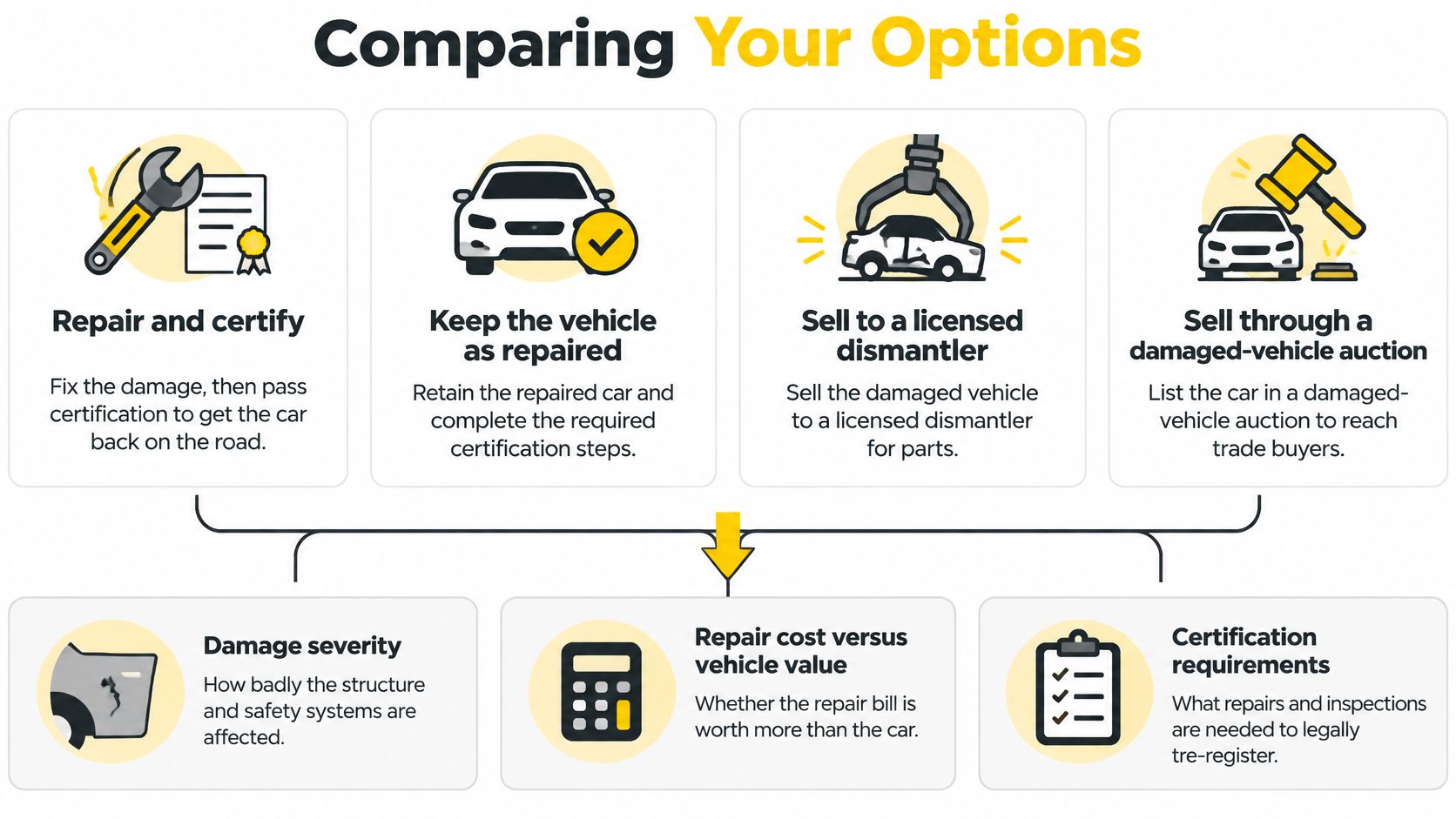
Repair and certify is the only route that ends with the car back in normal service, and it hinges on the certification result rather than on optimism about the damage. Keeping the vehicle as repaired is that same route with a different finish line, where you retain the car yourself and carry the recorded damage history on its file. Both depend on a certifier signing off the structural work first.
The two disposal routes are often confused with each other. A damaged-vehicle auction places your car in front of trade buyers, so the outcome depends on what that buyer intends to do with it, and you should check the register before bidding closes rather than after. Selling to a licensed dismantler ends the vehicle's road life permanently and converts it into parts, metal and battery value.
| Option | Best when | Paperwork needed | Road use afterwards |
|---|---|---|---|
| Repair and certify | Cause is repairable, safe tolerance can be restored and repair cost is justified | Entry assessment, repair records, LT308 certificate | Yes, once certified and registered |
| Keep as repaired | Owner intends to keep the vehicle and certification is complete | LT308 certificate, registration restored, inspection record | Yes, with the damage history recorded |
| Sell to a licensed dismantler | Non-runner, flood, fire or structural damage with no certification route | Insurer documents, NZTA ownership notification, removal record | No; vehicle leaves the road |
| Sell at a damaged-vehicle auction | Insurer manages the sale and the owner has no direct buyer | Insurer sale terms, buyer's inspection records | Depends on the buyer's certification; check the register first |
One number you shouldn't accept without a second opinion is the insurer's salvage tender. Get at least one competing offer from a dismantler so you can see what the parts and metal are worth in the open market, and compare the two on a like-for-like basis with towing and paperwork included. Whangarei owners weighing that comparison can start with damaged car buyers in Whangarei and put a firm figure beside the insurer's.
Disposal rule: if certification can't be reached at a sensible cost, compare disposal offers before committing to repairs. Repairs you can't certify are money spent twice.
How to Transfer a Written-Off Vehicle
The paperwork runs in a fixed order, and skipping a step stalls the next one. Treat the sequence below as the spine of the whole job, whichever route you end up choosing.
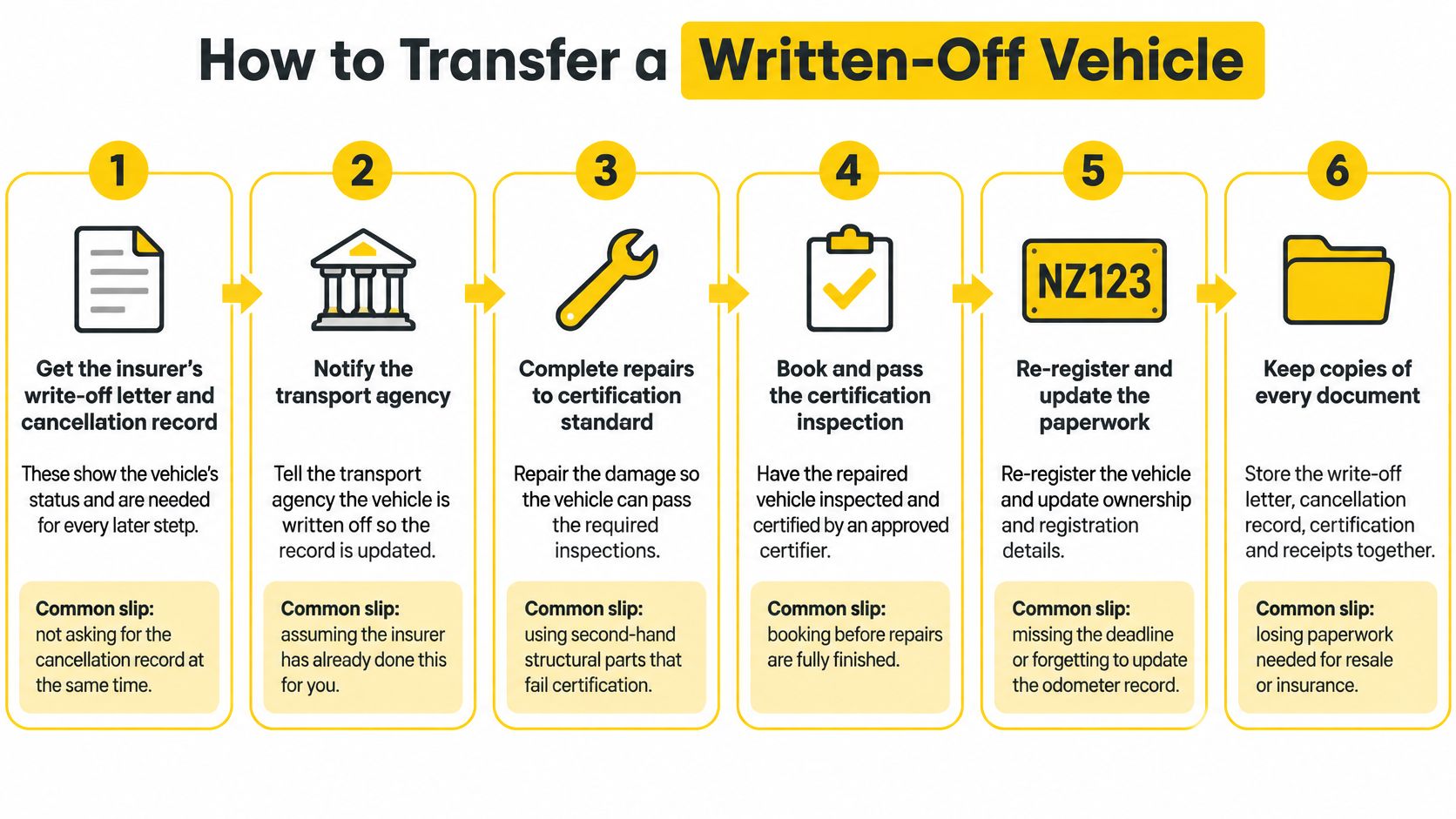
- Get the insurer's write-off letter and cancellation record. These documents state the recorded damage category, and every later decision depends on them. The common slip is relying on a phone description instead of the paper.
- Confirm salvage rights with the insurer before you sell anything. If the insurer retains the wreck, selling it without that check can breach the settlement terms and complicate your payout.
- Run the register check. The current flag decides whether you're on a certification route or a disposal route. Skip it and you'll price the car against the wrong future.
- If you intend to repair, start entry certification before any work begins. Repairs done first can complicate the specialist assessment, because there's no untouched baseline to inspect.
- Complete the NZTA change-of-ownership notification when the vehicle is sold or collected. The common slip is assuming the buyer will handle it. Until it's filed, the liability stays with you, and the NZTA registration change of ownership process sets out what the record needs.
- Keep the removal or sale receipt, the notification confirmation and any written removal confirmation together for the claim file. Insurers ask for these weeks later, when the details have gone fuzzy.
Every one of those documents earns its place at resale or at claim time. Store them in one folder, digital or paper, and keep it until the claim is formally closed.
Choose Your Write-Off Path Before You Sign
Three questions settle the route faster than any debate about payout figures. Which category did the insurer record? Is there a flag on the register right now? Can certification be reached at a cost the vehicle justifies?
Answer those and you're choosing between four known paths rather than guessing. If the answers point to disposal, the transfer steps above tell you what paperwork to collect. If they point to repair, the certification sequence decides the order of work.
Two offers, no cost: the insurer's salvage bid is one number, not the market. Request a written dismantler offer as well and compare them side by side before you sign anything.
For Whangarei and Northland owners, Car Removals Whangarei can put a written offer against an existing settlement, and it often pays more than an insurance salvage bid, particularly on late-model utes, 4WDs and European cars, with comparing the number costing you nothing. It accepts insurer documentation and supplies written confirmation of removal for your claim file, completes the required NZTA notification when it takes possession, and from that point the vehicle is its responsibility. Ask which documents it needs and how it handles the ownership notification before you rely on the details, then use a car valuation for insurance figure as your baseline.
Start today with the cheap steps. Confirm the category from the insurer's letter, check the Motor Vehicle Register, then get two written offers before you commit to repairs, a sale or a signature.
Car Removals Whangarei buys accident and insurance write-offs outright, including statutory losses and vehicles damaged by flood, fire or hail, and it completes the NZTA ownership notification at pickup so the vehicle stops being your responsibility. Send through the insurer's letter and you'll get a firm figure before loading, with free towing within about 100 km of Whangarei. Visit Car Removals Whangarei to book a collection or check what your written-off vehicle is worth.
- insurance write off nz
- NZTA write-off
- salvage vehicle NZ
- vehicle registration NZ
- damaged vehicle NZ