· Car Removals Whangarei
Cars for Parts in NZ: A Practical 2026 Guide
Your old car's sitting on the drive, the rego's overdue, and every week you keep telling yourself you'll sort it out. Then you look at the repair estimate, look at the driveway space it's wasting, and realise the car's become a problem, not a vehicle. That's the point where cars for parts stops being jargon and starts being the practical option.
The smart move is to separate three things straight away, the car's mechanical state, its legal status, and its recoverable value. A dead engine doesn't mean the vehicle is worthless, it just means the quote now depends on what's left to dismantle, recycle, and resell. If you're in Northland, don't guess, check the paperwork, inspect what's there, and be honest about the condition before anyone turns up with a truck.
Table of Contents
- When the Car on the Driveway Stops Making Sense
- What Cars for Parts Means in New Zealand
- Where to Find Cars for Parts in NZ
- How Wreckers and Removers Value a Vehicle
- NZTA Deregistration and the Paperwork That Protects You
- Buying Parts Vehicles Versus Selling Them Whole
- The EV and Hybrid Battery Question Most Guides Skip
- Your Pre-Call Checklist Before You Contact a Remover
When the Car on the Driveway Stops Making Sense
A Whangarei driveway full of a car that won't start is a familiar mess. The rego's expired, the battery's flat, rust has started around the edges, and another vehicle is already doing the daily runs. At that point, you've got four realistic choices, repair and relicence it, sell it whole, trade it where someone will accept it, or hand it over for dismantling.
Separate the problem before you call anyone
Start with the hard question, is the car still worth putting back on the road, or is it only worth what can come off it? A failed warrant, flood damage, a seized motor, or serious rust can make continued use uneconomic, but the shell can still hold useful value in reusable components and recyclable metal. That's why a car that's past sensible repair can still be a legitimate cars for parts candidate.
Practical rule: if the car wouldn't pass a basic honesty test on the street, don't describe it as roadworthy to a buyer or remover.
Before you ring a wrecker, get the basics together. Find the keys, plates, registration papers, service history, and proof of ownership. Check whether there's finance on it, whether it's tied up in an insurance claim, and whether anything removable has already been stripped.
Photograph the car properly, body, interior, odometer, and any major damage. If it's leaking fuel, badly flooded, or unsafe to move, say so plainly. That saves everyone time and stops the quote from being built on fantasy.
A clean handover starts with a clean description. If you hide the bad news, the truck driver still sees it when they arrive, and you've only wasted your own time.
What Cars for Parts Means in New Zealand
In New Zealand, cars for parts means a vehicle is being valued for dismantling, component recovery, and recycling, not for normal road use. That matters because a fair quote comes from what the vehicle can still return after transport, labour, compliance work, and disposal, not from what it once sold for as a drivable car.
The car is a donor, not a promise
A dismantler may pull the engine, gearbox, alternator, starter motor, catalytic converter, headlight clusters, ECU, alloys, glass, and interior trim before the shell goes to metal recycling. Some parts are tested and sold with a warranty, some are sold as visual or non-tested items, and some are only useful as matching body components. Fitment and part numbers matter more than a shiny exterior.
The market covers mechanical wrecks, damaged imports, insurance write-offs, abandoned vehicles, and end-of-life shells. A low-demand model can still be worth dismantling if its parts are scarce, while a complete and desirable vehicle can support a stronger offer because it gives the buyer more to harvest. Sellers should be blunt about whether the car is complete, missing major parts, flooded, fire-damaged, or non-running.
What buyers are really paying for
Buyers are weighing resaleable pieces, compatibility, storage time, and the labour needed to strip the vehicle safely. They also check whether the shell is worth the steel, because kerb-weight and scrap metal value still shape the bottom of the offer. That is why a tidy, complete donor often beats a cosmetically better car that is missing the parts people want.
The EV and hybrid question sits in the same decision. A battery system can add handling risk, specialist work, and disposal costs, so a quote may depend on whether the pack is intact, accessible, or already removed. Do not expect every wrecker to treat that vehicle the same way.
If you are buying, ask whether the part is tested, whether the seller really has it on site, and what happens if it does not fit. If you are selling, do not try to turn a dismantling quote into a retail sale. That only creates friction and delays pickup.
For a local example of a dismantling service model, see Car Wreckers Whangarei. The point is the process, inventory gets stripped for value, then the remaining metal is handled separately.
Where to Find Cars for Parts in NZ
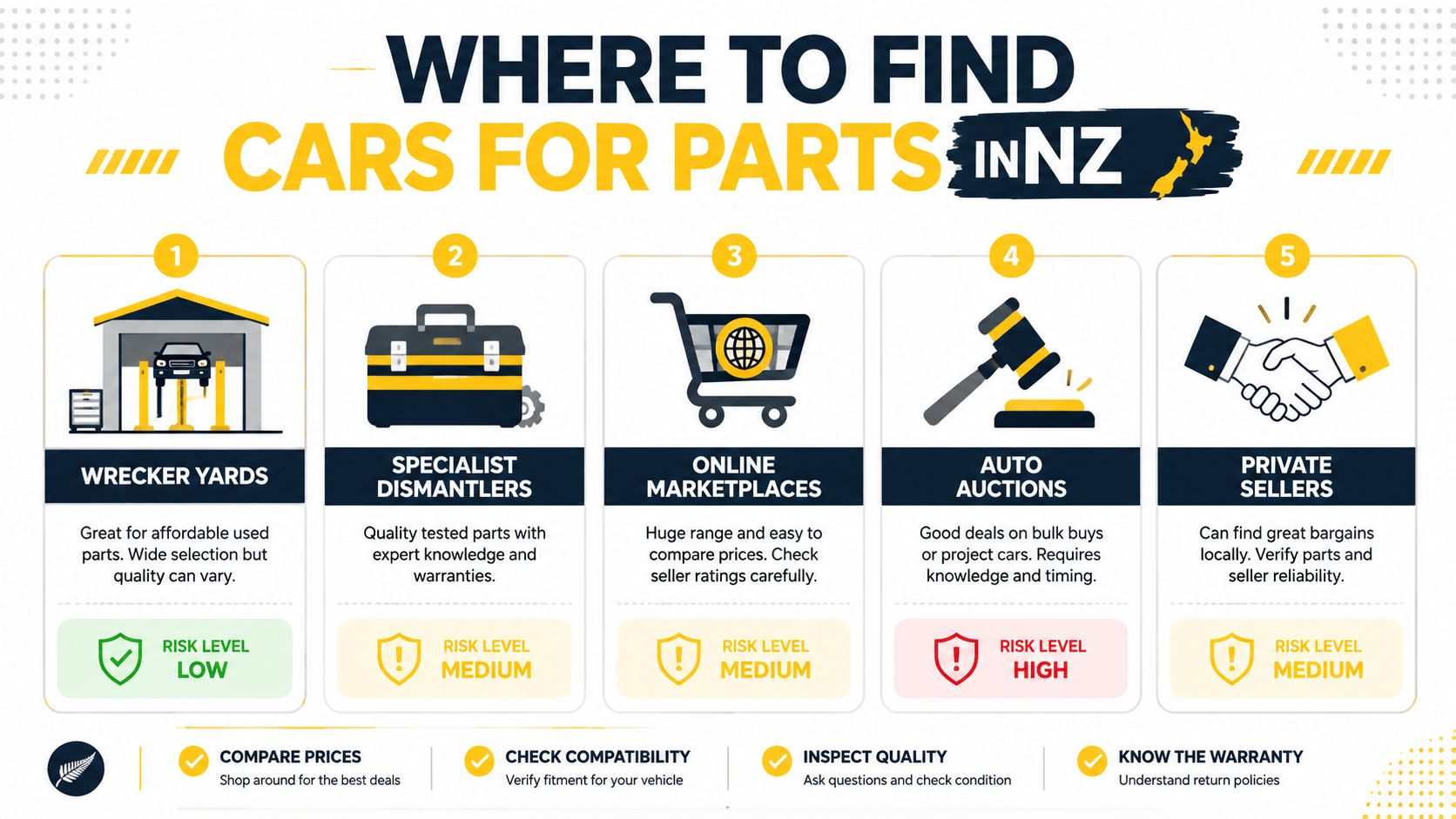
The safest source is still a proper wrecker yard or specialist dismantler. Their inventory is usually tagged by vehicle details, and staff can tell you whether a part is interchangeable, tested, or only suitable as a body component. That's the least painful route because the seller already understands the salvage game.
Five sourcing channels and how they differ
Wrecker yards are the lowest-risk starting point. You get clearer identification, fewer surprises, and less chance of buying a part that was described too loosely.
Online listings can work, but the listing is only a claim. Check the part number, inspect the item before you travel, and don't assume the seller has the part until you've seen it.
Salvage auctions and repairable write-offs can be useful if you want a late-model donor, but structural, water, fire, and deployment damage can wipe out value fast. Don't pay for a vehicle just because the photos look tidy.
Abandoned or council-related vehicles only enter the trade through lawful recovery pathways. Never tow something because it's sitting there and looks neglected.
Farm, dealership, and contractor clearances can uncover old cars that have been parked for years. Those can be cheap, but long-term exposure, missing paperwork, and unsafe fuel systems can turn a bargain into a headache.
Keep the chassis number, match part numbers, and budget for freight before you get too excited.
Why the paperwork matters in the background
NZTA's vehicle-deregistration process isn't just admin, it affects how the vehicle can move through the salvage chain. Licensed dismantlers can handle disposal paperwork as part of the pickup process, while other sales still need owner action through ownership transfer and deregistration. The practical point is simple, if the paperwork is messy, the quote usually gets cautious.
For the official process details, keep the dismantling workflow aligned with the agency's system, and use NZTA's vehicle buying and selling guidance when you're checking what needs to happen before handover.
How Wreckers and Removers Value a Vehicle
A proper quote starts with kerb weight. That is the floor. Steel and aluminium recovery set the base value, so even a dead shell has something behind it before anyone talks about engines, boxes, or electronics.
The quote stack, in plain English
From there, a dismantler looks at what can be sold whole, what has to be stripped, and what is only worth its material content. A complete drivetrain usually lifts the price because it saves labour and brings stronger resale value than a bare shell. Straight, tested parts rate better than damaged or incomplete ones, and the quote should reflect that. The same goes for high-demand items like converters, wheels, lamps, and ECUs, if they are present, clean, and worth reselling.
| Value Driver | What It Adds | Typical NZ Range |
|---|---|---|
| Kerb weight | Base metal recovery | Varies by vehicle |
| Complete drivetrain | Higher dismantling and resale value | More than a shell |
| Catalytic converter | Precious metal recovery | Depends on unit and condition |
| Recoverable body and trim parts | Extra resale value | Depends on demand |
| Clean fluids and battery removal | Better net recovery | Improves the net payout |
Steel pricing still sets the backstop, because the shell ends up as scrap. Catalytic converters matter because the precious metals inside them can shift the payout in a real way. A live, desirable drivetrain usually beats a stripped body every time.
Sanity-check the offer before you say yes
Check the offer against the car in front of you. If it is complete, the price should sit above scrap value. If major assemblies are missing, the number should drop fast. If the remover cannot explain the gap between metal value and parts value, treat that quote with caution.
For a practical pricing benchmark, use how much wreckers pay for cars and compare it with the condition of your vehicle. That is the level of logic you should expect, not a guess pulled out of thin air.
NZTA Deregistration and the Paperwork That Protects You
Once the car is leaving the road permanently, the paperwork has to move with it. NZTA requires the registered person to cancel registration when a vehicle is destroyed, removed permanently, written off, or becomes permanently useless, and if it's taken to a wrecker and dismantled, the owner needs a confirmation letter from the wrecker. That letter is your proof that the vehicle's status changed properly.
What the seller should do
The seller notification needs the plate number plus the full name and address of the person or organisation the vehicle was sold or given to. Both parties are legally required to notify NZTA when a vehicle changes hands, and that's not optional just because the car is going to parts. If a company is the buyer, the buyer notification can't be completed online in the same way as a private sale.
The point of the confirmation letter is simple. It shows that registration and levies stop accumulating once the vehicle is properly handed over and processed. If you skip that step, you're relying on goodwill instead of evidence.
Don't hand over the keys and assume someone else will sort the legal trail later.
Common mistakes that cost sellers
Handing the car over before notification is one. Forgetting the Wrecker's confirmation letter is another. Assuming the words “sold for parts” automatically cancel registration is the third, and that one catches a lot of first-time sellers.
If you're selling to a dismantler, treat the legal handover and the parts handover as one workflow. The car's value includes its paperwork trail, because title liability, plate surrender, and de-registration evidence all sit in the same job. That's the reality, not the theory.
For a straightforward overview of the handover process, selling a car to wreckers is the kind of checklist every seller should read before the truck arrives.
Buying Parts Vehicles Versus Selling Them Whole
Buyers want donors they can strip fast, with the right mix of parts still on board. Sellers want the driveway cleared, the legal paperwork closed, and a payment that beats a straight scrap price. Those motives overlap, but they're not the same thing.
Where the deal works
A buyer wants a complete enough vehicle to recover value. A seller wants a car gone without awkward follow-up, transport cost, or compliance trouble. When the car is complete, accessible, and clearly described, both sides move faster.
Where the deal breaks
A seller often thinks cosmetic tidiness should lift the price. A buyer cares more about what's under the bonnet, what's missing, and whether the car is worth the labour. That gap creates most of the friction in parts deals.
| Buyer Priority | Seller Priority | Watchpoint |
|---|---|---|
| Recoverable parts | Highest possible payout | Completeness matters |
| Easy stripping | Fast removal | Access and towing difficulty matter |
| Correct fitment | Clean legal transfer | Paperwork must be ready |
| Low risk on condition | No post-sale hassles | Be honest about faults |
If you're buying, inspect the body, driveline, interior, electronics, and missing components before you commit. If you're selling, gather the keys, plate details, ownership proof, and any service records that help show what's still there. The smoother the handover, the less everyone argues about value.
The EV and Hybrid Battery Question Most Guides Skip
Still think of cars for parts as engines, gearboxes, exhausts, and scrap steel. That old assumption falls apart with EVs and hybrids, because the battery changes the entire risk profile. You're no longer dealing with a normal consumable part, you're dealing with a high-voltage component that needs proper isolation and handling.
Why standard wreckers treat these differently
New Zealand currently lacks a system for end-of-life EV batteries, and there are still no official guidelines for depleted nickel-metal hydride batteries common in ageing Japanese imports. Industry commentary also points to battery volumes rising sharply, with forecasts cited at about 17,000 batteries by 2025 and 84,000 by 2030 in New Zealand (RNZ reporting on EV battery disposal). That's a real shift, not a niche issue.
The problem isn't just the battery itself, it's the isolation, packaging, storage, and onward pathway. A damaged or tired battery can turn a simple pickup into a specialist job. That's why some wreckers decline certain EVs outright, or discount them heavily until the battery condition is known.
What a fair EV or hybrid quote depends on
A quote for a Leaf, Aqua, or plug-in hybrid shouldn't be based on shell weight alone. Battery condition, risk of damage, and the local pathway for safe handling all affect the number. If the remover can't tell you how the high-voltage system will be isolated, I wouldn't hand the car over blindly.
If the battery condition is unknown, say so before the truck rolls in.
That honesty protects you and the remover. It also stops the job from turning into a surprise when the vehicle is already on the truck. In EV and hybrid disposal, hidden problems don't stay hidden for long.
Your Pre-Call Checklist Before You Contact a Remover
If the car's going, don't make the call blind. Check that the vehicle is yours to dispose of, confirm the plate details, and make sure you know whether it's still registered or already off the road. The quote is much cleaner when the legal status, the battery type, and the physical condition are all known up front.
Run these checks first
- Ownership: Make sure you're the registered person or have authority to dispose of it.
- Plates and papers: Find the number plate, ownership details, and any paperwork you still have.
- Contents: Remove tools, child seats, chargers, personal items, and aftermarket gear you want to keep.
- Battery type: Decide whether it's a normal 12V system, a hybrid battery, or a high-voltage EV setup.
- Photos: Take honest pictures of the front, rear, interior, engine bay, and visible damage.
- Access: Look at the driveway, gates, and turning space before you promise easy pickup.
Northland traps that slow pickups
Steep driveways can change the truck plan fast. Shared rural access can do the same, especially where neighbours, farm tracks, or tight corners affect loading. If the remover knows that early, they can bring the right gear and give you a quote that matches the job.
A decent remover doesn't need a perfect car. They need the truth, the paperwork, and enough detail to price the car as metal, parts, and logistics, not wishful thinking. Sort that out before you call, and the whole job becomes simpler.
If you've got a car sitting on your Whangarei or Northland property and you want it gone without the usual back-and-forth, talk to Car Removals Whangarei about a straight parts-based offer and proper NZTA handling. Visit Car Removals Whangarei to check the service details, then call with the plate number, the vehicle's condition, and the battery type so the quote reflects the job from the start.
- cars for parts
- car removals
- scrap cars NZ
- wreckers Whangarei
- vehicle deregistration