· Car Removals Whangarei
Car Removal for Cash in Whangarei: A Practical Guide
You've got a rusted Hilux behind the cowshed at Maungaturoto, or a dead Civic blocking the carport in Tikipunga. It hasn't moved in months, the WOF is long gone, and every time you look at it, you think about the tow bill, the paperwork and the space it's wasting.
Car removal for cash is simple when you control the five parts of the transaction: the quote, the paperwork, the payment, the pickup and the proof. Get those decisions right and the vehicle leaves without a last-minute price cut or a lingering registration problem. Get them wrong and the truck driving away doesn't necessarily end your responsibility.
Table of Contents
- What Car Removal for Cash Actually Means in Whangarei
- Getting Your Vehicle Ready to Quote
- Your Realistic Disposal Options in Northland
- NZTA Paperwork for a Cash-for-Cars Sale
- How Pickup and Free Towing Work
- What Really Moves the Payout Up or Down
- Your Car Removal for Cash Checklist
What Car Removal for Cash Actually Means in Whangarei
The price on the phone is only the first decision. Before a dead Corolla leaves a Whangarei driveway, you need control over the quote, paperwork, payment, pickup and proof. That five-part transaction is what car removal for cash actually involves. Handle each part properly and you avoid the usual trouble: a reduced offer at the gate, unclear payment, or registration still tied to your name.
A Whangarei dismantler values the vehicle differently from a private buyer. The offer reflects recoverable parts, kerb weight, scrap steel and loading difficulty. A car with a usable gearbox, differential, engine, catalytic converter, wheels or intact interior can bring more than a similar vehicle that has already been stripped. Access also matters. A vehicle on a clear driveway is cheaper to collect than one buried in long grass or blocked behind other cars.
The process should stay straightforward. Describe the vehicle, receive a quote, agree on pickup, hand over the keys, receive payment and complete the ownership notification. The vehicle then goes for assessment, dismantling and processing, not preparation for a retail forecourt.
The truck leaving your driveway isn't the legal finish line. The registered-person notification is.
NZTA requires both buyer and seller to notify the agency when a vehicle changes hands, and recommends completing the notification online at the time of sale. If the vehicle is no longer roadworthy, it must be deregistered. Follow NZTA's vehicle sale guidance while the sale is happening, not days later.
Northland has plenty of vehicles reaching this stage. The NZTA register records 4,309,833 light vehicles, with an average age of 14.8 years. 63.5% are at least 10 years old and 43.3% are at least 15 years old, according to the NZTA vehicle registrations dashboard and open data. Older vehicles commonly face rust, failed WOF inspections or repairs that no longer make financial sense.
Keep these five decisions clear:
- Quote: Give accurate details and get the agreed amount in writing.
- Paperwork: Complete the registered-person change or deregistration.
- Payment: Confirm cash or instant bank transfer before loading.
- Pickup: Explain the vehicle's exact position and access requirements.
- Proof: Keep the receipt, confirmation and buyer acknowledgment.
You are closing a transaction, not merely getting rid of an old car. Save the evidence before the truck leaves.
Getting Your Vehicle Ready to Quote
Don't ring a buyer with only “old Toyota” and an address. The more accurately you describe the vehicle, the less room there is for a revised offer when the truck arrives.
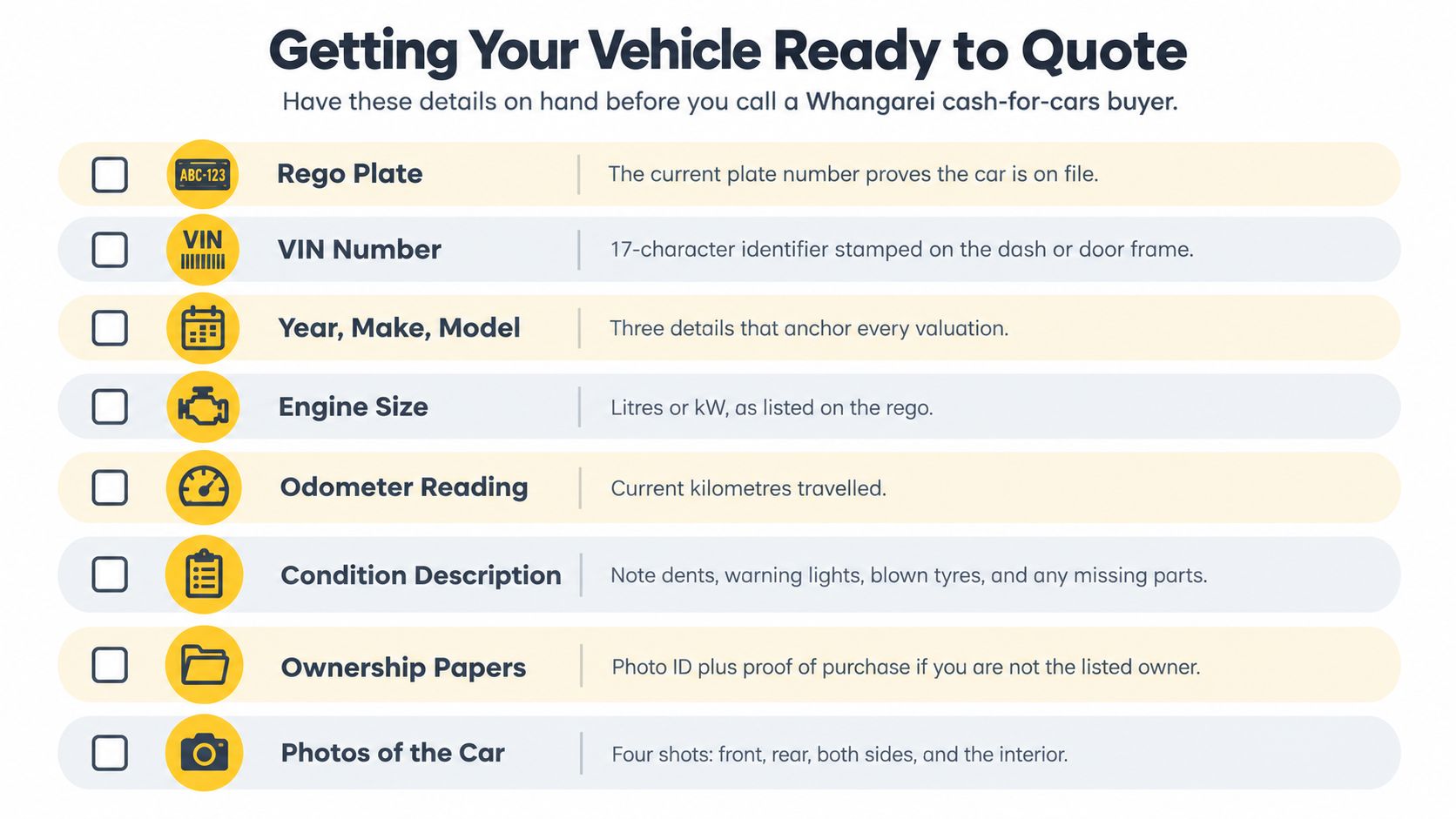
Have these details ready:
- Rego plate: The buyer can use it to identify the vehicle record.
- VIN: Useful when the plate is missing or the vehicle has been stored off-road.
- Year, make and model: Include the exact variant where you know it.
- Engine size: State the litres or engine code if available.
- Odometer reading: Give the current reading, even if the vehicle hasn't run recently.
- Condition: Say whether it starts, drives, rolls, has locked wheels, missing panels or missing parts.
- Location: A Whangarei driveway is different from a steep farm track or a vehicle buried in long grass.
- Ownership papers: Have photo ID and proof of purchase available if you're not the listed owner.
How a dismantler calculates the offer
Book value and Trade Me asking prices don't set a dismantler's number. A dismantler is asking a different question: what can be recovered, how quickly can it be processed, and what will it cost to collect?
A Toyota Hilux differential or Prado gearbox may attract stronger parts demand than an obscure model with limited local buyers. A running alternator, good battery, usable tyres, alloy wheels, tow bar or undamaged interior can also support the quote. The vehicle's weight matters too, because the remaining shell has scrap-steel value at current NZ rates.
Take clear photos before you call. Include the front, rear, both sides, interior, engine bay, wheels and any serious damage. Mention recent parts, aftermarket accessories and faults without dressing them up.
A buyer who arrives expecting a runner and finds a seized engine, missing wheels or a transmission failure will reassess the offer. Honest information protects the number you were quoted.
Your Realistic Disposal Options in Northland
The right disposal route depends on what you need today: a firm quote, quick payment, removal from your property, or the highest possible sale price. Compare the money left after transport, repairs, time and risk, not the biggest number in an advert.
| Option | Typical Payout | Effort Required | Liability & Paperwork |
|---|---|---|---|
| Local cash-for-cars removal specialist | A firm offer based on parts, steel, condition and access | Low, the buyer arranges collection and loading | Confirm payment, transfer or deregistration at pickup |
| Scrap metal yard | Payment based mainly on accepted metal and material value | High if the vehicle must be drained, stripped or transported | You remain responsible until the vehicle and record are dealt with correctly |
| Private sale on Trade Me | Potentially higher asking price if the car appeals to a private buyer | High, including enquiries, viewings, negotiation and delivery | Liability can remain with you until the buyer completes the transfer |
Choose removal when the car is a problem
Call a local removal specialist when the vehicle will not start, has failed its WOF, is badly rusted, blocks a property or needs repairs that make private sale difficult. A good removal deal combines quote, payment, pickup and proof in one controlled handover. Confirm the offer, ask how payment will be made, check that loading is included, and keep a record of the vehicle's condition before the truck arrives.
You are accepting a wholesale-style price. The buyer must recover value from parts and steel, pay for labour and transport, and take on the risk of a difficult vehicle. That lower headline figure can still leave you with more cash once towing, advertising, repairs and wasted time are removed.
Northland dismantlers regularly handle end-of-life vehicles. NZ vehicle fleet information and the NZTA registrations data provide context for the steady flow of vehicles leaving active use. That supply supports dismantling businesses, but it does not give every damaged shell the same value.
Use a scrap yard only if you can do the work
A scrap yard suits a vehicle that is already stripped, drained and ready to move as accepted metal. It becomes a poor deal when you must pay for transport, remove parts, manage fluids or handle hazardous components yourself. Check the yard's acceptance rules before loading anything. A complete unwanted car may not be treated as a simple drop-off.
Sell privately when the vehicle is usable
Private sale can produce a higher top-line figure for a roadworthy, desirable vehicle with clear ownership records. You will handle cleaning, advertising, messages, inspections, negotiation and delivery, while carrying the risk of no-shows.
Use this route only when the car can stand up to inspection and the extra work makes financial sense. A dead vehicle is rarely worth keeping listed because another seller has posted a similar model at an ambitious price.
NZTA Paperwork for a Cash-for-Cars Sale
Paperwork must happen while the vehicle is being handed over. Don't assume the buyer will remember it, and don't leave the keys with a promise that someone will sort the transfer next week.
Follow the sale in the correct order
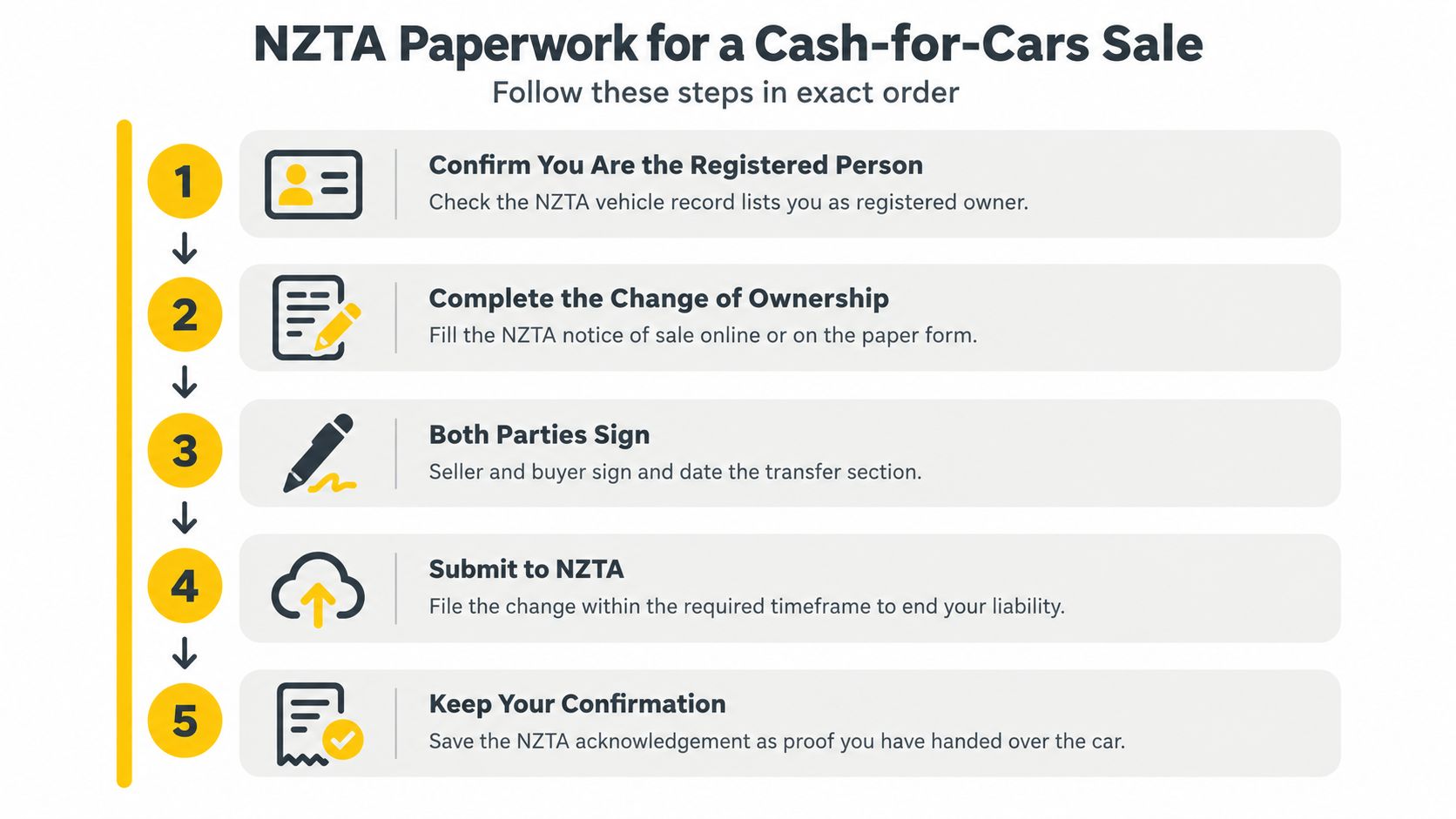
First, confirm the registered person. The person selling must match the vehicle record or have proper authority to act for the registered person. If the owner has died, the vehicle belongs to an estate process, not a casual driveway sale.
Next, complete the change of vehicle particulars. Use the NZTA change-of-ownership process, commonly handled through the MR13A seller notice, with the buyer's details. The buyer has a corresponding notification responsibility, so both sides should complete their part rather than relying on a verbal agreement.
Then, sign and date the transfer. Check the registration number, buyer details and vehicle identity before signing. If the vehicle is being sold as scrap, make sure the disposal route matches the vehicle's status.
Submit the notification promptly. Lodge the required form and fees at a PostShop within the applicable timeframe, which is within seven days of pickup for the sale process described here. Online notification at the time of sale is the cleaner option. This guide to NZTA registration change of ownership explains the practical handover point.
Deal with scrap and unlicensed vehicles separately
A vehicle that is scrap may need deregistration rather than an ordinary sale. Official guidance says an unwanted vehicle that is no longer roadworthy should be deregistered. If you're selling a registered vehicle as scrap, complete the cancellation process and hand in the plates, as explained in Rightcar's guidance on scrapping a vehicle.
Ask the Licensed Motor Vehicle Trader or authorised vehicle dismantler whether a Certificate of Destruction applies to your vehicle and disposal route. Keep the certificate if one is issued. It can provide useful evidence that the car entered an authorised end-of-life process.
An unlicensed vehicle creates another trap. NZTA says the seller remains responsible for licensing fees owed up to the date the change of registered person is notified. If road user charges are overdue at the time of sale, the seller commits an offence under the Road User Charges Act 2012. NZTA's vehicle buying and selling factsheet also warns that delaying the MR13B process can leave the previous registered person responsible for fees.
Save the receipted form, online acknowledgment, payment record and buyer confirmation. If a registration reminder or infringement appears later, you'll need proof that the handover was completed.
How Pickup and Free Towing Work
Once you accept the quote, the dispatcher needs more than an address. They need to know whether the vehicle rolls, whether the wheels steer, how close the truck can get and whether the driveway has a steep turn, narrow gate or soft ground.
Inside Whangarei, a vehicle may be fitted into a city run through areas such as Tikipunga, Onerahi, Raumanga or Maungatapere. Rural collections are usually arranged around a scheduled route or a dedicated flat-deck job. Dargaville, Ruakaka, Mangawhai, Kaikohe and the East Coast often need more planning because the truck has to cover greater distance and the vehicle may require different loading equipment.
Same-day collection is realistic in the city when the vehicle and access suit the available truck. Rural routes commonly need a planned window of two to five days, particularly when the vehicle is non-rolling, oversized or located away from the main road.
Tell the dispatcher what the truck will face
A winch-only truck can pull a car onto a road, but it may struggle with a vehicle buried in long grass, sunk into soft ground or blocked by farm equipment. A 4WD, van, truck or machinery job may need a flat-deck slot.
Give the buyer these details before confirming the booking:
- Loading position: Driveway, paddock, shed, roadside or storage yard.
- Vehicle movement: Starts, rolls, steers, has locked wheels or is a non-roller.
- Access: Gate width, overhead branches, steep slopes and turning space.
- Vehicle type: A Hiace, ute, 4WD or machinery item may require different equipment.
- Contact plan: Confirm whether you'll be home or whether a neighbour has the key and permission.
Free towing normally applies within the operator's service area, but distance, difficult access and specialised loading can affect the final price. Ask whether the agreed quote includes the collection before the truck is dispatched. The car wreckers pickup guide covers the access details that prevent failed collections.
Prepare the vehicle before arrival
Remove tools, documents, child seats, personal items and anything you want to keep. Remove the plates if the vehicle is being deregistered and you've confirmed that step with NZTA. Leave the keys where the driver can access them, but don't hide them inside a locked vehicle without telling the dispatcher.
Take a final photo of the vehicle at the pickup point. It records the condition and location before loading, which is useful if several vehicles are being cleared from one property.
What Really Moves the Payout Up or Down
The quote moves according to what the dismantler can sell or process, not how much you once paid for the vehicle. A late-model Japanese SUV or ute in drivable condition generally sits at the stronger end of the removal market. Common family sedans and hatchbacks occupy the middle. Non-runners, heavily rusted 4WDs and older commercial vehicles usually sit lower unless they contain sought-after parts.
| Factor | Impact on Quote | Direction |
|---|---|---|
| Strong local demand for parts | Valuable engines, gearboxes, differentials and body parts improve recovery potential | Up |
| Drivable condition | A vehicle that starts, rolls and steers is easier to collect and assess | Up |
| Complete vehicle | Wheels, battery, catalytic converter, interior and panels retain recovery value | Up |
| Clean ownership paperwork | Clear records reduce uncertainty at handover | Up |
| Present registration or recent WOF | Helps establish vehicle identity and condition, though it doesn't guarantee a high offer | Up |
| Severe rust or missing parts | Reduces reusable material and increases handling difficulty | Down |
| Difficult access | Adds loading time, equipment requirements or travel complexity | Down |
| Paint colour | Doesn't create dismantling value | Neutral |
| Polished engine bay | Won't repair a failed transmission or rotten panels | Neutral |
An accessorised vehicle can fare better than a stripped one. Alloy wheels, a tow bar, good tyres and an intact interior are useful, while a new battery or working alternator should be mentioned. Don't remove parts before asking for a quote. You may turn a complete vehicle into a lower-value shell.
Timing can matter when a dismantler needs particular stock, such as a common ute or SUV with strong parts demand. End-of-month or end-of-quarter collection pressure may help in some yards, but you shouldn't delay a vehicle that's losing condition or creating a property problem just to chase a possible timing advantage.
The moves that usually matter are accurate photos, complete parts and clean paperwork. Washing the engine bay is not one of them.
Get at least two written offers and compare what each includes. The guide to pricing a scrap car is useful for separating parts value, steel value and towing considerations. Ignore private listings that describe an ideal retail car when yours is a non-runner with rust and no WOF.
Your Car Removal for Cash Checklist
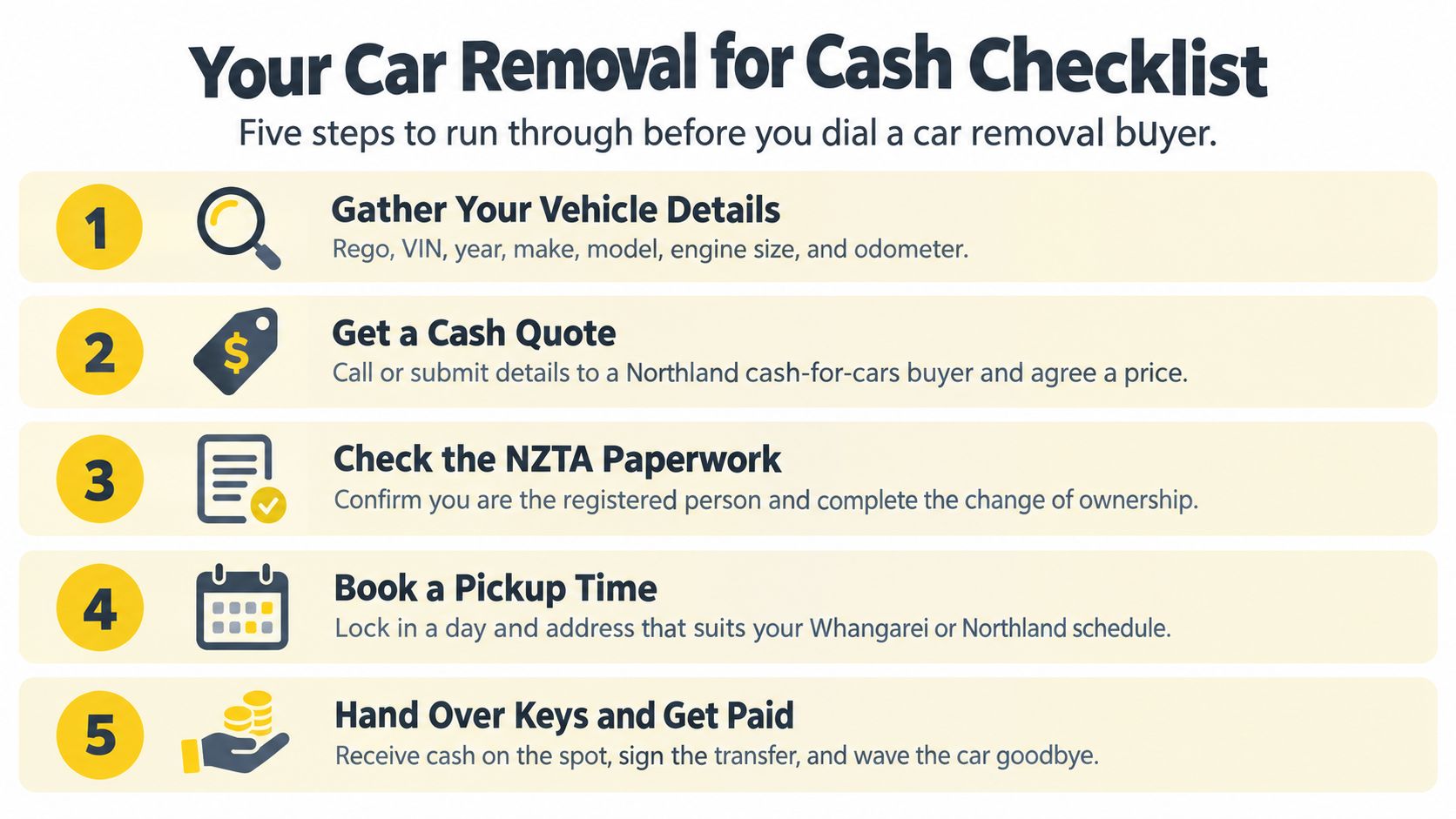
Run the transaction in order. A rushed owner usually loses money in one of two places, accepting the first vague offer or leaving the ownership notice until after the truck has gone.
Five actions before the phone call
1. Confirm the record. Check the registration, ownership status and whether the vehicle is registered, unlicensed or ready for deregistration. If the name on the record isn't yours, resolve that authority issue before booking removal.
2. Photograph the vehicle. Take clear images of every side, the interior, engine bay, wheels, odometer and damage. Write down the rego, VIN, year, make, model, engine size and whether it starts, drives and rolls.
3. Prepare the paperwork. Gather photo ID, ownership documents, keys and any information needed for the NZTA change-of-ownership process. If it's scrap, confirm how the deregistration and plates will be handled.
4. Ring at least two buyers. Ask for a firm written quote and state whether towing, payment and paperwork are included. Tell each buyer the same facts so you're comparing like with like, not one honest quote against one optimistic guess.
5. Book the collection properly. Agree the date, address, access conditions and payment method. Remove personal items, make the vehicle accessible and arrange for someone to be present or authorised to release the keys.
Protect the money and the proof
Don't accept a quote that can be reduced for an undisclosed towing charge after arrival. Ask when payment is made, whether it's cash or an instant bank transfer, and whether the amount is confirmed before loading.
At pickup, complete the transfer or deregistration step, collect the payment record and save the NZTA acknowledgment. A vehicle that has left your property but remains active against your name is not fully disposed of.
Northland's dumping problem shows why proper removal matters. The Ministry for the Environment reported about 25,000 cars dumped illegally each year, creating a public cleanup cost of $6 million. The ministry's waste guidance also notes that used oil, refrigerants, batteries and circuit boards must be managed as hazardous substances before recycling or disposal.
Modern dismantling requires more than crushing a shell. Fuel tanks, batteries, oil, coolants, airbags and seat-belt pre-tensioners need separate handling. Electric vehicles must not enter a shredder until the high-voltage battery has been removed by trained personnel following vehicle-specific procedures, as detailed in New Zealand vehicle dismantling guidance.
Act now while you still know where the keys and paperwork are. Contact Car Removals Whangarei for a firm quote, free towing arrangements and on-site NZTA ownership notification, then visit Car Removals Whangarei to start the pickup. Get the car out of your driveway, paddock or shed with the payment and proof sorted before the truck leaves.
- car removal for cash
- cash for cars Whangarei
- scrap car removal
- NZTA change of ownership
- free car towing Northland