· Car Removals Whangarei
Cash for Cars Northland: How It Actually Works
Your car's dead, half-dead, flood-soaked, rusted out, or just taking up space you're sick of looking at. You want it gone, you want a fair number, and you don't want drama on pickup day. That's what you mean when you search for Cash for Cars Northland.
In Northland, this usually isn't a tidy driveway sale. It's a ute with a blown motor on a farm track, a car that failed its WOF and never moved again, a van dumped at a rental, or a hybrid nobody wants to touch because of the battery. The process is simple when the buyer knows what they're doing. It gets messy when they don't.
Table of Contents
- What Selling a Car for Cars Northland Actually Looks Like
- How Quotes Are Calculated From Parts and Steel Weight
- Vehicle Types Accepted and What Each One Pays
- The Pickup, Towing and NZTA Ownership Process
- Paperwork, Liability and the NZTA Disposal Step
- Tips for Getting the Best Cash Payout
- EV and Hybrid Removal, Battery Value and Safety
- Service Area, Turnaround Times and Next Steps
What Selling a Car for Cars Northland Actually Looks Like
A Kaipara farmer rings about a body-bagged Hilux with a blown head gasket. It's been parked by the shed for months, one tyre's soft, and the rego paperwork is buried in a kitchen drawer. A Whangārei owner has a salt-stained Corolla after a downpour, never re-registered, sitting under a tree getting worse every week. A landlord in Kamo wants a Transit van gone because the tenant disappeared and the van hasn't seen a WOF in years.
Those are normal Northland jobs.
What usually happens first
The seller calls or messages with the basics. Make, model, year if known, whether it starts, whether it rolls, whether the catalytic converter is still on it, and where it's sitting. A proper operator can usually give a phone quote fast, then confirm it on site when the truck arrives.
The practical sequence is usually this:
- Initial quote: You describe the vehicle.
- Condition check: The buyer confirms what's there on arrival.
- Firm offer: The number is tied to steel value, parts demand, and pickup difficulty.
- Removal: The truck loads it and takes it away.
- NZTA notification: The registered person change gets handled straight away.
Practical rule: If the quote sounds high but the buyer won't talk clearly about paperwork, towing access, or what happens at handover, expect trouble.
What you hand over and what you keep
On pickup day, sellers normally hand over the keys, the vehicle itself, and the details needed to complete the NZTA disposal step. If the plates are on the vehicle, that gets discussed before loading, not argued about after the truck arrives.
You keep your personal items, any documents you want for your own records, and any entitlement you may have to a registration refund through the normal process. Clear the glovebox, boot, centre console, door pockets, and under-seat junk before the truck turns up. That saves time and stops stupid disputes.
Most cash-for-cars pages are fluff. What you need are straight answers on price, pickup timing, towing limits, and the NZTA handover. That's the part that decides whether the deal is clean or a headache.
How Quotes Are Calculated From Parts and Steel Weight
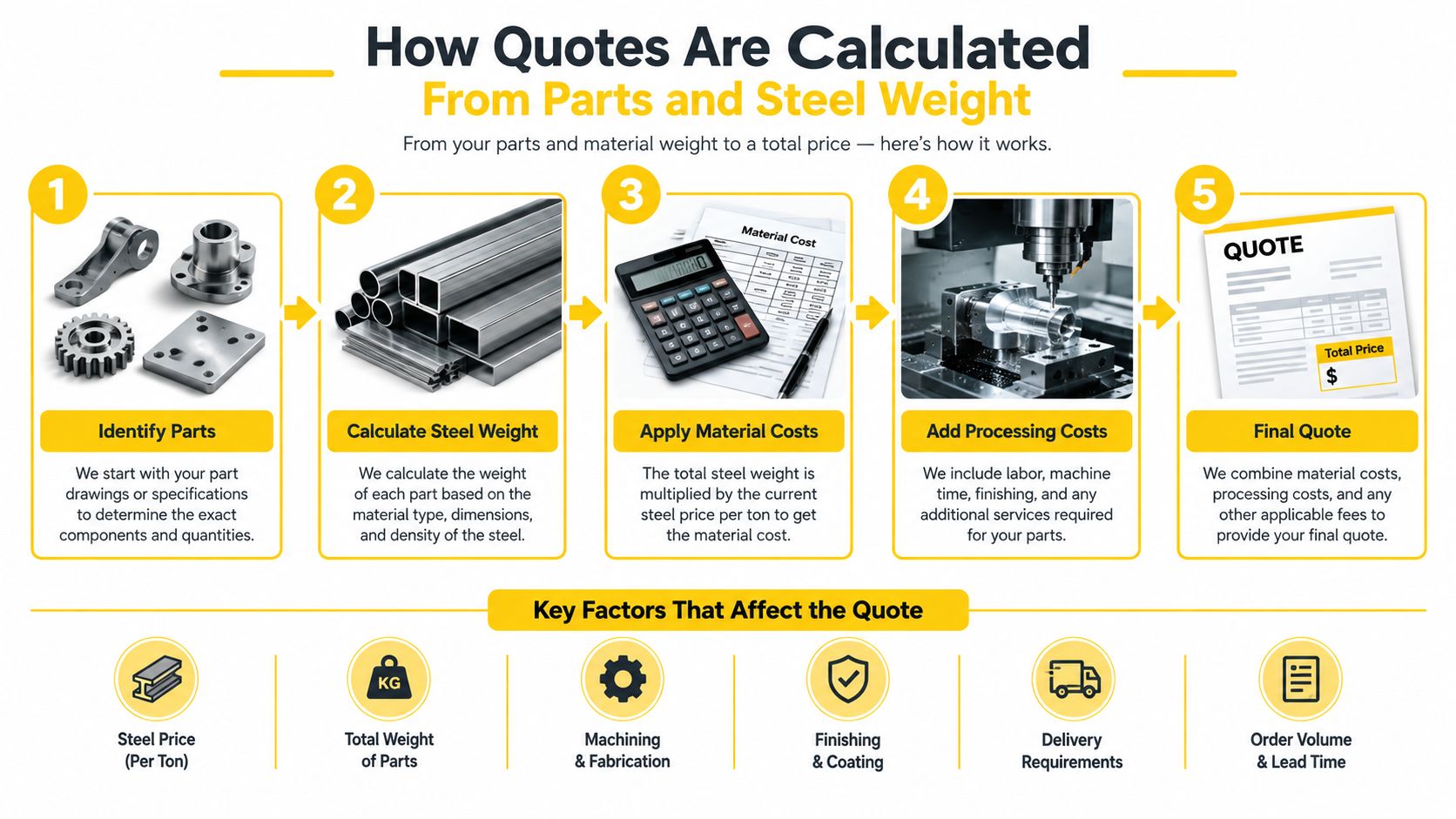
Most sellers guess wrong about value because they focus on age, rego, or what they paid years ago. Buyers don't price unwanted vehicles that way. The quote comes from recoverable parts plus scrap metal yield, then the operator subtracts the cost of collecting and processing it.
Independent NZ scrap pricing references cited in a Northland guide show whole automotive scrap around NZ$0.2100/kg, with complete ferrous car bodies around NZ$120/tonne and stripped cars around NZ$100/tonne. That's why a stripped shell is worth materially less before transport is even considered, as outlined in this Northland scrap car pricing guide.
The steel number is only the floor
Start with what's left as metal. Ferrous grades are commonly quoted per kilogram, which means kerb weight matters, completeness matters, and whether the drivetrain is still in the vehicle matters. That pricing logic is the key reason a complete dead car can beat a heavily stripped “project” by a wide margin, as explained in the change of car ownership and scrap value discussion.
A shell with no engine, no gearbox, no catalytic converter, and missing wheels isn't a “car” in pricing terms. It's a harder load with less saleable material.
Parts demand is where quotes move properly
The steel side gives a floor. Parts demand moves the number.
Common saleable items include:
- Panels: Doors, bonnets, guards, tailgates
- Electricals: ECUs, alternators, starter motors, switches
- Exhaust items: Catalytic converters where still fitted
- Rolling gear: Factory alloys, hubs, diffs
- Interior pieces: Seats, trims, clusters on popular models
A tidy late-model SUV with rear damage but strong mechanicals can pay very differently from an older sedan with a dead engine and stripped interior, even if both weigh roughly the same. Mileage matters because it changes whether the engine, gearbox, diff, and ancillaries are worth recovering. Accident history matters because it tells the dismantler which side of the vehicle is usable and which side is scrap.
Don't ask, “What do you pay for cars?” Ask, “How much of my quote is steel, how much is parts, and what changes it?”
Why quote timing matters
Steel pricing doesn't sit still. Neither does demand for common parts. A smart seller gets the quote, confirms the exact condition, and books the pickup while the number is still current. If you wait, then remove parts, lose the keys, or let the vehicle get harder to access, don't expect the same payout.
Vehicle Types Accepted and What Each One Pays
Not every vehicle sits in the same pricing lane. Some are bought for parts first and scrap second. Others are basically bought by weight. That difference matters more than sellers think.
The broad local payout range for cars handled by this kind of service is NZ$200 to NZ$15,000, depending on condition, parts demand, and vehicle type. That comes from the operating ranges used by the publisher for Northland removals. Use that as a band, not a promise without inspection.
What moves each category
Standard cars and utes often sit somewhere between low-end scrap logic and parts-based value. Clean late-model SUVs and 4WDs can jump well above ordinary wreck pricing because the driveline, body panels, trim, and electronics still have resale value. At the other end, burnt cars, flood write-offs, and stripped shells usually fall back toward scrap weight plus whatever remains usable.
Hybrids and EVs are their own category. Battery condition can lift the quote, but damaged high-voltage packs can also change who can safely take the job.
| Vehicle Type | Pricing Logic | Typical Payout (NZD) | Notes |
|---|---|---|---|
| Standard cars and utes | Parts value plus steel weight | $200 to $3,500 | Wide range depending on engine, gearbox, panels, and completeness |
| Clean late-model SUVs and 4WDs | Strong parts demand with scrap as the floor | $5,000 to $15,000 | Better when mechanicals, interior, and panels are intact |
| Non-running wrecks | Scrap floor plus any saleable components | Qualitative only | Exact value depends on what's still attached and loadable |
| Vans | Mixed parts and weight logic | Qualitative only | Payload models can carry good parts value if complete |
| Trucks and farm machinery | Mostly weight, clean load size, and recoverable heavy components | Qualitative only | Access and loading gear matter a lot |
| Partial vehicles and stripped shells | Reduced toward scrap-only pricing | Qualitative only | Missing engines, gearboxes, wheels, and cats pull quotes down hard |
| Hybrids and EVs | Vehicle scrap value plus battery-aware assessment | Qualitative only | Battery condition and safety handling can change the whole job |
The mistake that kills a quote
Sellers often say “it's all there” when it isn't. No catalytic converter. No battery. No tailgate. No seats. No wheels on one side. That changes the payout fast because the buyer has lost both saleable parts and easy loading.
If you want a firm number, describe the vehicle like a dismantler would. Tell them what's present, what's missing, whether it rolls, and whether access is clean.
The Pickup, Towing and NZTA Ownership Process
Pickup day should be boring. If it feels chaotic, somebody hasn't done their job.
Inside Whangārei and Kamo, the usual expectation is faster pickup. Outer and rural runs depend on route planning, truck space, and how awkward the vehicle is to load. A sensible Northland operator doesn't promise instant arrival for every farm, back section, or muddy paddock. They schedule properly.
What happens before the truck arrives
You should get a clear pickup window and a same-day confirmation message that the truck is coming. Have the vehicle accessible. Move other cars if needed. Find the keys if you've got them. Pull out your gear before the driver starts loading.
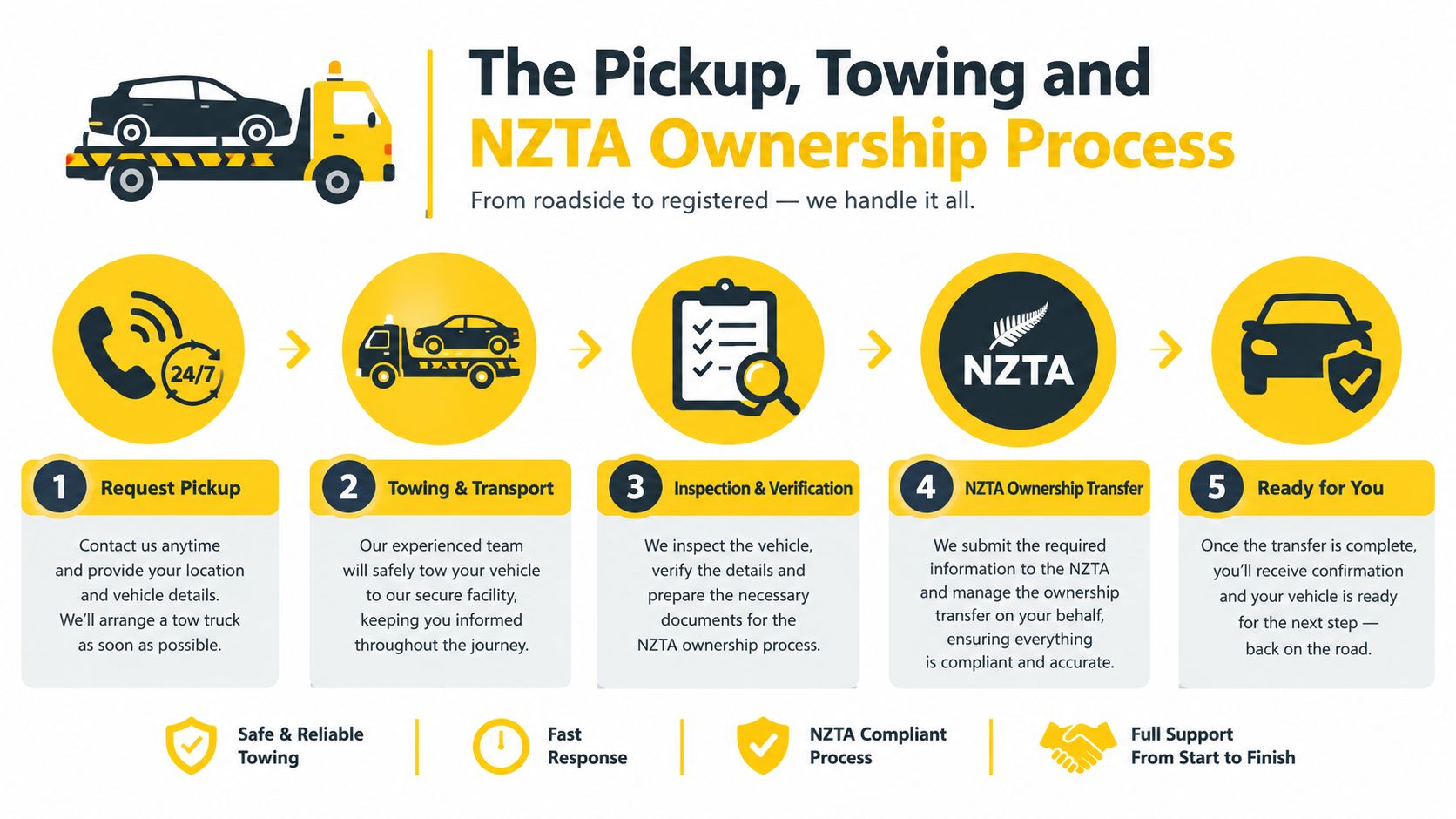
The normal handover looks like this:
- Arrival confirmed: You know roughly when the truck will turn up.
- Vehicle checked: The driver confirms the condition matches the quote.
- Payment made: Cash or bank transfer should be sorted before loading.
- Vehicle loaded: Wheel-lift or flatbed depends on condition and access.
- Records taken: Buyers often photograph the vehicle and chassis details for file purposes.
Towing isn't free in every situation
A lot of sellers hear “free towing” and stop thinking. That's a mistake. Towing can be built into the quote, but the hard jobs still cost the buyer more to do.
What changes the collection cost:
- Distance from Whangārei
- Rural access, especially soft ground or narrow approaches
- Non-rolling condition
- Blocked-in vehicles
- Missing wheels or collapsed suspension
- Whether extra gear is needed to winch or reposition it
The publisher states it provides free towing within roughly 100 km as part of its Northland operating model. That works well for straightforward jobs. Once a vehicle sits further out, or becomes a difficult recovery instead of a normal pickup, the quote has to reflect the work.
If the car is jammed behind a shed, bogged in, or stripped to the hubs, say so before booking. You'll get a cleaner quote and a smoother pickup.
The NZTA moment that matters
This is the part most sellers under-rate. In New Zealand, the legal admin step isn't some vague “title transfer”. NZTA says it does not record or handle vehicle ownership, but the registered person must be changed when a vehicle changes hands. That's why the disposal step matters at pickup, not days later, according to NZTA's buying and selling a vehicle guidance.
When the paperwork is handled on the spot, your liability doesn't keep hanging around after the truck leaves.
Paperwork, Liability and the NZTA Disposal Step
The NZTA disposal notification is the most under-valued part of the whole transaction. Sellers obsess over the dollar figure, then get casual about the one step that stops tickets, licensing notices, and admin mess from following them home.
The New Zealand Government's public guidance is blunt. Sellers need to tell NZTA the car changed hands as soon as it is sold so speeding or parking tickets don't keep arriving for the former owner, as set out on the government's vehicle selling guidance.
What you should have ready
You don't need to overcomplicate this. You need the right details ready at handover.
| Document | Who Handles It | Why It Matters |
|---|---|---|
| Photo ID | Seller | Confirms the person disposing of the vehicle |
| Registration details | Seller | Helps match the vehicle correctly |
| Buyer's full name and address | Buyer and seller | Needed for the NZTA notification |
| Signed disposal or handover details | Buyer and seller | Creates a clear record of the transaction |
| Confirmation receipt or transaction proof | Buyer gives to seller | Shows the notification was actually completed |
NZTA says both the buyer and seller must notify the agency when a vehicle changes hands, and the seller should do it straight away at the time of sale using a New Zealand driver licence plus the buyer's full name and address, as explained in NZTA's vehicle selling rules.
The red flag sellers ignore
If a buyer says, “We'll sort the paperwork later,” assume they won't. That's not a small detail. It's the difference between a clean exit and your name staying attached to the vehicle.
A useful local walkthrough of the process sits in this NZTA registration change of ownership guide. Read it before pickup if you've never done this before.
Non-negotiable: Get proof the disposal step was completed on the day the vehicle left your property.
Special cases need more care. Unregistered vehicles, write-offs, or cars missing plates can require extra checking before the handover is fully clean. If the ID marks don't line up, stop and sort that first.
Tips for Getting the Best Cash Payout
Most payout mistakes happen before the truck leaves the yard. Sellers either hide problems, leave preparation too late, or accept a vague number without asking how it was built.
The shortlist that actually helps
- Have your paperwork ready: If your ID and registration details are sorted before you call, the quote is more likely to stay firm.
- Empty the vehicle properly: Child seats, tools, documents, and stereo faces slow the job and create arguments after loading.
- Be honest about movement: Seized brakes, broken axles, missing wheels, and no steering all matter. Surprise recovery work drags the quote down.
- Discuss the plates early: If you're keeping the plates, say so before the number is agreed.
- Ask for the quote logic: Get them to break the offer into parts value, scrap value, and any battery component if it's a hybrid or EV.
- Group rural vehicles: If there's more than one vehicle on a farm or property, mention all of them in the first call.
What to challenge
Lowballing usually shows up as vagueness. The buyer won't explain the number. They won't commit to when they can collect. They won't be clear about what happens if the car doesn't start or roll. That's when you push back.
Ask direct questions. Is the catalytic converter included in the price? Is the battery being valued separately? Is the vehicle being priced as complete scrap or as a dismantling job? Straight answers are a good sign. Waffling usually means deductions start at the kerb.
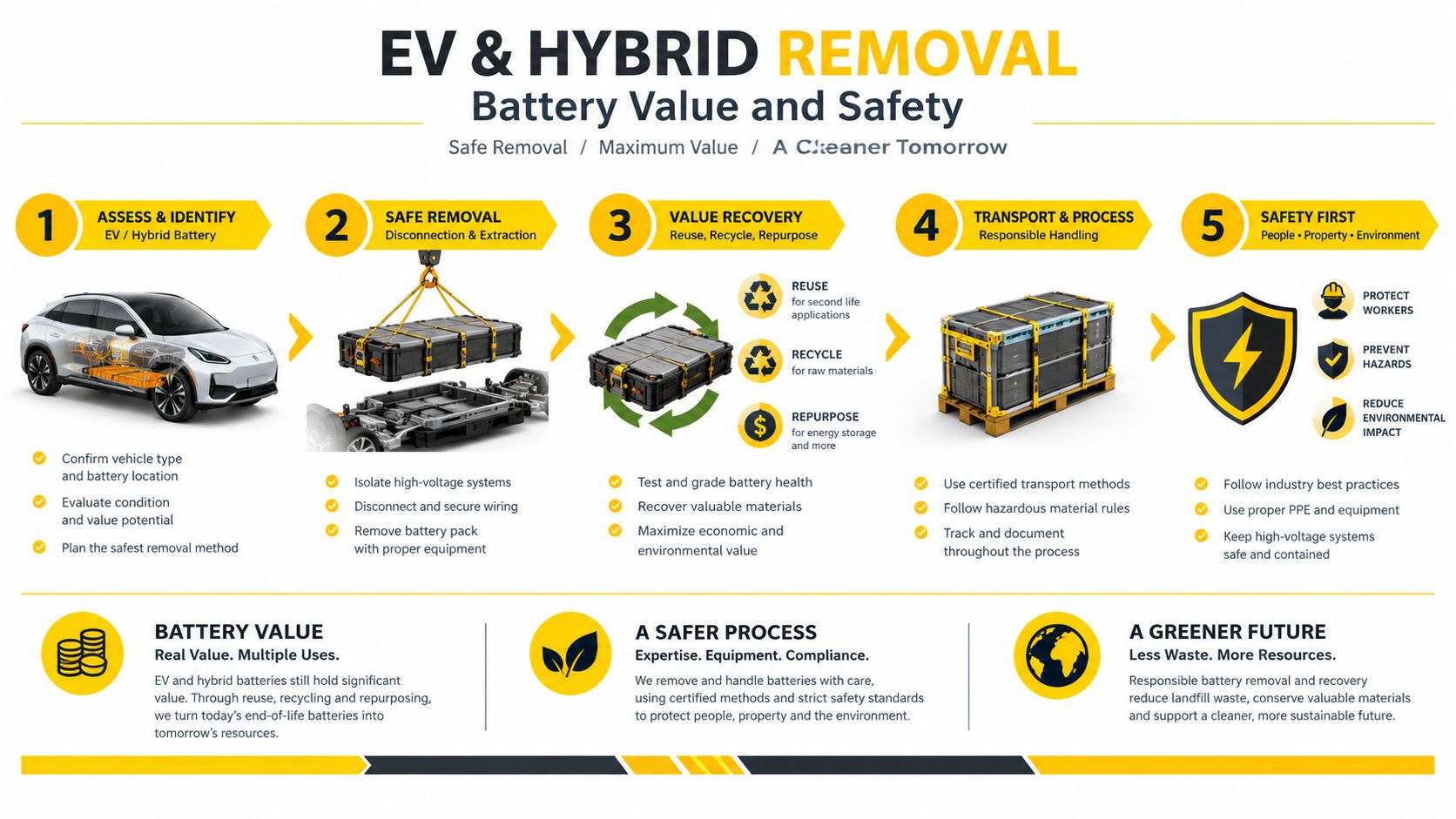
EV and Hybrid Removal, Battery Value and Safety
A hybrid or EV isn't just another scrap car with a different badge. Treat it like one and someone either loses money or creates a safety problem.
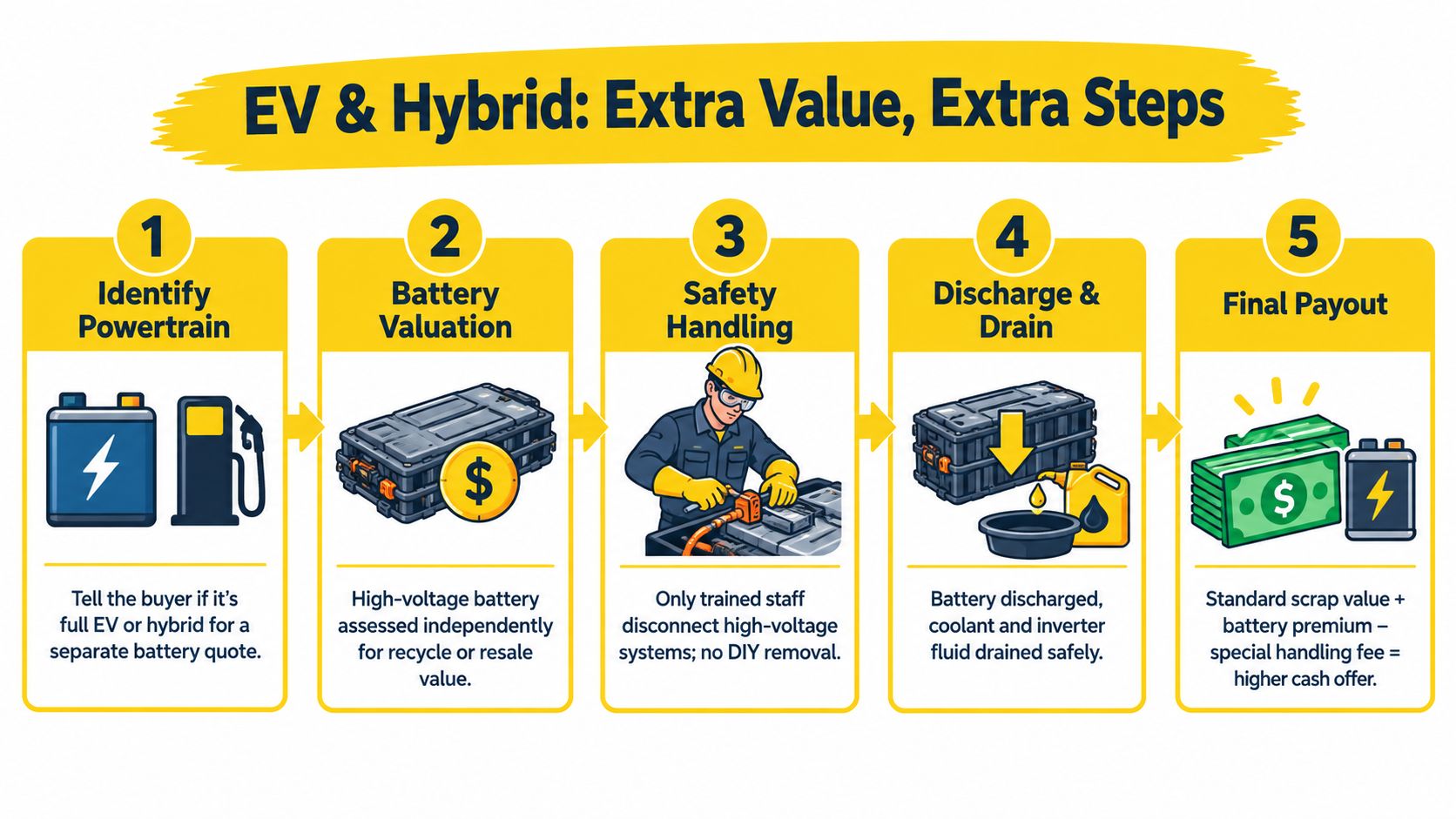
A Northland battery recycling guide published in 2026 says sellers should identify battery chemistry and condition, avoid DIY removal, and use handlers who can explain storage, transport, and downstream processing for high-voltage packs, as detailed in this Northland EV and hybrid battery recycling guide.
What changes the payout
A Prius, Leaf, or Tesla Model 3 doesn't get valued purely on tray weight and body steel. The high-voltage battery pack can add value if it's intact, identifiable, and recoverable. If the pack is damaged, compromised by impact, or showing signs of thermal trouble, the vehicle may need a more specialised downstream path.
That means the buyer should ask questions that ordinary scrap jobs don't need:
- Is it a full EV or a hybrid?
- Is the pack intact?
- Has the vehicle been submerged, burnt, or badly hit?
- Are warning lights active?
- Is there any known battery fault history?
What sellers should never do
Don't unbolt battery components yourself. Don't cut orange cables. Don't assume a non-running EV is electrically dead. High-voltage isolation is a trained task, not a shed job.
For broader context on how dismantlers handle these vehicles within the local wrecking process, this car wreckers near me guide is worth reading.
A hybrid that looks like “just an old car” can still need battery-specific transport and handling before anyone starts dismantling it.
Service Area, Turnaround Times and Next Steps
Northland sellers don't need hype. They need a realistic map of who'll come out, how fast they'll come, and what they need before they book.
Northland has long had a strong private vehicle base. A regional transport report recorded 54,456 households in Northland in the 2006 census, with 87% of households having access to at least one motor vehicle compared with 88% nationally. The same report said 37.2% owned one vehicle and 36.0% owned two vehicles, while 53.9% of Northland residents used a private or company vehicle to get to work on that census day versus 52.7% nationally. It also found the annual growth rate in licensed vehicles averaged 5.0% between 2001 and 2006, compared with 3.2% nationally, according to NZTA regional transport reporting. That's why Northland keeps producing a steady stream of unwanted, damaged, and end-of-life vehicles.
More recent official transport data still show a heavy-use region. NZTA research recorded about 101,000 motor vehicles in Northland and 1,651,300,000 vehicle-kilometres travelled in 2008, or roughly 4% of New Zealand's total in both cases. The same research said Northland vehicle owners averaged 12,573 VKT in 2022, up from 9,828 in 2016 and compared with 17,018 in 2021, as shown in the NZTA private motor VKT research report. Stats NZ's 2025 regional summary also listed Northland's population at 201,100 and highlighted motor vehicles per household as a key regional measure in official regional profiling. In plain terms, there are a lot of vehicles here, and they do real miles.
What the pickup map looks like in practice
| Area | Pickup Window | Typical Response Time | Notes |
|---|---|---|---|
| Whangārei city | Same day when schedule allows | Fastest | Best for straightforward driveway pickups |
| Kamo and nearby suburbs | Same day or next available run | Fast | Access and vehicle condition still matter |
| Mangawhai and Dargaville | Usually booked by route | Next run | Better to book earlier in the day |
| Kaikohe, Kerikeri, Kaitaia, Hokianga | Planned rural run | Usually later than city jobs | Farm access and multi-stop scheduling affect timing |
What to have ready before you call
Bring useful details, not guesses:
- Registration details
- VIN or chassis number if visible
- A clear photo
- Your postcode or exact location
- Whether it starts
- Whether it rolls
- Whether wheels or major parts are missing
If you want the job to move quickly, lock the pickup window, remove your belongings, and keep your proof of the NZTA notification until payment has fully cleared.
If you need a straight answer on Cash for Cars Northland, Car Removals Whangarei buys cars, vans, 4WDs, trucks, and machinery in any condition, pays before loading, and handles pickup-day NZTA admin as part of the job. If you want a firm quote based on parts, steel, and real pickup conditions, visit Car Removals Whangarei.
- cash for cars northland
- whangarei car removal
- scrap car buyers NZ
- NZTA change of ownership
- sell unwanted car northland