· Car Removals Whangarei
Trade in Price for My Car: What It Actually Means
Most advice about finding the trade-in price for my car starts with one instruction: get the highest offer. That sounds sensible, but it can lead you into a poor deal. A dealer can increase the trade-in allowance while reducing the discount on the replacement vehicle, adding finance charges, or including preparation costs elsewhere in the paperwork.
From my experience dealing with unwanted vehicles around Northland, the better question is not “What's my trade-in price?” It's “What will this change cost me, and what responsibility remains after my old vehicle leaves?” That distinction matters whether you're moving on a tidy car, a failed-WOF vehicle, a written-off ute, or a rusted vehicle sitting on rural property.
| Disposal route | What you mainly compare | Where the risk sits |
|---|---|---|
| Dealer trade-in | Replacement vehicle price less the trade-in allowance | Finance, preparation charges and negotiation structure |
| Private sale | Likely sale proceeds less repairs, advertising and your time | Buyer disputes, viewings and delayed payment |
| Cash removal or dismantling | Firm payout less any costs you must pay yourself | Vehicle completeness, parts demand and disposal paperwork |
New Zealand's large, ageing vehicle fleet creates several legitimate value pathways. The Ministry of Transport reported approximately 813 cars per 1,000 people, while the average national vehicle age was about 15 years, based on its transport datasets and Motor Vehicle Register analysis (Ministry of Transport fleet and ownership briefing). An older car may no longer attract a strong retail buyer, but its engine, transmission, panels, catalytic converter, wheels, battery or steel can still have value.
Table of Contents
- Why the Highest Trade In Price Is Not Always The Best Deal
- How Trade In Prices Are Calculated In New Zealand
- Vehicle Condition And Documentation That Affect Value
- Comparing Trade Ins Private Sales And Cash Removal Services
- Seller Liability And The Importance Of Proper Disposal Notification
- Choosing The Right Disposal Route For Your Situation
Why the Highest Trade In Price Is Not Always The Best Deal
The highest trade-in figure can be the least useful number on the page. A dealer may offer a generous allowance for your current car, then make up the difference by reducing the discount on the replacement vehicle, charging for preparation, or arranging finance products that increase the total repayment. You haven't improved your position just because one line of the offer looks larger.
Consumer NZ recommends negotiating the overall cost to change, which combines the vehicle discount and trade-in valuation, rather than concentrating on the headline allowance (Consumer NZ guidance on trading in a car). That approach works because it keeps both sides of the transaction visible.
Compare the complete transaction
Ask each dealer for these figures separately:
- Replacement vehicle price: What is the actual selling price before the trade-in is applied?
- Trade-in allowance: What value has the dealer assigned to your current vehicle?
- Finance cost: What interest, establishment charges, insurance or optional products will be added?
- Preparation and extras: Are delivery, compliance, warranty or accessory costs included?
- Amount required to change: What must leave your bank account, or what total will you repay?
Suppose Dealer A offers a higher trade-in allowance but sells the replacement vehicle at a higher price. Dealer B offers less for your old car but provides a cleaner replacement price and fewer added costs. The relevant comparison is the net amount required to leave your current vehicle and drive away in the next one, not the biggest allowance.
Practical rule: Get the replacement vehicle price and the trade-in value in writing before discussing monthly repayments.
A private sale can produce more than a dealer allowance for a roadworthy, desirable vehicle, but it also creates work. You may need to clean and photograph the car, answer repeated messages, arrange inspections, disclose faults and manage payment. A non-running, deregistered or failed-WOF vehicle may not attract serious private buyers at all. Advertising a vehicle as though it were an ordinary used car doesn't make repair risk disappear.
A separate cash-removal quote can be the more realistic benchmark for a vehicle that cannot be driven, has missing components, or needs expensive certification. The useful comparison is then the firm payout, less any repair or transport cost you would otherwise carry, against the dealer's cost-to-change figure. Guidance on the difference between selling a road car and disposing of an unwanted vehicle is set out in this Northland guide to selling a car in New Zealand.
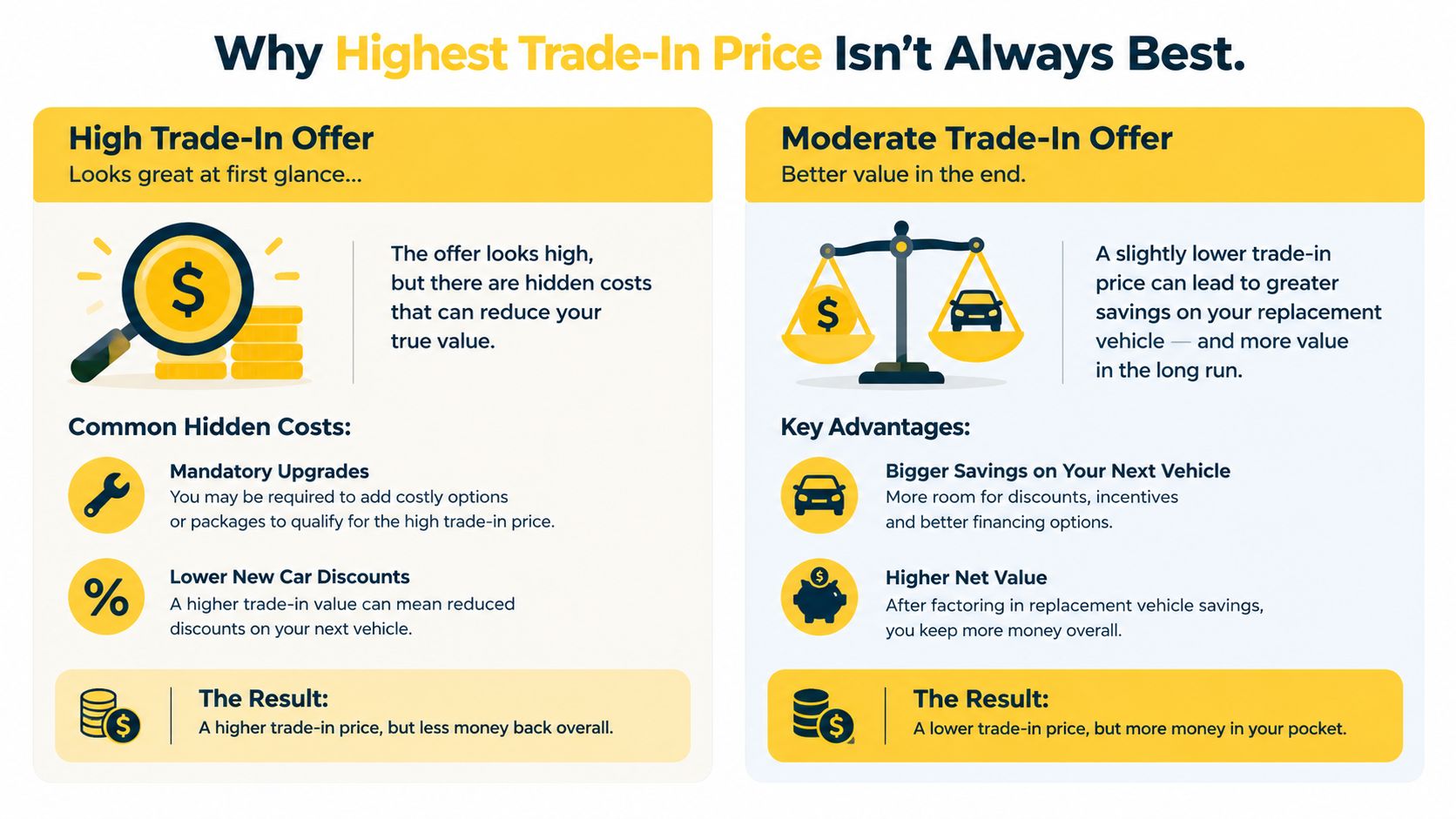
The highest quote can still leave you with less money, a more expensive replacement vehicle, or continuing responsibility for the old registration. A lower nominal trade-in paired with a transparent vehicle price, or a separate removal offer that ends the problem cleanly, may produce the better bottom line.
How Trade In Prices Are Calculated In New Zealand
A New Zealand trade-in calculation usually has three separate value components. Dealers and dismantlers may combine them in one offer, but understanding each component helps explain why two buyers can quote differently for the same vehicle.
Road resale value
The first component is the value of the vehicle as a usable road car. A buyer considers the make and model, age, odometer reading, inspection history, registration status, fuel type, equipment, service history and local demand. A current WoF and active registration support this pathway because the vehicle can be inspected, prepared and offered to another driver without immediately facing the same compliance obstacles as a deregistered or damaged vehicle.
NZTA records vehicle details that can materially affect valuation, including make and model, tare weight, fuel type, engine capacity, odometer reading, inspection history and whether the vehicle is subject to WoF or CoF requirements. Those details are explained in NZTA information about the Motor Vehicle Register.
Reconditioning value
The second component is the cost of making the vehicle saleable. A running car can still need tyres, mechanical work, paint repairs, a new inspection, cleaning or replacement equipment. A failed-WOF vehicle may have a lower resale pathway because the buyer must absorb uncertain repair costs. Missing keys, panels, seats, wheels, batteries or electronics also reduce completeness.
A dealer may accept a vehicle into a trade but account for every expected cost in the allowance. The trade-in figure isn't a sentimental assessment of what you paid. It reflects what the buyer believes can be recovered after transport, inspection, repairs, holding costs and resale risk.
Salvage and material value
The third component is salvage value. A car that has little appeal as a complete road vehicle may still contain sought-after assemblies or recoverable material. Engines, transmissions, panels, catalytic converters, wheels, batteries and electronics can support a dismantling offer, while steel and other metals provide a lower-value recovery pathway.
This is why the same damaged vehicle can receive a poor dealer trade-in but a meaningful dismantler quote. One buyer needs a road-ready product. The other assesses parts demand, vehicle weight, completeness, loading difficulty and the value of materials. The practical distinction is covered in this explanation of what wreckers consider when pricing vehicles.
Why condition changes the calculation
An older car isn't automatically worthless. The Ministry of Transport recorded approximately 4.3 million vehicles in its 2018 fleet report, with more than 90% classified as light vehicles. The same report recorded the average age of the light fleet rising from 11.7 years in 2000 to 14.1 years in 2018, with almost one in five light vehicles older than 20 years (New Zealand Vehicle Fleet Report 2018).
Those fleet conditions help explain why parts demand exists alongside ordinary retail demand. A two-wheel-drive hatchback with a current WoF may be valued as transport. A similar model with a failed inspection, no registration and a non-running engine may be valued mainly for components. Neither calculation is necessarily wrong. They answer different questions about what the buyer can do with the vehicle.
Vehicle Condition And Documentation That Affect Value
Before requesting a trade-in price, decide whether your vehicle belongs in the road-resale category or the salvage category. That decision prevents you from comparing an ordinary dealer valuation with a removal quote as though both buyers are pricing the same product.
Start with the legal and physical status
Use this checklist before you ask for offers:
- Record the identity. Write down the VIN, number plate, make, model, year and odometer reading. Take clear photographs of the VIN plate, exterior, interior and engine bay.
- Check the paperwork. Note the registration status, WoF or CoF expiry, service records and any finance or insurance information.
- Describe operation accurately. State whether the engine starts, whether the vehicle moves under its own power, and whether steering and braking work.
- List missing parts. Identify missing wheels, panels, seats, batteries, keys, catalytic converters, electronics or mechanical assemblies.
- Document damage. Separate cosmetic damage from flood, fire, structural or high-voltage-system damage.
- Confirm access. Explain whether a tow truck can reach the vehicle, whether it is on soft ground, and whether loading equipment will be needed.
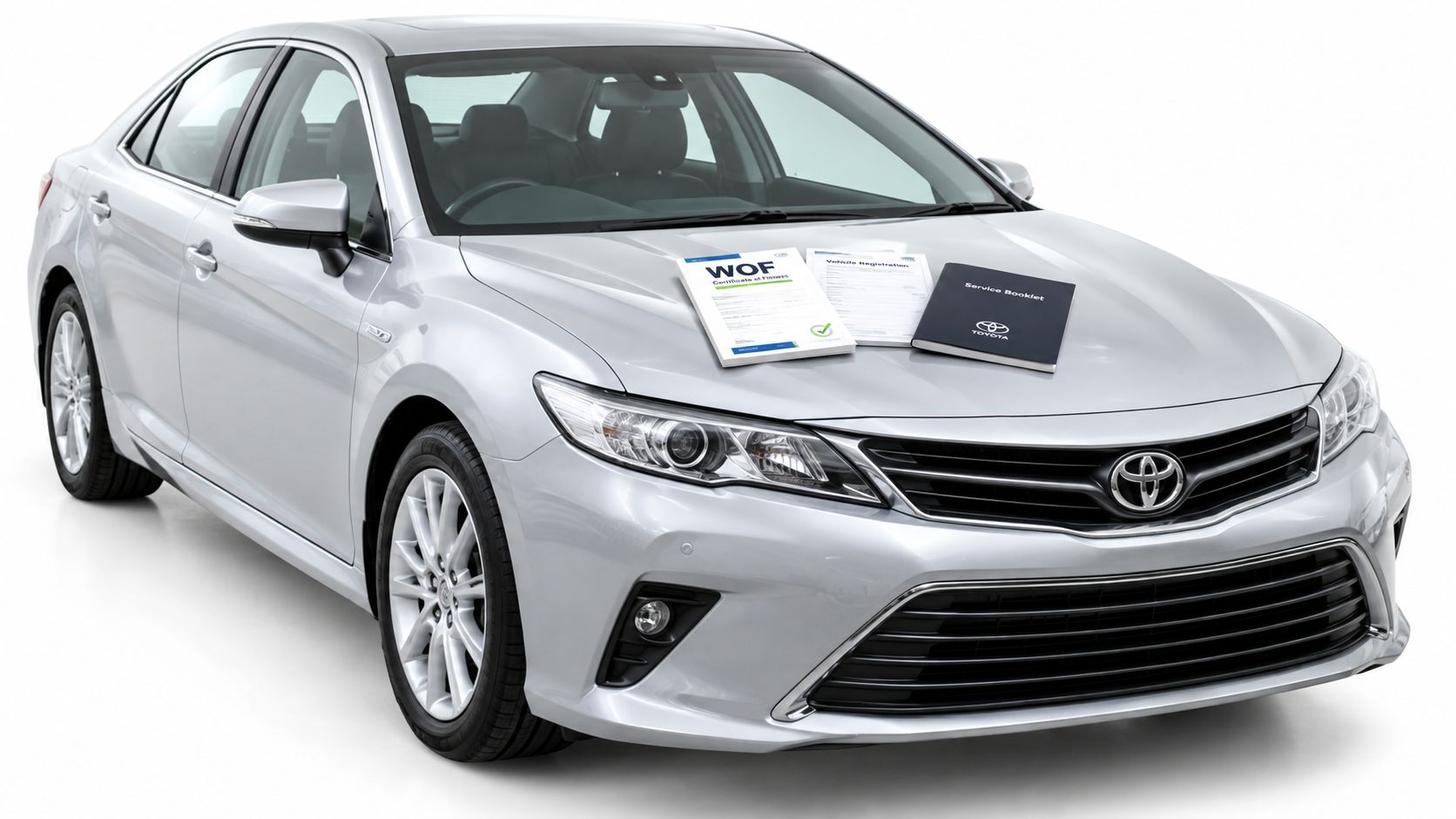
A current WoF and active registration can support a retail or trade resale route. An expired licence, failed inspection, non-running condition or missing equipment increases compliance, transport and reconditioning costs. If the vehicle is deregistered, don't value it like an ordinary used car. NZTA states that a cancelled registration requires inspection, certification, registration, licensing, plates and labels before the vehicle can return to the road.
Treat restricted vehicles as salvage assets
Written-off, flood-damaged, fire-damaged and structurally damaged vehicles need a separate assessment. NZTA's Vehicle Inspection Requirements Manual says documents identifying a vehicle as statutory, written-off, salvage, junked or non-repairable require referral to a repair certifier. Vehicles written off because of body or structural damage must undergo the applicable structural inspection process.
That requirement creates a discount compared with an equivalent clean-title vehicle. A buyer has to consider inspection, repair documentation, parts traceability, storage, water damage, high-voltage components and the possibility that re-registration won't be economical. If repair doesn't make sense, value may remain in usable assemblies and recyclable metal.
Don't hide damage to chase a higher quote. Send photographs, explain the history and ask whether the buyer is assessing it for road resale or dismantling. A firm offer based on accurate information is more useful than a headline figure that changes when the vehicle is loaded.
For registration and ownership paperwork, keep the NZTA change of ownership guidance available and make sure the transaction is recorded properly.
Comparing Trade Ins Private Sales And Cash Removal Services
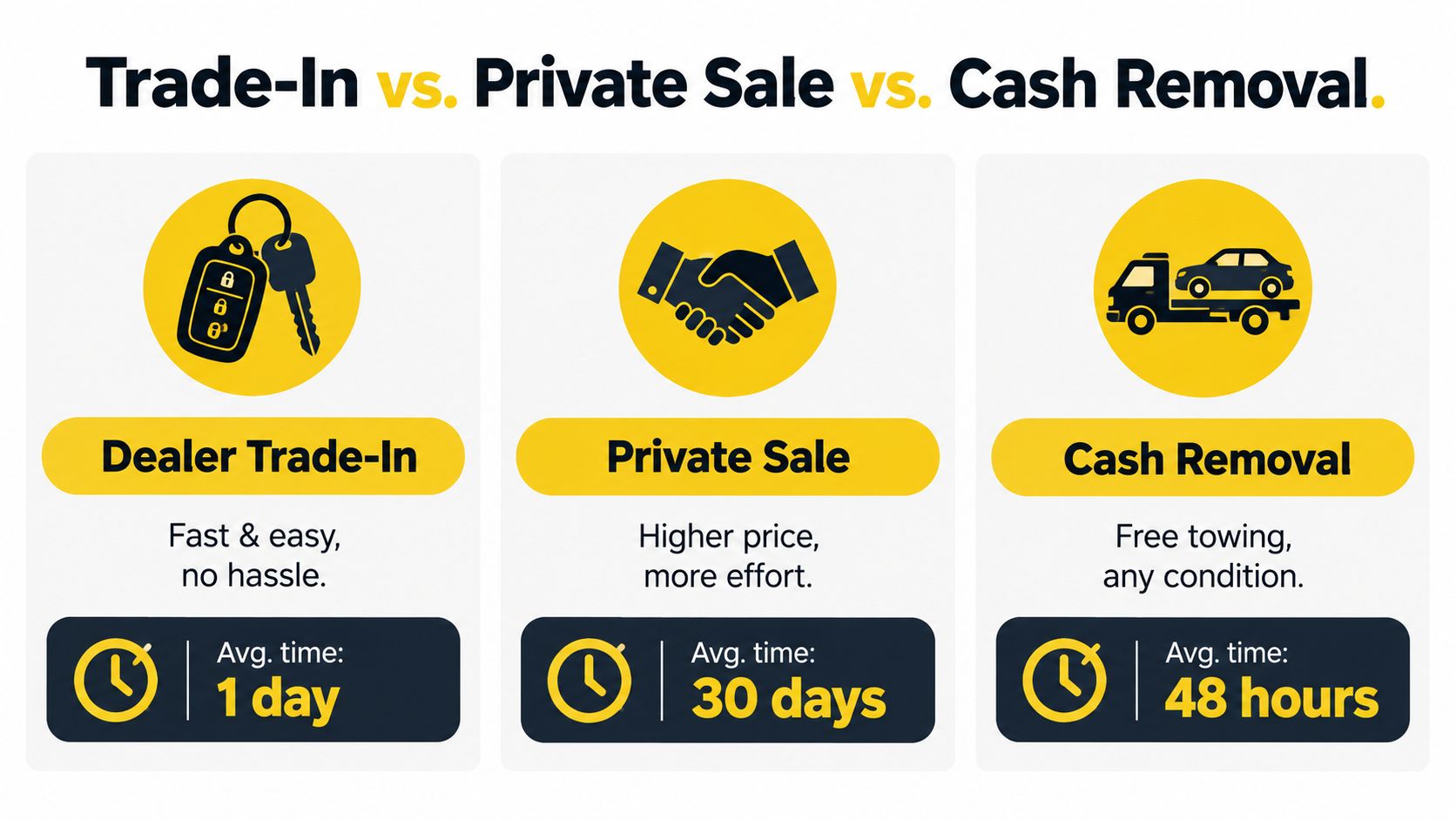
The right disposal route depends on what you value most. A dealer trade-in prioritises convenience during a vehicle upgrade. A private sale may preserve more road-car value, but it transfers the work and buyer communication to you. Cash removal focuses on a firm outcome for vehicles that are damaged, incomplete, difficult to move or no longer suitable for ordinary sale.
Dealer trade-in
A trade-in makes sense when you're already buying another vehicle and your current car is complete, documented and reasonably easy to resell. The dealer handles one combined transaction, which can save you from advertising and arranging separate transport.
The weakness is pricing visibility. A high allowance may conceal a higher replacement price, finance charges, a lower discount or added preparation costs. Insist on the total cost to change and compare it with the result of selling the old vehicle separately.
Private sale
A private sale usually suits a roadworthy vehicle with clear history, presentable condition and enough demand to attract local buyers. You control the asking price and can explain the vehicle directly, but you'll handle enquiries, viewings, test drives and payment arrangements.
The advertised price isn't the net result. Account for cleaning, repairs, inspection costs, advertising, time away from work and the possibility that a buyer raises a defect after the sale. For a non-running or deregistered car, the likely audience is much smaller, and an apparently high asking price may only delay disposal.
Cash removal
Cash removal is often more practical for a failed-WOF vehicle, written-off car, rusted farm vehicle, stripped shell, seized engine or abandoned vehicle on private land. The useful offer should account for the vehicle's parts, weight, completeness and collection difficulty. Ask whether towing is included, whether the quoted amount is firm, when payment occurs and who completes the registration notification.
| Situation | Route that usually deserves first consideration | Main question |
|---|---|---|
| Running vehicle with current WoF and active registration | Trade-in or private sale | Which route gives the better net result after the replacement price or selling effort? |
| Vehicle needing known repairs | Compare repair cost with a firm cash offer | Will repairs create genuine resale value or only postpone disposal? |
| Written-off or flood-damaged vehicle | Salvage or specialist removal | Can it be certified economically, or is parts recovery the realistic outcome? |
| Non-rolling shell or rural machinery | Removal and dismantling | Can the buyer load it safely without leaving you with transport costs? |
Northland conditions affect the practical choice. A vehicle stored on a farm may be far from a dealer and unsuitable for a test drive. A body shell at a rental property may need authorised clearance rather than an advertisement. A hybrid or EV needs careful handling around its high-voltage system, so the buyer must understand the vehicle before loading.
Don't choose solely by the first number you hear. Put the trade-in cost-to-change, private-sale net result and removal payout on the same page. The cleanest option is the one that leaves you with the strongest outcome and clear evidence that your obligations have ended.
Seller Liability And The Importance Of Proper Disposal Notification
The payout is only part of a safe disposal. NZTA records the registered person, not legal ownership, and that person remains exposed to vehicle-related responsibilities until the relevant sale, disposal or cancellation notification is completed. A car can leave your driveway while your name remains connected with licensing fees, tolls, speeding tickets, parking infringements or other enforcement issues.
NZTA explains the difference between legal ownership and the registered-person record in its vehicle ownership guidance. Both parties should notify the agency immediately when a vehicle is sold or disposed of. A certificate of registration isn't proof of legal title, and handing over keys isn't the same as completing the administrative transfer.
Complete the handover properly
Before the vehicle departs, use this record:
- Photograph the vehicle: Capture the number plate, VIN, condition and any visible damage.
- Record the transaction: Write down the pickup date, buyer or dismantler details, vehicle description and payment.
- Complete the notification: Submit the seller transaction to NZTA before releasing the vehicle, or confirm that the trader is completing the appropriate process.
- Keep confirmation: Save the receipt, notification confirmation, photographs, messages and payment record.
- Check remaining obligations: Confirm whether licensing fees or road-user-charge responsibilities remain attached to you.
If a vehicle is sold to a wrecker, the seller must notify NZTA that it has been sold to the wrecker. The wrecker then handles cancellation, unless the seller cancels the registration first through a registration agent. NZTA's selling a vehicle guidance explains that cancellation requires the application, number plates, identification and an administration fee.
A vehicle that is permanently removed from service should not be left in an uncertain administrative state. Once registration is cancelled, it can't return to the road under its previous registration. If it is later used on-road, it must be re-registered and issued new plates.
Traders and wreckers follow different processes
A motor-vehicle trader acquiring a vehicle should complete the Trader Notice of Acquisition, form MR13C, using the vehicle and seller details. NZTA states that vehicles in the trader network aren't subject to continuous vehicle licensing while they remain in that network. When the trader later sells the vehicle and the buyer transaction, form MR13B, is processed, continuous licensing applies again.
NZTA also states that a trader selling a vehicle with an expired licence of 12 months or more must immediately license it or place it on exemption, or the registration can automatically lapse from the Motor Vehicle Register (NZTA guidance for motor-vehicle traders). These details matter because the paperwork differs depending on who receives the vehicle and what happens next.
Outstanding licensing fees don't disappear just because you traded or scrapped the vehicle. The registered person recorded before the sale or cancellation remains responsible for outstanding amounts, as explained in NZTA's motor-vehicle FAQs. Treat notification as part of the sale, not as an optional task for later.
Choosing The Right Disposal Route For Your Situation
Start with the vehicle's actual status, then compare the net outcome. An older running car with a valid WoF may justify a dealer comparison and a private-sale estimate. A written-off vehicle should be priced as restricted salvage, not as a clean road car. A rusted farm vehicle or non-rolling shell usually needs a loading and dismantling assessment rather than an advert.
For a hybrid or EV, confirm that the buyer can manage high-voltage isolation and that traction-battery value is included in the quote. For any vehicle, request the offer in writing, confirm payment timing before loading, and keep photographs and NZTA records.
Use the trade-in price when it improves the complete cost to change. Use a private sale when the vehicle is roadworthy, marketable and worth the time required to sell it. Choose a removal service when the car is damaged, deregistered, non-running, incomplete or creating a storage problem. The strongest decision isn't always the largest headline figure. It's the option that combines a fair net outcome with a clean handover and no unresolved liability.
Car Removals Whangarei buys unwanted cars, vans, 4WDs, trucks and machinery in any condition, arranges towing around Northland, and completes the NZTA ownership notification at pickup. If you want a firm assessment based on your vehicle's condition and parts value, contact Car Removals Whangarei for a practical removal quote.
- trade in price for my car
- car removal Whangarei
- vehicle valuation NZ
- sell car NZ
- scrappage value